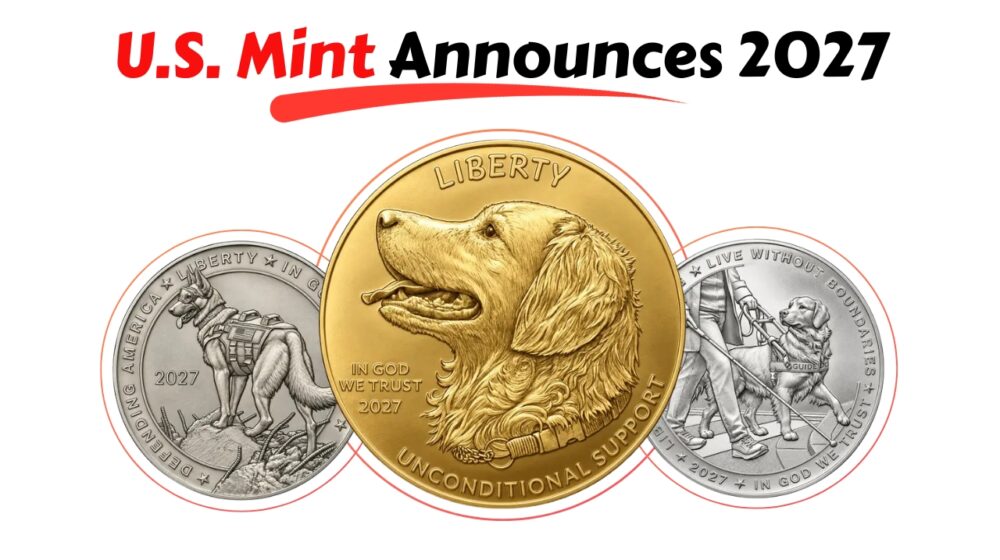
The United States Mint has taken the wraps off the six designs that will appear on its 2027 Working Dogs Commemorative Coin Program. The reveal took place on September 21, 2026, at a White House ceremony held in the Indian Treaty Room of the Eisenhower Executive Office Building. It coincided with National Service Dog Month. Officials from the Mint were joined by representatives of America’s VetDogs and the Guide Dog Foundation, along with program graduates, veterans and public officials.
The lineup is a classic modern commemorative trio: a $5 gold coin, a silver dollar and a clad half dollar. What sets it apart is that each denomination carries its own subject rather than repeating a single theme:
- $5 gold coin: therapy dogs
- Silver dollar: guide and service dogs
- Clad half dollar: military working dogs and police K-9s
The program was created by the Working Dog Commemorative Coin Act, signed by President Joe Biden on November 25, 2024, as Public Law 118-109. Surcharges built into each coin’s price will, after the Mint recovers its costs, go to America’s VetDogs, the nonprofit that trains and places assistance dogs with veterans, active-duty service members and first responders with disabilities.
The Mint has not yet announced retail prices or an on-sale date. It says the release date will be added to its 2027 Product Schedule. Official line art for all six sides is now available in the Mint’s online image library, and photographs of struck coins are expected later.
2027 Working Dogs Coins: Specs and Details
| Detail | $5 Gold Coin | $1 Silver Coin | Clad Half Dollar |
|---|---|---|---|
| Theme | Therapy dogs | Guide and service dogs | Military and police K-9s |
| Maximum authorized mintage | 50,000 | 500,000 | 750,000 |
| Composition | 90% gold | At least 90% silver | Standard clad half-dollar composition |
| Weight | 8.359 grams | 26.73 grams | 11.34 grams |
| Diameter | 0.850 inch | 1.500 inches | 1.205 inches |
| Surcharge (per coin) | $35 | $10 | $5 |
| Finishes | Proof and Uncirculated | Proof and Uncirculated | Proof and Uncirculated |
| Issue window | Calendar year 2027 (Jan. 1 – Dec. 31) | Calendar year 2027 | Calendar year 2027 |
| Authorizing law | Public Law 118-109 | Public Law 118-109 | Public Law 118-109 |
| Retail price | Not yet announced | Not yet announced | Not yet announced |
| On-sale date | Not yet announced | Not yet announced | Not yet announced |
| Designer / sculptor | Not yet publicly credited | Not yet publicly credited | Not yet publicly credited |
Other program facts
- Beneficiary: America’s VetDogs, which receives surcharge proceeds after the Mint recovers program costs, subject to the financial requirements in the law.
- Permitted uses of the funds: dog care, training staff, instructor development, and travel, lodging and meals for clients.
- Mandatory inscriptions: the year 2027, the denomination, LIBERTY, IN GOD WE TRUST, UNITED STATES OF AMERICA and E PLURIBUS UNUM.
- Product options: a three-coin proof set containing one of each denomination is also planned.
Because the mintage figures are maximums, the final number struck can be lower than the caps above, particularly if demand does not reach them.
How and When to Buy: The Ordering Process
Here is what is confirmed and what remains open.
Confirmed
- The coins may be issued only during calendar year 2027. The Mint cannot sell them after that period.
- They will be offered in Proof and Uncirculated versions.
- A three-coin proof set is planned in addition to individual coins.
- The Mint says it will publish the release date on its 2027 Product Schedule and sell the coins through its commemorative coin sales platform (its online catalog).
- The surcharge is part of the purchase price. Every coin you buy contributes $35 (gold), $10 (silver) or $5 (half dollar) toward the program’s beneficiary, once program costs are recovered.
Not yet announced
- Retail prices for any of the three coins or the proof set
- The exact on-sale date and time
- Household order limits
- Product limits for individual finishes or sets
- How mintage will be divided between Proof and Uncirculated versions
What to expect based on how the Mint usually operates
These points are general practice, not announced details for this program:
- Gold commemorative pricing is usually tied to the market price of gold at the time the Mint sets its price, so the $5 gold coin’s price will likely depend on where gold is trading when it is announced.
- Commemorative releases are commonly sold through the Mint’s website, and it is common for products to be made available at a specific date and time.
- Ordering caps are sometimes used on high-demand items. The gold coin, with its small 50,000 ceiling, is the most likely candidate for tight limits, though the Mint has not said so.
- Sales generally run until the mintage limit is reached or the authorized issue period ends.
Collectors who want to be ready should set up (and verify) a Mint account, keep payment and shipping details current, and watch the 2027 Product Schedule for the announcement.
Coin-by-Coin Background
Because these are brand-new designs, there is no earlier minting history for the coins themselves. The context below covers the subject behind each coin, the review history of its designs, and where the denomination fits in modern commemorative coinage. The Mint has not yet publicly credited individual designers or sculptors for the six sides. Candidate designs for federal commemoratives are usually produced by artists in the Mint’s Artistic Infusion Program and by its in-house medallic artists, so credits may follow when struck-coin photos are released.
The $5 Gold Coin: Therapy Dogs
Subject background. Therapy dogs work in settings such as hospitals, rehabilitation facilities and schools, offering comfort rather than performing a specific physical task for one handler. The law that created this program notes that facility dogs can also work alongside physical and occupational therapists. The gold coin’s message of emotional support is different from the other two coins, which lean toward mobility, independence and protection.
Design review history. The obverse was supported by both the Commission of Fine Arts and the Citizens Coinage Advisory Committee. The child-and-dog reverse was favored by America’s VetDogs and the CCAC. The CCAC asked for a heart to be removed from the reverse candidate and for the childlike lettering to be replaced with a more traditional typeface. The Commission of Fine Arts had earlier suggested a different reverse concept built around an outstretched hand and a therapy dog, and asked that keys be removed from one candidate.
Denomination history. The modern $5 gold commemorative has been a fixture since the mid-1980s. The 1986 Statue of Liberty program was the first modern commemorative set to pair a gold $5 coin with a silver dollar and a clad half dollar, exactly the structure used here.
The Silver Dollar: Guide and Service Dogs
Subject background. Guide dogs help people who are blind or have low vision move safely through the world, while service dogs perform tasks such as retrieving items, opening doors, turning on lights, providing balance support, or assisting during a medical episode. The law that authorized these coins also recognizes dogs trained to alert people with hearing loss to alarms, sirens and doorbells, and service dogs that help veterans manage symptoms related to post-traumatic stress disorder. The reverse inscription, PUPPY WITH A PURPOSE, points to the years of training behind every working assistance dog.
Design review history. America’s VetDogs and CCAC members preferred the selected obverse, while all three reviewing groups supported the reverse. The Commission of Fine Arts had favored a different obverse and asked for the wording on the dog’s vest on the reverse to be revised. That wording change does not appear in the Mint’s final line art.
Denomination history. Commemorative silver dollars have been part of the modern program since the 1980s and remain its workhorse denomination, with a much higher authorized mintage (up to 500,000) than the gold coin.
The Clad Half Dollar: Military and Police K-9s
Subject background. According to the congressional findings in the law, dogs informally assisted American soldiers during the Civil War and World War I. The military officially recognized its K-9 program on March 13, 1942, and during the peak of the wars in Afghanistan and Iraq the U.S. military employed an estimated 2,500 K-9s. Police K-9 units add a civilian law-enforcement dimension, including detection work at places such as airports.
Design review history. The CCAC recommended the selected obverse. Both the Commission of Fine Arts and the CCAC supported the reverse. America’s VetDogs had favored different designs for both sides.
Denomination history. The clad half dollar is the entry-level tier of the modern commemorative trio, struck to the same specifications as circulating-style half dollars, which makes it the most accessible way to own a piece of the program. Its surcharge is $5 per coin.
Obverse and Reverse Designs
$5 Gold Coin: Therapy Dogs
Obverse. A therapy dog is shown gazing upward, an image chosen to convey loyalty and dedication. Inscriptions: LIBERTY, IN GOD WE TRUST, UNCONDITIONAL SUPPORT and the date 2027.
Reverse. A child shares a quiet, close moment with a therapy dog, the emotional heart of the program. Inscriptions: UNITED STATES OF AMERICA, E PLURIBUS UNUM, $5 and THERAPY DOGS.
Silver Dollar: Guide and Service Dogs
Obverse. A golden retriever guide dog stops at a street crosswalk to alert its visually impaired handler to a raised curb. The scene focuses on the independence a trained dog can make possible. Inscriptions: LIBERTY, IN GOD WE TRUST, 2027, GUIDE DOG and LIVE WITHOUT BOUNDARIES.
Reverse. A Labrador retriever looks toward a veteran who uses a wheelchair. The Mint describes the scene as one of trust, support, dignity and renewed freedom. Inscriptions: UNITED STATES OF AMERICA, E PLURIBUS UNUM, ONE DOLLAR and PUPPY WITH A PURPOSE.
Clad Half Dollar: Military and Police K-9s
Obverse. A German shepherd wears a protective vest and goggles while standing on broken concrete and exposed rebar. The letters USA appear on its collar. Inscriptions: LIBERTY, IN GOD WE TRUST, 2027 and DEFENDING AMERICA.
Reverse. The focus shifts from protection to detection. A German shorthaired pointer holds its characteristic pointing stance while investigating a duffel bag on a tiled airport floor, with its human partner close behind. The dog’s harness reads DO NOT PET and K-9 UNIT, and POLICE K-9 runs along the outer border. Inscriptions: UNITED STATES OF AMERICA, E PLURIBUS UNUM and HALF DOLLAR.
How the Designs Were Chosen
The Mint developed nearly 60 concepts, which were narrowed to 28 (14 obverses and 14 reverses) for formal review. The Commission of Fine Arts reviewed the alternatives on February 19, 2026, and the Citizens Coinage Advisory Committee followed on February 24. Under the law, the Treasury Secretary makes the final selection after consulting America’s VetDogs and the Commission of Fine Arts, with review by the CCAC.
Why This Matters for Collectors
1. A distinctive, story-driven set. Many commemorative sets repeat one image across denominations. Here, each coin tells a separate story (comfort, independence, protection), so the three coins work as a set but also stand alone. The designs emphasize dogs in action alongside their human partners rather than relying on abstract symbolism.
2. A low-mintage gold coin. With a ceiling of 50,000 across Proof and Uncirculated, the $5 gold coin is the scarcest of the three by a wide margin. Whether the final number approaches that cap depends on demand and on how the Mint splits production between finishes.
3. A limited window. The Mint may sell these coins only in 2027. Once the authorized period closes, the primary source disappears, which is a familiar dynamic for modern commemoratives.
4. A collector-friendly range of price points. Surcharges of $35, $10 and $5 scale with the coin, and each denomination sits in a different budget tier. That gives collectors a choice between a full three-coin proof set or picking a single favorite subject.
5. Purchase with a purpose. Program proceeds support America’s VetDogs. The organization says it costs more than $50,000 to breed, raise, train and place a single assistance dog, yet it provides dogs and services to recipients at no charge. It traces its roots to 2003, when the Guide Dog Foundation created it to expand assistance-dog services for veterans, and it is accredited by both the International Guide Dog Federation and Assistance Dogs International. At the time of reporting, Charity Navigator gives it a four-star rating with a 94% score.
6. Broad thematic appeal. Working dogs draw interest well beyond numismatics, including from veterans, first responders, dog lovers and gift buyers. Crossover appeal like this can make a commemorative more visible, and keep in mind it may also bring in more buyers competing for the limited gold issue.
7. Watch the unknowns. Final pricing, household limits, product limits and the release date will all affect how the program plays out. It would be wise to treat any value predictions as premature until those details arrive.
Quick-Reference Buying Guide
- Decide what you want. Choose between individual coins ($5 gold, silver dollar, clad half dollar), a Proof or Uncirculated finish, or the planned three-coin proof set.
- Set up your U.S. Mint account now. Confirm your login, shipping address and payment method so you are not scrambling on release day.
- Watch the 2027 Product Schedule. The Mint says the on-sale date will be posted there. Check it regularly through late 2026 and early 2027.
- Wait for pricing. Prices and any household or product limits have not been announced. The gold coin’s price is likely to reflect the gold market when the Mint sets it.
- Prioritize by scarcity. With a maximum of 50,000, the gold coin is the one most likely to be in tight supply. If it is your top pick, be ready first for that release.
- Order through the Mint’s commemorative coin sales platform on the release date, following any ordering limits that are announced.
- Remember the deadline. Sales can occur only during calendar year 2027, so do not wait until the end of the year if you want a particular coin or finish.
- Keep your paperwork. Save order confirmations and any packaging or certificates for future reference.
Information in this article is based on the U.S. Mint’s September 21, 2026 announcement, coverage of the design review process, and the text of Public Law 118-109. Pricing, ordering limits and release dates had not been announced at the time of writing. Check the U.S. Mint’s website for the latest details.