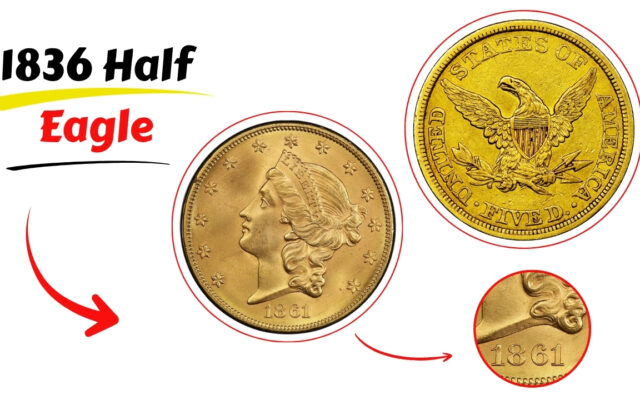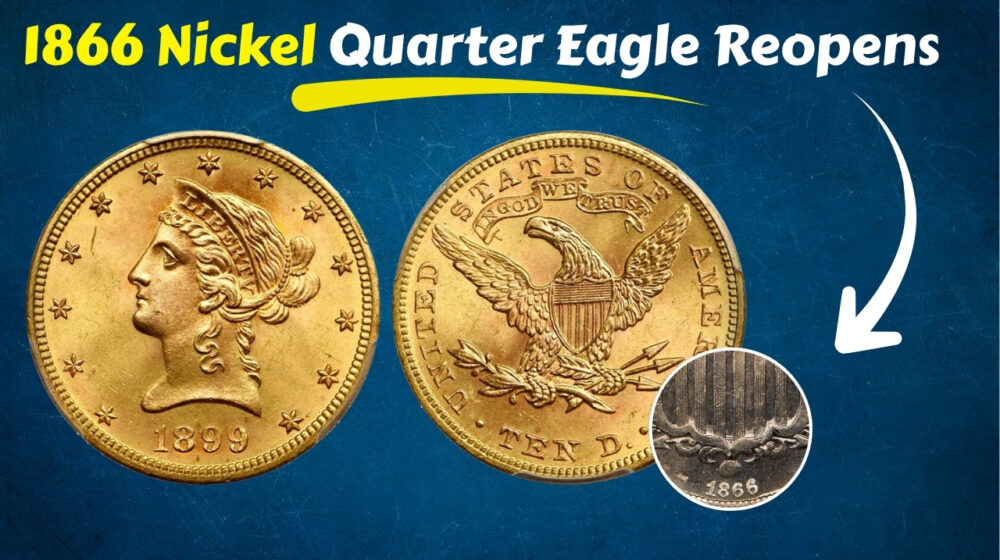
Every so often a 19th-century pattern coin surfaces that doesn’t just interest collectors it reopens a genuine historical whodunit. The 1866 Liberty Head Quarter Eagle struck in nickel, cataloged as Judd-542 and Pollock-607, is exactly that kind of coin.
Heritage Auctions offered a PCGS Proof-64, CAC-approved example of this extreme rarity as Lot 3598 in its August 31–September 5, 2026, ANA U.S. Coins Signature Auction, with the live Platinum Session held September 2 at Heritage’s Dallas headquarters. The coin ultimately sold for $18,300.
What makes it fascinating isn’t just the price it’s the coin’s very identity. It was struck from the Philadelphia Mint’s regular 1866 quarter eagle dies, meaning it should be a $2.50 gold coin. Instead, it’s nickel. And its dimensions come astonishingly close to matching a completely different denomination that had just entered production the year before: the copper-nickel Three-Cent Nickel. That coincidence has fueled a decades-long argument among specialists over whether this coin is a deliberate Mint experiment or the accidental byproduct of the wrong blank slipping into the wrong press.
Specifications at a Glance
| Attribute | Detail |
|---|---|
| Date | 1866 |
| Denomination Design | $2.50 Liberty Head Quarter Eagle |
| Designer | Christian Gobrecht |
| Catalog Numbers | Judd-542, Pollock-607 |
| PCGS Number | 60740 |
| Metal | Cataloged as nickel |
| Dies Used | Regular 1866 Liberty Head Quarter Eagle dies |
| Edge | Reeded |
| Rarity Rating | High R.7 |
| Grade (Featured Example) | PCGS Proof-64 |
| CAC Status | Green CAC approval |
| Teichman Roster Position | No. 4 |
| Known/Tracked Population | Six roster entries as of June 2026 (two uncertified entries may duplicate others) |
| Holder | PCGS Generation 1.2 “Rattler,” used February 1986–September 1989 |
| Weight of Featured Example | Not stated in the lot description |
| Comparable Standard 1866 Gold Quarter Eagle | 90% gold / 10% copper, 4.18 grams, 18 mm diameter, 3,080 business strikes |
| Comparable Three-Cent Nickel | 75% copper / 25% nickel, approx. 1.9 grams, approx. 17.9 mm diameter |
| Auction House | Heritage Auctions |
| Sale | 2026 ANA U.S. Coins Signature Auction |
| Lot Number | 3598 |
| Auction Dates | August 31–September 5, 2026 |
| Platinum Session Date | September 2, 2026 |
| Auction Location | Dallas, Texas (Heritage headquarters) |
| Realized Price | $18,300.00 |
The Auction Process: How This Lot Was Offered
Unlike a modern mint issue with a fixed mintage and a published order window, Judd-542 is a 160-year-old rarity that reaches the market only through the auction circuit and each appearance is essentially a unique event. Here’s how the process worked for this specific lot, and how collectors can approach similar opportunities in the future:
- Sale format. The coin was part of Heritage’s 2026 ANA U.S. Coins Signature Auction, a scheduled, multi-session event tied to the American Numismatic Association’s annual convention. Signature auctions of this caliber typically combine live floor bidding, phone bidding, and online bidding through Heritage’s platform.
- Session structure. High-value lots such as this one are typically grouped into a “Platinum Session” a session reserved for the auction’s most significant material. This lot’s Platinum Session ran on September 2, within the broader August 31–September 5 auction window.
- Lot identification. The coin was cataloged precisely by variety (Judd-542, Pollock-607), grade (PCGS PR64), and third-party approval (CAC), which is standard practice for pattern coinage buyers rely heavily on exact attribution rather than a simple date-and-denomination description.
- No fixed mintage or purchase limit. Because this is a single unique lot rather than a modern product run, there was no mintage limit, no per-customer purchase cap, and no fixed price the market determined the result through competitive bidding, closing at $18,300.
- Provenance and roster tracking. Serious bidders on coins like this typically cross-reference specialist census data — in this case, the Saul Teichman roster before bidding, since population data directly affects both authenticity confidence and price expectations.
For collectors hoping to acquire a similar rarity in the future, the practical path is to register with a major auction house such as Heritage or Stack’s Bowers, monitor upcoming Signature or Platinum Session catalogs for pattern and error material, and be prepared to bid competitively, since pieces of this rarity rarely appear on the open market outside of scheduled auctions.
Historical Background
The Quarter Eagle Design Behind the Coin
The coin’s dies come from Christian Gobrecht’s Liberty Head Quarter Eagle, a design that remained in production from 1840 through 1907 with remarkably little change over that long span. In its normal form, the $2.50 gold Liberty Head Quarter Eagle was a workhorse denomination of mid-19th-century American commerce a standard 90% gold, 10% copper coin weighing 4.18 grams and measuring 18 mm across. The Philadelphia Mint struck only 3,080 business-strike examples of the 1866 date, making even a normal-metal 1866 quarter eagle a scarce coin in its own right.
Judd-542 uses these same regular dies which is precisely what makes it so puzzling. It looks, in terms of design, exactly like the gold coin it was meant to represent. Its bright silver-gray surfaces are the only immediate clue that something unusual happened during striking.

The Three-Cent Nickel Connection
The mystery deepens because of timing. Congress authorized a new three-cent coin on March 3, 1865, and the Mint introduced the copper-nickel Three-Cent Nickel that same year a denomination that would remain in production through 1889. That coin was struck in a 75% copper, 25% nickel alloy, weighed about 1.9 grams, and measured approximately 17.9 mm in diameter.
That diameter is only a tenth of a millimeter smaller than the quarter eagle’s 18 mm. In other words, a Three-Cent Nickel planchet could plausibly have fit into quarter eagle striking equipment which is exactly the scenario some specialists believe explains Judd-542’s existence: an accidental substitution of the wrong blank rather than a deliberate pattern strike.
Pattern or Error? A Debate That Even Grading Services Have Struggled With
Nineteenth-century Mint officials were known to produce off-metal strikings from regular dies, sometimes for internal experimentation and sometimes for private or informal distribution to favored collectors so an intentional-pattern explanation is far from implausible. Reference works on the series reflect that ambiguity directly: Judd-542 is generally classified as a die trial, but with an acknowledged possibility that individual examples may actually be mint errors struck on Three-Cent Nickel planchets.
The clearest illustration of this uncertainty is the history of one specific Judd-542 specimen. NGC once certified it as a mint error struck on a Three-Cent Nickel planchet, at MS66, with a weight of 2.04 grams consistent with the Three-Cent Nickel’s tolerance range. That coin sold for $25,850 in April 2015. Later, PCGS certified the very same coin as a Proof-66 pattern, with CAC approval, and it sold again in May 2016 for $23,500 under that new attribution. Few coins in the American series demonstrate so clearly how even expert graders can land on different sides of the pattern-versus-error question for the exact same physical object.
Rarity and Census Data
Rarity is central to why this coin commands such attention. As of June 2026, the specialist roster maintained by researcher Saul Teichman tracked only six known Judd-542 examples, two of which remain uncertified and could potentially duplicate other listed entries. That population supports the coin’s High R.7 rarity designation among the rarest ratings applied in American pattern collecting. The featured PR64 CAC example sold in the 2026 ANA auction holds position No. 4 on that roster. The Newman Numismatic Portal separately preserves Teichman’s photographic research file on the issue, giving researchers an additional resource for studying individual examples.
Notable examples beyond this lot include a PCGS PR67 Cameo CAC specimen from the Simpson Collection, which Heritage sold for $31,200 in November 2020 cited at the time as the finest certified example of the variety.
Obverse and Reverse Design
Obverse: The obverse carries Christian Gobrecht’s standard Liberty Head design as used on the regular-issue 1866 gold quarter eagle Liberty facing left, rendered in the same style familiar from the series’ long production run. On this piece, the design sits on a nickel planchet rather than gold, giving the familiar portrait an unusually bright, silver-gray, almost steely appearance rather than the warm yellow tone collectors expect from the series. On the specific example sold at the 2026 ANA auction, a small lint mark appears near the base of Liberty’s neck, along with a few microscopic contact marks individually minor characteristics, but ones cataloged in detail given the coin’s rarity and value.
Reverse: The reverse follows the standard Liberty Head Quarter Eagle layout used for the 1866 date, unchanged from the gold issue apart from the metal itself. As with the obverse, the harder copper-nickel alloy produces a different visual texture than the gold version in this case, fine planchet striations run diagonally from southwest to northeast across the surfaces, an effect Heritage’s cataloguers described as subtle rather than distracting. The edge is reeded, matching the standard treatment for the denomination.
Taken together, the design is essentially identical to a normal 1866 quarter eagle the entire story of this coin lies not in an altered design, but in the metal itself and everything that choice implies about how it was made.
Why This Matters for Collectors
Judd-542 sits at an unusually rich intersection of collecting specialties, and that crossover appeal is a big part of what drives sustained demand for it:
- It’s a genuine open historical question. Most rarities are simply scarce; this one is scarce and unresolved. Whether the Mint intentionally experimented with a harder alloy, produced pieces informally for collectors, or accidentally struck a batch of coins on the wrong planchets remains a live debate more than a century and a half later.
- It appeals to three collecting communities at once. Pattern specialists want it as a documented off-metal die trial. Liberty Head gold collectors recognize the familiar Gobrecht dies. Error collectors are drawn to the wrong-planchet theory and the coin’s close dimensional match to the Three-Cent Nickel.
- Its certification history is a case study in numismatic ambiguity. The fact that a single physical coin has been certified both as an NGC mint error and, later, as a PCGS pattern with CAC backing shows just how difficult this issue is to classify definitively even for the professionals whose job is to do exactly that.
- The population is vanishingly small. With only six roster entries tracked as of mid-2026, and some of those potentially duplicative, Judd-542 is about as rare as 19th-century U.S. pattern coinage gets, reflected in its High R.7 rating.
- Holder history adds another collecting layer. The featured example remains housed in a PCGS Generation 1.2 “Rattler” holder, used only between February 1986 and September 1989 meaning collectors interested in early PCGS holder varieties get an additional point of interest layered on top of the coin itself.
- It rewards deep research. Because so much of the coin’s story depends on census tracking, prior certification history, and planchet analysis, Judd-542 is a coin where careful due diligence directly affects both confidence in an example and its ultimate value a trait serious pattern and error collectors specifically look for.
Quick-Reference Buying Guide
- Confirm the exact variety. Verify Judd and Pollock numbers (Judd-542, Pollock-607) directly against the holder and auction description pattern coinage depends on precise attribution.
- Check third-party certification and CAC status. Prioritize examples certified by PCGS or NGC, and treat CAC approval as an added layer of quality confirmation.
- Review the coin’s certification history. Given this issue’s documented history of being re-certified from mint-error to pattern designations (and vice versa), ask for or research any prior grading events tied to the specific coin.
- Cross-reference the Teichman roster. Compare the offered example against the specialist population census to understand where it sits among known survivors and whether its provenance is well documented.
- Evaluate physical characteristics independently of the label. Look closely at strike quality, planchet striations, and surface marks these details matter enormously for a rarity where design differences don’t exist and metal, strike, and preservation carry the story.
- Watch major Signature and Platinum Session auction catalogs. Coins of this rarity surface almost exclusively through major auction houses like Heritage Auctions and Stack’s Bowers register in advance and monitor upcoming ANA-affiliated sales.
- Set bidding expectations using recent comparable sales. Use realized prices for other Judd-542 examples (ranging from roughly $18,000 to over $31,000 depending on grade and pedigree) to establish a realistic bidding ceiling.
- Factor in holder and pedigree premiums. An early PCGS holder generation, a documented dual-certification history, or a notable prior owner (such as the Simpson Collection) can all justify paying above a baseline grade-based estimate.