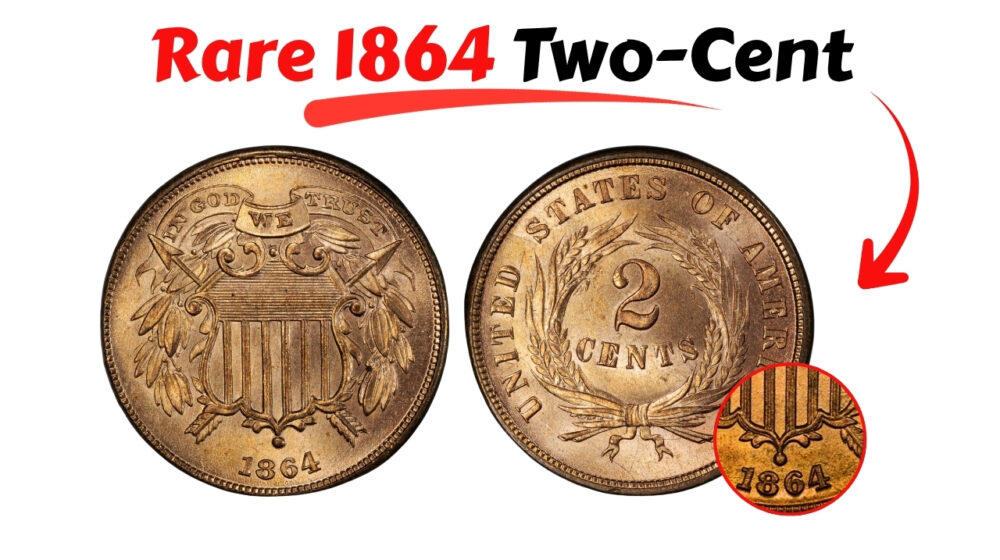
Some coins reveal their secrets only when you tilt them toward the light. The 1864 Large Motto Two-Cent Piece known as FS-1901 is one of them.
Look at the reverse, just above the letter S in CENTS. A faint portion of Liberty’s profile from an Indian Head cent appears in the field, with the nose and lips serving as the most recognizable clues. That image has no business on a two-cent piece, and its presence marks the coin as a multi-denominational die clash: the two-cent reverse die met an Indian Head cent obverse die.
A quick note on terminology, because the variety is sometimes casually described as an “overstrike.” It is not. An overstrike is a coin struck over another finished coin. FS-1901 is a die clash, meaning the image was transferred to the working reverse die itself, and every coin struck from that die while the marks were visible could carry it.
The variety returned to the spotlight when CAC chose a CAC MS64RB example as its Coin of the Week for September 23, 2026. PCGS separately lists the variety as the 1864 Two-Cent Piece “Clash w/ Ind. 1C,” and certified examples have appeared at major auctions for years. Heritage and GreatCollections have both pointed to the Liberty profile above the S, including the nose and lips, as a key identifier.
Specifications and Details
| Detail | Information |
|---|---|
| Coin | 1864 Two-Cent Piece, Large Motto |
| Variety | FS-1901 (older Fivaz-Stanton number: FS-001.8) |
| Special feature | Reverse die clashed with an Indian Head cent obverse die |
| Country | United States |
| Denomination | Two Cents |
| Mint / mintmark | Philadelphia / none |
| Date struck | 1864 |
| Authorizing act | April 22, 1864 |
| Designer | James Barton Longacre |
| Composition | Bronze: 95% copper, 5% tin and zinc |
| Weight | 6.22 grams (96 grains) |
| Diameter | 23 mm |
| Edge | Plain |
| Strike type | Business strike |
| Total 1864 mintage (all varieties) | 19,847,500 |
| Approximate Large Motto mintage | 19,822,500 (total less the initial 25,000 Small Motto delivery) |
| Mintage of FS-1901 itself | Not documented; the ordinary mintage figures say little about how many clashed coins exist |
| Featured coin | CAC MS64RB (Choice Mint State, Red-Brown) |
| CAC Coin of the Week date | September 23, 2026 |
| PCGS numbers | Dedicated numbers for Brown, Red-Brown and Red; Red-Brown is #38245, Red is #38246 |
| Key diagnostic | Indian Head cent Liberty profile above the S in CENTS |
Price Snapshot
There is no fixed price. FS-1901 trades on the secondary market, and values depend on grade, color and eye appeal. The figures below are indications only and should not be treated as current valuations.
| Source | Data point |
|---|---|
| Greysheet price ranges (indicative) | Brown (BN): about $265–$875; Red-Brown (RB): about $450–$1,100; Red (RD): a very wide range, from a few hundred dollars into the tens of thousands |
| Dealer retail listing (PCGS/CAC MS63 BN) | Listed at $975 |
| Stack’s Bowers, March 2011 | PCGS MS64RB sold for $2,314 |
| Stack’s Bowers, November 2016 | NGC MS65RB sold for $1,292 |
| Heritage, October 2018 | PCGS MS63RB sold for $528 |
| Heritage, October 2021 | MS65RB sold for $1,380 |
| Heritage, August 2022 | MS65+RB sold for $960 |
| Dealer sale, November 2022 | PCGS/CAC VF20 sold for $170 |
Notice how much results vary. Grade, color designation, strike quality, and the sharpness of the clash all matter, and the population of top-grade Red examples is thin, which is why price ranges at the high end can be so wide. The price of the CAC Coin of the Week coin itself was not part of the announcement.
How to Buy: The Acquisition Process
This is not a U.S. Mint release. There are no ordering windows, household limits, or release dates, because FS-1901 is a 19th-century variety that changes hands only on the secondary market. Here is how buying works in practice.
Where examples appear
- Auction houses. Heritage, Stack’s Bowers and GreatCollections have all handled certified examples. Auctions usually run for a set period, closing on a published date, and add a buyer’s premium to the hammer price.
- Specialty dealers. Dealers who focus on Indian cents and two-cent pieces sometimes list FS-1901 coins with detailed descriptions and offer want-list services.
- Online marketplaces. Certified coins turn up on third-party marketplaces and in dealer listings, often with a “buy it now” price.
- The Coin of the Week coin. CAC’s feature does not by itself put the coin on sale, and a price or seller was not published with the announcement. Interested collectors should check CAC’s channels and the dealer or auction house that submitted it.
What to verify before you pay
- Certification. Buy coins graded by a major service that lists FS-1901 or “Clash w/ Ind. 1C” on the label. PCGS numbers separate the Brown, Red-Brown and Red versions.
- The clash itself. Confirm the Liberty profile above the S in CENTS with a loupe and angled light. Look for the nose and lips. The strength of the image varies from coin to coin.
- Not just any clash. Ordinary die clashes are catalogued separately (for example, FS-1401 for 1864 Large Motto). Only a clash showing the Indian cent design qualifies as FS-1901.
- Color designation. Brown, Red-Brown and Red coins are priced very differently, and the designation should match the coin’s actual appearance.
- CAC sticker. A green CAC sticker signals that the coin was reviewed and approved for its grade, which many buyers treat as extra confidence.
Timing. No deadline applies. Because the Coin of the Week spotlight can bring extra attention to a variety, some collectors prefer to set a budget and act deliberately rather than rushing.
Historical Background
The 1864 Two-Cent Piece
A currency crisis. By the middle of the Civil War, Americans had hoarded gold and silver coins and then began setting aside copper-nickel cents as well. Merchants and shoppers needed change, and private tokens, fractional currency and other substitutes filled the gap.
The law. Congress responded on April 22, 1864. The act lowered the weight of the cent, replaced its copper-nickel alloy with bronze, and created an entirely new denomination: the two-cent piece. The coin was set at 96 grains (about 6.22 grams) in the same 95% copper bronze used for the new cent.
Designer. Chief Engraver James Barton Longacre, the fourth chief engraver of the U.S. Mint, designed the coin.
A milestone for American money. The 1864 two-cent piece was the first U.S. coin to carry the motto IN GOD WE TRUST. The Mint confirms that the new bronze coin introduced the motto to U.S. coinage. That gives every 1864 two-cent piece a place in numismatic history, and FS-1901 adds a mystery on top.
Small Motto to Large Motto. The earliest 1864 coins have smaller, more compact lettering in the motto. Researcher Robert W. Julian traced the first delivery to 25,000 pieces, identifying them as Small Motto coins. The Mint soon switched to larger, stronger lettering, and the Large Motto became the standard for the rest of the series. It is the more common of the two 1864 major varieties, and FS-1901 is a Large Motto variety.
A short life. The coin’s success faded quickly:
- 1864: nearly 20 million struck
- 1865: under 14 million
- 1866: just over 3 million
- 1872: only 65,000 for circulation
As normal coinage returned after the war, the emergency that created the denomination disappeared. The copper-nickel five-cent coin, introduced in 1866, further reduced demand. The Mint struck its last circulation two-cent pieces in 1872, made Proofs only in 1873, and the Coinage Act of 1873 ended the denomination.
The Indian Head Cent (the Source of the “Ghost”)
The design that appears on FS-1901 comes from the Indian Head cent, also designed by Longacre. The 1864 bronze version was smaller and lighter than the two-cent piece, measuring about 19 mm and weighing 3.11 grams, though it used essentially the same bronze composition. The Indian Head cent series began in 1859 and ran to 1909, so a great deal of the type’s history falls well outside the two-cent piece’s brief run. Its obverse portrait of Liberty is what left its mark on the two-cent reverse die.
The Die Clash Itself
How an ordinary clash happens. A clash starts when a press cycles without a planchet properly in place. The dies normally keep enough clearance to avoid contact, but if that clearance disappears they can strike each other and each die can pick up part of the opposing design. Coins struck afterward may show faint traces of the design from the wrong side.
Why FS-1901 is different. In this case the two-cent reverse die did not meet a two-cent obverse die. It met an Indian Head cent obverse die, which makes the event a clash between two different denominations.
The mystery. How the mismatched dies came together is unknown. The physical evidence proves that the clash occurred but does not reveal how it happened. Without documentation from the Philadelphia Mint, ideas such as an intentional test, an accident off the press or employee experimentation remain theories.
Obverse and Reverse Designs
Obverse
Longacre placed a Union shield at the center of the obverse, with crossed arrows and foliage behind it. A ribbon above the shield carries IN GOD WE TRUST, in the larger lettering of the Large Motto style. The date appears below. The clash does not affect this side.
Reverse (Where the Variety Appears)
The reverse shows 2 CENTS inside a wheat wreath, with UNITED STATES OF AMERICA around the border.
What to look for on FS-1901: Just above the S in CENTS, a faint section of Liberty’s profile facing right rises from the field. The nose and lips give the clearest evidence, and on some coins enough detail survives to make the foreign design unmistakable once you know where to look. The image is not damage added after the coin left the Mint. It was on the die.
Tips for viewing:
- Tilt the coin under a single light source.
- Rotate slowly and look for a shape that does not belong to the wreath or lettering.
- Compare the position against images of certified examples.
- On a well-preserved coin, the delicate clash detail is easier to study than on a worn one.
Why This Matters for Collectors
1. It is a genuine “wow” variety. A different denomination’s portrait on a coin is far more dramatic than a routine clash. PCGS lists it among the “cherrypicker” varieties for the 1864 Large Motto two-cent piece, calling out the Indian cent clash specifically.
2. It combines two collecting themes. The coin ties the first appearance of IN GOD WE TRUST on U.S. coinage to one of the most curious die varieties of the 1860s. Both types of collectors (type-set builders and variety specialists) have a reason to want one.
3. The market is established. Auction records go back many years, and PCGS assigns separate numbers to Brown, Red-Brown and Red examples. That gives buyers something firm to research, unlike varieties that are poorly documented.
4. The market is affordable at lower grades. Circulated and lower Mint State examples have sold for a few hundred dollars or less, so the variety is within reach for many collectors. Top-grade Red coins are a different story.
5. Preservation adds to the appeal. The featured coin is a CAC MS64RB, meaning Choice Mint State with enough original red color to qualify as Red-Brown. High-quality survivors are important here because the clash detail is delicate.
6. The mystery keeps it interesting. Nobody knows exactly how the dies met, and that open question is part of the variety’s charm.
7. Attention comes with caution. A Coin of the Week feature raises awareness, but historical auction prices are not current valuations. Compare several recent sales and dealer offers before paying a premium.
Quick-Reference Buying Guide
- Decide your target. Choose a color designation (Brown, Red-Brown or Red) and a grade range that fits your budget. The price gap between them is large.
- Study the diagnostic. Look at PCGS CoinFacts and auction images to learn what the Liberty profile above the S in CENTS should look like.
- Confirm the variety. Make sure the label or attribution says FS-1901 or “Clash w/ Ind. 1C,” not just a generic die clash.
- Insist on certification. Buy coins graded by a major service, and consider a CAC-approved coin for extra confidence in the grade.
- Check multiple price sources. Compare Greysheet ranges, recent auction results and current dealer listings. Treat older sales as history, not as today’s price.
- Shop several channels. Watch major auction houses, specialty dealers and online marketplaces, and consider giving a dealer a want list.
- Inspect before you commit. Examine high-resolution images or view the coin in hand, looking at the clash strength, color, strike and surfaces.
- Account for costs. At auctions, include the buyer’s premium, shipping and insurance in your budget.
- Set a limit and stick to it. Decide your maximum bid or price in advance, especially when a variety is in the news.
- Store it properly. Keep the coin in its holder, away from humidity and handling, to protect the original color.
This article draws on reporting about CAC’s September 23, 2026 Coin of the Week, PCGS CoinFacts and Greysheet pricing indications, and published auction records. Prices are historical or indicative and are not appraisals. The variety’s mintage is not documented, and the cause of the die clash has not been established.