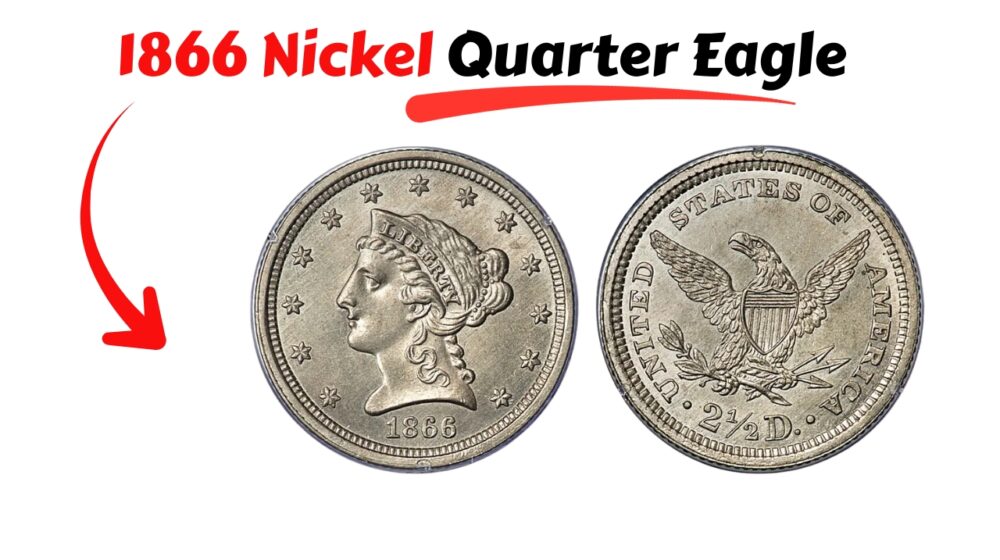
Some coins are rare simply because few survive. Others are rare because nobody can fully agree on how they came to exist in the first place. The 1866 Judd-542 Quarter Eagle belongs firmly in the second category a coin that looks, at first glance, like an ordinary $2.50 Liberty Head gold piece, struck from the Philadelphia Mint’s regular 1866 dies. Except it isn’t gold at all. It’s nickel.
That single substitution turns a routine 19th-century gold denomination into one of the more puzzling pattern coins in American numismatics. Was it a deliberate Mint experiment with a harder, more durable alloy? Or did a stray Three-Cent Nickel blank a coin denomination introduced just a year earlier accidentally slip into a quarter eagle press? Heritage Auctions recently offered a PCGS Proof-64, CAC-approved example of this coin as part of its 2026 ANA U.S. Coins Signature Auction, held August 31 through September 5, 2026, where the piece realized $18,300. The sale offers a good opportunity to unpack exactly what this coin is, why its origin remains debated, and why it continues to draw interest from three very different corners of the collecting world: pattern specialists, gold-series collectors, and error-coin enthusiasts.
Specifications at a Glance
| Category | Detail |
|---|---|
| Date | 1866 |
| Denomination Design | $2.50 Liberty Head Quarter Eagle |
| Designer | Christian Gobrecht |
| Judd Number | Judd-542 |
| Pollock Number | Pollock-607 |
| PCGS Number | 60740 |
| Metal (this issue) | Cataloged as nickel |
| Dies Used | Regular 1866 Liberty Head Quarter Eagle dies |
| Edge | Reeded |
| Rarity Rating | High R.7 |
| Grade (offered example) | PCGS Proof-64 |
| CAC Status | Green CAC approval |
| Teichman Census Position | No. 4 on the roster |
| Known/Tracked Examples | Six entries as of June 2026 (two uncertified, possibly duplicates) |
| Holder Type | PCGS Generation 1.2 “Rattler,” used February 1986–September 1989 |
| Realized Price (2026 ANA Auction) | $18,300 |
| Comparison: Standard 1866 Quarter Eagle | 90% gold, 10% copper; 4.18 grams; 18 mm diameter; 3,080 business strikes |
| Comparison: Three-Cent Nickel | 75% copper, 25% nickel; approximately 1.9 grams; approximately 17.9 mm diameter |
Heritage’s lot description for the Proof-64 CAC example did not include a specific weight for that particular specimen, though a separately tracked Judd-542 once certified as a mint error by NGC weighed 2.04 grams a figure that falls within the Mint’s tolerance range for a Three-Cent Nickel planchet.
How the Auction Unfolded
Because this specific coin has already changed hands, there’s no active order window or bidding process to describe going forward but understanding how it sold offers useful context for collectors tracking similar material:
- Auction house: Heritage Auctions, one of the largest numismatic auction houses in the world.
- Event: The 2026 ANA U.S. Coins Signature Auction, held in conjunction with the American Numismatic Association’s annual convention.
- Sale dates: August 31 through September 5, 2026.
- Lot number: 3598, sold during the live Platinum Session, which began September 2 at Heritage’s Dallas headquarters.
- Final price realized: $18,300.
For collectors interested in acquiring a comparable coin in the future, the practical path runs through the same channels used for most elite pattern and error coinage: major auction houses like Heritage, Stack’s Bowers, and GreatCollections, where Judd-542 examples have surfaced periodically over the past decade, along with direct outreach to established pattern-coin dealers who track census data for extreme rarities like this one.
Historical Background
The Liberty Head Quarter Eagle Design
The $2.50 gold Liberty Head Quarter Eagle, designed by Christian Gobrecht, had one of the longest production runs of any U.S. gold denomination, minted from 1840 through 1907 with only minor design refinements along the way. In its standard form, the 1866 issue was struck in a 90% gold, 10% copper alloy, weighed 4.18 grams, and measured 18 millimeters in diameter. Philadelphia’s business-strike output for the year was modest even by the standards of the era, totaling just 3,080 pieces making any 1866 Quarter Eagle a scarce coin in its own right, gold or otherwise.
The Three-Cent Nickel Connection
The other half of this mystery traces back to a decision made in Washington just one year earlier. Congress authorized a new three-cent coin on March 3, 1865, and the Mint responded by introducing the copper-nickel Three-Cent Nickel later that year, a denomination that would remain in production through 1889. That coin was struck in a 75% copper, 25% nickel alloy, weighed roughly 1.9 grams, and measured approximately 17.9 millimeters across a diameter just one-tenth of a millimeter smaller than the Quarter Eagle’s 18 millimeters.
That near-identical sizing is the crux of the entire debate. A Three-Cent Nickel planchet could, in theory, fit into equipment set up for striking quarter eagles, raising the possibility that Judd-542 wasn’t a deliberate pattern at all, but the result of a stray blank finding its way into the wrong press.
A Coin With Two Identities
Adding fuel to the debate, at least one other known Judd-542 specimen has literally worn both labels. NGC once certified a specimen weighing 2.04 grams as an MS66 mint error struck on a Three-Cent Nickel planchet; Heritage sold that coin in April 2015 for $25,850. The very same coin was later certified by PCGS as a Proof-66 Judd-542 pattern and received CAC approval, then sold again through Stack’s Bowers in May 2016 for $23,500. Few coins illustrate the blurred boundary between “pattern” and “error” as literally as this one, having carried an official mint-error attribution and a pattern-coin attribution within the span of about a year.
Pattern reference U.S. Patterns classifies Judd-542 as a die trial, while acknowledging that individual examples may represent genuine mint errors struck on Three-Cent Nickel planchets an unusually candid admission that the classification itself remains unsettled.
Description of the Design
Obverse
The obverse presents Gobrecht’s familiar Liberty Head portrait exactly as it appears on the standard gold Quarter Eagle: Liberty faces left, wearing a coronet inscribed “LIBERTY,” with her hair gathered beneath in a low bun. Thirteen stars encircle the border, and the date sits below the portrait. Because Judd-542 was struck from the Mint’s regular quarter eagle dies rather than any specially prepared pattern dies, the design elements match a normal 1866 gold Quarter Eagle stroke for stroke the only meaningful difference is the metal itself. On the Proof-64 CAC example offered by Heritage, a small lint mark appears near the base of Liberty’s neck, along with a few microscopic contact marks, while fine diagonal striations run southwest to northeast across the surfaces, described as creating a subtle rather than distracting visual texture.
Reverse
The reverse likewise mirrors the standard Liberty Head Quarter Eagle design: a heraldic eagle with wings displayed, clutching an olive branch and arrows, beneath the denomination and national inscriptions typical of the series. As with the obverse, no design element was altered for this off-metal or experimental striking it is purely the underlying planchet material, nickel rather than gold, that separates this coin from an ordinary circulation-strike 1866 Quarter Eagle. Under magnification, the surfaces show the same bright, silver-gray luster characteristic of nickel, a striking visual contrast to the warm yellow tone collectors expect from this design.
Why This Matters for Collectors
- It sits at the intersection of three collecting fields. Pattern collectors, Liberty Head gold specialists, and mint-error enthusiasts all have a legitimate claim on this coin, which broadens its appeal well beyond any single collecting niche.
- Its origin story remains genuinely unresolved. Unlike most coins where the “why” is a matter of historical record, Judd-542 still invites real debate among specialists some leaning toward deliberate Mint experimentation, others toward an accidental wrong-planchet strike.
- Extreme rarity is well documented. With a High R.7 rating and only six roster entries tracked as of June 2026 (two of them uncertified and possibly duplicates), this is a coin very few collectors will ever have the chance to own.
- Certification history adds intrigue. The fact that a sister specimen has carried both an NGC mint-error attribution and a PCGS pattern attribution with a five-figure sale under each label shows how even top grading services can reach different conclusions about the same physical coin.
- The holder itself is a small piece of history. The Proof-64 CAC example remains housed in a PCGS Generation 1.2 “Rattler” holder, used only from February 1986 to September 1989, adding a layer of holder-collecting interest on top of the coin’s own rarity.
Quick-Reference Buying Guid
- Understand what you’re buying. Confirm whether a given Judd-542 example is currently classified as a pattern, a mint error, or carries a mixed certification history, since this affects both desirability and long-term resale positioning.
- Verify the census position. Cross-reference any offered example against the Saul Teichman roster (also archived on the Newman Numismatic Portal) to understand exactly how many confirmed specimens exist and where a given coin ranks.
- Check certification and CAC status. Given the coin’s history of shifting attributions between grading services, confirm current holder type, grade, and whether CAC or another verification service has weighed in.
- Review auction records for comparables. Recent results including the $18,300 result from the 2026 ANA auction, the $25,850 and $23,500 sales of the dual-attributed specimen, and the $31,200 result for a PCGS PR67 Cameo CAC example from the Simpson Collection in November 2020 offer a useful pricing range across grades and attributions.
- Buy only through established auction houses or specialist dealers. Given the coin’s extreme rarity and six-figure attention from major auction houses, purchases should go through recognized platforms like Heritage Auctions, Stack’s Bowers, or GreatCollections.
- Inspect surface characteristics closely. Look for details like planchet striations, contact marks, or lint marks noted in official lot descriptions, since these details help confirm you’re viewing the specific specimen described in auction records.
- Consider the holder as part of the coin’s story. An early-generation PCGS holder, like the Generation 1.2 “Rattler” on the Heritage example, can add collector interest independent of the coin itself.
- Document provenance carefully. For a coin with as complex a certification history as Judd-542, keep thorough records of past sales, grading changes, and census documentation for any example you acquire.