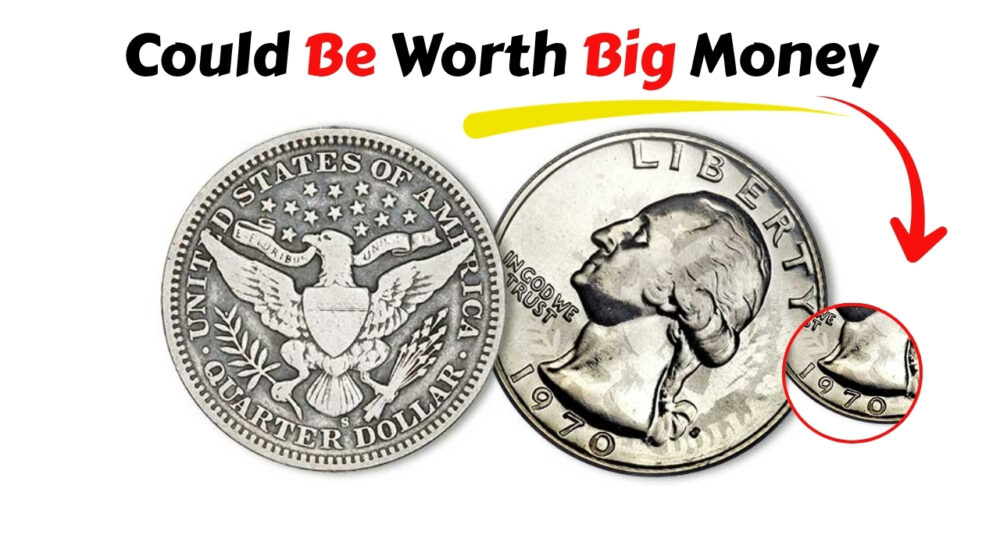
Every so often, the coin world turns up an object that sounds more like a magician’s trick than a minting accident. A San Francisco Mint Proof press from 1970 was supposed to be stamping out ordinary copper-nickel Washington Quarters. Instead, on at least one occasion, it came down on a coin that had no business being anywhere near that press: a $5 gold Liberty Head Half Eagle struck 72 years earlier, in 1898.
The result is a coin that wears two identities at once. On its surface sits John Flanagan’s familiar Washington Quarter design. Underneath, still legible if you know where to look, is Christian Gobrecht’s 19th-century Liberty Head Half Eagle date, denomination remnants, and all. Collectors and dealers have taken to calling it the “Gold Washington Quarter,” and it is now heading to auction through GreatCollections, with bidding scheduled to close on September 13, 2026.
Graded PCGS Proof-66 and described by the auction house as “Believed Unique,” this piece sits in the rarest tier of United States mint errors: a circulating-denomination design accidentally struck over a coin made of an entirely different metal, denomination, and century. Here’s everything collectors need to know about the coin, its history, and how to take part in the sale.
Specifications at a Glance
| Category | Detail |
|---|---|
| Item | “Gold Washington Quarter” mint error |
| Date/Mint mark struck | 1970-S |
| Denomination design struck | Washington Quarter (Proof) |
| Host coin | 1898 Liberty Head $5 Half Eagle |
| Quarter designer | John Flanagan |
| Half Eagle designer | Christian Gobrecht |
| Error coin weight | 8.3 grams |
| Standard 1898 Half Eagle weight | 8.36 grams |
| Standard 1970-S Proof Quarter weight | 5.67 grams |
| Standard 1970-S Proof Quarter composition | Copper-nickel clad outer layer over a pure copper core |
| Host coin composition | 90% gold, 10% copper |
| Standard 1970-S Proof Quarter diameter | 24.30 mm |
| Standard 1898 Half Eagle diameter | 21.65 mm |
| 1970-S Proof Quarter mintage | 2,632,810 |
| 1898 Philadelphia Half Eagle mintage | 633,420 |
| Current grade | PCGS Proof-66 |
| PCGS certification number | 48183803 |
| Prior certification | NGC PF66 |
| Rarity designation | GreatCollections lists it as “Believed Unique” |
| Selling venue | GreatCollections auction |
| Auction close | Sunday, September 13, 2026, 7:07:05 p.m. Pacific Time |
The weight is the single most telling clue to what happened here. A normal 1970-S Proof Quarter should weigh 5.67 grams. This coin weighs 8.3 grams nearly matching the 8.36-gram standard for an 1898 Half Eagle rather than the quarter it appears to be.
How to Bid: The GreatCollections Auction Process
Because this coin is being sold at public auction rather than through a fixed-price listing, the “ordering process” works differently than a typical numismatic product release. Here is what prospective bidders should understand about the process:
- Venue: The coin is being offered through GreatCollections, an online numismatic auction platform that specializes in certified U.S. coins.
- Certification on file: Bidders can verify the coin independently using PCGS certification number 48183803 before placing a bid.
- Auction close: Bidding is scheduled to close on Sunday, September 13, 2026, at 7:07:05 p.m. Pacific Time. As with most online coin auctions, expect competitive bidding activity to intensify in the final minutes before closing.
- No fixed mintage or purchase limit: Because this is a single, one-of-a-kind item rather than a manufactured product, there is no mintage limit, order limit, or per-household restriction to worry about only one example exists to be won.
- Registration: As with any GreatCollections sale, participants typically need to create a bidder account and may need to provide payment verification before bidding on higher-value lots. Prospective bidders should confirm current account and bidding requirements directly on the GreatCollections platform, since auction house policies can be updated at any time.
- Value context: GreatCollections has not published a fixed price, since the coin will sell to the highest bidder. However, comparable major mint errors provide useful context. A unique 1913 Buffalo Nickel struck on a $5 Indian Half Eagle planchet sold for $400,000. A 1915 Panama-Pacific gold half dollar brought $750,000 at a 2022 Heritage sale. Given the extreme rarity and the visual drama of this piece, serious interest from advanced error-coin collectors and gold-error specialists should be expected.
Bidders new to major error coins may want to review the coin’s TrueView images and certification details closely, and consider consulting a numismatic advisor before bidding at this level, since pieces this rare rarely come up for resale once they enter a collection.
Historical Background: The Two Coins in One
The 1970-S Washington Quarter (the “top” design)
The Washington Quarter series began in 1932, commemorating the 200th anniversary of George Washington’s birth. Sculptor John Flanagan won the design competition, producing an obverse portrait of Washington based on a Jean-Antoine Houdon bust, paired with a heraldic eagle reverse. The design proved durable, running in silver through 1964 before the U.S. Mint transitioned circulating quarters to a copper-nickel clad composition in 1965 amid a national coin shortage and rising silver prices.
By 1970, the San Francisco Mint was producing Proof Washington Quarters exclusively for collectors, using specially polished dies and planchets to create the mirror-like fields and frosted devices associated with Proof coinage. Proof coins of this era were often struck more than once to bring out full design detail a production detail that becomes highly relevant to this particular error, since it was struck using dies intended for an ordinary Proof quarter, not a gold coin.
The 1970-S Proof Quarter had a mintage of 2,632,810 pieces, made almost entirely on standard clad planchets. This error is the extraordinary exception.
The 1898 Liberty Head Half Eagle (the “host” coin)
The coin struck underneath the quarter design began life decades earlier, as a $5 gold Liberty Head Half Eagle dated 1898. The Liberty Head (or “Coronet Head”) half eagle design was created by Christian Gobrecht and, with modifications over the decades, was struck from 1839 through 1908, when it was replaced by Bela Lyon Pratt’s incuse Indian Head half eagle design.
The 1898 Philadelphia issue had a mintage of 633,420 coins, struck in the standard 90% gold, 10% copper alloy used for U.S. gold coinage of the era, at a standard weight of 8.36 grams and diameter of 21.65 mm. This particular Half Eagle survived intact for 72 years through two world wars, the end of the gold standard for U.S. citizens in 1933, and decades in circulation or in a collection before somehow ending up in a Proof coining operation at the San Francisco Mint in 1970, where Washington Quarter dies struck directly over it.
Exactly how a 28-year-old (at minimum) gold coin from an entirely different denomination entered a 1970 Proof production line has never been documented. What survives is the physical evidence: the coin itself, preserving traces of both eras in a single piece of gold.
Design Description: Obverse and Reverse
Obverse
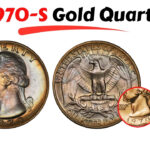
At first glance, the obverse presents John Flanagan’s familiar Washington Quarter portrait: a left-facing bust of George Washington, with “LIBERTY” arcing above, the date below, and “IN GOD WE TRUST” set beside the portrait. Because the quarter dies were struck onto a smaller, thicker gold planchet than the quarter’s intended blank, some peripheral device and lettering detail is affected by the mismatch between the two coins’ diameters (24.30 mm intended vs. 21.65 mm for the host), and underlying remnants of the Liberty Head design can be detected beneath the Washington portrait upon close inspection.
Reverse
The reverse carries Flanagan’s heraldic eagle design, with outstretched wings, an olive branch and arrows clutched in its talons, and “UNITED STATES OF AMERICA,” “E PLURIBUS UNUM,” and “QUARTER DOLLAR” arranged around the border. This is where the error is most dramatic and most legible: under magnification, the 1898 date from the underlying Half Eagle remains visible, positioned above the “QUARTER DOLLAR” denomination. Additional traces of the original Liberty Head Half Eagle reverse which itself depicted a heraldic eagle design credited to Gobrecht survive beneath the quarter’s eagle, creating a layered, almost ghost-imaged effect where two different eagle reverses from two different centuries occupy the same coin.
The overall effect, especially in hand under a loupe, is of a coin that visibly tells its own origin story: gold color, gold weight, and two dates and two design generations compressed into one object.
Why This Matters for Collectors
This coin sits at the intersection of several things advanced collectors chase simultaneously: extreme rarity, a compelling and legible story, gold content, and pedigree tied to a well-documented specialty publication (the coin appeared on the cover of Mint Error News Magazine Issue 66).
A few points make it especially significant:
- Off-metal errors on gold hosts are exceptionally rare. Most off-metal mint errors involve base-metal denominations struck on the wrong base-metal planchet. A base-metal design struck on a gold host coin rather than a blank gold planchet is a different and much rarer category altogether.
- The story is visible, not just documented. Many major errors require a certification label and a collector’s trust in the grading service’s attribution. Here, the underlying 1898 date and design elements remain visible to the naked eye or under light magnification, which adds a layer of verifiable, self-evident authenticity that strengthens the coin’s appeal.
- Comparable errors have sold for six figures. The 1913 Buffalo Nickel on a Half Eagle planchet ($400,000) and the 1915 Panama-Pacific gold half dollar ($750,000) demonstrate what advanced collectors will pay for coins in this category. Other examples, like the Indian Head Cents struck on $2.50 gold planchets and the Sacagawea Dollar/State Quarter mules, have traded in the low-to-mid six figures as well, though population estimates for those groups have shifted over time as new examples surfaced.
- A documented chain of custody matters. A related group of Proof and circulation-strike errors including other pieces from this same general era of San Francisco Proof production passed through a California Unclaimed Property auction in the early 2000s after review by the U.S. Secret Service, giving that broader category of errors an unusually clean ownership history. That precedent is relevant background for collectors evaluating extraordinary Mint errors of this kind, even though it does not directly document this specific coin’s path to market.
- Condition adds to rarity. A gold coin surviving 72 years, being struck a second time by dies not designed for it, surviving Mint quality control, and still grading PCGS Proof-66 speaks to exceptional survival and handling. Many major errors surface in circulated or lower Mint State grades; a Gem Proof example is unusual.
For type collectors, error specialists, and gold coin collectors alike, a piece like this rarely reappears once it settles into a collection which is part of why auctions for this caliber of error tend to draw serious, competitive bidding.
Quick-Reference Buying Guide
- Verify the coin’s certification. Look up PCGS certification number 48183803 directly on PCGS’s website to confirm the coin’s grade, images, and details match the auction listing.
- Review the auction listing on GreatCollections. Study the high-resolution photos closely, paying particular attention to the reverse, where the underlying 1898 date is visible above “QUARTER DOLLAR.”
- Register or confirm your GreatCollections bidder account. New bidders should set up an account in advance; returning bidders should confirm payment and bidding permissions are current, especially for a high-value lot.
- Research comparable sales. Review recent results for other major off-metal and gold mint errors (such as the 1913 Buffalo Nickel and 1915 Panama-Pacific gold half dollar) to build a sense of realistic value ranges before bidding.
- Set a maximum bid in advance. Given the coin’s “Believed Unique” status, competitive bidding is likely as the September 13, 2026 close approaches decide on a ceiling before the action starts.
- Watch the closing window. The auction is scheduled to close on Sunday, September 13, 2026, at 7:07:05 p.m. Pacific Time. Online coin auctions frequently see the heaviest bidding activity in the final minutes.
- Confirm post-sale logistics. After winning, follow GreatCollections’ standard payment, insurance, and shipping procedures for high-value certified coins.
This article is provided for informational purposes. Prices, auction terms, and bidding requirements should be verified directly with GreatCollections before participating in the sale.