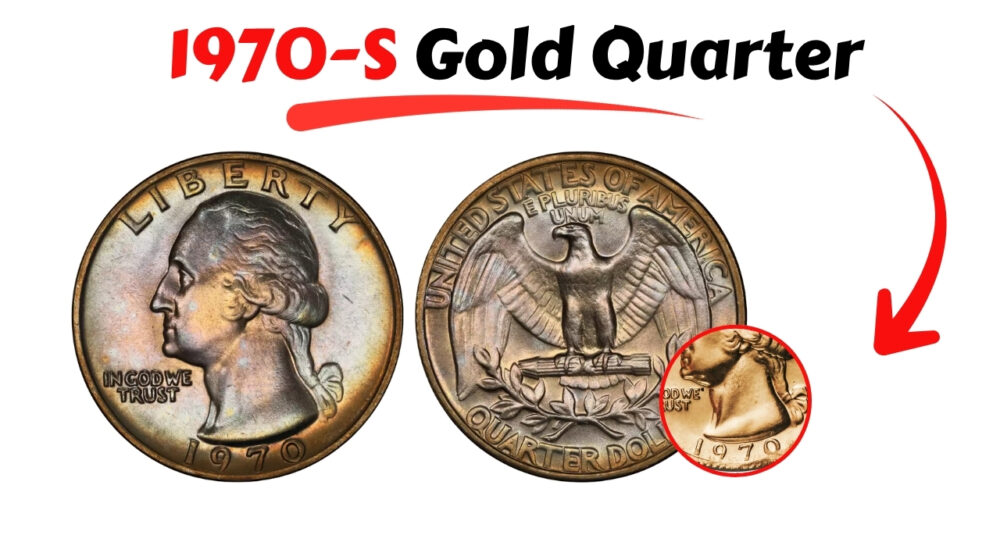
Every so often the error-coin world produces a piece so improbable that even seasoned collectors have to look twice. The coin at the center of this story is one of those pieces: a 1970-S Proof Washington Quarter that was never struck on a quarter planchet at all. Instead, San Francisco Mint dies came down on an already-finished 1898 Liberty Head $5 gold half eagle, fusing two denominations, two centuries, and two completely different metals into a single object.
The result is a coin that looks, at a glance, like an ordinary copper-nickel Proof quarter until you notice the color, the weight, and the ghostly outline of a 19th-century gold coin peeking out from underneath John Flanagan’s Washington portrait. Graded PCGS Proof-66 and described by GreatCollections as “Believed Unique,” the coin has been consigned to a GreatCollections auction, drawing renewed attention from error specialists and gold-coin collectors alike. The piece previously carried an NGC PF66 grade and was featured on the cover of Mint Error News Magazine Issue 66, where it was sold by veteran error dealer Mike Byers before later crossing into a PCGS holder.
Below is a complete rundown of the coin’s specifications, the history of both coins that make up this error, how the auction works, and what makes this piece such a landmark for the error-coin market.
Specifications at a Glance
| Detail | Information |
|---|---|
| Item | “Gold Washington Quarter” 1970-S Washington Quarter overstruck on an 1898 Liberty Head $5 Half Eagle |
| Design struck | Washington Quarter (obverse and reverse dies) |
| Host coin | 1898 Liberty Head (Coronet) $5 Half Eagle |
| Mint | San Francisco (S) |
| Grading service / grade | PCGS Proof-66 (PCGS cert #48183803); formerly NGC PF66 |
| Weight | 8.3 grams |
| Standard 1970-S Proof Quarter weight | 5.67 grams |
| Standard 1898 Half Eagle weight | 8.36 grams |
| Standard 1970-S Quarter composition | 75% copper / 25% nickel outer layers bonded to a pure copper core |
| Standard 1898 Half Eagle composition | 90% gold / 10% copper |
| Standard 1970-S Quarter diameter | 24.30 mm |
| Standard 1898 Half Eagle diameter | 21.65 mm |
| 1970-S Proof Quarter mintage | 2,632,810 |
| 1898 Philadelphia Half Eagle mintage | 633,420 |
| Rarity designation | GreatCollections lists it as “Believed Unique” |
| Auction house | GreatCollections |
| Auction close | Sunday, September 13, 2026, 7:07:05 p.m. Pacific Time |
| Recorded bidding level | Listing shown at $77,500 as bidding progressed toward close |
Because this is an assisted mint error rather than a regularly issued coin, there is no “price” in the retail sense its value is whatever collectors are willing to bid at auction. At last check, the GreatCollections listing showed a price of $77,500, though bidders should always confirm the final result directly on GreatCollections’ site, since prices realized can continue to update through and immediately after an auction’s close.
How the Auction Works: Bidding, Fees, and Timing
Unlike a Mint product with fixed mintages and order limits, this coin is being sold the way virtually all major rarities change hands today: through competitive online bidding at a specialist numismatic auction house. Here’s what prospective bidders need to know about buying through GreatCollections.
Registration. Anyone wishing to bid must first create a free GreatCollections account. Registration takes only a few minutes and does not obligate a bidder to purchase anything.
Bid limits. New bidders are typically assigned an initial bidding limit (commonly around $10,000) calculated against any open invoices and standing maximum bids. Because this lot is likely to sell well above that threshold, collectors interested in bidding seriously should contact GreatCollections in advance to request a higher limit verification of funds or trade references may be requested for large purchases.
Maximum (proxy) bidding. GreatCollections uses a proxy-bidding system: a bidder enters a confidential maximum amount, and the system bids on their behalf only as high as needed to stay ahead of competing bids, up to that ceiling. This means the final hammer price is often lower than a bidder’s true maximum.
Buyer’s premium. GreatCollections charges a buyer’s fee on all auction lots historically a discounted rate (around 10%) for payment by check, eCheck, or wire transfer, and a standard rate (around 12.5%) for payment by credit card or PayPal. This fee is added on top of the winning bid and applies to every buyer regardless of dealer status.
Sales tax and shipping. California residents are subject to state sales tax on winning bids, and shipping is calculated separately according to GreatCollections’ standard shipping schedule. Multiple winning lots can often be combined into a single shipment.
Closing and payment. The auction for this coin is scheduled to close on Sunday, September 13, 2026, at 7:07:05 p.m. Pacific Time. As with all GreatCollections lots, bidding intensifies in the closing minutes, and the platform is designed so that late bids extend the countdown slightly to prevent last-second “sniping.” Winning bidders receive an invoice after the close and are expected to complete payment promptly; GreatCollections generally ships paid orders within one business day.
The Host Coin: 1898 Liberty Head $5 Half Eagle
Before it became an accidental quarter, this coin lived a full life as a five-dollar gold piece.
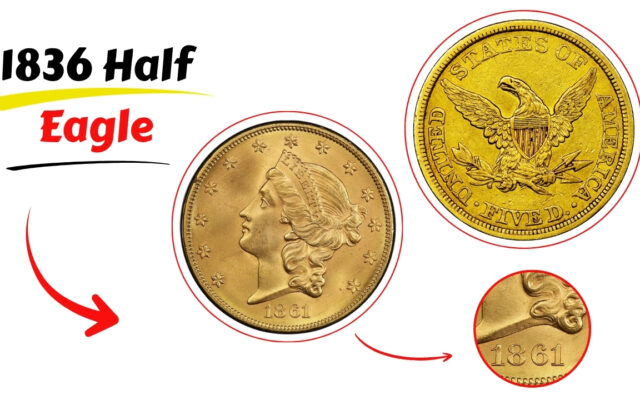
The Liberty Head (or Coronet) half eagle design was created by Christian Gobrecht, the same engraver responsible for some of the 19th century’s most enduring American coin designs, including the Seated Liberty series and the Gobrecht Dollar. Gobrecht’s half eagle obverse depicts Liberty facing left, wearing a coronet inscribed LIBERTY, surrounded by thirteen stars and the date. The reverse carries a heraldic eagle with a shield, arrows, and an olive branch, encircled by UNITED STATES OF AMERICA and the denomination FIVE D.
The design series ran, with modifications, from 1839 through 1908, making it one of the longest-lived gold coin designs in U.S. history. The 1898 half eagle came from the Philadelphia Mint, one of 633,420 pieces struck that year a coin intended for ordinary commercial circulation at a time when five dollars in gold represented real purchasing power. Struck in 90% gold and 10% copper, at a standard weight of 8.36 grams and diameter of 21.65 mm, it was a workhorse of the pre-Federal Reserve American monetary system.
Nothing about this particular half eagle marked it as special during the 72 years following its creation. It was simply one gold coin among hundreds of thousands until, somehow, it ended up in a San Francisco Mint Proof coining press in 1970.
The Overstruck Design: 1970-S Washington Quarter
The design that was struck on top of the gold half eagle is far more familiar to modern collectors: the Washington Quarter, created by sculptor John Flanagan.
Flanagan’s design debuted in 1932 as a circulating commemorative marking the bicentennial of George Washington’s birth, replacing the Standing Liberty Quarter. The obverse presents a left-facing portrait of Washington based on a Jean-Antoine Houdon bust, with LIBERTY above, the date below, and IN GOD WE TRUST to the left of Washington’s profile. The reverse depicts a heraldic eagle with outstretched wings perched above a bundle of arrows, flanked by two olive branches, with UNITED STATES OF AMERICA arched above and QUARTER DOLLAR below.
By 1970, the Washington Quarter had long since become a fixture of American pocket change, produced in enormous quantities at Philadelphia, Denver, and San Francisco. The San Francisco Mint, however, specialized in that era in Proof coinage specially prepared coins struck from polished dies onto polished planchets, often with more than one blow of the press, for collectors rather than circulation. The 1970-S Proof Quarter had a substantial mintage of 2,632,810, making it common in its normal copper-nickel clad form. It is only this single, wildly aberrant example struck on a gold coin instead of its intended planchet that elevates an otherwise ordinary date into one of the most talked-about errors in American numismatics.
Obverse and Reverse: What Collectors Actually See
Obverse. At first glance, the obverse presents Flanagan’s familiar Washington portrait, LIBERTY arcing above, IN GOD WE TRUST beside the bust, and the 1970 date below. Look closer, though, and the design sits slightly incomplete around the rim the underlying half eagle’s smaller diameter (21.65 mm) meant there was not quite enough metal to fill every crevice of the quarter dies out to the edge, leaving softness in the peripheral details that a normal, correctly sized planchet would not show. Faint traces of Gobrecht’s Liberty Head design can be detected beneath the Washington portrait under magnification.
Reverse. The reverse is where the error tells its clearest story. The familiar heraldic eagle, arrows, and olive branches of the Washington Quarter reverse appear on the surface, with QUARTER DOLLAR arcing along the bottom. But directly above the words QUARTER DOLLAR, the digits “1898” the date of the original half eagle remain legible, a ghost of the host coin’s reverse peeking through the quarter dies. Additional remnants of the half eagle’s eagle-and-shield design survive in the field, visible as subtle underlying texture beneath the quarter’s own devices.
Color and weight. Because the planchet beneath the design is 90% gold rather than copper-nickel clad, the coin’s color reads differently from a normal Proof quarter under close inspection, and its 8.3-gram weight nearly 50% heavier than a standard 5.67-gram quarter, and close to the half eagle’s own 8.36-gram standard is the single most telling physical clue to what lies beneath the surface.
Why This Matters for Collectors
A different category of error. Off-metal errors coins struck on the wrong planchet are already prized among error collectors, but the vast majority involve a blank planchet intended for a different denomination, not an already-struck, already-circulating coin from a different design series and century. Overstrikes on a completed coin are far rarer and considered a more dramatic class of error altogether.
Extraordinary production conditions. Proof coinage at the San Francisco Mint in this era involved hand-fed blanks, specially prepared dies, and layers of quality-control inspection specifically meant to catch anomalies before coins left the building. A major error surviving that process at all is unusual; a gold half eagle surviving it, 72 years after its original strike, is close to unprecedented.
Comparable rarities set the market context. Other coins struck on the wrong gold planchet have brought striking prices at auction — a 1913 Type 2 Buffalo Nickel struck on a $5 Indian Half Eagle planchet sold for $400,000, and the famous 1915 Panama-Pacific gold half dollar (struck on a cut-down Double Eagle planchet, with only two examples known) brought $750,000 at Heritage in 2022. Sacagawea Dollar/Statehood Quarter “mule” errors, of which more than twenty are known, have traded in the $100,000–$250,000 range depending on grade and market timing. This gold quarter, by contrast, is currently unmatched no second example has surfaced.
A documented ownership trail. Some Proof errors face lingering questions about how they ever left Mint custody. This coin’s known history traces back to a group of several hundred error coins that surfaced from a safe-deposit box and were reviewed by the U.S. Secret Service before being released to the State of California’s Office of Unclaimed Property, which then sold the group at auction. That documented chain of custody gives collectors added confidence in the coin’s legitimate market history.
Condition matters as much as rarity. A Gem-quality Proof-66 grade on a coin this physically unusual is notable in its own right. Overstriking an already-hardened gold coin under Proof pressure is a stressful process for any planchet, and the fact that this piece still presents with strong, fresh Proof surfaces adds to its desirability.
Quick-Reference Buying Guide
- Confirm the auction is still active. Check the current listing on GreatCollections directly, since bidding for this lot is scheduled to close September 13, 2026, and status can change quickly near the deadline.
- Register for a free GreatCollections account if you don’t already have one, using the “Register” link at the top of the site.
- Request a higher bid limit in advance if you intend to bid seriously, since new accounts default to a limit far below this coin’s likely selling price; contact GreatCollections by phone or email to raise it.
- Review the certification details PCGS cert #48183803, Proof-66 directly on PCGS’s cert verification tool before bidding, and study the high-resolution auction photos for the visible 1898 date and half eagle remnants described above.
- Decide on a maximum bid you’re comfortable with and enter it as a confidential proxy bid; GreatCollections’ system will bid incrementally on your behalf up to that ceiling.
- Factor in the buyer’s premium (roughly 10% for check/wire payment or 12.5% for credit card/PayPal) plus any applicable California sales tax and shipping costs when calculating your real total cost.
- Watch the closing minutes closely. Significant lots like this one often see the bulk of serious bidding activity concentrated in the final moments before the countdown ends.
- After winning, pay promptly to ensure fast shipment, and request appropriate insured, signature-required shipping given the coin’s value.
Note: Prices realized at auction can change up to and immediately after a lot closes. Bidders should always verify current status, price, and lot details directly on GreatCollections’ website before participating.