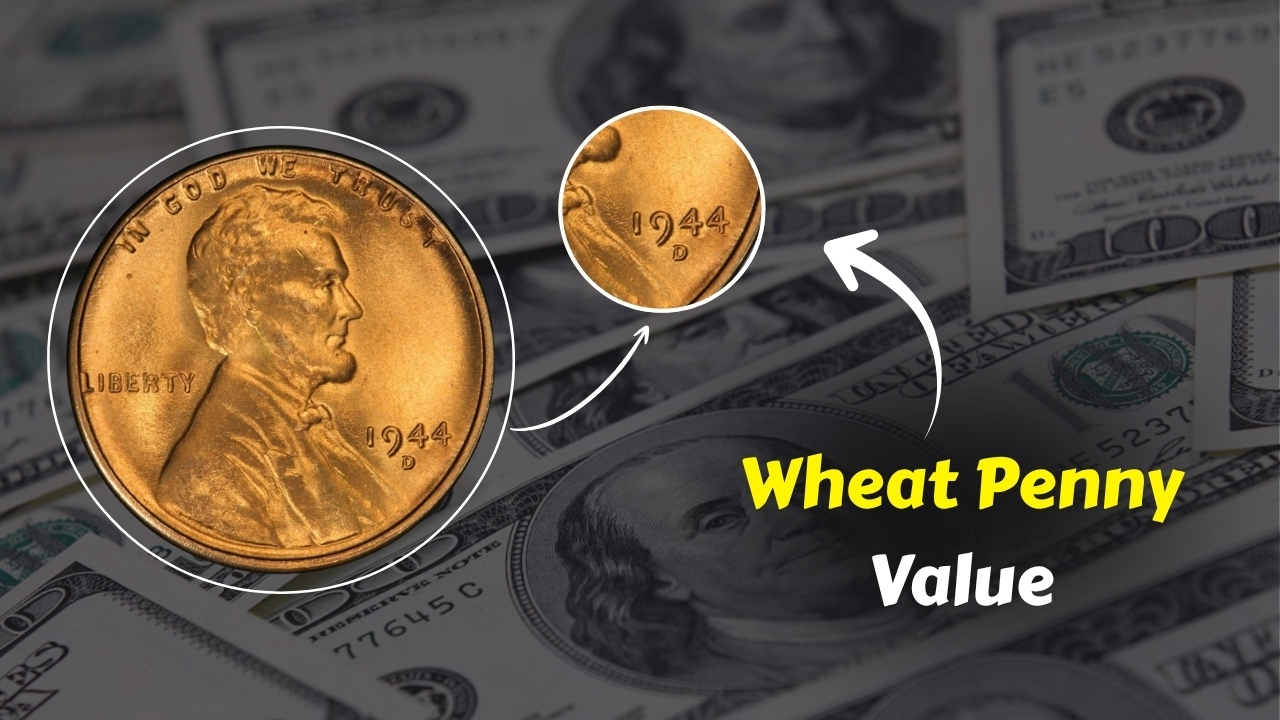
The 1944 Lincoln Wheat cent is a classic example of a coin that is common in its normal form but potentially spectacular in an unusual one. More than 2.1 billion regular 1944 cents were struck at Philadelphia, Denver and San Francisco, so an ordinary circulated example is generally a modest-value collectible. Yet the same date includes the famous 1944 steel cent the accidental carryover of a 1943 steel planchet and a number of collectible die and mintmark varieties.
That contrast is the key to understanding the 1944 penny market in 2026. A normal brown 1944 cent may be worth only a few cents to a few dollars depending on grade, while a certified 1944-D/S over-mintmark variety can bring hundreds or thousands of dollars in strong grades. The extremely rare 1944 steel cents are in an entirely different league: PCGS currently records an estimated 25–30 known for the Philadelphia issue, seven for 1944-D, and two for 1944-S. Recent certified auction records demonstrate why authentication is essential before assigning a headline value to any silver-colored 1944 cent.
Important: The figures below are market guides, not guaranteed selling prices. Coin values change with grade, color designation, eye appeal, certification, provenance and auction conditions.
1944 Lincoln Wheat Cent at a Glance
| Specification | Regular 1944 Lincoln cent |
|---|---|
| Denomination | One cent |
| Date | 1944 |
| Series | Lincoln Cent, Wheat Reverse |
| Designer | Victor David Brenner |
| Regular composition | 95% copper, 5% tin and zinc |
| Weight | 3.11 g |
| Diameter | 19.00–19.05 mm |
| Edge | Plain |
| Reverse | Two wheat ears surrounding ONE CENT and UNITED STATES OF AMERICA |
| Mints | Philadelphia (no mintmark), Denver (D), San Francisco (S) |
| Philadelphia mintage | 1,435,400,000 |
| Denver mintage | 430,578,000 |
| San Francisco mintage | 282,760,000 |
| Combined regular mintage | 2,148,738,000 |
| Regular-metal status | Common date in circulated grades; better red Mint State coins are scarcer |
| Famous error | 1944 steel cent, struck on a leftover 1943 steel planchet |
| 1944-D/S variety | Denver over San Francisco mintmark; FS-511 is a major recognized variety |
| Proof issue | No regular 1944 proof cent was struck |
PCGS gives the regular Denver issue a 3.11-gram weight and 19.00-mm diameter, while the rare steel issues weigh about 2.70 grams.
1944 Wheat Penny Value in 2026
There is no single “1944 wheat penny value.” The date must first be separated into normal copper cents, varieties and genuine off-metal errors.
Typical regular 1944 cents
A circulated 1944 Philadelphia, Denver or San Francisco cent is usually a low-dollar collectible. In broad retail-market terms, circulated pieces commonly trade for roughly $0.05 to $1, with cleaner Extremely Fine and About Uncirculated coins generally worth more. Common Mint State examples can range from several dollars upward, while truly exceptional red coins can become much more valuable.
The upper end is driven by condition rather than the date itself. A recent 2026 market report, for example, records a PCGS/CAC MS68 Red 1944 Philadelphia cent selling for $24,400. That is not representative of an ordinary 1944 penny; it is a reminder that population rarity at the finest grades can transform a common-date coin into a major condition rarity.
PCGS’s current guide also shows why color and grade matter: ordinary 1944-S Red examples occupy relatively modest price levels through much of Mint State, but the finest grades command substantially more. citeturn0search0turn0youtube51
1944-D/S: the variety collectors should know
The 1944-D/S is an over-mintmark variety in which remnants of an S mintmark appear beneath the D. PCGS identifies FS-511 as a recognized 1944-D/S variety and notes that the underlying S is positioned high enough for parts of it to remain visible around the D.
PCGS’s current price guide lists the 1944-D/S in values that can rise from tens of dollars in lower grades to thousands or tens of thousands in very high Red grades. A PCGS CoinFacts example reports a $49,938 auction record for an MS67+ Red example. citeturn1search0turn1search8turn1search7
Do not confuse an over-mintmark variety with a random-looking mintmark. The exact shape, placement and die markers matter, which is why attribution references and professional certification are valuable for expensive examples.
The 1944 steel cent
The great prize is the 1944 steel cent. During 1944, normal Lincoln cents returned to the bronze alloy used before the 1943 steel experiment. A small number of leftover zinc-coated steel planchets apparently entered production and were struck with 1944 dies.
PCGS estimates approximately 25–30 known 1944 Philadelphia steel cents, seven 1944-D steel cents, and two 1944-S steel cents. These are not merely “silver-colored pennies”; they are recognized transitional/off-metal errors with extraordinary rarity.
Auction results show the scale of the market. PCGS records a $122,000 auction result for a 1944-D steel cent graded MS62 in January 2026 and a $408,000 record for a 1944-S steel cent graded MS66 in 2021. PCGS also lists a 1944-S steel example in its condition census as one of only two known. citeturn1search10turn0search6
A practical value range
| 1944 issue | Broad 2026 collector-market expectation |
| 1944 Philadelphia, circulated | About $0.05–$1+ |
| 1944-D, circulated | About $0.05–$1+ |
| 1944-S, circulated | About $0.05–$2+ |
| Regular Mint State examples | Several dollars to hundreds+, depending heavily on grade/color |
| 1944-D/S FS-511 | Roughly tens to thousands+ depending on grade/color |
| 1944 steel cent | Tens of thousands to hundreds of thousands+ for authenticated examples |
| 1944-D steel cent | Tens of thousands to six figures+ |
| 1944-S steel cent | Six-figure territory is documented for top examples |
These ranges intentionally avoid pretending that one price applies to every grade. PCGS’s current guide and CoinFacts records show large spreads between ordinary pieces and elite certified coins.
Historical Background: The Lincoln Cent and the Wheat Reverse
The Lincoln cent began in 1909, when Abraham Lincoln became the first U.S. president to appear on a circulating American coin. Victor David Brenner designed the portrait. The U.S. Mint notes that the Wheat reverse remained in use from 1909 through 1958, making the 1944 cent part of one of the longest-running and most recognizable designs in American numismatics. citeturn1search12
Victor David Brenner’s Lincoln portrait
Brenner’s Lincoln portrait was based on his earlier work and became the defining obverse of the Lincoln cent. It was introduced for Lincoln’s centennial in 1909 and remained on the cent, with modifications, for decades.
On a 1944 cent, Lincoln faces right. The inscription IN GOD WE TRUST arcs across the top, LIBERTY appears to the left of the portrait, and the date appears on the right. A mintmark, when present, is below the date.
The Wheat reverse
Brenner’s original reverse design uses two stylized wheat ears framing the central inscriptions ONE CENT and UNITED STATES OF AMERICA, with E PLURIBUS UNUM above.
The wheat ears were widely interpreted as a symbol of prosperity and abundance. The design stayed in production through 1958, after which the Lincoln Memorial reverse replaced it.
Why 1944 Is Historically Important
The 1944 cent sits directly in the middle of the World War II era. Its composition tells an important story about wartime industrial priorities.
In 1943, the Mint temporarily used zinc-coated steel planchets for cents to conserve copper for the war effort. In 1944, bronze returned as the standard cent composition. The return created an unusual opportunity for leftover 1943 steel planchets to be accidentally mixed with the new production stock.
That is the origin of the famous 1944 steel cent. PCGS describes the 1944-D steel as a rare off-metal striking caused by a leftover 1943 steel blank entering a normal 1944-D bronze-cent production run. The same basic explanation applies to the Philadelphia and San Francisco steel discoveries. citeturn0search1turn0search6
Obverse Design: What to Look For
The obverse is dominated by Brenner’s right-facing portrait of Abraham Lincoln.
Key elements include:
- IN GOD WE TRUST across the top.
- LIBERTY at left.
- 1944 at right.
- Mintmark below the date on Denver (D) and San Francisco (S) coins; Philadelphia cents have no mintmark.
- Lincoln’s hair, cheek, jaw and coat are important grade-sensitive areas because wear appears there first.
On a high-grade coin, collectors want strong detail, clean surfaces and original red color. For a variety attribution, the date and mintmark area deserve close inspection under magnification.
Reverse Design: What to Look For
The Wheat reverse is instantly recognizable:
- Two wheat stalks frame the design.
- ONE CENT occupies the center.
- UNITED STATES OF AMERICA surrounds the denomination.
- E PLURIBUS UNUM appears at the top.
- The reverse is intentionally simple and symmetrical compared with later Lincoln cent designs.
On circulated coins, the wheat ears can show obvious wear. On Mint State pieces, sharp separation in the wheat lines and clean fields contribute to grade and eye appeal.
Rare Varieties and Errors to Check
1. 1944 Steel Cent
This is the headline rarity. It should be steel, substantially lighter than a normal bronze cent, and typically magnetic.
A magnet is a useful screening test, but it is not authentication. A plated or altered coin can produce misleading results, and counterfeit 1944 steel cents are a serious concern because of the potential value.
The most important measurements are:
- Normal bronze: about 3.11 g
- Steel: about 2.70 g
- Normal diameter: about 19 mm
PCGS lists 2.70 g for the 1944 steel issues.
2. 1944-D/S Over-Mintmark
The 1944-D/S is a legitimate collectible variety rather than an off-metal error. PCGS identifies multiple 1944-D/S varieties and recognizes FS-511 as a major variety. The remnants of the underlying S can be visible around the D.
This is a particularly good target for variety collectors because it is rare enough to be interesting but far more obtainable than a genuine 1944 steel cent.
3. 1944-D/D Repunched Mintmarks
PCGS catalogs multiple 1944-D/D repunched mintmark varieties, including FS-502 and FS-507. These arose from the older practice of hand-punching mintmarks into working dies. A repunched mintmark can show secondary contours or displaced remnants of an earlier punch. citeturn1search13turn1search14
4. Doubled Dies and Other Die Varieties
Specialized references catalog additional 1944 varieties, including a 1944-D doubled-die obverse (DDO) designation. Not every apparent doubling is a true doubled die: machine doubling, die deterioration and post-mint damage can create false positives.
For valuable attribution candidates, compare the coin with a recognized variety reference rather than relying on a generic “double die” checklist.
How to Tell a 1944 Steel Penny From a Normal 1944 Cent
Use a three-stage screening process:
- Visual check: a genuine steel cent normally has a gray or silver appearance rather than the reddish-brown color of bronze.
- Weight: use a precise digital scale. About 2.70 g strongly supports a steel planchet; about 3.11 g supports the normal bronze composition.
- Magnet: a genuine steel planchet should respond to a magnet.
If all three indicators point toward steel, stop handling the coin unnecessarily and seek professional authentication. Do not clean, scrape, acid-test or otherwise modify it.
PCGS specifically notes that the 1944 steel cent is a major rarity and that population information must be interpreted carefully because certification classifications have changed over time.
Buying a 1944 Wheat Penny: What Is the Ordering Process?
Unlike a new U.S. Mint product, a 1944 wheat penny is a secondary-market collectible. There is no official Mint order window, household purchase limit, launch date or government allocation for the coin in 2026. Collectors buy surviving coins from dealers, auction houses, coin shows, online marketplaces and other collectors.
A sensible buying process
Step 1 – Decide what you are buying.
Choose between a normal 1944, 1944-D, 1944-S, a variety such as 1944-D/S, or a rare steel cent.
Step 2 – Set a grade and budget.
A circulated album coin and an MS67 Red registry-level coin are completely different purchases.
Step 3 – For major varieties, confirm attribution.
Look for a recognized attribution such as FS-511 rather than relying on seller language alone.
Step 4 – For steel cents, require authentication.
Because of the enormous price gap, a raw “1944 steel penny” should be treated as a candidate, not as a proven rarity.
Step 5 – Compare recent realized prices.
Auction records are more useful than inflated asking prices. Compare the same mintmark, variety, color designation and grade.
Step 6 – Buy from a reputable source.
For high-value coins, consider an established dealer or a major auction house and insist on a major third-party grading-service holder when appropriate.
Step 7 – Preserve the coin.
Store it in an inert holder, away from PVC, moisture and unnecessary handling.
Are there purchase limits or order dates?
No official 2026 order limits or order window apply. The 1944 cent was issued in 1944 and is now a collectible on the secondary market. Availability changes whenever a dealer lists a coin or an auction opens.
For an auction purchase, the relevant dates are the lot closing date, bidding deadline and payment deadline established by the auctioneer. For a fixed-price dealer listing, the relevant “order window” is simply the period during which the coin remains available.
What Makes a 1944 Penny Valuable?
Collectors should think in terms of five variables:
- Metal: genuine 1944 steel is vastly more important than ordinary bronze.
- Mintmark: Philadelphia, Denver and San Francisco have different availability and variety profiles.
- Variety: 1944-D/S and repunched mintmarks can carry substantial premiums.
- Grade: the difference between a worn brown cent and a superb Red Mint State example can be enormous.
- Authenticity: an attractive but altered coin is not equivalent to a genuine Mint error.
Color designations also matter. BN means Brown, RB means Red-Brown, and RD means Red. For copper cents, original red color can be worth a substantial premium in high grades.
Why This Matters for Collectors
The 1944 cent is an unusually good teaching coin because it demonstrates several core principles of numismatics in one date.
First, mintage is not the same thing as rarity. More than two billion regular cents were struck, but the surviving population at elite grades is much smaller.
Second, errors can completely change a coin’s identity and value. A 1944 steel cent is not simply a “rare color” version of a normal cent; it is an off-metal error with a documented production explanation.
Third, variety attribution rewards careful study. The 1944-D/S and repunched-mintmark varieties show why collectors examine mintmarks with magnification and compare die characteristics.
Finally, 1944 illustrates why collectors should distrust sensational one-size-fits-all price claims. A headline saying “1944 penny worth $100,000” can be technically true for a rare steel error while being completely misleading for the ordinary 1944 cent in a jar of old change.
Common Buying and Identification Mistakes
Mistake: Assuming every silver-colored 1944 cent is valuable
Some ordinary cents can become discolored, plated or chemically altered. Color alone proves nothing.
Mistake: Trusting the magnet test alone
Magnetism is a screening clue. It is not a substitute for weight, diagnostics and professional authentication.
Mistake: Cleaning the coin
Cleaning can permanently damage surfaces and reduce collector value. Never polish or chemically clean a suspected rarity.
Mistake: Confusing damage with a mint error
A gouge, scrape, flattened mintmark or post-mint alteration is not automatically a Mint error.
Mistake: Using a generic online price
A dealer’s asking price is not necessarily a market value. Compare completed sales for coins with the same grade and variety.
Collector Tips for 2026
- Keep ordinary 1944 cents in date-and-mintmark order before evaluating them individually.
- Inspect the mintmark area with a 5x–10x loupe.
- Weigh suspicious coins to at least hundredths of a gram.
- Photograph both sides before sending a valuable candidate for examination.
- Learn the difference between RD, RB and BN.
- For expensive steel candidates, use a respected third-party grading service or an established numismatic specialist.
- Keep provenance and certification records with the coin.
- Never buy a six-figure rarity solely because a seller says “looks genuine.”
Quick-Reference Buying Guide
- Identify the date: confirm the coin actually reads 1944.
- Identify the mint: no mintmark = Philadelphia; D = Denver; S = San Francisco.
- Check the metal: suspicious gray/silver appearance deserves a weight test.
- Weigh it: approximately 3.11 g is normal bronze; approximately 2.70 g is consistent with a steel planchet.
- Use a magnet: magnetic response supports the steel hypothesis, but does not authenticate it.
- Inspect the mintmark: look for recognized 1944-D/S or repunched-mintmark characteristics.
- Check the grade: determine whether the coin is circulated, About Uncirculated or Mint State and assess its color.
- Compare realized prices: use auction results and established price guides for the exact variety and grade.
- Authenticate major rarities: especially any purported 1944 steel cent.
- Buy safely: use reputable dealers, established auctions and clear return/authentication policies.
- Preserve the coin: avoid cleaning and store it in a suitable inert holder.
- Document the purchase: retain the invoice, certification number, photos and provenance.
Final Takeaway
For most collectors, the 1944 Lincoln Wheat cent is an affordable World War II-era coin with enormous historical appeal. Its ordinary copper versions are common enough for beginners to collect by date and mint, while high-grade Red examples provide a deeper condition-rarity challenge.
The real excitement comes from the exceptions: the 1944-D/S over-mintmark, repunched mintmarks, recognized die varieties and, above all, the extraordinarily rare 1944 steel cent. In 2026, certified examples demonstrate that these rarities can command five- and six-figure prices.
The smartest collector approach is therefore simple: identify first, measure second, attribute third, and value last. A 1944 penny is worth what its specific variety, condition and authenticity can support not what the date alone suggests.
Sources and further reading
- U.S. Mint, Lincoln cent history and design overview.
- PCGS Price Guide, Lincoln Cent Wheat Reverse values.
- PCGS CoinFacts, 1944-D/S FS-511 and related varieties.
- PCGS CoinFacts, 1944-D steel cent.
- PCGS CoinFacts, 1944-S steel cent.
Editorial note: This article is intended for educational and publishing use. Numismatic prices are volatile and should be checked against current auction results and professional price guides before a purchase or sale.