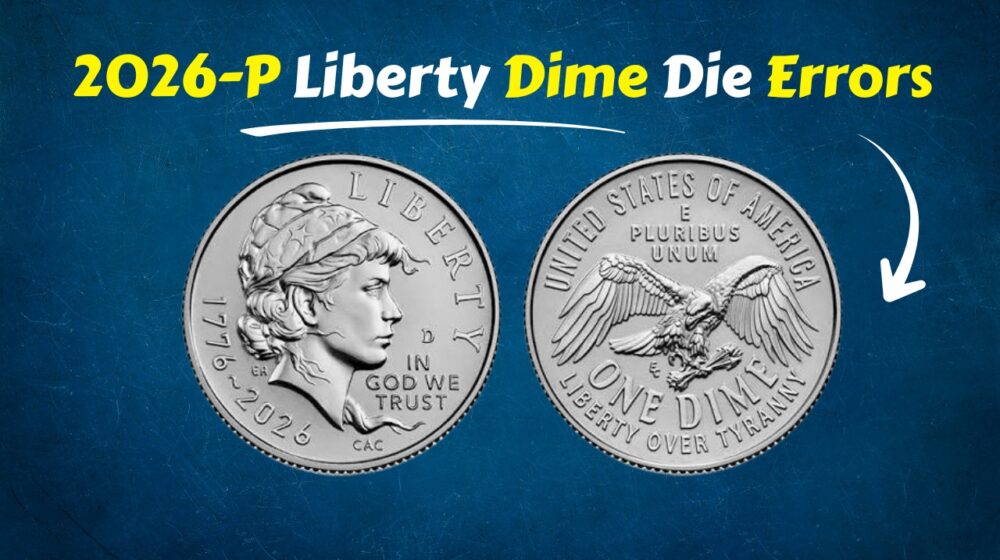
2026-P Liberty Dime Die Errors:The 2026 Emerging Liberty Dime was always going to draw attention. It is the first American dime since 1946 to drop the portrait of Franklin D. Roosevelt, and only the second time in the denomination’s history after the Mercury dime era that a Liberty figure has appeared on its obverse. Struck as part of the U.S. Mint’s Semiquincentennial program marking the nation’s 250th birthday, the coin was always intended as a one-year design, with Roosevelt scheduled to return in 2027.
That alone would have made 2026-P and 2026-D dimes a must-have for date-and-mintmark collectors. But a second story has developed alongside the coin’s release, and it has nothing to do with mintage numbers or packaging. Researchers examining Philadelphia-struck examples under high-resolution optical profilometry have found a cluster of unusual die events concentrated in one small area of the design the narrow band between the base of Liberty’s neck and the date. The events fall into three recognizable types: wave-like ripples in the die surface, elliptical patches resembling early-stage material spalling, and, in advanced cases, full interior die breaks.
What makes the discovery notable isn’t just that die wear happened dies always wear but where and how it happened, and that a strikingly similar formation has turned up on an entirely different 2026 coin, the Mayflower Compact quarter dollar. Both coins share a design trait that may be driving the phenomenon: a zone of unusually high, rapidly steepening relief sitting right next to a much flatter area of the design. This article covers both halves of the story the coin as an official Mint product, and the die-variety research now developing around it.
Coin Specifications at a Glance
| Detail | Information |
|---|---|
| Coin | 1776 ~ 2026 Emerging Liberty Dime |
| Program | U.S. Semiquincentennial (250th Anniversary) one-year design |
| Denomination | Ten cents (dime) |
| Composition | 8.33% nickel, balance copper (standard copper-nickel clad) |
| Weight | 2.268 grams |
| Diameter | 0.705 inch (17.91 mm) |
| Edge | Reeded |
| Mints | Philadelphia (P) and Denver (D) |
| Privy mark | None |
| Obverse designer/sculptor | Esao Andrews (design); Craig A. Campbell (sculpting) |
| Reverse designer/sculptor | Eric David Custer (design and sculpting) |
| Authorizing legislation | Circulating Collectible Coin Redesign Act of 2020 |
| Design life | 2026 only; Roosevelt portrait returns in 2027 |
| Circulation shipping began | January 5, 2026 |
| Two-Roll Set price | $40.00 (product code 26SDR) |
| 200-Coin Bag price | $54.00 (product code 26SDB) |
| Sales window opened | April 17, 2026, 12:00 p.m. ET |
Mint production reports through February 2026 showed roughly 193.5 million Emerging Liberty dimes struck for circulation, with about 124.5 million from Philadelphia and 69 million from Denver figures that will continue to climb as the Mint finalizes audited totals for the full calendar year.
How to Order the Rolls and Bags
Collectors who don’t want to rely on finding the coin in pocket change have two official purchasing paths through the U.S. Mint:

- Two-Roll Set ($40.00): Contains two $5 rolls of 50 dimes each one roll struck in Philadelphia, one in Denver — for 100 coins total, all circulation-quality but set aside before entering general circulation.
- 200-Coin Bag ($54.00): A canvas bag holding 200 dimes, split evenly between the two mints (100 P, 100 D).
Ordering details to know before you buy:
- Sales opened April 17, 2026, at noon Eastern Time, following a Federal Register pricing notice published March 20, 2026.
- Household order limits were not imposed on this release at launch, though the Mint routinely reserves the right to add or adjust limits at its discretion if demand spikes.
- Product limits differ from mintage limits: the Mint has capped individual product runs at 12,000 Two-Roll Sets and 8,000 200-Coin Bags, even though the overall mintage of the coin itself (in circulation and across all products) is uncapped.
- “Remind Me” alerts are available on the Mint’s website for anyone who wants a notification if a product sells out and is later restocked.
- Coins can also simply be found in circulation, since hundreds of millions have already been released into the money supply through Federal Reserve Banks.
Historical Background: Two Coins, Two Founding Stories
The Emerging Liberty Dime
The dime’s obverse breaks an 80-year streak. Every circulating dime since the Roosevelt design debuted on January 30, 1946, has featured the 32nd president, a tribute originally tied to his fight against polio. The Emerging Liberty design instead revives an allegorical Liberty figure, echoing (without replicating) the Mercury dime era of 1916–1945, itself designed by Adolph Weinman. The new figure was created under the Mint’s Artistic Infusion Program by designer Esao Andrews and sculpted by Mint engraver Craig A. Campbell, with the reverse eagle designed and sculpted by Eric David Custer. Because the redesign is authorized for calendar year 2026 only under the Circulating Collectible Coin Redesign Act of 2020, the dime is a guaranteed one-year type Roosevelt’s portrait is scheduled to return in 2027, giving the Emerging Liberty design permanent short-set status from the moment it left the press.
The Mayflower Compact Quarter
The quarter referenced throughout the die-research comparison is one of five 2026 Semiquincentennial quarter designs, each honoring a different chapter of the nation’s founding. The Mayflower Compact quarter depicts the November 21, 1620 agreement among the Mayflower’s passengers to govern themselves by common consent before ever setting foot in the New World a document historians regard as an early forerunner to the Declaration of Independence and the Constitution. Its obverse was designed by Artistic Infusion Program artist Ronald Sanders and sculpted by Eric David Custer; its reverse, showing the Mayflower under full sail crossing rough seas, was designed and sculpted by Mint medallic artist Phebe Hemphill.
Obverse and Reverse Design Details
Dime Obverse
Liberty is shown mid-motion rather than in a static, formal pose hair caught in what the Mint describes as the “winds of revolution,” her expression resolute as she faces down the authority of the British crown. Her liberty cap carries a stars-and-stripes motif, a deliberate callback to allegorical caps used on early American coinage. Obverse inscriptions read LIBERTY, IN GOD WE TRUST, and the dual date 1776 ~ 2026.
Dime Reverse
An eagle in flight carries arrows in its talons, a visual reference to the Revolutionary War and the colonists’ armed struggle for independence. The reverse motto departs from the usual E PLURIBUS UNUM placement on this side, instead adding the phrase LIBERTY OVER TYRANNY alongside UNITED STATES OF AMERICA, E PLURIBUS UNUM, and ONE DIME.
Quarter Obverse (Mayflower Compact)
Two Pilgrims are shown embracing as they take in their first view of the New World, a moment chosen to represent the human stakes behind the signing of the Compact rather than a literal depiction of the document itself. Inscriptions are E PLURIBUS UNUM, 1776 ~ 2026, and IN GOD WE TRUST.
Quarter Reverse (Mayflower Compact)
The Mayflower is rendered under full sail, foresail and mainsail both catching wind as the ship pushes west through rough water the same forward edge of the foresail that die researchers have identified as the highest-relief point measured anywhere on the quarter. Inscriptions read UNITED STATES OF AMERICA, LIBERTY, MAYFLOWER COMPACT, and 25¢.
The Die Event Research: What’s Actually Happening on These Coins
Independent researchers studying Philadelphia-struck 2026 dimes under white-light interferometry have documented a recurring cluster of die anomalies concentrated almost entirely in the narrow field between the base of Liberty’s neck and the date. Rather than force these findings into the traditional “variety” or “error” categories, researchers have proposed a third term a die event to describe changes that develop gradually during a die’s working life, distinct from one-time striking mistakes or intentional design varieties.
Why this one small zone? Liberty’s portrait sits off-center on the design, and the base of her neck happens to be the highest point of relief anywhere along the design’s outer edge coming within roughly 14 micrometers of the single highest point on the entire obverse (found in a strand of hair beneath her cap). Because that high point sits so close to the comparatively low relief of the date, the die surface between them has to curve exponentially rather than gradually, creating a steep, rapidly accelerating slope on the die face. Cross-sectional scans show this translates into a raised ridge on the die itself exactly the kind of geometry that concentrates pressure, stress, and shear during striking.
Three types of die events have emerged:
- Wave-like formations a raised ripple in the die surface that terminates in an abrupt, near-vertical “wall,” with a raised ledge trailing the trough of the wave. Researchers suspect this results from competing metal-flow demands: the high-relief neck requires far more metal movement than the shallow date beside it, and the transition zone between high and low shear traction may be where the wave-and-wall pattern forms not unlike a windblown sand dune building a long gentle slope on one side and a steep face on the other.
- Incipient spalling large, elliptical, flake-like surface patches, sometimes connected to fine cracks, resembling the earliest visible stage of fatigue-driven material spalling documented in industrial bearing and rolling-contact research. The elliptical shape may reflect a die surface that curves steeply in two directions at once.
- Interior die breaks the most advanced stage, where accumulated subsurface stress produces a crack large enough to qualify as a freestanding interior die break under standard error-variety classification.
Notably, a nearly identical wave-like formation has been found on 2026-P Mayflower Compact quarters, in front of the ship’s foresail the quarter’s own highest-relief point, sitting opposite a lower-relief “UN” inscription near the rim. The parallel between two unrelated coin designs, both pairing an unusually high-relief peripheral feature with a rapidly changing curvature nearby, strengthens the case that this is a geometry-driven phenomenon rather than a one-off flaw.
Researchers have also found closely matched pairs of these die events within the same coin rolls, suggesting the coins were struck in close succession from the same working die effectively offering snapshots of how a single die changes over its lifespan.
Why This Matters for Collectors
For collectors, the appeal here runs on two separate tracks.
As a coin, it’s a guaranteed short-set piece. A one-year design that breaks an 80-year visual tradition on a denomination struck by the billions is exactly the kind of release that tends to hold long-term collector interest, particularly once the 2027 Roosevelt dime returns and the Emerging Liberty design becomes permanently closed to new mintage.
As a die-variety subject, it’s an unusually active and evolving area of study. Unlike most die cracks or chips, which tend to be one-off curiosities, this cluster of formations appears in a wide range of expressions from subtle waves to visible interior breaks concentrated in one identifiable location, and apparently tied to the design’s underlying geometry rather than to any single die’s manufacturing defect. That makes it possible, in principle, to trace the progression of an individual die from early wave formation through spalling to eventual breakage, something rarely documented this clearly on a modern U.S. coin.
There’s also an open mint-specific question worth watching. Nearly all known examples of these die events have come from Philadelphia rather than Denver, and comparative scans show Philadelphia dies in this study measuring notably steeper in the affected zone as much as 45 micrometers higher than the Denver examples reviewed. Whether that reflects a genuine difference in die crown height between the two facilities, as some Mint contract research has previously indicated can happen, remains unresolved and is the subject of ongoing inquiry, including a pending Freedom of Information Act request.
For collectors building a variety set, that combination a single-year design, a documented and photographable die phenomenon, and an unanswered question about mint-to-mint differences is the kind of story that tends to keep a coin interesting well past its release year.
Quick-Reference Buying Guide
- Decide your format. Choose the $40 Two-Roll Set (100 coins, 50 each from Philadelphia and Denver) or the $54 200-Coin Bag (100 coins per mint) depending on how many coins you want to search through.
- Order directly from the U.S. Mint at usmint.gov once the product page is live, or set up a “Remind Me” alert if it’s temporarily sold out.
- Check for order limits at checkout the Mint can add household limits on short notice if demand is high, even if none applied at launch.
- Inspect coins under 10x–20x magnification, focusing on the narrow band between the base of Liberty’s neck and the date on Philadelphia strikes, where documented die events are concentrated.
- Look for the three known die-event types: a raised wave with an abrupt “wall” edge, an elliptical flake-like patch (incipient spalling), or a larger raised/cracked interior die break.
- Compare notes across rolls. Because some die events appear in near-identical pairs within the same roll, examining multiple coins from one roll can help identify examples from the same working die.
- Cross-check against the Mayflower Compact quarter if you collect across denominations a closely related wave formation has been documented near the foresail on 2026-P examples.
- Document and photograph any suspected die event before selling or submitting for grading, since this remains an actively developing area of research without finalized attribution standards yet.