Most legendary U.S. coin rarities earned their fame the old-fashioned way: the Mint struck only a handful of pieces, and collectors have spent generations chasing the survivors. The 1974 aluminum Lincoln cent breaks that mold entirely. Philadelphia struck more than 1.5 million of them. The federal government then destroyed nearly all of that mintage, spent decades trying to claw back the handful that escaped, and ultimately went to court to recover a unique Denver specimen that had been headed for a multimillion-dollar auction.
The result is one of the strangest stories in American numismatics a coin that is, by the government’s own stated position, illegal for any private citizen to own, even though a small number of genuine examples are known to exist. This article walks through the coin’s origin as a Cold War-era cost-cutting experiment, its abrupt rejection by Congress, the tangled ownership disputes that followed, and the one closely related aluminum cent that collectors actually can buy and sell legally today.
At a Glance: Specifications
| Detail | Description |
|---|---|
| Denomination | One cent |
| Date | 1974 |
| Striking facility | Philadelphia (experimental); Denver (unauthorized, unique example) |
| Composition | 96% aluminum alloy |
| Approximate weight | 0.93 gram |
| Approximate diameter | 19 mm |
| Edge | Plain |
| Obverse designer | Victor David Brenner |
| Reverse designer | Frank Gasparro |
| Reverse motif | Lincoln Memorial |
| Confirmed Philadelphia production | 1,571,167 pieces |
| Denver production | At least one confirmed example (unauthorized) |
| Circulation status | Never released for circulation |
| Legal ownership status | Classified by the U.S. Mint as government property; not lawfully transferable to private hands |
| Only legally collectible aluminum “1974” cent | 1974-S off-metal error struck on a Philippine sentimo planchet |
Why There Is No “Ordering Process” and What Collectors Should Know Instead
Readers coming to this story expecting a standard collector’s guide release dates, household order limits, a mint-direct purchase window will find something very different, and that difference is the whole point of the story.
The 1974 aluminum cent was never offered for sale to the public. It was struck as an internal experimental piece, evaluated by Treasury and Congress, and then ordered destroyed once lawmakers rejected the aluminum-cent proposal. No collector ever had the opportunity to purchase one through an official channel, and the U.S. Mint’s long-standing legal position is that any surviving example remains government property. According to statements in the historical record, Mint officials have said the pieces were produced solely as experimental prototypes, were never issued, and that the Mint lacked lawful authority to issue them meaning no private individual can establish valid legal title to one.
That position was tested directly in the 2014–2016 dispute over a unique 1974-D example discovered among a former Denver Mint official’s estate. Even after the coin was authenticated, graded, and prepared for a headline auction with pre-sale estimates as high as $2 million, the federal government intervened, litigation followed, and the holders ultimately surrendered the coin and relinquished all ownership claims in a 2016 settlement. No bidding ever took place, and no market price was ever established.
So what can a collector actually pursue?
- The 1974-S “Philippine sentimo” error cent. This is the one aluminum 1974-dated Lincoln cent with clean, legally recognized private ownership. It was not part of the Mint’s aluminum-cent experiment at all; it resulted from the San Francisco Mint accidentally striking a U.S. cent die on an aluminum planchet meant for a Philippine sentimo coin. PCGS has authenticated and graded examples of this error, and one sold at a major public auction for $19,200 in January 2023. Collectors interested in owning a genuine aluminum 1974-dated cent should focus their search here, working only with reputable third-party graded examples and established auction houses.
- Study and observation of known experimental pieces. A confirmed Philadelphia example resides in the Smithsonian’s National Numismatic Collection, and PCGS has publicly documented at least one other Philadelphia specimen tied to a colorful (if disputed) provenance story. These pieces can be studied, photographed, and discussed by numismatists, but they are not on the market and, per the Mint’s stated position, are not legally available for private sale.
- Documentation over acquisition. Given the ownership cloud over any genuine Philadelphia or Denver experimental piece, collectors are best served treating this coin as a research and historical interest rather than a target for a want list. Any offer to sell a “1974 aluminum cent” outside of the documented 1974-S error variety should be treated with serious skepticism.
Historical Background
The Philadelphia Experimental Pieces
The aluminum cent was born from a genuine economic emergency. Copper prices climbed sharply in 1973, and the rising cost of the metal pushed the melt value of a bronze cent uncomfortably close to its one-cent face value. At the same time, demand for cents was surging Mint records show cent production had climbed from roughly 1.126 billion pieces in 1959 to 6.392 billion in 1973, and Treasury officials later attributed much of that spike to speculative hoarding rather than ordinary commerce.
Facing the possibility that the cent could become uneconomical to produce, the Mint tested alternative compositions, including plated steel, before settling on an alloy that was 96% aluminum. The metal resisted tarnish, reduced wear on the coin dies, and was significantly cheaper to strike in bulk than bronze.
Philadelphia produced the aluminum cents in two production runs: the first ran from October 17, 1973, through March 29, 1974, yielding 1,441,039 pieces, and the second ran from April 12 through May 30, 1974, adding another 130,128 pieces a combined total of 1,571,167 coins.
Treasury pushed legislation that would have authorized the Treasury Secretary to switch the cent’s composition to a 96%-aluminum alloy. But the proposal ran into two serious objections at House hearings in March 1974: the vending machine industry warned that the much lighter aluminum cent could jam or be misread by coin-operated equipment, and pediatric and radiology experts warned Congress that an aluminum cent would be difficult to detect on an X-ray if swallowed or inhaled by a child. Congress rejected the aluminum-cent plan, and by the end of 1974 the release of stockpiled government copper had eased the price pressure that started the whole experiment. (When copper costs became a problem again in the early 1980s, the Mint solved it differently, switching in 1982 to the now-familiar copper-plated zinc cent.)
With the project dead, the Mint moved to destroy the experimental coins. Audit records indicate that all but 59 pieces from the first run and all but 67 from the second run were destroyed, with some samples having already been distributed to members of Congress and staff for demonstration purposes before the recall began. Not all of those samples were returned, and the government has since acknowledged it cannot fully account for who received them or how many remain outside its custody. An earlier federal investigation closed in 1976 without finding criminal intent among those known to possess surviving pieces, but that did not resolve the underlying ownership question a question the Mint continues to answer with a firm “government property” position.
The Unique 1974-D Denver Cent
The Denver example is the most dramatic chapter of the story. Mint records contain no official authorization for Denver to strike aluminum cents at all but Philadelphia had sent experimental aluminum sheet stock to Denver so that employees there could cut blanks using different equipment, letting researchers study whether blank size affected the alloy’s performance. The Mint later acknowledged that at least one former Denver employee recalled using a Denver-mintmarked die to strike aluminum blanks, in violation of internal instructions.
That single unauthorized striking surfaced decades later, in 2014, when Randy Lawrence discovered the coin among items inherited from his father, longtime Denver Mint official Harry Edmond Lawrence. After showing the coin to California coin dealer Michael McConnell, the pair had it authenticated and graded MS63 by PCGS, which also recorded its weight at approximately 0.93 gram and diameter at 19 mm consistent with the Philadelphia pieces.
Lawrence and McConnell prepared to sell the coin through Heritage Auctions, with published pre-sale estimates reaching as high as $2 million. Before the sale could occur, Mint officials learned of the plan and, in February 2014, the Mint’s chief counsel formally demanded the coin’s return from Lawrence, McConnell, and Heritage. Heritage withdrew the coin from its scheduled April 2014 sale.
Lawrence and McConnell then sued the federal government seeking a declaration of ownership. A federal judge dismissed their initial complaint in July 2014 for insufficient factual support, but allowed them to refile and in March 2015, the same judge declined to dismiss their amended complaint, finding it plausible that an authorized Mint official may have permitted Harry Lawrence to keep the coin. That ruling kept the case alive but did not resolve ownership either way.
The matter never reached trial. In March 2016, the parties settled: Lawrence and McConnell returned the coin to the U.S. Mint and relinquished all claims to its title. No auction, no bidding, and no public sale price ever materialized for what would likely have been one of the most valuable Lincoln cents ever sold.
The 1974-S Error Cent (The Legal Exception)
Separate from the Mint’s experimental program entirely, a genuine mint error created the only aluminum “1974” cent that collectors can legally buy and sell today. At the San Francisco Mint, a cent die was struck on an aluminum planchet that had actually been intended for a Philippine sentimo coin an unrelated denomination San Francisco was producing at the time. The resulting uniface error piece was authenticated and graded MS61 by PCGS, and Heritage Auctions sold an example for $19,200 on January 12, 2023, describing it as the only known 1974-dated aluminum U.S. cent that collectors can legally own.
Design Details: Obverse and Reverse
The 1974 aluminum cents both the Philadelphia experimental pieces and the anomalous Denver strike used the standard Lincoln cent dies of the era, so their designs are identical in appearance to the familiar bronze cents struck that year; only the metal composition and resulting weight and color differ.
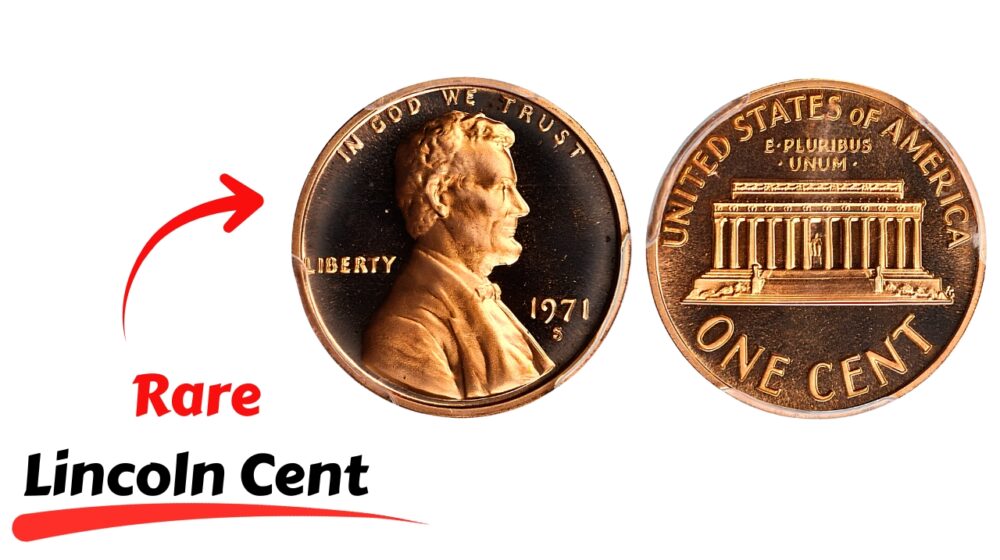
Obverse: The obverse carries Victor David Brenner’s iconic profile portrait of Abraham Lincoln, a design that has appeared on the cent since 1909. Lincoln faces right, with “IN GOD WE TRUST” arched above his portrait, “LIBERTY” to the left, and the date to the right. On genuine aluminum examples, the design’s fine details Lincoln’s coat lapel, hair, and beard lines sit on a noticeably lighter, silvery-gray surface rather than the warm copper-bronze tone collectors associate with a standard-issue cent.
Reverse: The reverse uses Frank Gasparro’s Lincoln Memorial design, introduced in 1959 to mark the Lincoln sesquicentennial and used through 2008. The Memorial building is rendered in detail, with a tiny, magnifier-visible statue of Lincoln discernible between the central columns. “UNITED STATES OF AMERICA” arches above, “E PLURIBUS UNUM” appears just above the building, and “ONE CENT” is centered beneath it. As with the obverse, the design elements are unchanged from the standard bronze cent the aluminum composition affects only the coin’s weight, color, and (per contemporary accounts) its ring when dropped, not its imagery.
Why This Matters for Collectors
The 1974 aluminum cent occupies a category almost no other American coin shares: extraordinary rarity created not by low mintage but by deliberate government destruction and an unresolved legal cloud over the survivors. That combination makes it significant to collectors for several reasons:
- It documents a real monetary crisis. The coin is physical evidence of a moment when rising commodity prices genuinely threatened the viability of America’s lowest-denomination coin a problem the Mint would face again in the 1980s and beyond.
- It illustrates how coins can be “rare” for reasons other than mintage. Numismatists typically rank rarity by how many coins survive. The 1974 aluminum cent forces a second axis into that conversation: legal availability. A coin can be authenticated, graded, and studied while still being off-limits to the private market.
- It set real legal precedent for numismatics. The Lawrence-McConnell litigation is one of the clearest modern examples of the federal government actively asserting and enforcing ownership over an experimental coin that had been in private hands for decades, reinforcing the Mint’s broader position on other unreleased or experimental pieces (including certain pattern coins and trial strikes).
- It highlights the importance of provenance research. The contrast between the disputed Toven-associated Philadelphia piece and the legally sold 1974-S error cent shows why collectors need to distinguish carefully between “authenticated as genuine” and “legally available to own.”
- It remains a benchmark story, not a market opportunity. Unlike most six- and seven-figure rarities, the 1974 aluminum cent has essentially no legitimate open-market sales history for the true experimental pieces making it one of the rare cases where a coin’s fame vastly outpaces its documented auction record.
Quick-Reference Guide for Collectors Researching This Coin
- Understand what you’re looking at. Confirm whether a coin being described as a “1974 aluminum cent” is a genuine Philadelphia/Denver experimental piece, or the unrelated 1974-S error struck on a Philippine sentimo planchet only the latter has clear legal title.
- Do not attempt to purchase a Philadelphia or Denver experimental piece. The U.S. Mint’s stated position is that these remain government property; no private sale of a genuine example carries clean legal title, and the government has demonstrated it will actively pursue recovery.
- If pursuing the legal 1974-S error, buy only PCGS- or NGC-graded examples from established auction houses (such as Heritage) with documented sale history, and verify the certification number directly with the grading service.
- Treat “provenance stories” with caution. Colorful backstories, like the Capitol Police account tied to one Philadelphia example, add historical color but are not a substitute for documented legal chain of title.
- Use reputable secondary sources for research. Organizations such as PCGS, Coin World, and Treasury Inspector General reports provide the most reliable documentation of known surviving pieces and their status.
- Consult a numismatic attorney or advanced specialist dealer before engaging in any transaction involving an experimental U.S. coin of disputed ownership the legal issues here are substantive, not a formality.
- Enjoy the coin as history, not inventory. For most collectors, the realistic and rewarding way to engage with the 1974 aluminum cent is through study, museum viewing (such as the Smithsonian’s confirmed example), and reading the documented court history not through acquisition.