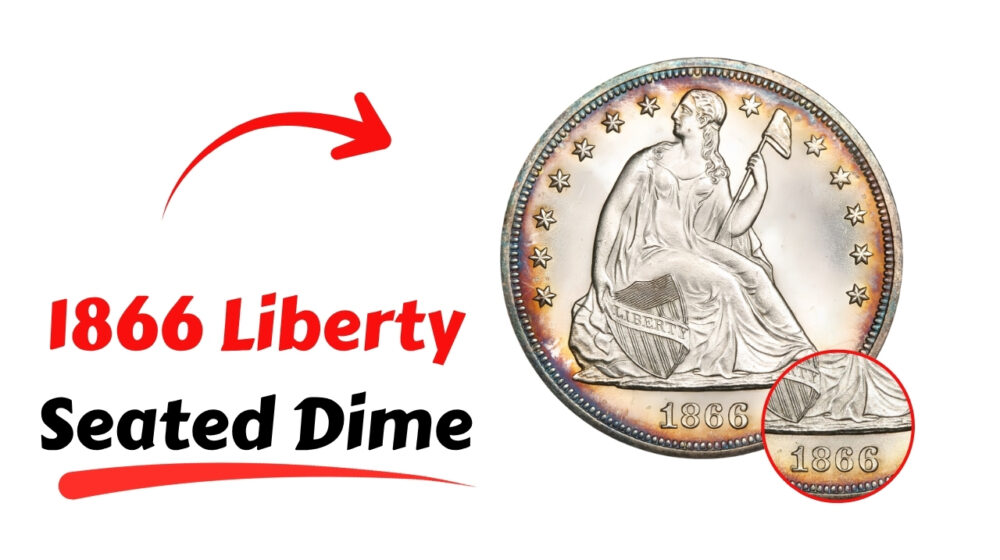
Some of the scarcest coins in American numismatics weren’t created by deliberate design they’re simply the byproduct of a Mint that had bigger problems to solve. The 1866 Liberty Seated Dime is a textbook example. The Philadelphia Mint struck every single business-strike example of this date on one day, January 31, 1866, and stopped at just 8,000 coins. For comparison, that same year the Mint struck 744,900 half dollars and nearly 700,000 Liberty Head Double Eagles. The dime got a fraction of that attention.
The reason wasn’t neglect for its own sake it was the aftermath of the Civil War. Gold and silver coinage had all but vanished from everyday American commerce, greenbacks dominated transactions at fluctuating discounts to specie, and the Treasury was years away from restoring normal coin circulation. Against that backdrop, a low-value silver dime simply wasn’t a production priority. The result, more than a century and a half later, is one of the true key dates of the Liberty Seated Dime series: a coin so scarce in top condition that specialists can name most of the handful of surviving Mint State gems by pedigree.
This guide covers the coin’s full specifications, the historical moment that shaped its tiny mintage, its design, current population data, notable auction results, and practical guidance for collectors pursuing an example today.
Specifications at a Glance
| Detail | Information |
|---|---|
| Country | United States of America |
| Year | 1866 |
| Denomination | One Dime (10 cents) |
| Mint | Philadelphia |
| Mintmark | None |
| Business-strike mintage | 8,000 (all struck on January 31, 1866) |
| Proof mintage | 725 |
| Composition | 90% silver, 10% copper |
| Weight | 2.48 g (PCGS); some period/type references list 2.49 g |
| Diameter | 17.90 mm |
| Edge | Reeded |
| Design type | Liberty Seated Dime, Legend Obverse (introduced 1860) |
| Designer | James B. Longacre, with design lineage tracing to Christian Gobrecht, Robert Ball Hughes, Thomas Sully, and Titian Peale |
| Die marriages | F-101 (Proof only) and F-102 (Proof and business strike); all business strikes trace to F-102 |
| Die states | F-102a “Perfect Reverse” and F-102b “Clashed Reverse” |
| PCGS population (Aug. 25, 2026 report) | 111 grading events total, including 3 at MS67, none higher |
| NGC census (June 18, 2026) | 58 grading events, including 1 at MS68 (NGC’s highest grade for the date) |
| PCGS survivor estimate | Roughly 400 surviving examples across all grades, about 50 in MS60 or better, and only about 8 in MS65 or better |
| PCGS auction record (regular business strike) | $12,650 (New York Connoisseur’s Collection, MS66, 2006) |
Because this is a 19th-century key-date coin traded on the collector market, there’s no fixed retail price value depends heavily on grade, die state, toning, and pedigree, ranging from affordable circulated pieces to five-figure Mint State gems.
How Collectors Acquire This Coin Today
There is no current Mint order window for an 1866 dime the coin hasn’t been struck since that single January day 160 years ago. Collectors instead pursue examples through the established rare-coin market, and given the coin’s genuine scarcity, understanding how that market works matters as much as understanding the coin itself.

Where to buy. Major auction houses with strong 19th-century U.S. silver departments Stack’s Bowers Galleries, Heritage Auctions, and American Numismatic Rarities among them have handled the finest known examples of this date, including pedigreed pieces from the Millholland, Hansen, Simpson, Gardner, and New England Museum collections. Dealers specializing in Liberty Seated coinage are another strong resource, particularly for circulated grades.
Pricing by condition. Circulated examples, while still scarce compared to more common dates in the series, are attainable for collectors working on a complete Liberty Seated Dime set. The real difficulty and the real money sits at the top of the condition census. PCGS’s own survivor estimate of roughly eight coins in MS65 or better explains why documented Mint State examples routinely bring five-figure prices at auction, with the standing PCGS auction record at $12,650 for the coin sold as part of the New York Connoisseur’s Collection in 2006.
Certification matters even more on a key date like this. Given the size of the price gap between adjacent high grades, and the coin’s importance as a condition-census rarity, buying PCGS- or NGC-certified examples ideally with CAC verification for top-end pieces gives collectors confidence in both authenticity and grade consistency.
Watch die states, not just grade. Specialists recognize two distinct die states among 1866 business strikes: F-102a, the “Perfect Reverse,” and F-102b, the “Clashed Reverse,” created when the obverse and reverse dies struck each other directly during the single day of production. Interestingly, F-102b examples despite being considered slightly less available overall by specialists currently dominate the PCGS condition census, making die-state identification a genuine point of interest for advanced collectors of this date.
Pedigree carries real value. Because so few high-grade 1866 dimes exist, several of them are individually known and tracked by name the Dell Loy Hansen specimen, the James Allaire Millholland Collection coin (which spent 112 years off the market before surfacing in 2023), and others. A documented pedigree connecting a coin to one of these collections adds both historical interest and resale confidence.
No purchase limits, but real scarcity. There’s no artificial cap on how many examples a collector can acquire the limiting factor is simply how many genuinely exist and how rarely the finest survivors come to market.
Historical Background
A Nation Rebuilding From Catastrophic Loss
The 1866 dime was struck into a country still absorbing the shock of the Civil War’s end. Robert E. Lee surrendered the Army of Northern Virginia at Appomattox Court House on April 9, 1865, though other Confederate forces remained active for a time afterward. Just five days later, John Wilkes Booth shot President Abraham Lincoln at Ford’s Theatre; Lincoln died the next morning, removing the leader who had already begun focusing on national reconciliation and Reconstruction.
The human toll of the war continues to be studied and refined by historians. Earlier demographic research by J. David Hacker placed Civil War deaths near 750,000, within a broad range of roughly 650,000 to 850,000. More recent scholarship has sharpened that estimate: a 2024 study published in the Proceedings of the National Academy of Sciences, using full-count census records rather than an earlier one-percent sample, calculated approximately 698,000 Civil War deaths, with an estimated range of roughly 647,000 to 749,000 placing the most likely total somewhat below the earlier commonly cited figure.
The economic damage was just as severe. Roughly two-thirds of assessed Southern wealth disappeared during the war, a decline driven by both physical destruction of railroads, livestock, farm machinery, and factories, and by emancipation removing enslaved people from property valuations altogether. The reunified nation entered 1866 facing an enormous reconstruction burden, without Lincoln’s leadership, and with a monetary system still far from normal.
Greenbacks and a Mint Pulled in Two Directions
The monetary backdrop shaped the Mint’s priorities directly. Congress had authorized federal Legal Tender Notes greenbacks to help finance the war, and unlike coin, these notes didn’t convert to gold or silver on demand, so their market value floated against specie. More than $400 million in greenbacks remained in circulation during 1866, with a March 1866 Treasury report placing the figure above $423 million. Because Americans had spent years treating gold and silver coin as more valuable than paper currency, precious-metal coins had largely disappeared from ordinary transactions. Treasury Secretary Hugh McCulloch wanted to retire greenbacks and return the country to specie payments, but that transition couldn’t happen overnight.
As a result, Philadelphia’s 1866 coinage output split sharply along two tracks: large volumes of low-value base-metal coins for everyday domestic use, and substantial gold coinage 698,745 Liberty Head Double Eagles, worth nearly $14 million at face value to satisfy continued demand from banks, government institutions, and international commerce. Silver denominations in between, including the dime, received comparatively little attention. Of Philadelphia’s 16 circulating business-strike denominations struck in 1866, nine had mintages below 25,000 pieces, and the half dollar, at 744,900 pieces, stood alone among Philadelphia’s 1866 silver issues with substantial business-strike output. The dime, by contrast, received only 8,000 pieces a genuinely token production run.
A Broader Series Low Point
The 1866 dime’s scarcity wasn’t an isolated event. Philadelphia dime production had been declining sharply since 1863, and the trend continued to a low point in 1867, when the Mint struck just 6,000 business-strike dimes even fewer than 1866. All five Philadelphia dime issues from 1863 through 1867 present real challenges for collectors, making this a broader key-date stretch within the series rather than a single anomalous year.
Why So Few High-Grade Survivors Exist
Nineteenth-century collectors of the period generally preferred Proof coins when the Mint offered them, and Philadelphia did strike 725 Proof 1866 dimes for that market notably, a higher total than the 1,000 Proof dimes struck back in 1860, which weakens any theory that postwar collector sentiment specifically drove up 1866 Proof demand. Because collectors of the era focused their saving efforts on Proofs rather than business strikes, most of the 8,000 circulation-strike dimes entered ordinary commerce, where wear, handling, and the passage of time steadily thinned their ranks. That pattern is exactly why today’s population reports show so few coins surviving in Mint State, let alone Choice or Gem Mint State condition.
The Motto That Didn’t Make the Cut
1866 marked a significant design change across American coinage: the Mint began adding IN GOD WE TRUST to gold and silver coins on January 1 of that year. The dime, notably, was excluded. Mint officials considered the denomination too small to accommodate the motto legibly, and the U.S. Mint’s own historical record specifically identifies the dime as the exception when the motto rolled out across gold and silver coinage that year. That small design detail makes the 1866 dime an interesting companion piece to its larger silver and gold counterparts from the same year, which did receive the new motto.
Design Description
Obverse
Liberty sits on a rock, her head turned toward her right shoulder, with flowing robes draped across the seated figure. Her left hand holds a pole topped by a Phrygian, or Liberty, cap a long-standing symbol of freedom. Her right hand supports a Union shield, across which a curved ribbon carries the word LIBERTY. The legend UNITED STATES OF AMERICA arcs around the upper rim, the date 1866 sits beneath Liberty, and denticles frame the coin’s edge.
This obverse belongs to the Legend Obverse type that Chief Engraver James B. Longacre introduced to the Liberty Seated Dime series in 1860, itself a reworking of the earlier Seated Liberty concept originally associated with Christian Gobrecht, Robert Ball Hughes, Thomas Sully, and Titian Peale.
Reverse
The denomination ONE DIME occupies the center of the reverse, encircled by a cereal wreath combining corn, wheat, maple leaves, and oak leaves, tied together by a ribbon at the bottom. Denticles again frame the rim. This composition is more accurately described as a cereal wreath rather than the simpler “wheat wreath” label sometimes applied to it in older references.
Edge
The 1866 Liberty Seated Dime has a reeded edge, consistent with the rest of the series.
Population Data and the Condition Census
Grading population reports shift constantly as collectors submit, cross, and occasionally resubmit coins, so any snapshot reflects a specific date rather than a permanent count. As of PCGS’s August 25, 2026 Population Report, the service lists 111 grading events for the 1866 dime, including three at MS67 with none graded higher. NGC’s census, updated June 18, 2026, shows 58 grading events, topped by a single coin at MS68 NGC’s highest recorded grade for the date.
These figures count grading events, not necessarily unique coins, since resubmissions and cross-service submissions can inflate totals. PCGS’s own survivor estimate roughly 400 examples across all grades, about 50 in MS60 or better, and only about eight in MS65 or better offers a clearer picture of just how difficult genuinely high-grade examples are to find.
Notable Auction Appearances
Several individually documented 1866 dimes anchor the coin’s condition census and illustrate the range of prices the date has commanded:
- PCGS MS67, James Allaire Millholland Collection: Sold by Stack’s Bowers on March 21, 2023, for $7,200, after remaining off the market for 112 years within Millholland’s estate. PCGS identifies it as die state F-102b, with olive, gold, and russet toning.
- PCGS MS67, Dell Loy Hansen Collection: A brilliant, frosty F-102b example that stands out visually against the heavily toned coins that otherwise dominate the top of the condition census.
- PCGS MS67, “Nic’s 1866 Philly Mint Set”: A third coin now recorded at the MS67 level, bringing PCGS’s total MS67 grading events to three.
- PCGS MS66+ CAC / PCGS MS66: Two auction appearances an NGC MS66 example sold at Heritage on December 16, 2021, for $3,960, and a PCGS MS66+ CAC example sold at Heritage on June 18, 2021, for $5,160 with plum and red-gold toning around champagne centers noted on the later holder.
- PCGS MS66, New England Museum: Sold by Stack’s Bowers on May 9, 2013, for $12,925, with antique olive, blue, and red toning across the surfaces.
- PCGS MS66 CAC, Bob R. Simpson Collection of Seated Dimes: Sold by Heritage on September 23, 2010, for $6,325, distinguished by lavender and seafoam-green toning.
- PCGS MS66, New York Connoisseur’s Collection: Sold by American Numismatic Rarities on March 14, 2006, for $12,650 still the standing PCGS auction record for a regular-issue 1866 business strike with apricot toning and deep blue and green coloring around the borders.
Toning defines much of the upper end of this market, with the Hansen specimen’s bright, frosty surfaces standing out as a notable exception among condition-census coins known primarily for rich original color.
Why This Matters for Collectors
A coin shaped directly by national crisis. The 1866 dime’s tiny mintage isn’t a random production quirk it’s a direct consequence of the Civil War’s monetary aftermath, greenback-driven coin hoarding, and the Mint’s decision to prioritize gold coinage and base-metal denominations over small silver. Owning one connects a collector tangibly to that specific moment in American economic history.
Genuine, well-documented rarity. With PCGS estimating only about 400 total survivors and roughly eight examples in MS65 or better, this isn’t inflated modern-market rarity talk it’s a scarcity borne out by decades of population data and a very short list of individually trackable high-grade coins.
A built-in specialist story. The single die marriage, its two distinct clashed and unclashed die states, and the fact that the supposedly scarcer state now dominates the condition census give variety-focused collectors real material to study beyond a simple date-and-mintmark approach.
Pedigree collecting at its most concentrated. Because so few Mint State examples exist, several carry individually documented ownership histories Millholland, Hansen, Simpson, Gardner, the New England Museum turning acquisition of a top-tier example into pedigree collecting as much as date collecting.
A meaningful design footnote. As the sole 1866 gold or silver denomination excluded from that year’s new IN GOD WE TRUST motto, the dime offers a small but genuine point of numismatic interest that connects directly to one of the best-known design changes in U.S. coinage history.
Quick-Reference Buying Guide
- Decide your target grade range first. Circulated examples are attainable for a Liberty Seated type or date set; Mint State examples require a far larger budget and real patience given the extreme scarcity at that level.
- Buy certified. PCGS or NGC certification is essential on a key date this scarce, and CAC verification adds further confidence for higher-grade purchases.
- Learn to recognize the two die states. F-102a (Perfect Reverse) and F-102b (Clashed Reverse) are both collectible, but knowing which you’re buying and that F-102b currently leads the condition census adds meaningful context to any purchase.
- Research pedigree before bidding on high-grade pieces. Several top examples carry documented collection histories; knowing a coin’s provenance can meaningfully affect both desirability and price.
- Shop major auction houses for top-end examples. Stack’s Bowers Galleries and Heritage Auctions have handled most of the significant 1866 dime sales in recent years and remain the most likely venues for future condition-census pieces to surface.
- Compare recent sold prices by grade and die state, not just by numeric grade alone, since toning, eye appeal, and pedigree all move prices meaningfully within the same grade.
- Register with your chosen auction house in advance, and confirm buyer’s premiums, payment terms, and secure shipping arrangements before bidding on higher-value lots.
- Be patient. With an estimated eight or fewer survivors in MS65 or better, top-tier examples simply don’t come to market often building a want list and waiting for the right coin is often more realistic than expecting to buy on demand.
This article covers a historical U.S. coin traded on the secondary collector market. There is no current mint, order window, or fixed retail price for this issue; figures above reflect documented auction results and population data as reported by PCGS and NGC, and can change as new grading events and market data emerge.