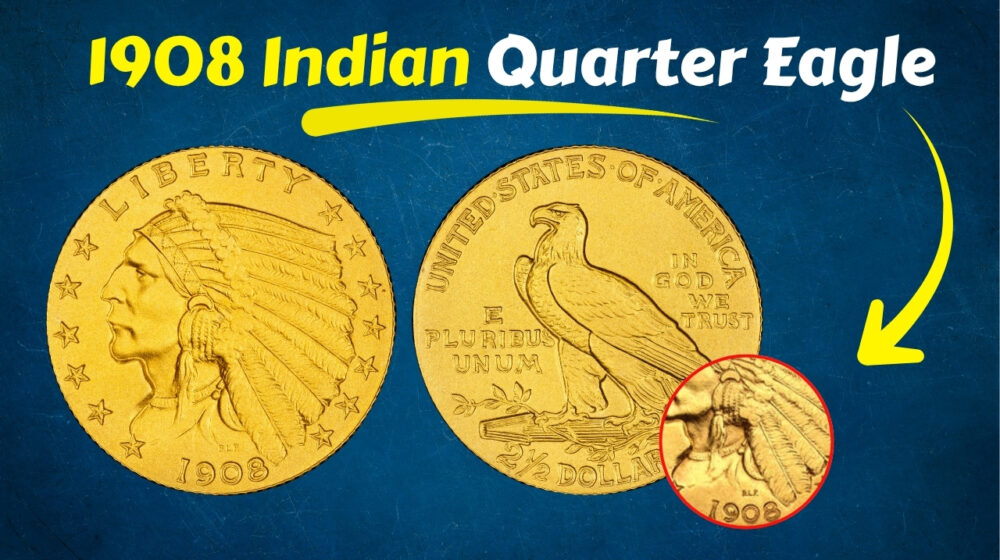
A 1908 Indian Quarter Eagle has just reached a level of preservation that almost no coin in its series has ever achieved. Stack’s Bowers Galleries offered the coin, graded MS-67 by PCGS, as Lot 2237 in its Summer 2026 Global Showcase Auction, where it sold for $67,100.
On paper, the 1908 date shouldn’t command that kind of attention. It’s the debut year of the design, the Philadelphia Mint struck more than half a million examples, and collectors have long treated it as an easy, affordable entry point for a type set. But that familiar story collapses well before a coin reaches MS-67. As of August 18, 2026, PCGS’s population report shows only six grading events at that level for the 1908 date and only eight MS-67 grading events across the entire circulation-strike Indian Quarter Eagle series combined, with nothing graded higher. This is a coin that isn’t rare because of its date. It’s rare because almost nothing has survived at the very top of the condition scale.
Specifications at a Glance
| Attribute | Detail |
|---|---|
| Denomination | $2.50 Quarter Eagle |
| Year | 1908 |
| Mint Facility | Philadelphia |
| Mintage | 564,821 |
| Designer | Bela Lyon Pratt |
| Composition | 90% gold, 10% copper |
| Actual Gold Weight | Approximately 0.121 troy ounce |
| Weight | 4.18 grams |
| Diameter | 18 mm |
| Edge | Reeded |
| Obverse Motif | Native American portrait facing left (incuse design) |
| Reverse Motif | Standing eagle perched on arrows and an olive branch (incuse design) |
| Grade of Auctioned Coin | PCGS MS-67 |
| PCGS Number | 7939 |
| NGC Universal ID | 288Y |
| PCGS Population at MS-67 | 6 examples; none finer, as of August 18, 2026 |
| PCGS Population Across Series at MS-67 | 8 total (6 dated 1908, 1 dated 1914, 1 dated 1929) |
| Auction House | Stack’s Bowers Galleries |
| Auction Event | Summer 2026 Global Showcase Auction, Rarities Night |
| Lot Number | 2237 |
| Realized Price | $67,100 |
How This Coin Actually Came to Market
Unlike a modern Mint product with a fixed order window, purchase limits, and a set release price, a coin like this reaches collectors through the competitive auction process and understanding that process matters just as much as understanding the coin’s grade.
- Consignment and cataloging: The coin was consigned to Stack’s Bowers Galleries, one of the leading rare coin auction houses in the United States, and cataloged as Lot 2237 for the firm’s Summer 2026 Global Showcase Auction.
- Placement in a premier session: The coin appeared in the auction’s Rarities Night session, the portion of a major numismatic auction reserved for the highest-value and most historically significant lots, where serious collectors and dealers concentrate their bidding.
- Certification before sale: The coin carried a PCGS MS-67 grade the essential credential that allowed bidders to trust its condition and rarity before the sale, since a coin at this population level lives or dies on independent third-party certification.
- Bidding format: As with all major Stack’s Bowers auctions, bidding was open to registered participants through in-person, phone, absentee, and online bidding channels, standard practice for high-value rare coin sales.
- Result: The coin realized $67,100, a price that reflects its status as one of only six coins at this grade for the date and one of only eight at this grade across the entire circulation-strike series.
For collectors hoping to acquire a coin like this in the future, there is no “order form” or issue-price purchase path the only route is through major rare coin auctions (Stack’s Bowers, Heritage, and similar firms) or through private treaty sales with dealers who specialize in high-grade classic U.S. gold.
Historical Background
A Series Born From One of America’s Great Design Eras
The Indian Quarter Eagle emerged during one of the most celebrated periods in American coinage history. Sculptor Augustus Saint-Gaudens had already reshaped the nation’s larger gold coins, the $10 Eagle and $20 Double Eagle, before his death in 1907. With that work complete, the Mint turned its attention to the smaller gold denominations, and the task fell to Bela Lyon Pratt, a sculptor who had studied under Saint-Gaudens himself.
Pratt took an entirely different creative path than his mentor. Rather than raising the portrait, lettering, and eagle above the coin’s surface in traditional relief, Pratt sank the entire design below the coin’s fields an incuse format unlike anything used on any other United States coin struck for circulation. He applied the same radical technique to both the $2.50 Indian Quarter Eagle and the $5 Indian Half Eagle, giving both denominations an appearance unlike anything Americans had previously carried in their pockets.
A Design That Sparked Public Controversy
The incuse format did not arrive without a fight. Philadelphia coin dealer Samuel H. Chapman became one of the design’s most outspoken critics, arguing that the recessed areas of the coin could collect dirt and even harbor germs. He also raised concerns that the unusual format might make the coins easier to counterfeit. The controversy grew serious enough to reach President Theodore Roosevelt’s attention. Despite the criticism, the Mint moved forward, and the design entered circulation in 1908.

History has since reversed that early verdict entirely. Collectors today prize the Indian Quarter Eagle specifically because Pratt broke so completely with convention the recessed devices make the series instantly recognizable, even among collectors who don’t typically focus on early American gold.
The Same Design That Created the Coin’s Modern Rarity
The very feature that makes the Indian Quarter Eagle so distinctive also explains why gem examples are so difficult to find today. Because the design sits below the coin’s surface, the broad, flat, open fields around it become the coin’s highest points meaning any contact with other coins tends to leave visible marks directly across those open areas. PCGS has noted that handling tends to show up more noticeably on these coins than on traditionally raised designs, especially as grades climb into the highest Mint State levels.
Why 1908 Survives Better Than Most Dates Up to a Point
The 1908 issue benefits from being the series’ debut year. As numismatist David Akers observed, many collectors at the time saved examples simply because they represented the first year of Pratt’s dramatic new design, treating them as novelties rather than spending money. PCGS estimates that more than 41,000 examples of the 1908 issue survive today across all grades, with more than 26,000 surviving in Mint State, and roughly 1,016 examples surviving at MS-65 or finer.
That relative abundance, however, evaporates almost completely at the top of the grading scale. PCGS currently records 123 grading events at MS-66, another 14 at MS-66+, and just six at MS-67 with nothing certified any finer. The 1908 date may be one of the easiest coins in the series to acquire in typical Mint State condition, but at the absolute summit of the population report, it is exceptionally scarce.
Obverse and Reverse: A Closer Look
Obverse: The obverse presents a Native American portrait facing left, rendered not in traditional raised relief but sunk into the coin’s surface Pratt’s signature incuse technique. The feathered headdress and facial detail sit below the coin’s flat outer field, creating a striking visual effect very different from any other American gold coin of the era.
Reverse: The reverse depicts a standing eagle perched atop a bundle of arrows, with an olive branch nearby a design that echoes the peace-and-strength symbolism common to American coinage of the period, again executed in Pratt’s incuse style. On the Stack’s Bowers example, PCGS and cataloging notes highlight deep honey-orange gold coloration across the surfaces, with softly mottled powder-blue and pinkish-apricot toning, combined with strong, frosted luster. The strike on this particular coin shows unusually sharp definition; the 1908 date is known to sometimes display limited detail in portions of the eagle’s wing, a characteristic PCGS attributes primarily to the original die work rather than a weak strike, since later-year issues received refined die detail.
Why This Matters for Collectors
The 1908 Indian Quarter Eagle’s importance at MS-67 comes down to a distinction every serious collector should understand: this is condition rarity, not date rarity.
- The date itself is genuinely common. With a mintage of 564,821 and tens of thousands of survivors across all grades, a typical 1908 Indian Quarter Eagle is one of the more accessible coins in the series for a type or date collection.
- The top of the grading scale is a different world entirely. Only six PCGS grading events exist at MS-67 for the 1908 date, and only eight exist for the entire circulation-strike series across all dates combined with none graded higher by PCGS as of August 18, 2026.
- The incuse design actively works against high grades surviving. Because the coin’s open fields are its highest points, ordinary handling marks show up more readily than on conventionally designed coins, making genuinely mark-free surfaces unusually hard to find at this size and age.
- This coin combines condition with strong eye appeal. Beyond the numerical grade, the piece shows notably attractive color, strong luster, and sharper strike definition than is typical for the issue qualities that matter greatly to registry-set collectors chasing not just a grade, but genuine visual quality.
- It represents a turning point in American coin design. Bela Lyon Pratt’s incuse format was controversial enough to draw presidential attention in 1908, yet it has become one of the most recognizable and celebrated designs in classic U.S. gold coinage — owning a top-tier example connects a collector directly to that design history.
- Price reflects rarity, not the underlying date. At $67,100, the coin’s price is a function of its unmatched population-report standing, not the relative commonness of the 1908 issue in typical circulated or lower Mint State grades.
Quick-Reference Buying Guide
- Separate date rarity from condition rarity. Before evaluating any 1908 Indian Quarter Eagle, understand that the date is common in typical grades its value at the MS-67 level comes entirely from how few coins have survived in that condition.
- Check the current PCGS Population Report before bidding or buying. Population figures can shift slightly over time as more coins are submitted for grading, so confirm the latest numbers rather than relying solely on older published figures.
- Insist on third-party certification. Given how much value depends on a precise grade at the top of the scale, only consider coins certified by PCGS or NGC, and verify the certification number directly with the grading service.
- Evaluate eye appeal, not just the grade on the holder. Because the incuse design makes fields prone to visible marks, look closely at color, luster, and strike quality two coins with the same numerical grade can differ meaningfully in visual appeal.
- Watch major rare coin auctions. Coins of this caliber typically surface through premier auction sessions like Stack’s Bowers’ Rarities Night or comparable Heritage sales, rather than through everyday dealer inventory.
- Register early for major auctions. If bidding on a comparable lot, register with the auction house in advance to secure phone, absentee, or online bidding access before the sale begins.
- Compare against realized prices for similar top-population coins. Use documented results like the $67,100 realized for this coin as a benchmark, while remembering that toning, strike quality, and specific population counts can all shift what a comparable coin might bring.
- Consult the primary grading service resources directly. For the most current population data and coin-specific facts, review PCGS CoinFacts (PCGS Number 7939) and NGC’s records (Universal ID 288Y) before finalizing any purchase decision.