Heritage Auctions closed out its ANA U.S. Coins Signature Auction with a new all-time record for a single American coin: an 1879 Liberty Head Quintuple Stella pattern that sold for $2,562,000. Held August 31 through September 5, the sale anchored a run of major U.S. gold rarities and patterns that together pushed the U.S. coin auction to $39.92 million. Combined with $26.42 million from Heritage’s companion World & Ancient Coins auction and $850,798 from its Physical Cryptocurrency sale, the firm’s ANA-week events totaled $67.18 million.
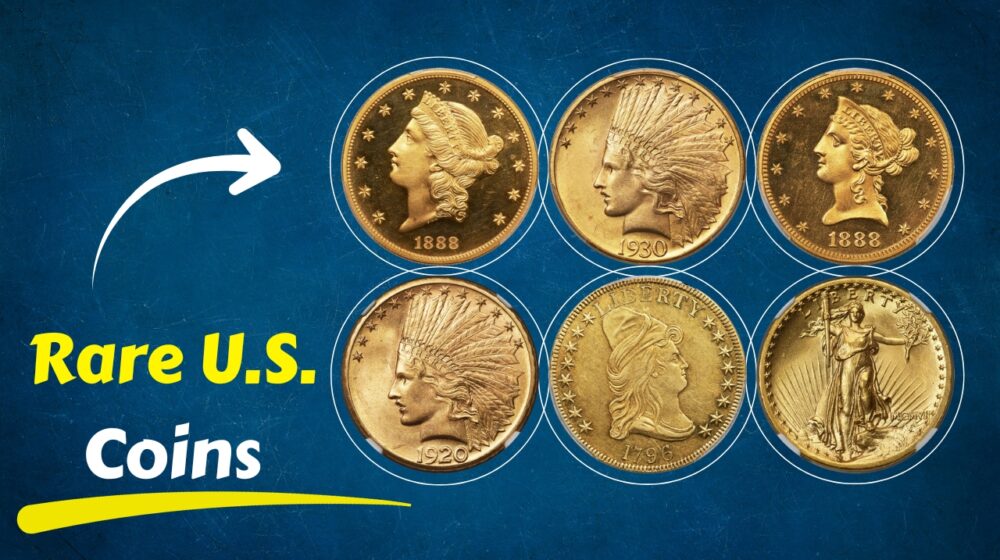
Five U.S. coins individually crossed the seven-figure mark, a concentration of million-dollar results rarely seen even at the top end of the rare coin market. The session drew heavily from two marquee collections the Bob R. Simpson Collection and the Harry W. Bass Jr. Core Collection whose pedigrees added significant weight to several of the week’s headline prices.
Auction Results at a Glance
| Coin | Grade | Pedigree/Notes | Hammer Price |
|---|---|---|---|
| 1879 Liberty Head Quintuple Stella (Judd-1643, Pollock-1843) | PCGS PR64+ Deep Cameo | Bob R. Simpson Collection; ex Virgil Brand; one of five traced | $2,562,000 (new auction record) |
| 1879 Coiled Hair Stella (Judd-1638) | NGC PR67 Cameo | One of 14 traced; tied for finest certified; 100 Greatest U.S. Coins | $1,891,000 |
| 1824/1 Capped Head Left Quarter Eagle | PCGS PR67 | Harry W. Bass Jr. Core Collection; only certified proof example | $1,494,500 |
| 1876 Liberty Double Eagle pattern (Judd-1490) | PCGS PR64+ Cameo, CAC | Bob R. Simpson Collection; unique; first auction appearance since 1980s | $1,403,000 (auction record) |
| 1880 Coiled Hair Stella (Judd-1660) | PCGS PR64 Cameo | Ten examples traced | $1,189,500 |
| 1897-S Liberty Double Eagle | PCGS MS67, CAC | Ex Eliasberg; finest known; traced to 1897 Mint purchase | $390,400 (new record; prior record $60,375 in 2005) |
| 1797 Small Eagle Half Eagle, 16 stars | PCGS AU58+ | Unique; variety not identified until 1972 | $317,200 |
| 1884 Liberty Double Eagle | NGC PR64 Cameo | Only 71 proofs struck; no circulation strikes that year; est. 20–24 survivors | $268,400 (new record) |
| 1860-O Seated Liberty Half Dollar indented by half dime planchet (with matching half dime) | Paired since striking at New Orleans Mint, 1860 | $219,600 | |
| 1914 Lincoln Cent | PCGS PR68+ Red, CAC | Bolt Collection of Proof Lincoln Cents; only PR68+ graded | $195,200 (new record; prior record $126,500 in 2008) |
Prices shown are hammer/realized totals as reported by Heritage Auctions. Dates, mintages, and composition details for each coin type are addressed individually in the historical background sections below, where Mint-era production figures are known.
How Heritage’s Auction Process Works
These results were achieved through Heritage Auctions’ Signature Auction format rather than a fixed-price retail sale, so there is no order window, mintage limit, or set price in the way a new Mint product would have. For collectors interested in participating in a future Heritage sale whether pursuing coins from this same series or similar rarities the general process runs as follows:
- Registration. Bidders must create a free Heritage Auctions account and register for the specific auction (or Heritage’s platform broadly) before placing bids, whether bidding live, by phone, by mail, or online.
- Preview period. Major lots, including all of the coins listed above, are typically posted online with full-resolution photography and cataloging weeks ahead of the sale, and are often available for in-person inspection at pre-auction viewings.
- Bidding formats. Heritage accepts internet (live proxy) bidding, phone bidding for high-value lots, mail bids, and in-person floor bidding during the live session.
- Buyer’s premium. As with most major auction houses, the “hammer price” reported publicly is generally exclusive of the buyer’s premium, which is added on top of the winning bid and varies by sale.
- Settlement. Winning bidders are invoiced after the sale closes and must complete payment within the timeframe specified in Heritage’s terms before the lot ships or can be picked up.
- Future opportunities. Collectors interested in comparable material should watch Heritage’s upcoming Signature Auction calendar, since major pedigreed collections such as the Simpson and Bass holdings featured in this sale are often dispersed across multiple auction events rather than a single sale.
Because this article covers a completed auction rather than a new product release, there is no ongoing “order window” or purchase limit to report; any of these specific coins would now need to be pursued through private treaty sale or a future consignment, not a repeat public offering at these terms.
Historical Background by Coin
The 1879 Liberty Head Quintuple Stella The Record-Setter
The stella pattern series originated in the late 1870s as an experimental U.S. coinage concept intended to ease international trade by aligning American gold coinage with European metric gold standards, particularly the French-led Latin Monetary Union. The familiar $4 stella patterns of 1879 and 1880 are the best-known products of that effort, but the Quintuple Stella struck at five times the gold weight of the $4 piece is a far rarer companion pattern, sometimes referred to informally as the “metric double eagle” for its relationship to the $20 denomination. Only five examples of the 1879 Liberty Head Quintuple Stella (Judd-1643, Pollock-1843) are known to survive, one of which resides permanently in the Smithsonian Institution’s National Numismatic Collection. The record example sold at this Heritage sale carries additional historical weight through its prior ownership by Virgil Brand, one of the most significant American coin collectors of the early 20th century, and its more recent inclusion in the Bob R. Simpson Collection.
The 1879 Coiled Hair Stella
A design variant within the same $4 stella experiment, the Coiled Hair Stella replaced the more commonly seen Flowing Hair portrait with a tighter, coiled hairstyle. Fourteen examples of the 1879 Coiled Hair Stella (Judd-1638) are traced today, and the coin sold in this auction is tied for the finest known certified example. Its significance within American numismatics is underscored by its inclusion in the widely referenced “100 Greatest U.S. Coins” listing, a status that consistently drives strong demand whenever an example reaches the market.
The 1824/1 Capped Head Left Quarter Eagle
This quarter eagle overdate variety struck from a die where an 1824 date was punched over an earlier 1 represents one of the more elusive proof issues in early U.S. gold coinage. Only two proof examples of the 1824/1 have ever been confirmed to exist: the piece sold at this Heritage auction, pedigreed to the Harry W. Bass Jr. Core Collection, and a second example held by the Smithsonian Institution. Notably, the Heritage example stands as the only proof of this variety certified by either of the two major third-party grading services, giving it a unique status among specialists in early U.S. gold.
The 1876 Liberty Double Eagle Pattern
Also from the Bob R. Simpson Collection, this unique 1876 pattern (Judd-1490) reflects the same era of experimentation in U.S. gold coin design that produced the stella series, though on the $20 double eagle denomination rather than the $4 piece. As a unique pattern with only three total auction appearances on record and none since the 1980s prior to this sale its reappearance on the market was treated as a significant event among pattern specialists, and it went on to establish a new auction record for the type.
The 1880 Coiled Hair Stella
A later-dated counterpart to the 1879 Coiled Hair Stella, the 1880 issue (Judd-1660) is similarly scarce, with ten examples traced across all known survivors. Like its 1879 counterpart, it belongs to the broader stella pattern series born from the Mint’s short-lived push toward an internationally compatible gold coinage standard.
The 1897-S Liberty Double Eagle
Unlike the patterns above, the 1897-S is a regular-issue circulation double eagle from the San Francisco Mint, part of the long-running Liberty Head (Coronet) double eagle series designed by Chief Engraver James B. Longacre and struck across multiple mints for decades. What makes this particular example exceptional is its condition and pedigree: it is the finest known example of the date, previously part of the celebrated Louis E. Eliasberg Collection, and its ownership is documented back to an 1897 purchase directly from the U.S. Mint at face value. The coin has reportedly remained untouched in its late-1980s PCGS holder since certification, adding a layer of continuity to its provenance.
The 1797 Small Eagle Half Eagle, 16 Stars
Part of the early Draped Bust half eagle series, this $5 gold piece is a unique variety distinguished by its 16-star obverse arrangement a detail tied to the addition of Tennessee as the 16th state. Although the coin itself has circulated among collectors since the 1800s, numismatists did not formally identify it as a distinct die variety until 1972, illustrating how even well-known historic coins can yield new discoveries generations after they were struck.
The 1884 Liberty Double Eagle
Another Liberty Head double eagle, the 1884 issue stands out because the Philadelphia Mint struck no circulation double eagles that year at all the entire Philadelphia mintage for the date consists of just 71 proof coins produced for collectors. Research cited by Heritage places the surviving population at only 20 to 24 coins today, three of which are held in museum collections, making any appearance of the date at auction a notable event.
The 1860-O Seated Liberty Half Dollar Indented by a Half Dime Planchet
An unusual Mint error rather than a standard design issue, this piece pairs a Seated Liberty half dollar (designed by Christian Gobrecht) with a half dime planchet that became indented into it during striking at the New Orleans Mint in 1860. The two pieces have remained physically paired since the moment they were struck, offering a rare, visually striking example of a mid-19th-century minting mishap preserved intact for over 160 years.
The 1914 Lincoln Cent
Part of the Bolt Collection of Proof Lincoln Cents, this piece represents the proof-format version of Victor David Brenner’s Lincoln cent design, first introduced in 1909. Graded PCGS PR68+ Red and CAC-approved, it is the only 1914 proof cent to receive that specific grade from PCGS, making it the condition benchmark for the date in proof format.
Obverse and Reverse Design Notes
Stella patterns (1879–1880, $4 and Quintuple denominations): The Liberty Head stellas feature a female Liberty portrait with flowing hair, encircled by stars representing the states, while the Coiled Hair variant substitutes a tightly bound hairstyle for the flowing version. The reverse of the stella series centers on a large five-pointed star the design element that gives the series its name inscribed with the coin’s metric weight and fineness values reflecting its intended role in international trade.
1824/1 Capped Head Left Quarter Eagle: The obverse depicts Liberty facing left wearing a soft cap inscribed LIBERTY, with stars surrounding the portrait and the date below. The reverse carries a heraldic eagle with a shield on its breast, clutching an olive branch and arrows, encircled by UNITED STATES OF AMERICA.
1876 Liberty Double Eagle pattern: Following the established Liberty Head double eagle format, the obverse presents a left-facing Liberty portrait encircled by stars, while the pattern reverse explores design elements associated with the era’s experimental gold coinage rather than the standard heraldic eagle reverse used on circulating double eagles of the period.
1897-S and 1884 Liberty Double Eagles: Both coins carry James B. Longacre’s Liberty Head double eagle obverse, showing Liberty facing left wearing a coronet inscribed LIBERTY, surrounded by thirteen stars with the date below. The reverse depicts a heraldic eagle beneath a field of stars and rays, with UNITED STATES OF AMERICA arched above and the denomination TWENTY D. below.
1797 Small Eagle Half Eagle: The obverse shows a right-facing Draped Bust Liberty portrait with stars surrounding the design sixteen stars on this variety and the date below. The reverse carries the early “Small Eagle” motif: a comparatively delicate, perched eagle within a wreath, predating the later heraldic eagle reverse adopted across U.S. gold coinage.
1860-O Seated Liberty Half Dollar: Christian Gobrecht’s Seated Liberty design shows Liberty seated on a rock, holding a shield and liberty pole topped with a Phrygian cap, with stars encircling the figure. The reverse features a heraldic eagle with a shield, olive branch, and arrows, encircled by UNITED STATES OF AMERICA and the denomination HALF DOL.
1914 Lincoln Cent: Victor David Brenner’s obverse presents a right-facing portrait of Abraham Lincoln with LIBERTY to the left and IN GOD WE TRUST above. The reverse of this era carries the Wheat Ears design, with ONE CENT and UNITED STATES OF AMERICA framed by two stylized wheat stalks.
Why This Matters for Collectors
Million-dollar results at this concentration are unusual. Five separate coins clearing $1 million in a single sale let alone a single specialty auction week signals sustained strength at the very top of the U.S. rare coin market, not an isolated result driven by one exceptional lot.
Pedigree is driving price as much as rarity. Several of the week’s top results trace to named collections (Simpson, Bass, Eliasberg, Bolt) or historically significant prior owners (Virgil Brand). For collectors and market watchers, this reinforces how documented ownership history continues to command premiums independent of a coin’s underlying population data.
Pattern coins are commanding rarity-level respect. The dominance of stella patterns and the unique 1876 double eagle pattern among the week’s top lots highlights continued strong demand for experimental and pattern coinage material that was never intended for circulation but is increasingly valued for its role in U.S. Mint design history.
New benchmark prices reset expectations across multiple series. Records set on the 1897-S double eagle, 1884 double eagle, and 1914 Lincoln cent give owners of comparable coins finest-known or high-grade examples of the same dates updated reference points for insurance, estate planning, or future sale.
Error coins remain a distinct but valuable collecting lane. The indented 1860-O half dollar/half dime pairing shows that Mint errors, when exceptionally documented and preserved, can command results well into six figures alongside traditional rarities a reminder that error and variety collecting is not a lesser category within numismatics.
Quick-Reference Guide: Following or Pursuing Similar Rarities
- Track Heritage’s Signature Auction calendar. Major collections are frequently sold across several auction events rather than a single sale, so upcoming sessions may include related material from the same consignors.
- Register for a Heritage Auctions account early. Registration and bidder approval are required before placing bids on high-value lots, and can take time to process for first-time high-dollar bidders.
- Study the pedigree, not just the grade. For coins at this level, prior ownership (named collections, historic pedigrees) materially affects both desirability and final price research a lot’s ownership history before bidding.
- Attend or request access to pre-auction viewings. For six- and seven-figure lots, in-person or high-resolution digital inspection before bidding is standard practice among serious collectors.
- Budget for the buyer’s premium. The final cost of a winning bid will exceed the hammer price once the buyer’s premium is applied confirm the exact percentage in the auction’s terms before bidding.
- Set a firm bidding ceiling in advance. Live and proxy bidding on rarities of this caliber can move quickly; determine your maximum bid, inclusive of premium, before the session begins.
- Consult a specialist for six-figure-plus purchases. For pattern coins, unique varieties, or finest-known examples, working with a numismatic advisor or established dealer can help verify condition, authenticity, and fair market value before committing to a bid.