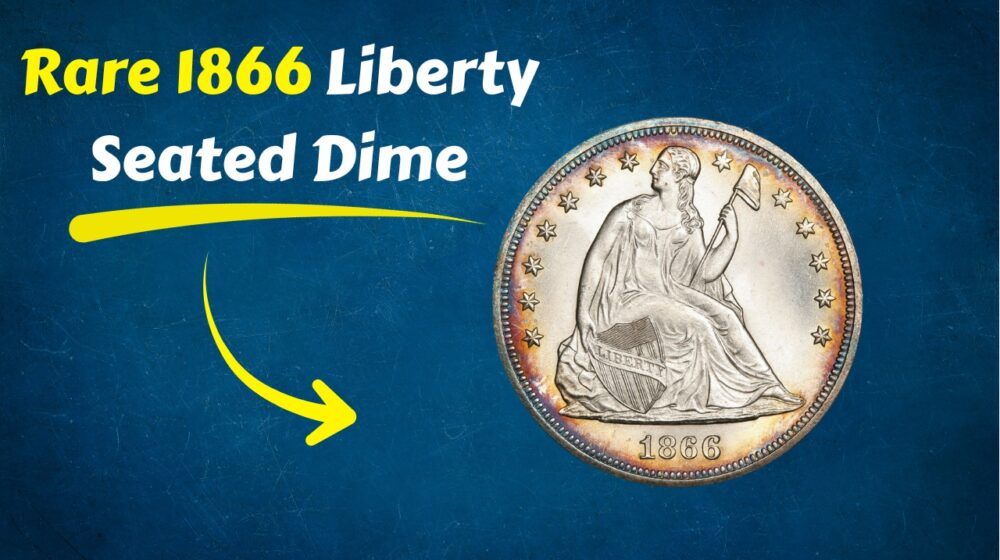
Some coins are rare because of a die error. Others are rare because a nation was too broken to strike very many of them. The 1866 Liberty Seated Dime falls firmly into the second category. The Philadelphia Mint struck its entire business-strike run of this date just 8,000 coins on a single day, January 31, 1866, at a moment when the United States was still reeling from four years of civil war, a presidential assassination, and a monetary system in disarray.
That combination of a razor-thin mintage and an extraordinary historical backdrop has turned the 1866 dime into one of the key issues of the Liberty Seated series. High-grade survivors are genuinely scarce, an unusual number of the finest known examples carry rich original toning, and the coin’s pedigree trail runs through some of the most respected collections in American numismatics. Here’s a complete look at the coin, the year that produced it, and what collectors need to know if they’re chasing one today.
Specifications at a Glance
| Category | Detail |
|---|---|
| Country | United States of America |
| Year | 1866 |
| Denomination | One Dime (10 cents) |
| Mint | Philadelphia |
| Mintmark | None |
| Business-Strike Mintage | 8,000 |
| Proof Mintage | 725 |
| Composition | 90% silver, 10% copper |
| Weight | 2.48 grams (PCGS); some period and type references list 2.49 grams |
| Diameter | 17.90 mm |
| Edge | Reeded |
| Design Type | Liberty Seated Dime, Legend Obverse (1860-type) |
| Designer | James B. Longacre (1860-type modification) |
| Design Lineage | Rooted in the earlier Gobrecht-Hughes-Sully-Peale Seated Liberty motif; Anthony C. Paquet is associated with engraving work on the cereal wreath |
| Die Marriages | F-101 (Proof only) and F-102 (Proofs and business strikes); F-102 splits into F-102a “Perfect Reverse” and F-102b “Clashed Reverse” |
| PCGS Population (as of August 25, 2026) | 111 grading events total, including 3 at MS67 and none higher |
| NGC Population (as of June 18, 2026) | 58 grading events, with 1 coin at MS68, its highest recorded grade |
| PCGS Survival Estimate | Roughly 400 survivors across all grades; about 50 in MS60 or better; only 8 in MS65 or better |
| PCGS Auction Record (business strike) | $12,650 — New York Connoisseur’s Collection example, American Numismatic Rarities, March 14, 2006 |
Because the 1866 dime is a historical issue rather than a coin currently offered through a single sale, prices vary enormously depending on grade, toning, and pedigree — the notable auction results later in this article give a much fuller picture of that range.
How Collectors Acquire an 1866 Liberty Seated Dime Today
There’s no Mint order window or fixed release schedule for a coin struck 160 years ago availability today depends entirely on the secondary market. Here’s how serious collectors typically go about finding one:
- Major auction houses. Stack’s Bowers, Heritage Auctions, and American Numismatic Rarities have all handled significant 1866 dimes in recent decades, including several of the finest known examples.
- Liberty Seated dime specialists. Because the date’s die varieties (F-101 and F-102, with its two distinct die states) matter to advanced collectors, dealers who focus specifically on Seated coinage are often the best source for well-attributed examples.
- Certified population tracking. Both PCGS and NGC maintain updated population reports for the date; checking current figures before buying helps collectors understand exactly how scarce a given grade really is.
- Pedigreed collections. Notable examples have passed through collections such as Millholland, Hansen, Gardner, Simpson, and the New England Museum coins with this kind of ownership history tend to carry premiums and are worth researching individually.
- CAC verification. Given how much upper-tier value depends on eye appeal and originality, CAC-approved examples offer collectors an added layer of quality confirmation, particularly for MS66 and better coins.
Because the finest survivors move infrequently, patience is often the most important tool for anyone targeting a premium 1866 dime top-tier coins can go years between public sales.
Historical Background
A Nation in Crisis
To understand why the Philadelphia Mint struck so few dimes in 1866, it helps to understand the state of the country at that moment. Robert E. Lee’s surrender to Ulysses S. Grant at Appomattox Court House on April 9, 1865, is often remembered as the war’s end, though scattered Confederate military activity continued afterward. Just days later, on April 14, John Wilkes Booth shot President Abraham Lincoln at Ford’s Theatre; Lincoln died the next morning, removing the leader who had already begun turning toward postwar reconciliation.
The war’s human toll remains an area of active historical research. Earlier demographic estimates placed Civil War deaths near 750,000, with a range of roughly 650,000 to 850,000. More recent research, published in 2024 using full-count census records rather than earlier sampling methods, narrowed that estimate to around 698,000 deaths, with an interval of approximately 647,000 to 749,000. Economically, the South lost roughly two-thirds of its assessed wealth during the war a figure driven not only by physical destruction of railroads, farms, and infrastructure, but also by the abolition of slavery, which removed enslaved people from prewar property valuations entirely.

A Currency System in Disarray
The nation’s money supply was in nearly as much disorder as its physical infrastructure. Congress had authorized Legal Tender Notes, commonly called greenbacks, to help fund the war effort. Unlike gold or silver coin, greenbacks did not convert to specie on demand, and their market value fluctuated relative to coin. More than $400 million in greenbacks remained in circulation during 1866, with a March 1866 financial report placing the total above $423 million. As a result, Americans had grown accustomed to treating gold and silver coins as more valuable than paper money, and precious-metal coinage had largely vanished from everyday transactions.
Treasury Secretary Hugh McCulloch hoped to retire greenbacks and steer the country back toward specie payments, but that transition would take years, not months. In the meantime, the Philadelphia Mint split its attention unevenly: it produced large volumes of low-value base-metal coinage for domestic commerce while also striking 698,745 Liberty Head Double Eagles worth nearly $14 million at face value to satisfy continued demand for gold in banking and international trade. The Mint also introduced an entirely new denomination that year, the copper-nickel Shield Nickel, authorized by Congress on May 16, 1866, which would eventually replace the smaller silver half dime (though half dime production continued through 1873).
Against that backdrop, silver dimes simply weren’t a priority. Philadelphia struck 744,900 half dollars in 1866 a substantial number by comparison while devoting only a single day of production to the dime denomination.
The Legend Obverse Design and James B. Longacre
The design itself predates 1866 by six years. Chief Engraver James B. Longacre introduced the Legend Obverse version of the Liberty Seated design in 1860, reworking the original Seated Liberty concept associated with Christian Gobrecht, Robert Ball Hughes, Thomas Sully, and Titian Peale decades earlier. Longacre’s update added the “UNITED STATES OF AMERICA” legend around the coin’s border, a design choice that carried through unchanged into the 1866 issue. PCGS credits Longacre as the designer of record for the type, while acknowledging the deeper design lineage tracing back to the original Seated Liberty concept.
A Notable Absence: No “IN GOD WE TRUST”
1866 was also the year the Mint began adding the motto “IN GOD WE TRUST” to gold and silver coinage, starting January 1 of that year. The dime, however, was left out of that change Mint officials at the time considered the denomination too small to accommodate the additional lettering. That detail makes the 1866 dime a small but interesting exception among the silver and gold coinage of its year, retaining its existing design while its larger silver counterparts adopted the new motto.
One Die Marriage, Two Die States
Liberty Seated dime specialist Gerry Fortin has identified two principal die marriages associated with the 1866 date: F-101, used exclusively for Proof production, and F-102, which produced both Proof and business-strike coins. That means every known 1866 business strike traces back to the single F-102 marriage. During the one-day production run, however, the obverse and reverse dies clashed together without a planchet between them at some point, transferring faint elements of each design into the opposing die. As a result, collectors recognize two distinct F-102 die states: F-102a, known as the “Perfect Reverse,” and F-102b, the “Clashed Reverse.” While F-102a is generally considered slightly more available overall, F-102b examples currently dominate the upper end of the PCGS Condition Census.
Description of the Obverse and Reverse
Obverse
Liberty is shown seated on a rock, her head turned toward her right shoulder, draped in flowing robes. In her left hand she holds a pole topped with a Phrygian cap, a classical symbol of liberty and emancipation, while her right hand steadies a Union shield wrapped with a ribbon bearing the word “LIBERTY.” The legend “UNITED STATES OF AMERICA” arcs around the upper rim, with the date “1866” resting beneath Liberty’s seated figure, all framed by a border of denticles. This is the Legend Obverse variant that Longacre introduced in 1860, distinguishing it from earlier Seated Liberty dimes that lacked the surrounding national legend.
Reverse
At the center of the reverse sits the denomination “ONE DIME,” encircled by a cereal wreath composed of corn, wheat, maple leaves, and oak leaves, joined at the bottom by a ribbon. A ring of denticles frames the coin’s border. This wreath design is more varied and detailed than it’s sometimes given credit for earlier, looser descriptions characterizing it simply as a “wreath of wheat” undersell the mix of agricultural elements actually present in the design.
Edge
The 1866 Liberty Seated Dime has a reeded edge, consistent with the rest of the series.
Notable High-Grade Examples and Auction Histor
The upper end of the 1866 dime market is defined almost as much by toning as by grade. Many condition-census pieces display rich blue, green, violet, gold, or russet patina, while a handful of coins stand out for their bright, frosty originality. Notable public sales include:
- PCGS MS67, Millholland Collection — Previously unknown to the market, this coin emerged from the estate of James Allaire Millholland (1842–1911) after being held privately for 112 years. Stack’s Bowers sold it on March 21, 2023, as Lot 3003, for $7,200; PCGS attributes it to F-102b and describes olive, gold, and russet toning.
- PCGS MS67, Dell Loy Hansen Collection — A brilliant, frosty F-102b example that stands in visual contrast to the heavily toned coins that otherwise dominate the condition census.
- PCGS MS67, “Nic’s 1866 Philly Mint Set” — A third coin at the MS67 level, bringing the PCGS population at that grade to three grading events with none higher.
- PCGS MS66+ CAC — This coin’s auction trail includes an NGC MS66 appearance at Heritage on December 16, 2021 (Lot 3049, $3,960) and a PCGS MS66+ CAC appearance at Heritage on June 18, 2021 (Lot 3411, $5,160); PCGS describes plum and red-gold toning around champagne centers.
- PCGS MS66, New England Museum — Sold by Stack’s Bowers on May 9, 2013, as Lot 207, for $12,925, showing antique olive, blue, and red toning.
- PCGS MS66 CAC, Bob R. Simpson Collection — Sold by Heritage on September 23, 2010, as Lot 3668, for $6,325, distinguished by lavender and seafoam-green toning.
- PCGS MS66, New York Connoisseur’s Collection — Sold by American Numismatic Rarities on March 14, 2006, as Lot 560, for $12,650, which remains the PCGS auction record for the regular business-strike issue; PCGS describes apricot toning with deep blue and green near the borders.
Why This Matters for Collectors
- The mintage tells a genuine historical story. An 8,000-coin business-strike run, produced entirely in a single day, is a direct reflection of the economic chaos gripping the country in early 1866 this isn’t a manufactured scarcity, but a real byproduct of postwar disruption.
- High-grade survivors are exceptionally hard to find. With PCGS estimating only about 400 total survivors across all grades and just eight examples in MS65 or better, this date represents a serious condition-rarity challenge even for well-funded Seated dime collectors.
- Die-variety specialists have real material to study. With a single die marriage split into two distinguishable die states (Perfect Reverse and Clashed Reverse), the date offers genuine attribution interest beyond simple grade-chasing.
- Pedigree adds another dimension. Coins from the Millholland, Hansen, Gardner, Simpson, and New England Museum collections connect this date to some of the most respected collecting names in American numismatics.
- Toning defines the top of the market. Unlike dates where bright, untoned coins command the highest premiums, the 1866 dime’s finest survivors are often prized specifically for their rich, original color, giving the date a distinctive character at the high end.
Quick-Reference Buying Guide
- Decide which era of the coin’s story interests you most. Whether it’s the mintage rarity, the die-clash variety story, or the postwar historical context, knowing your focus will guide which specific coin and grade to pursue.
- Check current PCGS and NGC population data before buying. Population figures shift due to resubmissions and crossovers, so always confirm the latest reported totals rather than relying on older figures.
- Learn to distinguish F-102a from F-102b. If die-state attribution matters to your collecting goals, study reference photos of the Perfect Reverse versus Clashed Reverse before purchasing.
- Weigh toning against brilliance. Since many top-condition-census coins carry rich original color, decide whether you’re seeking a toned coin (the market norm at this level) or a brighter example like the Hansen specimen.
- Research recent auction results for context. Past sales ranging from around $3,960 to $12,925 for MS66-level coins, and the $7,200 result for the Millholland MS67, offer useful pricing benchmarks.
- Buy from major auction houses or Seated dime specialists. Firms like Stack’s Bowers and Heritage Auctions, along with dealers focused specifically on Liberty Seated coinage, are the most reliable sources for well-attributed examples.
- Consider CAC approval for upper-grade coins. At MS66 and above, CAC verification adds meaningful confidence around originality and quality.
- Document pedigree and certification thoroughly. Given how much of this date’s story is tied to notable past owners and specific auction appearances, keep detailed records of any provenance associated with a coin you acquire.