Great coin designs are common. Coins that carry those designs to the very summit of the modern grading scale are not. Adolph A. Weinman’s Walking Liberty Half Dollar is widely regarded as one of the most beautiful coins the United States Mint ever produced, and among its short-lived Proof series, one 1939 example has now reached the top of the population report.
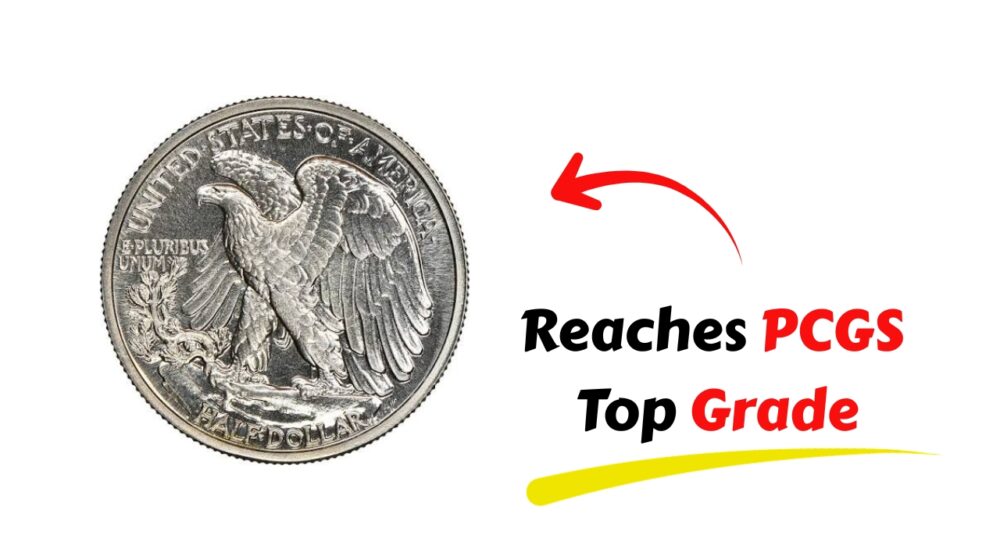
Stack’s Bowers Galleries offered the coin as Lot 2103 in its Summer 2026 Global Showcase Auction, part of the Session 2 Rarities Night lineup. Graded Proof-68+ by PCGS and approved by CAC, the coin sold for $20,740. PCGS has certified only seven 1939 Proof Walking Liberty Half Dollars at this grade, and none higher meaning this coin sits, quite literally, at the ceiling of what collectors can currently obtain for the date. Beyond the technical grade, Stack’s Bowers describes rich, original color across the surfaces, giving the coin both condition-rarity credentials and strong visual appeal, a combination that tends to draw serious attention from advanced Walking Liberty specialists.
Specifications at a Glance
| Detail | Description |
|---|---|
| Country | United States |
| Year | 1939 |
| Denomination | Half Dollar |
| Mint | Philadelphia |
| Mintmark | None |
| Mintage (Proof) | 8,808 |
| Finish | Proof |
| Designer | Adolph A. Weinman |
| Composition | 90% silver, 10% copper |
| Weight | 12.50 grams |
| Diameter | Approx. 30.6 mm (PCGS lists 30.00 mm) |
| Edge | Reeded |
| PCGS Number | 6639 |
| NGC Universal ID | 27V7 |
| Grade | PCGS Proof-68+ |
| Approval | CAC |
| Auction | Stack’s Bowers Summer 2026 Global Showcase Auction |
| Session | Session 2 – Rarities Night |
| Lot Number | 2103 |
| Result | $20,740 |
| Prior Auction Record (issue) | $40,800 (Heritage Auctions, April 2020, PCGS Proof-68+) |
How This Coin Reached the Market: The Auction Process
This coin did not come from a Mint order form with a published release date or household purchase limit it is an 87-year-old Proof coin that resurfaced through the numismatic secondary market. Understanding that process is useful for collectors hoping to compete for something similar.
- Venue: Stack’s Bowers Galleries, a leading auction house for U.S. numismatic rarities, handled the sale.
- Session placement: The coin was placed in Session 2, Rarities Night the portion of a major sale reserved for the auction’s most significant lots.
- Lot number: Lot 2103.
- Cataloging: Stack’s Bowers detailed the coin’s toning, strike, and population standing, drawing on current PCGS and CAC census data current as of early August 2026.
- Result: The coin brought $20,740, a figure well below the issue’s standing $40,800 auction record but still reflective of its top-of-census status.
- Grading and approval: The coin carries a PCGS Proof-68+ grade the highest grade PCGS has awarded any 1939 Proof Walking Liberty Half Dollar along with CAC’s green-sticker approval, confirming the coin is solid, and arguably better than average, for its assigned grade.
For collectors interested in acquiring a comparable coin, there is no fixed retail “order window.” Because Proof-68+ examples of this date are so scarce, availability depends entirely on when an owner chooses to consign a piece and when a major auction house schedules an appropriate sale sometimes years apart.
Historical Background
The Walking Liberty Half Dollar Design
Adolph A. Weinman designed the Walking Liberty Half Dollar for its debut in 1916, replacing the half dollar design Charles E. Barber had produced since 1892. Weinman was one of the most accomplished sculptors working in American coinage at the time, and in the same year he also created the “Mercury” dime, giving 1916 an outsized legacy in U.S. coin design history. The Walking Liberty design proved so enduringly popular that the Mint later revived its obverse for the American Silver Eagle bullion coin decades later, cementing Weinman’s Liberty as one of the most recognized images in American numismatics.
The Proof Series and the Mint’s Return to Collector Coinage
Regular annual Proof coin production had ended after 1916, and for nearly twenty years collectors had no way to order fresh Proof coinage directly from the Mint. That changed in 1936, when Mint Director Nellie Tayloe Ross revived and expanded the Proof program. The Philadelphia Mint responded by striking Proof Walking Liberty Half Dollars from 1936 through 1942, creating a short, tightly bounded series that requires only seven dates to complete.
The 1939 issue falls at the midpoint of that run. Philadelphia struck 8,808 Proof half dollars that year, only slightly more than the 8,152 struck in 1938. Despite their similar mintages, the two dates diverged sharply in how well they survived. Collectors appear to have set aside 1939 Proofs with unusual care, and both PCGS and CAC note that the date turns up in superb condition more often than one might expect from its mintage alone. As a result, examples in Proof-64 through Proof-67 are reasonably attainable, and even Proof-68 coins appear at auction with some regularity. Above that level, however, supply tightens dramatically a dynamic that sets up the significance of a Proof-68+ coin like the one sold in this sale.
Obverse and Reverse Design Details
Obverse
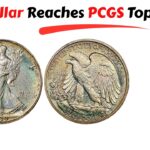
The obverse depicts Liberty walking confidently toward a rising sun, her body angled forward in a pose that conveys motion and forward momentum. Her right hand reaches outward, as if extending toward the future, while her left arm cradles branches of laurel and oak, symbolizing civil and military accomplishment. Behind her, the folds of an American flag stream in the wind, wrapping around her figure and reinforcing the sense of movement across the coin’s field. On a Proof strike such as this one, those design elements take on unusual sharpness: the fine lines of the gown, the individual folds of the flag, and the texture of Liberty’s hair all show crisp, fully struck detail rarely seen on circulation-strike examples.
Reverse
The reverse presents a powerful eagle perched on a rocky outcropping, wings partially raised as if preparing for flight. A sprig of mountain pine grows from a crevice in the rock beside the eagle, a pairing meant to suggest resilience and independence enduring in a rugged landscape. As with the obverse, the Proof finish sharpens every element of the design individual feathers on the eagle’s wings and breast, the texture of the rocky perch, and the needles of the pine sprig all render with a clarity that distinguishes Proof coinage from ordinary business strikes.
Finish and Surface Character
Beyond the sharpness of Weinman’s design, Stack’s Bowers describes this specific coin as an upper-end “Ultra Gem” with exceptional eye appeal. Warm sandy-gold toning covers the surfaces, joined by accents of powder-blue and rose-russet iridescence. The strike itself carries full, crisp detail from the rims all the way into the central devices, with no evidence of weakness. That is a meaningful distinction: many technically high-graded Proof coins are visually plain, while others display attractive color but fall short on strike or preservation. This coin combines all four qualities color, strike, surface preservation, and top-tier grade in a single piece, which is part of why its PCGS Proof-68+ designation tells only part of the story.
Why This Coin Is a Major Condition Rarity
Mintage alone does not make the 1939 Proof Walking Liberty Half Dollar the scarcest date in its series; the 1936 issue holds that distinction on paper. Condition, however, tells a different story.
As of early August 2026, PCGS’s population report showed only seven coins graded Proof-68+ across the entire 1939 Proof Walking Liberty Half Dollar issue, with none graded higher. An additional 75 coins stood at the Proof-68 level. Because population reports can include coins resubmitted for grading more than once, these numbers do not necessarily represent 75 or seven distinct physical coins but they still illustrate just how difficult it is for a coin of this date to reach the Plus-graded top tier.
CAC’s records add a similar picture from a different angle. At the time Stack’s Bowers prepared its auction description, CAC’s Stickered Population for combined Proof-68 and Proof-68+ examples stood at 27, with none higher; CAC’s live database has since shown that combined total rise to 28. Either way, the message is consistent: coins at this level are rare occurrences, not routine auction appearances.
Why This Matters for Collectors
- Top of the census: With PCGS grading no 1939 Proof Walking Liberty Half Dollar higher than Proof-68+, this coin represents the technical ceiling for the date there is no higher numerical grade to chase.
- A short, popular series: Because the Proof Walking Liberty series spans only seven dates (1936–1942), collectors pursuing a complete set have strong incentive to seek out the finest available example of each date, and 1939 is no exception.
- Rarity independent of mintage: The coin demonstrates how condition rarity can matter as much as, or more than, original mintage figures the 1939 issue is not the lowest-mintage Proof Walker, yet it is exceptionally hard to find at this grade.
- CAC approval: A CAC sticker confirms that a panel of expert graders considers the coin to be solid, or better, for its assigned grade, adding a layer of confidence beyond the PCGS holder alone.
- Documented market benchmark: With a standing $40,800 auction record set by a PCGS Proof-68+ example at Heritage Auctions in April 2020, and this coin’s own $20,740 result, collectors now have two market data points for gauging value at the top of the census.
- Combination of eye appeal and grade: Attractive, original sandy-gold, powder-blue, and rose-russet toning gives the coin strong visual character in addition to its numerical grade a combination advanced collectors specifically seek out, since grade alone does not guarantee an attractive coin.
Quick-Reference Buying Guide
For collectors interested in pursuing a 1939 Proof Walking Liberty Half Dollar whether a more accessible Gem example or a top-population Proof-68+ coin like this one the following steps offer a practical roadmap.
- Set your target grade and budget. Proof-64 through Proof-67 examples are attainable with normal auction and dealer searching; Proof-68 coins appear regularly but at a premium; Proof-68+ coins are extreme rarities that command outsized prices when they do surface.
- Understand the population reports. Check current PCGS and CAC population data before bidding, and remember that population figures can reflect resubmissions rather than unique coins always confirm the specific certification number of the coin you’re considering.
- Look for CAC approval. A CAC sticker adds an independent check on grade quality and can meaningfully affect both price and desirability, particularly at the Proof-68 and Proof-68+ levels.
- Study the coin’s color and strike, not just its grade. Since two coins can share the same numerical grade while looking very different, review high-resolution auction images (or view the coin in hand) for originality of toning and completeness of strike.
- Track major auction calendars. Coins at this level typically appear through firms such as Stack’s Bowers or Heritage Auctions during marquee sales, often in a Rarities Night session watch for upcoming Global Showcase or platinum-level auctions.
- Benchmark against past results. Compare any coin under consideration to prior sales, such as the $40,800 record set in 2020 and the $20,740 result for this coin, to gauge a reasonable bidding range.
- Verify the full holder details. Confirm the PCGS or NGC certification number, grade, Plus or Star designations, and CAC status directly against the grading services’ online verification tools before bidding.
- Consider working with a specialist dealer. For high-end Proof Walking Liberty coins, an experienced numismatic advisor can help evaluate condition, originality, and fair market value, particularly when bidding against other advanced collectors for a top-population coin.
This article is intended for informational purposes and reflects publicly reported auction results and population data current as of the sale discussed. Prices realized at auction, as well as PCGS and CAC population figures, can change over time.