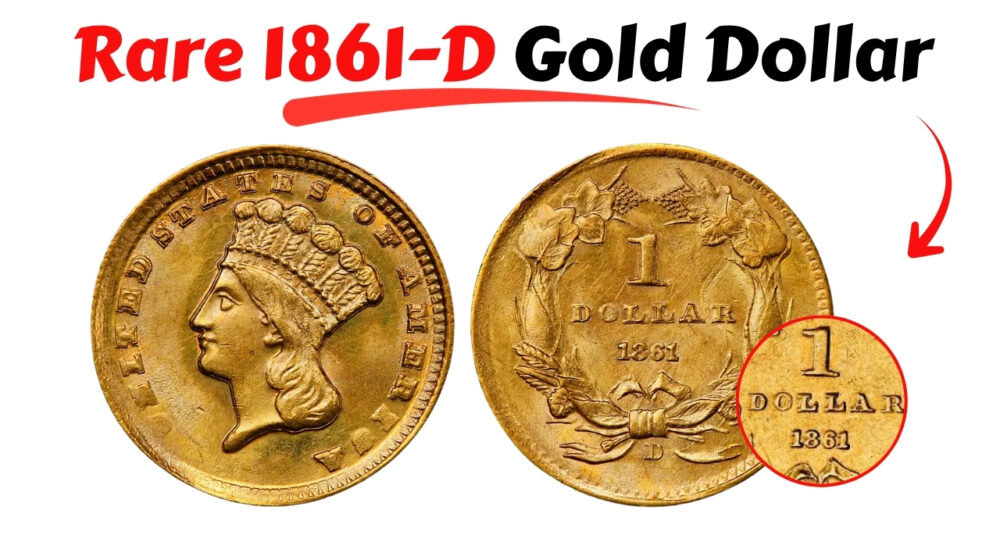
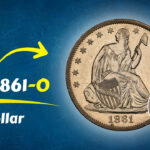
Some coins carry Civil War-era dates. The 1861-D Gold Dollar carries something far stranger: a United States design, struck with United States dies, on United States minting machinery under a government actively at war with the United States. By the time workers at the Dahlonega Branch Mint in Georgia pressed these tiny gold dollars into existence, the facility no longer answered to Washington. It answered to Richmond.
That makes the 1861-D unique among regular-issue U.S. coinage. Other Southern branch mints New Orleans among them struck coins both before and after Confederate authorities took control, so a given date from those mints could theoretically trace to either government. The 1861-D Gold Dollar offers no such ambiguity: Dahlonega had never struck a gold dollar dated 1861 before the Confederacy took over the mint, so every genuine example was made entirely under Confederate authority. Few coins in American numismatics capture a specific historical moment as precisely as this one.
This guide covers everything a collector needs to know: the coin’s specifications, how the buying process works on today’s market, the remarkable history of how a U.S. Mint changed hands, its design and diagnostics, the sophisticated counterfeits collectors need to watch for, and current auction benchmarks for the series.
Specifications at a Glance
| Detail | Information |
|---|---|
| Denomination | One Dollar (Gold Dollar) |
| Date/Mintmark | 1861-D |
| Mint | Dahlonega, Georgia |
| Design type | Type 3 Gold Dollar, Large Head / Indian Princess |
| Designer | James Barton Longacre, U.S. Mint Chief Engraver |
| Composition | 90% gold, 10% copper |
| Weight | 1.672 grams |
| Actual gold weight | Approx. 0.04838 troy oz |
| Diameter | Approx. 15 mm |
| Edge | Reeded |
| Known die marriage | Winter 12-Q (the only one identified for this issue) |
| Mintage | Unknown/unrecorded; commonly estimated at 1,000–1,500 pieces |
| Estimated survivors | Roughly 65–75 in all grades (Doug Winter estimate); perhaps 10–15 in Mint State |
| Strike period | Spring 1861, generally placed in May |
| Issuing authority | Confederate States of America |
| Auction record | $180,000 (PCGS MS64+, Bob R. Simpson Collection, Heritage, September 2020; matched by a PCGS MS63 CAC example at Heritage, May 2023) |
| Recent circulated benchmarks | PCGS AU58: $102,000 (Stack’s Bowers, Nov. 2024) and $96,000 (Heritage, Aug. 2025); PCGS AU55: $88,450 (Jan. 2026) |
Because mintage records from the Confederate period never survived, no official production figure exists every number above reflects specialist estimation rather than a documented Mint report.
How Collectors Buy This Coin Today
There is, obviously, no current “order window” for an 1861-D Gold Dollar the Confederate authorities who struck it shut Dahlonega down as a coining facility within weeks of production, and no comparable coin has been made since. Collectors pursue this issue entirely through the established rare coin market, and given both its price level and its counterfeit risk, the buying process deserves real care.
Where to buy. Major auction houses with strong Southern gold and Confederate-era specialties Heritage Auctions and Stack’s Bowers Galleries chief among them have handled essentially every significant 1861-D sale of the past two decades, including the finest known examples. Specialist dealers in Dahlonega and branch-mint gold, such as Doug Winter, are another critical resource given how much expertise this issue demands.
Certification is not optional. Given the enormous price gap between a genuine 1861-D and a common 1861 Philadelphia gold dollar with an altered mintmark, buying only PCGS- or NGC-certified examples is essential. Even then, collectors should understand the specific 12-Q die diagnostics discussed below rather than relying on certification alone, since recognizing genuine characteristics helps buyers evaluate photos, auction descriptions, and even certified holders with informed eyes.
Pricing has moved sharply upward. Even circulated examples now command prices that would have seemed extraordinary a generation ago. What once might have been estimated at $15,000–$20,000 for an About Uncirculated example now regularly brings well over $80,000, with recent AU58 sales at $102,000 and $96,000, and an AU55 realizing $88,450 in January 2026. Mint State examples occupy a different tier entirely, topped by the $180,000 auction record.
Condition and originality both matter enormously. Because many surviving 1861-D Gold Dollars were saved as Civil War keepsakes and later converted into jewelry, or later cleaned to improve their appearance, originality carries a real premium on this issue. A technically higher numeric grade on a coin with disguised repairs may be worth less to an informed buyer than a lower-graded coin with clean, honest surfaces.
Registering and bidding. As with any high-value certified-coin auction, serious bidders should register with the auction house in advance, and for a coin at this price level, discussing financing, authentication questions, or condition concerns directly with the auction house’s specialists before bidding is standard practice rather than an unusual step.
No purchase limits just genuine scarcity. There’s no modern cap on how many a collector can buy; the real constraint is that perhaps only 65 to 75 genuine examples survive across all grades, and the finest pieces trade infrequently among a small group of advanced Southern gold specialists.
Historical Background: A Mint That Changed Allegiance
Dahlonega Before the Confederacy
Congress established the Dahlonega Branch Mint in response to Georgia’s gold rush, which created demand for a Federal minting facility near the Southern gold fields. The mint began striking coins in 1838 and, throughout its operating life, produced gold coinage exclusively. Its “D” mintmark identifies Dahlonega not to be confused with Denver, which didn’t begin striking coins until decades later.
The Dies Arrive, Then the State Secedes
The chain of events that produced the 1861-D reads almost like a historical accident. On December 10, 1860, the Philadelphia Mint shipped two 1861-dated gold dollar reverse dies to Dahlonega; the branch mint received them on January 7, 1861. Just twelve days later, on January 19, Georgia seceded from the Union. A Federal mint, stocked with Federal equipment and freshly arrived Federal dies, suddenly sat inside a state that no longer recognized itself as part of the United States.
The Confederacy Takes Control
On March 9, 1861, the Confederate Congress passed a resolution directing that operations continue at both the New Orleans and Dahlonega mints, and instructed officials to arrange for dies to support future Confederate coinage a decision documented directly in surviving Confederate legislative records. Georgia authorities had already moved to secure Federal property within the state, and on April 8, 1861, the Dahlonega Mint formally passed out of Federal control. Mint Superintendent George Kellogg later informed President Abraham Lincoln that Georgia had transferred U.S. public property to the Confederate government.
One detail often lost in popular retellings deserves emphasis: Confederate soldiers did not storm the coining room and seize the machinery from Federal operators. The existing Dahlonega mint employees largely stayed in their positions, continuing to run the same equipment — only now under a different government’s authority. The people, the machinery, the dies, and the design all remained the same. Only the governing authority had changed, which is precisely what makes the 1861-D such a uniquely layered historical artifact.
A Short, Final Chapter
Dahlonega’s Confederate-era production didn’t last long. Officials closed the facility as a coining mint in June 1861, just weeks after the gold dollar strikes, and converted it into an assay office that summer. The Dahlonega Mint never struck another coin after that. The 1861-D Gold Dollar therefore represents one of the final acts of coinage from a mint whose operational life, remarkably, ended under a government other than the one that built it.
Distinguishing the Gold Dollar From Other 1861-D Coinage
It’s worth noting that Dahlonega’s 1861-D Half Eagle presents a genuinely different situation: the branch mint had already struck 1,597 half eagles dated 1861 before the Confederate takeover, with additional half eagles struck afterward under Confederate authority. That means collectors cannot look at an 1861-D Half Eagle and automatically know whether Federal or Confederate hands produced it. The gold dollar carries no such ambiguity Dahlonega struck no 1861-dated gold dollars before Confederate control began, so every genuine example dates entirely to the Confederate period.
Obverse and Reverse: The Design Itself
The 1861-D uses the Type 3 Gold Dollar design, commonly called the Large Head or Indian Princess type, created by U.S. Mint Chief Engraver James Barton Longacre.
Obverse. Liberty’s portrait dominates the design, wearing a feathered headdress reminiscent of Native American imagery the source of the type’s popular “Indian Princess” nickname, though the figure represents an allegorical Liberty rather than a specific individual. The legend UNITED STATES OF AMERICA surrounds the portrait, with the date positioned below.
Reverse. The reverse carries the denomination and date within a wreath, following the standard Type 3 Gold Dollar reverse format used across the design’s production run at all mints.
The specific dies behind the 1861-D. What makes this particular issue diagnostically distinct is the single known die marriage used to strike it: Winter 12-Q. Dahlonega workers paired an obverse die already used to strike 1860-D Gold Dollars with one of the two newly delivered 1861 reverse dies the second reverse die from that December 1860 shipment has never been found on any surviving coin. Because the obverse die was already worn from prior use, and Dahlonega’s overall production quality never matched Philadelphia’s, genuine 1861-D Gold Dollars look noticeably less sharp than their Philadelphia counterparts.
Authentication: What Genuine 1861-D Diagnostics Look Like
Because only one die marriage exists for this issue, specialists have built a detailed diagnostic profile collectors can check against:
| Feature | Genuine 12-Q Characteristic |
|---|---|
| Obverse die | Same die previously used for the 1860-D Gold Dollar |
| U in UNITED | Characteristically weak; sometimes nearly or fully lost |
| N in UNITED | Usually weak |
| I and C in AMERICA | May also show weakness |
| Liberty’s hair and plumes | Usually incompletely defined |
| Date | Small, positioned somewhat to the left |
| First “1” in 1861 | Sits beneath the left portion of the first L in DOLLAR |
| D mintmark | Small, positioned high in the field, noticeably tilted right |
| Mintmark position | Very close to the right ribbon end |
| Obverse border | Left side typically weaker than the right |
| Reverse periphery | Often weak; die polishing affects parts of the wreath and ribbon |
| Die clashes | Some genuine examples show clash marks at the centers |
Collectors should weigh these characteristics together rather than relying on any single feature. A notable PCGS AU58 that Heritage sold for $96,000 in August 2025 actually displayed a better-than-usual strike, including a fully outlined U in UNITED proof that a clear U doesn’t automatically disqualify a coin, since authentication depends on the complete die pattern rather than any one diagnostic point in isolation.
The Danger of Altered-Mintmark Counterfeits
The enormous price gap between a common 1861 Philadelphia Gold Dollar and a genuine 1861-D creates a clear financial incentive for fraud and counterfeiters don’t need to fabricate an entire coin to exploit it. Instead, a fraudster can start with a genuine 1861 Philadelphia gold dollar and add a fake D mintmark.
NGC has documented exactly this type of alteration on a submitted coin: the added D showed malformed, shortened serifs, with dark purple material apparently used to disguise the point where the fake mintmark met the coin’s surface, alongside cleaning hairlines in the surrounding field. This is precisely why position and shape matter so much a genuine 1861-D mintmark sits small, high, tilted to the right, and very close to the right ribbon end, matching the specific 12-Q die. Simply confirming that “a D exists” on a coin proves nothing; the mintmark’s exact position and form must match the known genuine die characteristics.
Jewelry Damage and Surface Doctoring
A meaningful share of surviving 1861-D Gold Dollars carry damage from a very human cause: people recognized these coins as unusual Civil War artifacts almost immediately, and some saved them as keepsakes occasionally by turning them into jewelry. Auction archives document examples with removed mounts, filed rims, smoothing, and reconstructed fields. NGC specifically warns collectors to watch for expertly repaired pieces for this reason.
Collectors should examine the entire rim under magnification for flat areas, filing, solder traces, or disturbed reeding that might indicate a former mount, along with any unnaturally smooth patch in the field where normal mint texture and flow lines should not simply vanish. A repaired coin isn’t necessarily counterfeit the underlying coin may be entirely genuine but restoration can dramatically affect both grade and value.
Given the coin’s high value, other forms of surface doctoring are also worth watching for: mechanical cleaning that leaves parallel hairlines crossing fields and devices, “whizzing” (a rapidly rotating brush used to fake mint luster, which disrupts natural cartwheel luster and can leave raised ridges near design elements), and even added substances like putty or wax used to disguise marks all practices PCGS explicitly identifies as forms of coin doctoring collectors should watch for on valuable, heavily handled issues like this one.
The Finest Known Example and Current Market Benchmarks
For years, the numismatic community pointed to the Duke’s Creek Collection specimen, graded NGC MS65, as the finest certified 1861-D Gold Dollar. Heritage sold that coin for $138,000 in April 2006, and again for $149,500 in January 2008. The coin later crossed over to a PCGS MS64+ holder and, offered as part of the Bob R. Simpson Collection, brought $180,000 at Heritage in September 2020 a figure PCGS still lists as the issue’s auction record and the coin that currently tops its condition census. A PCGS MS63 CAC example matched that $180,000 level at Heritage in May 2023.
Circulated grades have climbed just as dramatically. A PCGS AU58 realized $102,000 at Stack’s Bowers in November 2024, another PCGS AU58 brought $96,000 at Heritage in August 2025, and a PCGS AU55 sold for $88,450 in January 2026 figures that dwarf the roughly $15,000–$20,000 estimates that once applied to About Uncirculated examples of this issue not long ago.
Why This Matters for Collectors
A coin that captures a specific historical instant. Few artifacts document the fracturing of the United States as precisely as the 1861-D Gold Dollar. It shows a country where the physical machinery of government a mint, its dies, its design hadn’t yet caught up with the political reality that had already changed around it.
Unambiguous Confederate-period origin. Unlike other Southern branch mint issues from 1861, where Federal and Confederate production can overlap within the same date, every genuine 1861-D Gold Dollar traces cleanly to the period of Confederate control, with no earlier Federal production to complicate the story.
Genuine, well-documented rarity. With an estimated 65 to 75 survivors across all grades and perhaps only 10 to 15 in Mint State, this is a legitimately scarce issue, not a coin whose reputation outpaces its actual population.
A serious authentication challenge that rewards expertise. Between the single known die marriage, the risk of altered-mintmark counterfeits, and the prevalence of jewelry damage and surface doctoring among survivors, this is an issue where genuine numismatic knowledge not just a certification label protects a collector’s investment.
A market still finding its ceiling. Recent circulated and Mint State sale prices have repeatedly broken past what were once considered generous long-term estimates, suggesting continued strong demand among advanced Southern gold and Confederate-era specialists.
Quick-Reference Buying Guide
- Buy certified, no exceptions. Given the coin’s value and counterfeit risk, only consider PCGS- or NGC-certified examples, ideally with CAC verification for added confidence.
- Learn the 12-Q diagnostics before you shop. Familiarize yourself with the specific weak-letter patterns, mintmark position, and date placement described above so you can evaluate photos and descriptions with informed eyes.
- Scrutinize the rim and fields for jewelry damage. Given how many survivors were mounted as keepsakes, examine auction images closely for filing, solder traces, disturbed reeding, or unnaturally smooth patches.
- Prioritize originality over numeric grade alone. A lower-graded coin with honest, unaltered surfaces may be a better long-term purchase than a higher-graded coin with disguised repairs.
- Shop major auction houses and branch-mint gold specialists. Heritage Auctions and Stack’s Bowers Galleries handle most significant 1861-D sales, and specialist dealers like Doug Winter bring deep expertise in Dahlonega gold specifically.
- Compare very recent sold prices, not older price guide figures. This issue’s market has moved substantially in the past two years; older published estimates may understate current value significantly.
- Budget realistically. Even circulated AU examples now regularly exceed $85,000–$100,000, while Mint State pieces compete at or near the $180,000 auction-record level.
- Consult directly with auction specialists before bidding at this price level. For a coin this valuable and this easily targeted by sophisticated counterfeiters, a direct conversation with a knowledgeable specialist is a normal and worthwhile step before committing to a purchase.
This article covers a historical U.S. coin traded on the secondary collector market. There is no current mint, order window, or fixed retail price for this issue; figures above reflect documented auction results and specialist research, and can change as new examples come to market.