Most 19th-century U.S. coins were made to circulate at home. The Trade Dollar was different from the start a silver dollar engineered specifically to win over merchants in China and Japan, where America’s existing silver coinage simply couldn’t compete. Authorized under the Coinage Act of 1873, it was heavier than the standard silver dollar of the day, struck with export markets in mind, and for a few years it did exactly what Congress hoped: it moved by the millions into Asian commerce, trading for tea, silk, and porcelain.
Then it came home and caused problems nobody had quite planned for. The very same coins that succeeded abroad ended up circulating domestically at a discount, prompting Congress to strip their legal tender status and, eventually, shut the series down entirely. What followed is one of the more unusual final chapters in American coinage: a decade of Proof-only strikings for collectors, culminating in two dates 1884 and 1885 that were apparently struck in secret and remained unknown to the hobby for more than 20 years.
This guide covers everything a collector needs on the Trade Dollar: full specifications, how the series is bought and sold today, the history behind its creation and its downfall, a close look at its design, and practical guidance for anyone looking to add one to their collection.
Specifications at a Glance
| Detail | Information |
|---|---|
| Denomination | Trade Dollar ($1, intended for export rather than domestic circulation) |
| Years of issue | 1873–1885 (business strikes 1873–1878; Proof-only 1879–1885) |
| Designer | William Barber, U.S. Mint Chief Engraver |
| Mints | Philadelphia (no mintmark), San Francisco (S), Carson City (CC) |
| Composition | .900 silver, .100 copper |
| Weight | 27.22 grams (420 grains) |
| Actual silver weight | Approx. 0.7877 troy oz |
| Diameter | 38.10 mm |
| Edge | Reeded |
| Highest business-strike mintage | 9,519,000 (1877-S) |
| Lowest business-strike mintage | 97,000 (1878-CC) |
| Highest Proof mintage | 1,987 (1880) |
| Lowest Proof mintage | 5 (1885) |
| Total production | $35,965,924 face value, including 6,564 Proofs |
| Typical common-date value (circulated business strike) | Roughly $325–$500 |
| Key-date range | 1873-CC: roughly $570–$188,000+; 1878-CC: roughly $750–$65,000+, both depending heavily on grade |
| Regular Proof value range (1873–1883) | Roughly $1,400–$6,500 depending on grade and eye appeal |
| 1884 / 1885 Proofs | Six- to seven-figure prices; the finest known 1885 has sold for $5.3 million |
Values above reflect general market ranges for problem-free, professionally certified examples and shift with silver spot prices, grade, and demand; chopmarked coins and pieces with surface issues trade at meaningful discounts to these figures.
How the Trade Dollar Is Bought and Sold Today
There was, briefly, an original “ordering” story here but it belongs to 19th-century commerce, not modern collecting. Congress ended new Trade Dollar coinage with the Act of 1887, which also gave the public a six-month window to redeem existing Trade Dollars for standard silver dollars. That redemption period pulled roughly $7.6 million worth of the coins out of circulation, most of it recoined into Morgan Dollars and subsidiary silver coinage meaning a meaningful share of the original mintage no longer exists in its original form at all.
For today’s collector, the series lives entirely on the secondary market. Here’s how that process typically works.
Where to buy. Major auction houses with strong U.S. silver dollar departments Heritage Auctions, Stack’s Bowers Galleries, and GreatCollections among them regularly handle Trade Dollars across the full date-and-mint range, from common San Francisco business strikes to the ultra-rare 1884 and 1885 Proofs. Established dealers specializing in U.S. type coins and silver dollars are another reliable source, particularly for coins in the low-to-mid four figures.
Certification is strongly recommended. The Trade Dollar series is heavily counterfeited, in part because of its silver content and international circulation history. Buying coins certified by PCGS or NGC gives collectors a documented grade and an authenticity guarantee a real safeguard on a series where genuine and counterfeit examples can be difficult to distinguish without expert authentication.
Pricing depends on multiple factors at once. Grade matters, as with any coin, but so does mint (Carson City issues carry a real premium over Philadelphia or San Francisco), date (1873-CC and 1878-CC are recognized key dates), surface originality, and whether a coin carries a chopmark. Coins with natural, original toning can command a premium over cleaned or “brilliant white” examples, while chopmarked pieces have historically traded at a discount to problem-free coins, even though collector interest in chopmarked examples has grown substantially in recent years.
Registering and bidding. As with any certified-coin auction, serious bidders typically need to register in advance with the auction house, and should confirm buyer’s premiums, payment methods, and shipping/insurance arrangements before bidding especially for higher-value Carson City or Proof examples where shipping security matters.
No purchase limits. There’s no modern order window or per-collector cap; availability simply depends on what’s consigned to auction or held by dealers at a given time. Common dates are genuinely plentiful; the 1884 and 1885 Proofs are essentially never available, changing hands perhaps once every few years among a small number of advanced collectors and institutions.
Historical Background
Born From a Trade Disadvantage
By the early 1870s, American merchants doing business in Asia were at a real disadvantage. The existing U.S. silver dollars of the era the Gobrecht Dollar (1836–1839) and the Liberty Seated Dollar (1840–1873) were lighter and less trusted abroad than Mexico’s silver peso, which dominated regional trade across China and Japan. Louis Garnett, the San Francisco Mint’s Treasurer and Assayer, observed this disadvantage directly and pushed Congress to authorize a heavier, more competitive export coin. His advocacy helped bring about the Trade Dollar under the Coinage Act of 1873, a coin designed explicitly to restore American merchants’ standing in Asian silver commerce.
An International Silver Contest
The Trade Dollar didn’t emerge in a vacuum it was America’s entry in an ongoing competition among trading nations to produce the silver coin Asian merchants would trust most. Mexico’s peso, the regional favorite, was struck slightly purer (.902778 fine) but weighed less than the American coin; Japan and France each fielded their own competing trade coins, adjusting weight standards over time. The U.S. Mint aimed to match or beat these rivals with a coin that felt substantial in the hand, and between 1874 and 1878, it succeeded: millions of Trade Dollars poured out of the Philadelphia, San Francisco, and Carson City Mints, with the great majority shipped directly into Asian trade.
A Domestic Headache
Success abroad created a genuine problem at home. Silver producers and banks began releasing surplus Trade Dollars into domestic commerce, where the public didn’t want them they circulated at a discount to face value and confused everyday transactions. Congress responded by revoking the coin’s limited legal tender status in 1876, a status it never formally regained in practice, even though some later argued the Coinage Act of 1965 indirectly restored it. In any case, the point was largely academic: the silver content alone was worth more than a dollar, so almost nobody would have spent one at face value regardless of its legal status.
The End — and a Strange Final Chapter
The reintroduction of the standard silver dollar in 1878 removed the Trade Dollar’s export rationale, and business-strike production ended that year. From 1879 through 1883, the Philadelphia Mint kept the design alive as a Proof-only issue struck specifically for collectors. Then, remarkably, two more dates were struck: 1884 and 1885, apparently without official authorization, at the Philadelphia Mint. These pieces stayed completely unknown to the numismatic world until 1907, and every known example traces back to coin dealer William K. Idler. With only about ten 1884 Proofs and just five 1885 Proofs known, they now rank among the rarest and most valuable coins the United States Mint has ever produced and among the highest-priced U.S. silver coins in the entire hobby.
Chopmarks: From Discount to Distinction
Because so many Trade Dollars circulated for years in Asian markets, merchants there routinely stamped them with chopmarks small counterstamps confirming the coin’s silver content and authenticity. For decades, American collectors dismissed chopmarked examples in favor of pristine, unmarked coins. That view has shifted substantially in recent years: researchers and collectors increasingly treat chopmarks as genuine historical artifacts documenting a coin’s real journey through 19th-century global commerce, and specialist references including William Taylor Leverage’s By Weight, Not By Coyne: An Introduction to Chopmarked Coins (2023) have helped build a dedicated collecting niche around them.
Obverse and Reverse: The Design Itself
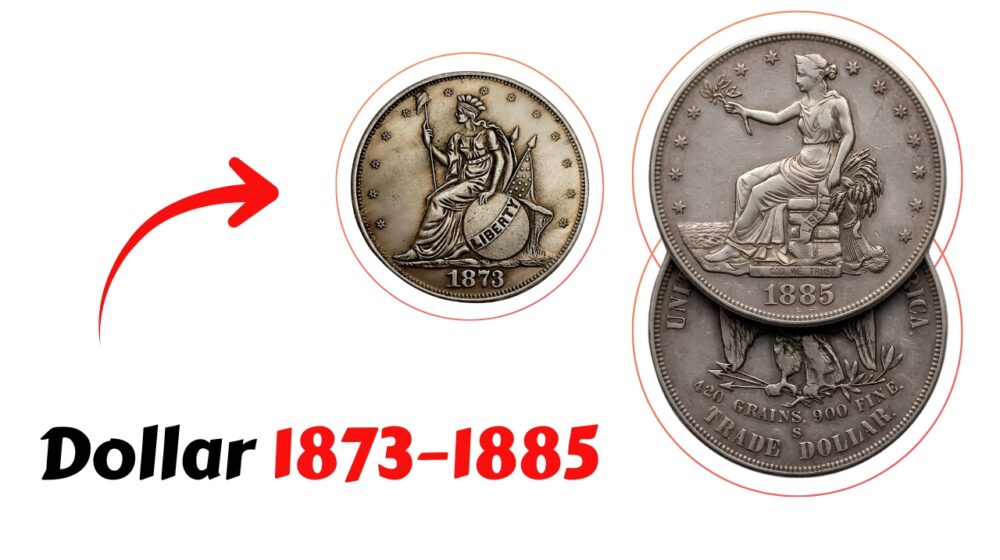
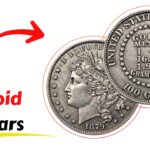
Obverse. Liberty sits on a bale of goods beside a sheaf of grain, facing west toward the Pacific a deliberate visual nod to the coin’s export purpose. Her right hand extends an olive branch toward Asia, symbolizing peaceful trade, while her left hand grips a ribbon inscribed LIBERTY. Beneath the bale, a panel carries the motto IN GOD WE TRUST. Thirteen stars ring the upper rim, and the date sits anchored at the bottom of the design.
Reverse. An eagle with outstretched wings grips three arrows and an olive branch, a banner above bearing E PLURIBUS UNUM. The legends UNITED STATES OF AMERICA and TRADE DOLLAR frame the design, separated by the inscription 420 GRAINS, 900 FINE a direct, on-coin statement of the weight and purity standards that were central to the coin’s entire commercial purpose. Mintmark placement below the eagle identifies coins struck at San Francisco (S) or Carson City (CC); Philadelphia strikes carry no mintmark. All Trade Dollars have a reeded edge.
Notable varieties. Collectors recognize a number of die varieties within the series, most famously the 1875-S Over CC overdate-style variety and the 1876-CC Doubled Die both popular target coins for variety specialists building out a complete type set.
Why This Matters for Collectors
A coin with a genuine foreign-policy story. Few U.S. coins were created this explicitly as an instrument of trade competition with other nations. The Trade Dollar is a tangible artifact of post-Civil War America’s push to project economic influence into Asian markets.
Real depth across every collecting budget. Common San Francisco business strikes are attainable in the low hundreds of dollars, giving new collectors genuine access to the series, while Carson City key dates, regular Proofs, and the legendary 1884/1885 Proofs offer escalating tiers of rarity for collectors building toward a more advanced or complete set.
A built-in variety and specialty market. Between mintmark rarities, die varieties like the 1875-S/CC and 1876-CC Doubled Die, and the growing chopmark specialty, the Trade Dollar rewards collectors who want to go beyond a simple date run and dig into the series’ finer details.
One of the great rarity stories in American numismatics. The 1884 and 1885 Proofs unauthorized, hidden for over two decades, traceable to a single dealer represent one of the more genuinely mysterious chapters in U.S. Mint history, and owning or even studying one connects a collector to that story directly.
Authentication knowledge pays off. Because the series is heavily counterfeited, learning to evaluate Trade Dollars well weight, diameter, strike characteristics, and certification is a skill that carries over usefully into collecting 19th-century U.S. silver more broadly.
Quick-Reference Buying Guide
- Decide your entry point. A common-date San Francisco business strike in circulated grade is the most accessible way into the series, typically in the $325–$500 range.
- Learn the key dates before you shop. 1873-CC and 1878-CC carry real premiums due to low Carson City mintages; budget accordingly if you want either in your collection.
- Buy certified whenever possible. PCGS- or NGC-graded examples protect you against the series’ well-documented counterfeiting problem and give you a verifiable grade.
- Decide how you feel about chopmarks early. They typically sell at a discount to problem-free coins, but they carry genuine historical significance some collectors now seek them out specifically for that reason.
- Shop major auction houses and specialist dealers. Heritage Auctions, Stack’s Bowers Galleries, and GreatCollections are strong starting points for both common dates and rarities.
- Compare recent sold prices for the same date, mint, grade, and certification service before bidding, since Trade Dollar values can swing significantly with condition and originality.
- Register with your chosen auction house in advance, and confirm buyer’s premiums, payment terms, and secure shipping before bidding on higher-value lots.
- If chasing a Proof or a 1884/1885 rarity, work with a specialist dealer. These pieces rarely appear at general auction and are best pursued through dealers and houses with established relationships in the top tier of the U.S. silver dollar market.
This article covers a historical U.S. coin series no longer in production. There is no current mint, order window, or fixed retail price; figures above reflect general secondary-market ranges and can vary significantly by grade, mint, originality, and current silver prices.