Most coins have one government behind them. This one had three. Between January and April of 1861, the New Orleans Mint struck half dollars bearing the same date, the same mintmark, and the same familiar Liberty Seated design while the authority overseeing the building itself changed hands from the United States, to the independent State of Louisiana, and finally to the Confederate States of America. The employees stayed largely the same. The dies stayed the same. Only the flag above the building changed.
Within that narrow, chaotic window, Mint workers also produced a tiny handful of extraordinarily well-made half dollars coins struck with polished dies, reflective fields, and presentation-quality surfaces unlike anything meant for ordinary commerce. One of those coins, a Specimen-63 example graded by PCGS, crossed the auction block at Stack’s Bowers Galleries’ Summer 2026 Global Showcase Auction, selling for $170,800 during the Rarities Night session. But the coin brings more than a price tag it brings a genuine numismatic mystery that researchers still haven’t fully solved.
Specifications at a Glance
| Category | Detail |
|---|---|
| Denomination | Half Dollar |
| Date and Mint | 1861-O (New Orleans) |
| Type | Liberty Seated Half Dollar, No Motto |
| Featured Variety | JD-1, W-01 |
| Rarity Rating | Rarity-8 |
| Featured Grade | PCGS Specimen-63 |
| Composition | 90% silver, 10% copper |
| Standard Weight | 12.44 grams |
| Actual Silver Weight | 0.3599 troy ounce |
| Diameter | 30.6 mm |
| Edge | Reeded |
| Designer | Christian Gobrecht (Seated Liberty concept based on Thomas Sully) |
| Total 1861-O Mintage | 2,532,633 |
| United States Production | 330,000 |
| State of Louisiana Production | 1,240,000 |
| Confederate Production | 962,633 |
| PCGS Number | 6422 |
| NGC ID | 27TM |
| Auction House | Stack’s Bowers Galleries |
| Auction | Summer 2026 Global Showcase Auction, Rarities Night |
| Lot Number | 2094 |
| Realized Price | $170,800 |
| Estimated Surviving Specimens (all varieties) | Only four or five distinct Specimen or Branch Mint Proof examples |
NGC confirms the same 12.44-gram standard weight, .900 silver fineness, 30.6 mm diameter, and reeded edge, and notes that 1861-O halves use the Type 2 reverse adopted in 1858.
How the Auction Unfolded
Because this specific coin has already sold, there’s no active bidding window to track but the sale offers valuable context for anyone following top-tier Liberty Seated material:
- Auction house: Stack’s Bowers Galleries.
- Event: The Summer 2026 Global Showcase Auction.
- Session: Rarities Night, the auction’s showcase session for its most significant offerings.
- Lot number: 2094.
- Realized price: $170,800, reflecting both the coin’s extreme rarity and its documented pedigree Dannreuther selected this exact coin as the plate specimen for the issue on page 814 of his 2025 reference on United States Proof coinage.
- Track record: Stack’s Bowers notes that this SP63 represents the fourth 1861-O Specimen example the firm has brought to auction over roughly the past decade and a half, giving prospective buyers a sense of just how rarely these coins surface publicly.
For collectors hoping to acquire a comparable 1861-O Specimen in the future, the path runs through major auction houses with a track record in this material Stack’s Bowers in particular along with specialist dealers who track Liberty Seated die-marriage research and maintain relationships with pedigreed collections.
Historical Background
Louisiana Secedes and Seizes the Mint
The story begins with secession. Louisiana voted to leave the Union on January 26, 1861, by a vote of 113 to 17. Three days later, the Louisiana Secession Convention adopted an ordinance permitting federal employees to continue working under state authority, and on January 31, Louisiana formally took possession of the New Orleans Mint.
Remarkably, the Mint’s workforce remained largely intact through the transition. Its principal officers Superintendent William A. Elmore, Treasurer A.J. Guirot, Assayer Howard Millspaugh, Chief Coiner Dr. Benjamin F. Taylor, and Melter and Refiner M.F. Bonzano, M.D. stayed in place. Louisiana had inherited not just a building, but a fully operating federal mint complete with trained staff, machinery, dies, and bullion.
Chief Coiner Taylor later recalled that Louisiana turned the facility over to the Confederacy during the final days of February, though numismatic and historical accounts generally place the Confederate government’s formal possession of the Mint building on April 1, 1861. That narrow window between January 31 and April 1 when Louisiana, not yet the Confederacy, controlled the Mint sits at the center of the entire Specimen half dollar mystery.
Three Governments, One Coin Design
The production numbers for the 1861-O half dollar tell a genuinely unusual story. The New Orleans Mint struck a total of 2,532,633 half dollars dated 1861-O, a figure confirmed by both PCGS and NGC. But no single government produced all of them:
- The United States controlled the Mint when workers struck the first 330,000 pieces in January.
- The State of Louisiana produced 1,240,000 half dollars during February and March, after taking control of the facility.
- The Confederate States of America struck the remaining 962,633 pieces, principally during April.
Those three figures add up precisely to the accepted total mintage meaning coins bearing an identical date, mintmark, and design were struck under three entirely different political authorities in the span of just a few months.
The Die-Marriage Puzzle
Identifying which government struck a particular 1861-O half dollar requires careful die-marriage research, since the coins themselves carry no outward political markings. Numismatist Bill Bugert cataloged the dies used in 1861-O production in his 2013 reference on New Orleans Branch Mint half dollar varieties. PCGS currently attributes die marriages W-01 and W-02 to United States production, W-03 through W-08 to Louisiana, and later marriages to Confederate output.
That attribution creates a genuine puzzle for the coin at the center of this story. The Specimen offered by Stack’s Bowers carries the W-01/JD-1 die pairing a pairing officially associated with United States-era production. Yet Stack’s Bowers believes this coin, along with the other known special-strike 1861-O halves, likely originated from a small ceremonial production run under Louisiana’s authority, after the state seized the Mint. Those two positions don’t fit together neatly without further explanation.
Other Specimens Point Toward Louisiana
Complicating the picture further, several other known special 1861-O half dollars support a Louisiana connection more clearly than the W-01 coin does. The celebrated Robert LeNeve example, which has been exhibited at the former New Orleans Mint building (now the Louisiana State Museum), comes from the W-04/JD-2 die pairing a marriage Bugert assigns to Louisiana production. The E. Horatio Morgan specimen, graded Specimen-62 by NGC and sold by Stack’s Bowers for $66,000 in November 2019, also uses the W-04/JD-2 pairing, as does an NGC Specimen-62+ example Stack’s Bowers handled in its Summer 2025 Global Showcase Auction.
Those W-04 coins fit neatly into the theory that Louisiana officials commissioned a small number of specially prepared pieces shortly after taking control of the Mint. The W-01 coins simply don’t align with that same explanation as cleanly.
A Second W-01 Clue: The James A. Stack Coin
Adding another layer to the mystery, researcher John W. Dannreuther identified only one other known W-01/JD-1 Specimen in his 2025 research a coin from the legendary collection of James A. Stack, Sr., sold in March 1975 and later graded Specimen-64. Crucially, this coin does not share the same die state as the example sold in 2026, suggesting Mint workers may have produced these special pieces during more than one striking period rather than in a single ceremonial event. Dannreuther himself has acknowledged the uncertainty directly, noting that numerous questions about the issue remain unanswered.
A Possible Motive: Timing and the Confederate Half Dollar
One piece of circumstantial evidence offers a compelling theory. On April 1, 1861, Confederate Treasury Secretary Christopher G. Memminger requested designs for a distinctly Confederate half dollar from New Orleans officials a request confirmed by archival research. The Confederacy soon approved a dramatically different reverse design featuring a Confederate shield, seven stars, cotton and sugar cane, and the legend “CONFEDERATE STATES OF AMERICA.” Only four original Confederate half dollars, pairing that new reverse with the existing federal Seated Liberty obverse, were ever produced.
That timeline supports an important argument: if Confederate officials had wanted presentation pieces once they controlled the Mint, they had their own distinctive design to showcase, not the standard United States motif. That makes it more plausible that the special 1861-O halves bearing the ordinary U.S. design were struck earlier most likely around January 31, when Louisiana first took possession of the Mint, potentially to commemorate the state’s new authority over one of the federal government’s most significant Southern institutions. No surviving contemporary document confirms this theory outright, and the die evidence complicates it further, so it remains a compelling but unproven explanation.
Description of the Obverse and Reverse
Obverse
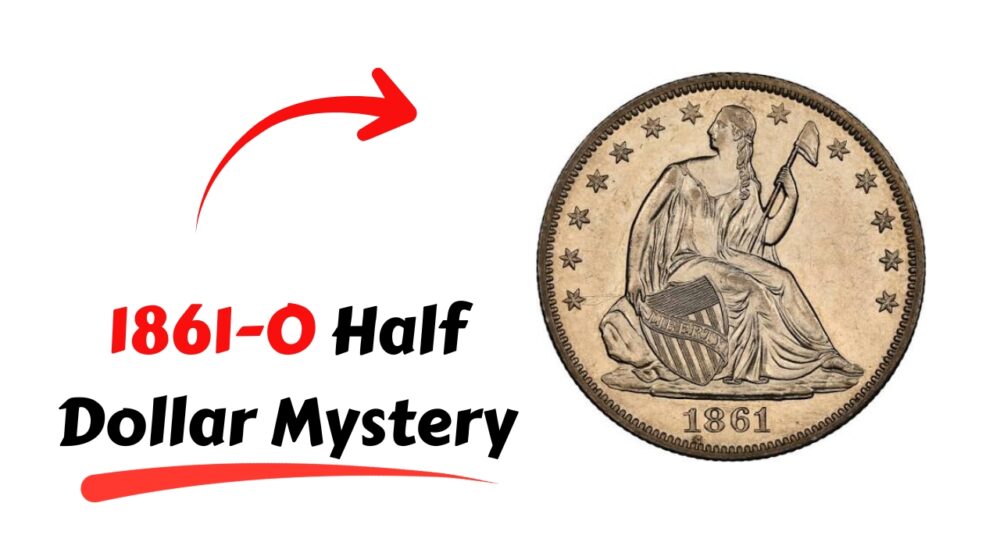
The obverse follows Christian Gobrecht’s Liberty Seated design, based on Thomas Sully’s original concept. Liberty sits upon a rock, draped in flowing robes, holding a shield inscribed “LIBERTY” in her right hand and a Liberty cap on a pole in her left enduring symbols of vigilance and freedom. On this particular Specimen, Stack’s Bowers describes attractive original toning across the surfaces, with powder-blue halos near the borders and reddish-gold iridescence dominating toward the centers. Under direct light, the fields show unusually strong reflectivity, the result of extensive die polishing prior to striking, while the design elements retain a delicate frosted texture that creates a subtle cameo contrast. The strike itself shows virtually full detail across the design, with only slight softness at the top of Liberty’s head and at stars 7 and 8 a characteristic shared by at least four other known Specimens of the issue.
Reverse
The reverse uses the Type 2 design adopted in 1858, featuring a perched eagle with wings spread, clutching an olive branch and arrows, encircled by the denomination and national inscriptions typical of the Liberty Seated series. As on the obverse, this coin shows a thin partial wire rim along portions of both sides, along with the same highly reflective, carefully prepared surfaces that distinguish it from an ordinary circulation-strike 1861-O half dollar. The surfaces appear unusually smooth for the assigned grade, with only faint wispy hairlines visible as the coin is tilted beneath a light source.
Why This Matters for Collectors
- It’s a tangible artifact of a genuinely unique moment in American history. Few coins can claim to have been struck under three different governments using the same dies and design within a matter of months.
- Its rarity is extreme even by elite standards. Stack’s Bowers estimates only four or five distinct Specimen or Branch Mint Proof 1861-O half dollars survive in total, a population far smaller than nearly any other American coin of comparable historical significance.
- The coin actively challenges an accepted numismatic theory. Rather than confirming a settled narrative, the W-01/JD-1 die pairing complicates the widely held belief that these special strikes came from a single Louisiana presentation event, giving researchers genuine new material to study.
- It carries documented reference-book pedigree. John W. Dannreuther selected this exact coin as the plate specimen for the issue in his 2025 reference on U.S. Proof coinage, tying the physical coin directly to the scholarly record.
- Regular-issue 1861-O halves remain historically resonant but far more available. With millions originally struck and substantial survival aided by factors like the recovery of coins from the wreck of the SS Republic, collectors can pursue an ordinary 1861-O half dollar affordably while the Specimen strikes occupy an entirely different tier of rarity and price.
Quick-Reference Buying Guide
- Understand the difference between regular-issue and Specimen 1861-O halves. Millions of ordinary business-strike examples exist and remain widely available, while Specimen or Branch Mint Proof examples are exceptionally rare and priced accordingly.
- Learn to read die marriages. Familiarize yourself with Bugert’s W-numbering system and Dannreuther’s JD-numbering system, since die pairing is central to understanding which government-era production a given coin belongs to.
- Research known Specimen pedigrees before buying. With only four or five surviving examples believed to exist, cross-reference any offered coin against documented pedigrees like LeNeve, Morgan, and James A. Stack, Sr.
- Review recent auction results for context. Prices such as the $170,800 result for this SP63 coin and the $66,000 result for the Morgan SP62 example offer useful benchmarks across grades.
- Buy exclusively through major, established auction houses. Given the coin’s extraordinary rarity and value, purchases should go through recognized platforms with a documented track record in this specific material, such as Stack’s Bowers.
- Examine surface characteristics closely. Look for the hallmarks of genuine special-strike preparation reflective fields, frosted devices, sharp strike detail, and partial wire rims as described in official lot descriptions.
- Consider the coin’s place in ongoing research. Because scholars like Dannreuther consider the issue’s origin still unresolved, acquiring a well-documented example can mean owning a piece actively relevant to numismatic scholarship, not just a static collectible.
- Keep thorough documentation. Retain auction records, reference-book citations, and any pedigree information tied to your coin, since provenance carries exceptional weight for a rarity at this level.