Few coins in American history were designed with a mission as specific as the Trade Dollar’s: not to circulate at the corner store, but to compete head-to-head with foreign silver in the markets of China and Japan. Struck from 1873 to 1885, the U.S. Trade Dollar was a heavyweight silver coin engineered for export, and its story includes commercial ambition, domestic backlash, secretive later strikings, and a collecting niche chopmarked coins that has only recently earned the respect it deserves.
Today, the Trade Dollar occupies a unique place in American numismatics. It is simultaneously a workhorse trade coin, a short-lived and troubled domestic issue, and home to some of the rarest Proof coins the U.S. Mint ever produced. This guide walks through its origins, its specifications, its design, and what collectors need to know before buying one.
Specifications at a Glance
| Detail | Information |
|---|---|
| Years of issue | 1873–1885 |
| Denomination | Trade Dollar (non-standard, export-purpose silver dollar) |
| Authorizing legislation | Coinage Act of 1873 |
| Composition | .900 silver, .100 copper |
| Weight | 27.22 grams (420 grains) |
| Diameter | 38.10 mm |
| Edge | Reeded |
| Designer | William Barber |
| Mint facilities | Philadelphia (no mintmark), San Francisco (S), Carson City (CC) |
| Highest business-strike mintage | 9,519,000 (1877-S) |
| Lowest business-strike mintage | 97,000 (1878-CC) |
| Highest Proof mintage | 1,987 (1880) |
| Lowest Proof mintage | 5 (1885) |
| Total recorded production | $35,965,924 face value, including 6,564 Proofs |
| Legal tender status | Limited at introduction; revoked in 1876 |
| Redemption period | Six months, authorized by the Act of 1887 |
| Amount exported | More than $28 million |
| Amount melted before 1887 | Nearly $1 million |
| Amount redeemed/recoined | Approximately $7.6 million |
How Collectors Acquire Trade Dollars Today
The Trade Dollar was never sold to the public through a Mint order window the way modern commemorative or bullion coins are. It entered circulation through banks, silver producers, and international commerce, and today it exists purely as a secondary-market collectible. Here’s what buying one actually looks like in practice.
Where Trade Dollars are bought and sold:
- Major auction houses — Firms such as Heritage Auctions and Stack’s Bowers regularly feature Trade Dollars in both flagship and online-only sales, ranging from heavily circulated, chopmarked survivors to gem Proofs.
- Certified coin dealers — Because counterfeits are a well-documented problem in this series (NGC has published specific diagnostic guidance for detecting fakes among 1875-S and 1878-S/CC issues), buying from an established dealer who deals in PCGS- or NGC-certified coins is the safest route.
- Coin shows — Regional and national shows, including the ANA’s annual convention, are reliable venues to view multiple examples side by side before committing to a purchase.
Pricing considerations:
- Common-date circulated business strikes, including many with chopmarks, can often be found for well under $500, making the series accessible to collectors on a budget.
- Key dates such as the low-mintage 1878-CC, along with condition-rarity issues in high grades, command significant premiums.
- Proof-only issues from 1879–1883, and especially the secretly struck 1884 and 1885 Proofs, are in an entirely different price tier and surface only rarely at auction.
- Because the coin’s silver content alone historically exceeded one dollar in melt value, even the most worn, “junk box” survivors typically carry value above face.
No order limits, no order dates. Unlike a modern numismatic product release, there are no mintage caps to reserve against, no purchase-per-household limits, and no announced sale windows availability is governed entirely by what collectors and dealers choose to bring to market at any given time.
Historical Background
The Trade Problem That Created the Coin
By the early 1870s, American merchants doing business in Asia faced a persistent disadvantage. Earlier U.S. silver dollars the Gobrecht dollar (1836–1839) and the Liberty Seated dollar (1840–1873) were both lighter and less trusted abroad than Mexico’s silver peso, which had become the dominant trade coin throughout China and Japan. Louis Garnett, Treasurer and Assayer at the San Francisco Mint, saw this disadvantage up close and pressed Congress to authorize a heavier, more competitive export coin. His advocacy helped bring about the Trade Dollar under the Coinage Act of 1873.
An International Competition of Weights and Purities
The Trade Dollar didn’t exist in a vacuum it was America’s entry into a broader contest among trading nations, each fielding its own coin to win merchant confidence. Mexico’s peso, the regional favorite, was struck slightly purer at .902778 fine but weighed less than the American coin. Japan and France issued their own trade coinage at 420 grains before later reducing the standard to 416 grains. The U.S. Mint aimed to match or exceed these competitors with a coin that felt substantial and reliable in hand, striking millions between 1874 and 1878 across the Philadelphia, San Francisco, and Carson City facilities. Most of this early output went straight into Asian commerce, exchanged for goods like tea, silk, and porcelain.
Trouble at Home
While the coin succeeded at its overseas mission, it created real problems domestically. Silver producers and banks began pushing Trade Dollars into circulation within the United States, where merchants and the public increasingly accepted them only at a discount to face value. Congress responded by revoking the coin’s limited legal tender status in 1876, a fix that curbed the practice but didn’t eliminate the confusion entirely. (Some later argued that the Coinage Act of 1965 indirectly restored legal tender status, though in practice almost no one would have spent a Trade Dollar at face value its silver content alone was worth more.)
The End of Production and the Redemption Period
Congress finally closed the book on the Trade Dollar with the Act of 1887, which authorized a six-month window during which the public could redeem their Trade Dollars for standard silver dollars. This redemption drive pulled the majority of surviving pieces out of domestic hands and permanently ended any further coinage of the series. Mint records tally total production at $35,965,924, including 6,564 Proofs; of that total, more than $28 million had already gone abroad, nearly $1 million had been melted before the 1887 act, and roughly $7.6 million came back through redemption, much of it later recoined into Morgan Dollars and subsidiary silver coinage.
From Trade Coin to Proof-Only Collectible
The reintroduction of the standard silver dollar in 1878 eliminated the Trade Dollar’s original export purpose. From 1879 through 1883, the Mint kept the series alive purely as a Proof issue struck for collectors rather than for commerce. Then, in an unusual coda to the series, Proofs dated 1884 and 1885 were struck quietly at the Philadelphia Mint coins whose existence remained unknown to the collecting public until 1907, and which can all be traced back to coin dealer William K. Idler. These two dates now rank among the rarest and most valuable U.S. silver coins ever produced.
Chopmarks: From Overlooked Damage to Prized History
Because Trade Dollars circulated so extensively throughout Asia, merchants there developed the practice of stamping coins with small counterstamps — chopmarks — to verify silver content and authenticity before accepting them in trade. For much of the 20th century, collectors treated chopmarked coins as damaged goods, favoring pristine, unmarked examples instead. That view has shifted substantially in recent years, with researchers and collectors increasingly viewing chopmarked pieces as tangible artifacts of the coin’s genuine commercial history rather than as flaws. William Taylor Leverage’s 2023 study, By Weight, Not By Coyne: An Introduction to Chopmarked Coins, stands as one of the most thorough modern examinations of the practice and its cultural context.
Design Breakdown: Obverse and Reverse
Obverse
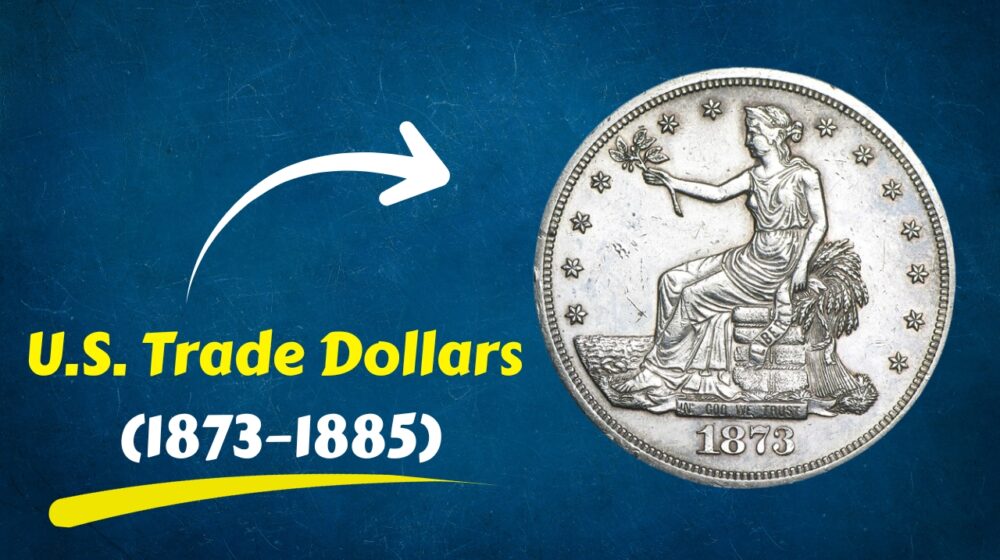
William Barber’s obverse design places Liberty in a seated pose atop a bale of goods, positioned beside a sheaf of grain, and facing westward deliberately oriented toward the Pacific and the coin’s intended Asian markets. Her right hand extends an olive branch in that same direction, a visual gesture toward peaceful trade, while her left hand holds a ribbon bearing the word LIBERTY. Below the bale, a panel carries the motto IN GOD WE TRUST. Thirteen stars trace the upper rim of the coin, representing the original states, with the date positioned beneath the central design.
Reverse
The reverse features an eagle with wings outstretched, gripping three arrows and an olive branch the familiar combination of preparedness and peace found on other American coinage of the era. A banner above the eagle carries E PLURIBUS UNUM. The surrounding legends read UNITED STATES OF AMERICA and TRADE DOLLAR, separated by an inscription unique among American silver coinage: 420 GRAINS, 900 FINE, a direct, on-coin declaration of the piece’s weight and fineness intended to reassure foreign merchants of its intrinsic value. Every Trade Dollar, regardless of mint, carries a reeded edge, and mintmarks S for San Francisco or CC for Carson City appear on examples from those facilities, while Philadelphia strikes carry none.
Why This Matters for Collectors
- A genuinely different kind of U.S. coin. Few American issues were designed from the outset for foreign commerce rather than domestic use, which gives the Trade Dollar a distinct historical narrative compared to most series in a standard collection.
- A wide range of entry points. Common circulated dates, including many chopmarked examples, remain attainable for under $500, while key dates like the 1878-CC and the Proof-only issues of 1879–1885 offer a serious challenge and serious expense for advanced collectors chasing a complete set.
- Rarities within the rarities. The secretly struck 1884 and 1885 Proofs, unknown to collectors until decades after they were made, represent some of the lowest-mintage and most historically curious Proof coins in the entire American series.
- A growing appreciation for chopmarked coins. What was once considered damage is now recognized as evidence of a coin’s real working life in Asian trade, and the market for well-documented chopmarked pieces has expanded accordingly a trend worth watching for collectors interested in specialization.
- Counterfeit risk demands diligence. As a heavily counterfeited series particularly certain San Francisco and Carson City dates the Trade Dollar rewards buyers who stick to certified coins and reputable sources rather than bargain-hunting on unverified material.
- A window into post-Civil War economic ambition. Beyond its collectibility, the Trade Dollar is a physical record of America’s push to become a serious player in global silver trade, and of the domestic complications that ambition created back home.
Quick-Reference Buying Guide
- Decide which era of the series interests you. Determine whether you’re pursuing circulated business strikes from the 1873–1878 trade era, the 1879–1883 Proof-only collector issues, or the ultra-rare 1884–1885 Proofs, since price and availability differ enormously between these groups.
- Set a budget and learn the key dates. Identify low-mintage or high-demand issues such as the 1878-CC, the 1875-S Over CC variety, and the 1876-CC Doubled Die that will command a premium over common dates.
- Buy certified whenever possible. Given well-documented counterfeiting in this series, prioritize coins graded by PCGS or NGC, and consult published counterfeit-detection guidance for the most frequently faked dates before buying raw examples.
- Decide your stance on chopmarks early. Chopmarked coins are typically more affordable than unmarked examples of the same date and grade, and are increasingly valued as historical artifacts decide whether you want a “clean” coin or one that tells its trade history on its surface.
- Compare multiple sources before buying. Check listings and recent results from major auction houses alongside dealer inventories to understand current market pricing for the specific date, mint, and grade you want.
- Verify mintage and rarity context. Cross-reference a coin’s date and mintmark against published mintage figures (for example, the 9,519,000 struck at San Francisco in 1877 versus only 97,000 at Carson City in 1878) to understand how scarce a particular issue truly is.
- Be patient with the rarest issues. Proof-only dates, and especially 1884 and 1885, surface infrequently at auction be prepared to wait, and to move decisively with proper due diligence, when one becomes available.
- Keep documentation with your purchase. For chopmarked or pedigreed pieces in particular, retain certification paperwork, auction records, or provenance notes, since documented history increasingly adds to a Trade Dollar’s value and desirability.
This article is intended for informational purposes for numismatic collectors and enthusiasts. Market values, population data, and pricing guidance should be verified against current dealer and auction sources before making a purchase.