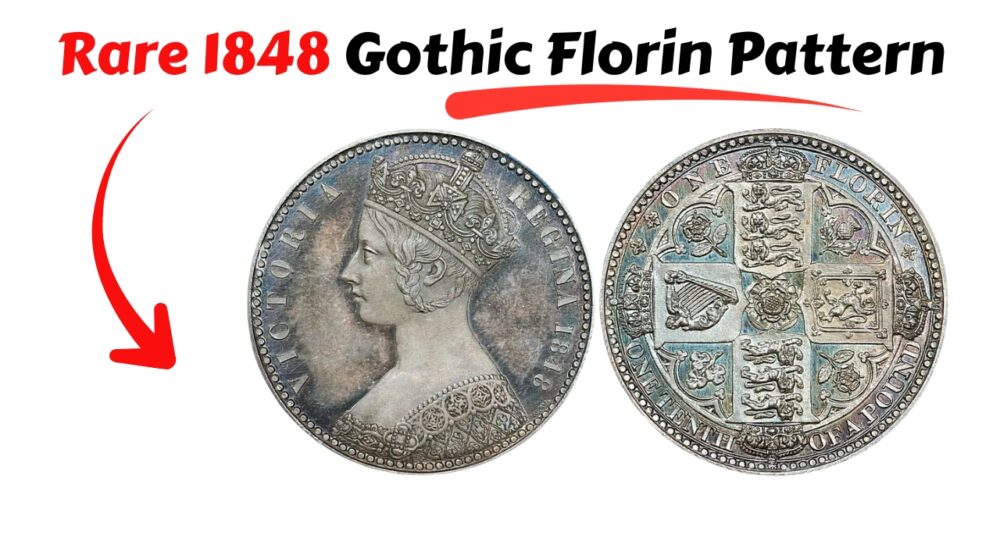
At first glance, it’s pure Victorian spectacle: Queen Victoria in an elaborate crown, her braided hair and richly detailed dress evoking medieval England, while the reverse arranges crowned shields into a cross around a central rose, with roses, a thistle, and a shamrock representing the nations of the United Kingdom. But the 1848 Great Britain Gothic Florin Pattern is far more than an exercise in ornamental design. It represents Britain’s first serious step toward decimal currency and it quietly carries the design decision that would soon ignite one of the great controversies in British numismatic history.
An exceptional survivor of this pattern recently crossed the auction block. Stack’s Bowers Galleries offered a 1848 Silver “Gothic” Florin Pattern, graded NGC Proof-66, as Lot 41511 in its Summer 2026 Global Showcase Auction. The plain-edge rarity came from the Charles “Cheech” Litman Collection, carried a pre-sale estimate of $20,000 to $30,000, and ultimately sold for $39,040 well above expectations. Here’s the full story behind this small silver coin that sat, quite literally, at the crossroads of British tradition and mathematical modernization.
Specifications at a Glance
| Category | Detail |
|---|---|
| Country | Great Britain |
| Monarch | Queen Victoria |
| Date | 1848 |
| Denomination | Florin / Two Shillings / One-Tenth Pound |
| Mint | Royal Mint, Tower Hill, London |
| Composition | Sterling silver (.925 fine) |
| Approximate Type Weight | 11.3 grams |
| Approximate Type Diameter | 28 mm |
| Obverse Designer | William Wyon |
| Reverse Designer | William Dyce |
| Edge | Plain (on the Stack’s Bowers specimen) |
| Catalog Numbers | S-3890; KM-745; ESC-2917 (old 799) |
| Grade | NGC Proof-66 |
| Provenance | Charles “Cheech” Litman Collection |
| Auction House | Stack’s Bowers Galleries |
| Auction | Summer 2026 Global Showcase Auction |
| Session | Session B — Ancient Coins & World Coins Part 2: Great Britain, Ireland & Scotland |
| Lot Number | 41511 |
| Sale Date/Location | September 2, 2026, at Griffin Studios, Costa Mesa, California |
| Pre-Sale Estimate | $20,000–$30,000 |
| Realized Price | $39,040 |
How the Auction Unfolded
Because this coin has already been sold, there’s no active bidding window to track going forward but the sale itself offers useful context for collectors interested in British pattern coinage:
- Auction house: Stack’s Bowers Galleries.
- Event: The Summer 2026 Global Showcase Auction.
- Session: Session B, dedicated to Ancient Coins and World Coins, specifically the segment covering Great Britain, Ireland, and Scotland.
- Sale date and location: September 2, 2026, at Griffin Studios in Costa Mesa, California.
- Result: The coin sold for $39,040, comfortably exceeding its $20,000–$30,000 pre-sale estimate a sign of strong demand for a high-grade, well-pedigreed example of this historically significant pattern.
For collectors interested in acquiring comparable British pattern material, the most reliable avenues are major world-coin auction houses like Stack’s Bowers, along with specialist dealers in British and Commonwealth coinage who track pattern rarities and notable collection pedigrees such as the Litman holdings.
Historical Background
Britain’s Math Problem
To understand why this coin exists, it helps to set aside decimal currency entirely and think in terms of Victorian Britain’s actual monetary system: pounds, shillings, and pence. One pound equaled 20 shillings, and one shilling equaled 12 pence, meaning a single pound contained 240 pence. Britons had used this system for generations and understood it well, but reformers increasingly saw it as needlessly complicated for a modernizing, internationally trading nation.

Calls for decimal coinage reached Parliament well before Victoria’s florin appeared. Sir John Wrottesley recommended decimal denominations to the House of Commons as early as 1824, and the Lost Standards Commission raised a similar proposal in 1841. Then, on April 27, 1847, economist and politician John Bowring pressed the issue directly in Parliament, proposing two new denominations: one equal to one-tenth of a pound, and another equal to one-hundredth.
The tenth-pound coin offered a particularly elegant bridge between the old system and the new. It equaled exactly two shillings under existing currency, while simultaneously equaling exactly one-tenth of a pound under a decimal system meaning Britain could introduce the coin without abandoning pounds, shillings, and pence outright. Chancellor of the Exchequer Sir Charles Wood recognized both the opportunity and the risk, warning Parliament that people formed unusually strong attachments to their national coinage. Even so, he accepted the logic of a two-shilling piece precisely because it could function under either monetary system.
A Numismatic Laboratory
The Royal Mint began experimenting in earnest during 1848, and the surviving pattern coins reveal just how unsettled the project remained even at that late stage. Mint officials tested several possible names for the new tenth-pound denomination, including Centum, Decade, Dime, and Florin a naming experiment confirmed by Royal Mint records and documented in nineteenth-century auction catalogs featuring surviving 1848 patterns bearing these various proposed names. Some patterns even carried the inscription “100 MILLES,” reflecting an abandoned attempt at an entirely new decimal accounting structure.
The Royal Mint ultimately settled on “florin.” The choice wasn’t simply a revival of England’s short-lived medieval gold florin; instead, the new British silver coin roughly matched contemporary Dutch and Austrian florins in size and value. Later accounts credit Prince Albert with favoring the name, since he reportedly supported the decimal movement and was familiar with continental florins from his youth.
William Wyon and the Gothic Revival
With a denomination chosen, the Mint needed a design and few British engravers could match William Wyon, who served as the Royal Mint’s Official Chief Engraver from 1828 until his death in 1851. Wyon had already produced one of the masterpieces of Victorian numismatics with his 1847 Gothic Crown, which introduced an ornate crowned portrait of Victoria rendered in the Gothic Revival style then sweeping through British architecture, art, literature, furniture, and fashion.
For the florin project, Wyon adapted that celebrated crowned portrait to a much smaller format an ambitious undertaking for a coin only about 28 millimeters across. The reverse design is credited to Scottish artist William Dyce, whose cruciform arrangement of four crowned shields around a central rose incorporated the heraldic and floral symbols of England, Scotland, and Ireland. Royal Mint specifications formally credit Wyon as the obverse designer and Dyce as the reverse designer, a pairing that carried through into the eventual 1849 circulation florin as well.
The Two Missing Phrases That Changed Everything
Perhaps the most consequential part of this coin’s story involves words that don’t appear on it at all. Traditional British royal titles commonly included “DEI GRATIA” (“By the Grace of God”) and “FIDEI DEFENSOR” (“Defender of the Faith”). The 1848 pattern omitted both, identifying the monarch simply as “VICTORIA REGINA” Queen Victoria.
A year later, the Royal Mint carried that same abbreviated legend onto the circulating 1849 florin, and the reaction was fierce. Critics quickly dubbed the coin the “Godless Florin” or “Graceless Florin,” and religious suspicion intensified because Richard Lalor Sheil, then Master of the Royal Mint, was Roman Catholic a fact that fueled rumors of ulterior motives far beyond simple design choices. Contemporary journals repeatedly attacked the issue.
The real story, however, differs sharply from the popular legend. In February 1850, Sheil addressed the House of Commons directly and accepted responsibility for the abbreviated inscription, explaining that he had wanted visual balance: since the reverse already carried a lengthy denomination inscription, he believed a shorter obverse legend produced a cleaner overall design. Notably, Royal Mint Museum research indicates that William Wyon himself opposed the omission, while evidence suggests Prince Albert favored the emphatic simplicity of “VICTORIA REGINA.” Rather than an accidental oversight, the coin reflects a deliberate if ultimately unpopular artistic decision made during the development of an entirely new national denomination.
The public backlash proved so intense that authorities suspended further issues of the design.
A Gothic Makeover
The decimal experiment survived; the original design did not. The Royal Mint reworked the florin, restoring the omitted religious titles and pushing the Gothic aesthetic even further. The revised coin grew to approximately 30 millimeters, adopted ornate Gothic lettering, expressed its date in Roman numerals, and once again included abbreviations for Dei Gratia and Fidei Defensor. A limited 1851 issue preceded regular circulation production beginning in 1852, and the resulting Gothic Florin design became one of the defining British silver coin types of Victoria’s long reign an ironic outcome, given that the very controversy which nearly killed the florin ultimately helped produce an even more elaborately Gothic coin.
Full decimalization, meanwhile, remained more than a century away. The British government didn’t formally announce the change until 1966, with Decimal Day finally arriving on February 15, 1971. Yet the basic mathematical logic behind the florin a two-shilling coin that also equaled one-tenth of a pound had proven remarkably durable across that entire span, serving as a quiet bridge to the decimal system long before it officially arrived.
Struck at the Steam-Powered Tower Hill Mint
The setting in which these patterns were produced adds another layer to the story. The Royal Mint had relocated from the cramped quarters of the Tower of London to a purpose-built facility at Tower Hill beginning in 1810, equipped with modern steam-powered machinery that represented a major leap forward in British coin production eight coining presses capable of striking roughly 60 coins per minute. The 1848 Gothic Florin Pattern therefore paired old-world Gothic imagery with some of the most advanced industrial coinage technology available anywhere at the time, a contradiction that feels distinctly Victorian: a design looking backward toward medieval Britain, attached to a denomination looking forward toward mathematical modernization.
Description of the Obverse and Reverse
Obverse
Queen Victoria faces left, her crown rising into the upper border of the coin, with intricate clothing and hair details filling the portrait without overwhelming it. The inscription is deliberately stark: “VICTORIA REGINA 1848,” omitting the traditional religious titles that would later spark public controversy when carried over to the 1849 circulation issue. On the Stack’s Bowers example, NGC’s Proof-66 grade reflects exceptional preservation, with the auction house describing gunmetal-gray devices set against strong old cabinet toning a look that gives the coin a distinctly aged, archival character rather than the bright, flashy appearance often associated with proof coinage.
Reverse
William Dyce’s reverse design arranges four crowned shields into a cruciform pattern around a central rose, with additional floral and heraldic symbols representing England, Scotland, and Ireland woven throughout the composition. The denomination surrounds the design in full: “ONE FLORIN ONE TENTH OF A POUND,” a phrase that openly advertised the government’s decimal ambitions every time the coin was examined. On this particular example, cobalt blue toning dominates the fields, complementing the gunmetal-gray devices on the obverse and reinforcing the coin’s sense of genuine age and archival history.
Edge
The Stack’s Bowers specimen carries a plain edge, consistent with its classification as an experimental pattern piece rather than a circulation issue.
Why This Matters for Collectors
- It connects directly to one of Victorian numismatics’ most celebrated engravers. As an extension of William Wyon’s acclaimed 1847 Gothic Crown, this pattern represents his design philosophy adapted to an entirely new, smaller denomination.
- It documents a genuine moment of monetary experimentation. The coin preserves evidence of the Royal Mint testing several potential decimal denomination names including the almost unrecognizable “Centum,” “Decade,” and “Dime” before settling on “florin.”
- It sits at the exact hinge point of a famous controversy. Struck the year before the “Godless Florin” scandal erupted, this pattern captures the design decision the omission of “Dei Gratia” and “Fidei Defensor” in its original, pre-controversy form.
- Its history reflects a broader clash between tradition and modernity. Gothic Revival imagery, monarchy, and religious symbolism appear on the same coin that represents Britain’s push toward decimal mathematics and steam-powered industrial production.
- Exceptional preservation and pedigree add further weight. An NGC Proof-66 grade, combined with a documented history in the Charles “Cheech” Litman Collection, places this specific example well above the typical surviving pattern in terms of both condition and provenance.
Quick-Reference Buying Guide
- Understand what makes a “pattern” coin distinct. Pattern pieces like this one were experimental or trial strikes, not circulating coinage factor that into rarity and pricing expectations relative to the eventual 1849 and 1851–1852 circulation florins.
- Learn the relevant catalog numbers. Reference S-3890, KM-745, and ESC-2917 (old 799) when researching or discussing this specific pattern variety with dealers and auction houses.
- Research pedigree carefully. Coins with documented ownership history, such as the Charles “Cheech” Litman Collection example, often carry added value and desirability tied to that provenance.
- Compare recent auction results. The $39,040 result against a $20,000–$30,000 estimate offers a useful, current benchmark for a high-grade example of this pattern.
- Prioritize certified examples from reputable services. An NGC or PCGS grade adds crucial third-party verification for a coin this specialized and valuable.
- Buy through major auction houses or British-coin specialists. Firms like Stack’s Bowers, along with dealers focused specifically on British and Commonwealth coinage, are best positioned to source and authenticate genuine examples.
- Study the toning and surface characteristics described in lot listings. Details like gunmetal-gray devices and cobalt blue fields help confirm you’re viewing the specific coin described in official auction records.
- Keep thorough documentation after purchase. For a coin this tied to historical narrative and pedigree, retain auction records, catalog descriptions, and any provenance documentation associated with your specific example.