Two Lincoln cents define scarcity in the series but they earned that reputation in almost opposite ways. The 1909-S VDB became an instant sensation the moment it left the Mint, its designer’s initials sparking a public controversy that had collectors saving examples within weeks of release. The 1914-D took a far quieter path. Denver struck a little over a million of these cents, and almost nobody thought to set them aside. They circulated as ordinary money for decades, spent in stores and passed through cash registers with no idea they would one day become one of the great condition rarities in American numismatics.
More than a century later, that difference has flipped the traditional Lincoln cent hierarchy on its head. While the 1909-S VDB remains the series’ most famous key date, the 1914-D has emerged as something arguably rarer for advanced collectors: the toughest Lincoln cent to find in full, original Mint State Red condition. Current PCGS population data shows more than nine full-Red 1909-S VDB cents in existence for every full-Red 1914-D a gap that only widens at the very top of the grading scale.
At a Glance: Specifications
| Detail | Description |
|---|---|
| Denomination | One Cent |
| Date | 1914 |
| Mint facility | Denver |
| Mintmark | D, below the date |
| Mintage | 1,193,000 |
| Designer | Victor David Brenner |
| Composition | 95% copper, 5% tin and zinc |
| Weight | 3.11 grams |
| Diameter | 19.00 mm |
| Edge | Plain |
| PCGS numbers | 2471 (BN), 2472 (RB), 2473 (RD) |
| PCGS RD population (as of Sept. 9, 2026) | 279 |
| PCGS auction record | $158,625 — MS66+ RD, Legend Rare Coin Auctions, May 2018 |
| Finest known grade | MS66+ RD (two examples, none finer) |
| Typical circulated value (Brown, as of Sept. 2026) | ~$120 (Poor-1) to ~$375 (Very Fine-20) |
| Mint State value range | ~$2,900 (MS60 BN) to $165,000 (MS66+ RD), per PCGS Price Guide |
How Collectors Acquire a 1914-D Lincoln Cent
Unlike a modern commemorative, the 1914-D was never sold directly to collectors by the Mint it entered circulation as ordinary currency in 1914, and today it exists entirely within the secondary numismatic market. There is no order window, mintage allocation, or purchase limit to track. Instead, acquiring one requires navigating a market shaped heavily by grade, color designation, and authentication:
- Decide on a target grade and color. Circulated Brown examples are attainable for a few hundred dollars, while full Red Mint State coins command five and six figures depending on grade.
- Search major auction houses and dealers. Heritage Auctions, Stack’s Bowers, GreatCollections, and Legend Rare Coin Auctions have all handled notable 1914-D sales in recent years, making them reliable places to track current market activity.
- Insist on third-party certification. Because the 1914-D is among the most heavily counterfeited U.S. coins, buying only PCGS- or NGC-certified examples is essential, particularly at higher price points.
- Verify pedigree and CAC approval when available. Coins with documented ownership history (such as the Dell Loy Hansen or Stewart Blay Red Copper Collection pedigrees) or CAC verification often command stronger prices and carry additional buyer confidence.
- Compare recent auction results before bidding. Given how much color, strike, and eye appeal affect price even within the same numeric grade, reviewing multiple recent sales provides a far more realistic price expectation than relying on a single price guide figure.
- Budget for authentication if buying raw. Lower-value circulated examples are sometimes sold ungraded; if authenticity is in doubt, submitting the coin to PCGS or NGC before a significant purchase is a prudent step.
Historical Background
The Lincoln Cent Series
The Lincoln cent debuted on August 2, 1909, marking the first time a U.S. president appeared on a regularly circulating American coin. President Theodore Roosevelt had admired sculptor Victor David Brenner’s earlier 1907 Lincoln plaque, and Brenner’s portrait was subsequently adapted for the new cent. The design coincided with the 100th anniversary of Abraham Lincoln’s birth, giving the coin’s release considerable public attention from the outset.
The 1909-S VDB Controversy
Brenner’s initials, “V.D.B.,” appeared prominently at the base of the reverse on the earliest cents. Public criticism followed almost immediately, and the Mint removed the initials after a short production run. San Francisco had struck only 484,000 VDB cents before the change took effect, and collectors quickly recognized the significance of that low mintage. Examples were saved in meaningful numbers from the very beginning, which is why Mint State 1909-S VDB cents survive today in far greater numbers than their mintage alone would suggest.
The 1914-D: A Rarity Created by Circulation
Denver’s 1914 cent production reached 1,193,000 modest compared to Philadelphia’s 75,238,432 and larger than San Francisco’s 4,137,000 that same year, but with no public controversy to alert Americans that the coin might someday be valuable. As a result, the 1914-D simply circulated as money throughout the 1910s and 1920s. It wasn’t until the 1930s, when inexpensive coin boards developed by Joseph Kent Post and popularized by Whitman helped fuel a nationwide boom in date-and-mintmark collecting, that collectors began actively searching for the date. By then, roughly two decades of circulation had already stripped the coin’s fresh Mint State supply from everyday pocket change.
The Hoards That Preserved Its Mint State Population
A handful of documented hoards likely account for much of the Mint State 1914-D population that survives today. Numismatist Walter Breen, as cited by NGC, described a group of roughly 700 Mint State examples that reportedly stayed together into the early 1950s. PCGS offers a somewhat different account attributed to Breen, describing ten rolls (about 500 coins) held by a New England dealer as late as 1943, while cautioning that Breen’s recollections are not always considered fully reliable. Decades later, researcher Q. David Bowers, as cited by NGC, documented the discovery of two additional rolls around 100 coins during the 1970s, believed to have originated in Hawaii or the Philippines. The tropical environment left many of those pieces with spotting and Red-Brown or Brown toning rather than full Red color, illustrating that even coins spared from circulation wear were not spared from the natural effects of time.
Obverse and Reverse Design Details
Obverse
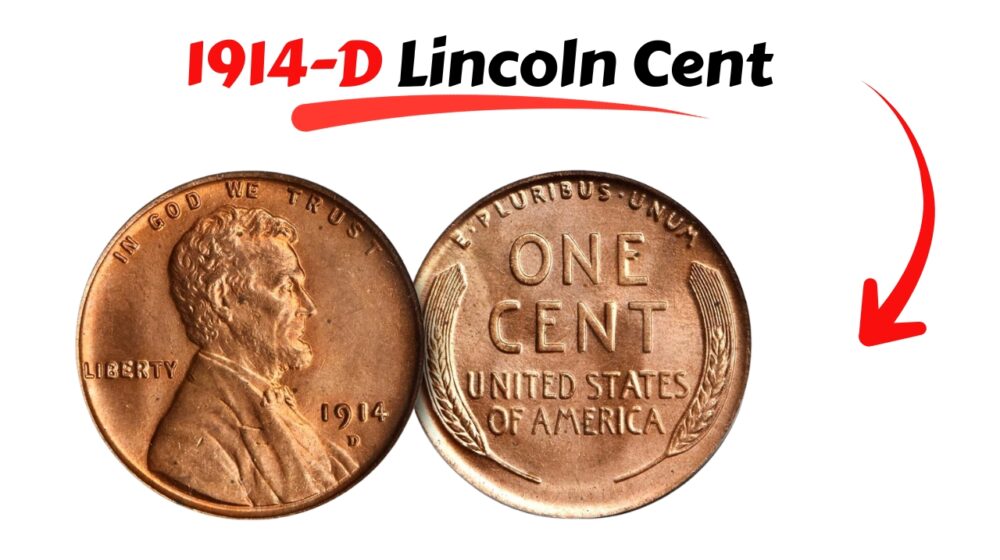
The obverse features Victor David Brenner’s portrait of Abraham Lincoln in profile, facing right. The word “LIBERTY” appears to the left of the portrait, with the motto “IN GOD WE TRUST” arched above, and the date centered below. On the 1914-D, the “D” mintmark appears beneath the date, a critical detail for authentication given how frequently counterfeiters have added false Denver mintmarks to genuine Philadelphia-struck 1914 cents. Genuine 1914-D cents also lack Brenner’s initials on the shoulder, since the Mint did not restore the tiny “V.D.B.” to that location until 1918 meaning any 1914-D bearing those initials should be treated with immediate suspicion.
Reverse
The reverse displays two wheat ears flanking the denomination “ONE CENT” and the inscription “UNITED STATES OF AMERICA,” a design that remained in use on Lincoln cents until it was replaced by the Lincoln Memorial reverse in 1959. On the 1914-D specifically, NGC notes that many surviving examples show moderate die erosion, and heavy die polishing can weaken fine details, particularly around Lincoln’s coat lapel on the obverse. Carbon spotting is also considered an endemic characteristic of high-grade 1914-D cents by PCGS, meaning even top-tier examples frequently display tiny surface flecks that collectors must factor into eye-appeal assessments.
Why This Matters for Collectors
- A genuine condition rarity, not just a mintage rarity. While the 1914-D’s mintage of 1,193,000 is far higher than the 1909-S VDB’s 484,000, its far lower survival rate in full Red Mint State makes it dramatically scarcer in the grades advanced collectors chase most.
- A striking population comparison. As of the September 9, 2026 PCGS Population Report, only 279 1914-D cents have earned the RD designation, compared to 2,573 for the 1909-S VDB meaning collectors can find more than nine full-Red VDB cents for every full-Red 1914-D.
- An extreme gap at the top of the grading scale. PCGS currently lists just eight 1914-D cents at MS66 RD and two at MS66+ RD, with none finer, compared to 288 1909-S VDB cents at MS66 RD, 34 at MS66+ RD, and 18 at MS67 RD.
- Expert consensus on its rarity. Stack’s Bowers has described the 1914-D as the rarest Lincoln cent regular issue in Mint State, excluding varieties and errors, while NGC notes its surviving population is smaller than both the 1909-S VDB and the lower-mintage 1931-S.
- A documented, traceable pedigree at the top. The two finest-known PCGS MS66+ RD examples include a coin from the celebrated Dell Loy Hansen collection, which sold for a record $158,625 in 2018, and a second example that realized $128,100 at Heritage in January 2026.
- Real value at every collecting level. Even heavily circulated Brown examples carry meaningful premiums over an ordinary Wheat cent, giving budget-conscious collectors a way to own a piece of the story without competing for six-figure Mint State coins.
- A serious counterfeit risk that rewards careful buyers. NGC ranks the 1914-D among the most commonly counterfeited U.S. coins, making authentication knowledge and third-party certification especially valuable for anyone considering a purchase.
Quick-Reference Buying Guide
- Decide whether you’re chasing the date or the condition rarity. A modestly priced circulated Brown example satisfies a date-and-mintmark collection, while pursuing full Red Mint State requires a substantially larger budget and more patience.
- Check the mintmark carefully. Confirm the “D” beneath the date is genuine and correctly positioned, since applied or altered mintmarks are a well-documented counterfeiting method for this issue.
- Look for the absence of shoulder initials. A genuine 1914-D will not show Brenner’s “V.D.B.” on Lincoln’s shoulder, since that detail wasn’t restored to the design until 1918; its presence is a red flag.
- Insist on third-party certification for any meaningful purchase. Given the coin’s counterfeiting risk and price sensitivity to color designation, PCGS or NGC certification is essential once you move beyond low-grade circulated examples.
- Understand the color designations. Learn the difference between Brown (BN), Red-Brown (RB), and Red (RD) grading, since color has an outsized effect on value for this particular issue.
- Expect carbon spotting even in high grades. Don’t be surprised to see small surface flecks on an otherwise well-preserved example; PCGS considers this a common characteristic of the issue rather than a defect that automatically disqualifies a coin.
- Research pedigree and CAC status on expensive examples. Documented ownership history and CAC verification can meaningfully affect both price and buyer confidence at the Mint State level.
- Compare multiple recent auction results before bidding. Because eye appeal, strike, and surface quality vary significantly even within the same numeric grade, reviewing several comparable sales gives a far more reliable price benchmark than a single price guide number.