The United States Mint’s 2026 Freedom 250 Race Medal is no longer available to order. The two-week window that opened at noon ET on Aug. 21 closed at 3 p.m. ET on Friday, Sept. 4, 2026, and the Mint has said that no additional medals will be made. Anyone who placed an order is now waiting for delivery, which the Mint expects to begin on Sept. 28.
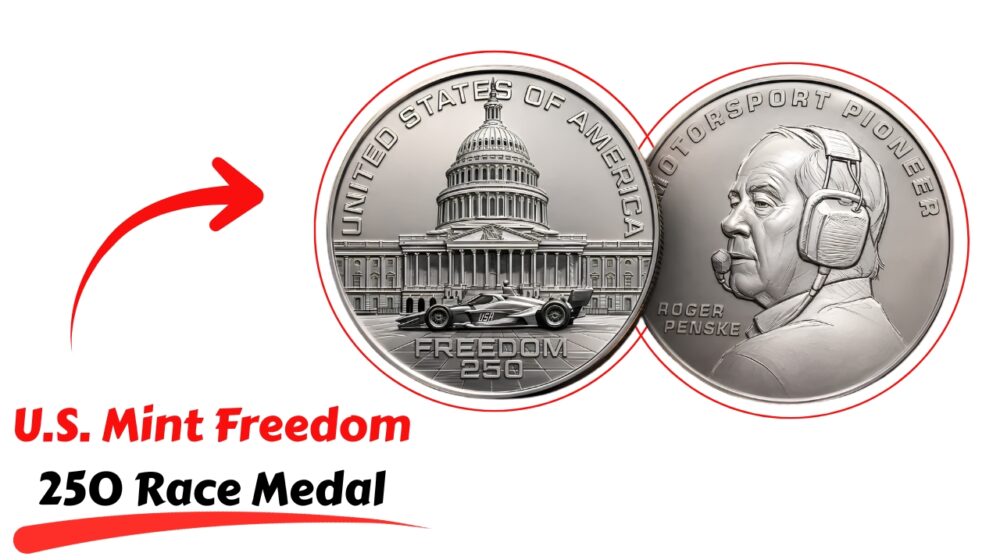
The medal was an unusual product for the Mint. Priced at $60, it commemorates the inaugural Freedom 250 Grand Prix, the first NTT IndyCar Series race held in Washington, D.C., which ran Aug. 22-23 as part of the nation’s 250th-anniversary celebrations. The back of the medal honors racing figure Roger Penske. It is struck at the Philadelphia Mint on a standard U.S. half dollar planchet, so it matches the size, weight and composition of the coin in your pocket while remaining a medal with no denomination.
Rather than being sold until a cap was reached, the medal was made to order. The Mint would strike only as many as buyers requested during the window, up to a ceiling of 15,000. The window closed with roughly 11,400 reported sold, about 76% of the maximum, which means the ceiling was never reached and the final mintage will sit well below it.
2026 Freedom 250 Race Medal: Specifications at a Glance
| Detail | Information |
|---|---|
| Product | 2026 Freedom 250 Race Medal |
| Mint item number | 26DCRM |
| Price | $60.00 |
| Order window | Aug. 21, 2026, noon ET, to Sept. 4, 2026, 3 p.m. ET |
| Mintage limit | 15,000 |
| Product limit | 15,000 |
| Household order limit | None |
| Production method | Made to demand from orders received in the window; no additional medals |
| Reported sales (latest) | 11,401 (Mint sales report covering Sept. 8-13) |
| Composition | Copper-nickel clad half dollar planchet (8.33% nickel, balance copper) |
| Weight | 11.340 grams |
| Diameter | 1.205 inches (30.61 mm) |
| Finish | Matte |
| Edge | Plain |
| Denomination | None (a medal, not legal tender) |
| Struck at | Philadelphia Mint (no mint mark) |
| Packaging | Encapsulated, in a black presentation box bearing the U.S. Mint seal |
| Expected shipping | Beginning Sept. 28, 2026 |
Ordering Details: The Window, the Limits and How It Played Out
Dates. Orders opened at noon ET on Friday, Aug. 21, 2026, and closed at 3 p.m. ET on Friday, Sept. 4. The Mint announced the medal only two days before the window opened, and its price was published in the Federal Register on Aug. 21. The medal received little advance publicity and was added to the Mint’s lineup shortly before the race weekend.
How the ordering worked. Buyers placed orders through the medal’s product page on usmint.gov. Unlike most Mint products, which are produced and then sold until they run out, the medal was made to demand. The Mint counted orders during the window and struck exactly that number, subject to the 15,000 ceiling. Both the mintage limit and product limit were set at 15,000.

Limits. The Mint listed no household order limit, so buyers could order as many as they wanted.
Price. $60 per medal, plus any applicable shipping charges.
Delivery. Orders are expected to begin shipping Sept. 28, 2026. As of this writing that date has not yet arrived, so medals have not been delivered.
The sales pace. Sales built steadily rather than exploding at launch:
| Reported sales period | Cumulative sales | Share of 15,000 cap |
|---|---|---|
| Opening week (first report) | 5,105 | 34.0% |
| Through Aug. 30 | 8,242 | 54.9% |
| Close of the window (Sept. 9 report) | 11,423 | 76.2% |
| Sept. 8-13 report | 11,401 | 76.0% |
The Mint added 3,137 in the week to Aug. 30 and 3,181 in the final stretch, so the final week was just as strong as the middle of the window. That is a little under the roughly 3,500 that CoinNews had estimated might remain available on the final morning. The small drop in the latest report (down 22 medals) is typical of Mint tallies, which can shift slightly as orders are cancelled or returned.
Where things stand now. The order window is closed, and the Mint has said no additional medals will be produced. The final mintage is the number of orders the Mint ultimately fulfills. It should land near 11,400 unless further cancellations move it.
Historical Background
The medal connects three separate stories: a first-of-its-kind race in the nation’s capital, a motorsports pioneer, and the humble half dollar planchet.
The Freedom 250 Grand Prix
Event: Freedom 250 Grand Prix of Washington, D.C. Dates: Aug. 22-23, 2026 (main IndyCar race on Sunday, Aug. 23) Announced: Jan. 30, 2026, by President Donald Trump and Transportation Secretary Sean Duffy
The Grand Prix was staged as part of the yearlong celebration of the 250th anniversary of the Declaration of Independence. It was the first NTT IndyCar Series race on the National Mall and the first IndyCar street race in Washington. Drivers tackled a temporary 1.7-mile street circuit with seven turns, running past landmarks including the U.S. Capitol and the Washington Monument and using part of Pennsylvania Avenue.
Organizers originally planned 125 laps but extended the race to 147 laps, covering roughly 250 miles to echo the anniversary. The main event was the 15th round of the 2026 IndyCar season. Kyle Kirkwood of Andretti Global won, followed by Christian Lundgaard of Arrow McLaren and Will Power of Andretti Global, with Alex Palou on pole. The win trimmed Palou’s points lead from 133 to 91 points with three races left.
The Mint pitched the medal as a keepsake of the weekend. In an unusual twist for a commemorative product, buyers could order it while the event was still unfolding.
Roger Penske
Role on the medal: Reverse portrait, inscribed MOTORSPORT PIONEER
Roger Penske, now 89, was one of America’s most successful young road racers before he retired from driving in 1965 to concentrate on business. He founded the team that became Team Penske in 1966, first fielding sports cars. The team entered the Indianapolis 500 for the first time in 1969 with driver Mark Donohue, who finished seventh and won Rookie of the Year. Donohue delivered Penske’s first Indy 500 victory in 1972.
Since then, Team Penske has become the most successful team in Indianapolis 500 history with 20 victories, along with hundreds of wins across IndyCar, NASCAR, sports cars and other series. Penske Entertainment also owns the Indianapolis Motor Speedway and the NTT IndyCar Series itself, which adds an extra layer of significance to an IndyCar medal honoring him. In May 2026, one of his drivers came within 0.0233 seconds of giving him a 21st Indy 500 win, in the closest finish in the race’s history.
The Half Dollar Planchet
Denomination it borrows from: U.S. half dollar Original mint years: First struck in 1794; the modern clad version dates to 1971
Choosing a half dollar planchet gives the medal a direct physical link to American coinage. The half dollar is among the oldest denominations in U.S. history, with the first pieces struck in 1794. Since 1971, circulating half dollars have been made of a copper-nickel cladding over a pure copper core, weighing 11.34 grams and measuring 30.61 millimeters, the same specifications as this medal. The medal is not legal tender, has no mint mark and carries entirely different designs.
The Mint has been busy with half dollars in 2026. It introduced one-year-only changes to the circulating dime, quarter and half dollar as part of the Semiquincentennial, and it has released a variety of special numismatic coins and medals throughout the year.
About the Designers
The Mint’s release materials reviewed for this article did not name the artist or sculptor of the Freedom 250 Race Medal. That information may be published later, and collectors should watch the Mint’s product page and news releases for an update.
Design Description: Obverse and Reverse
Obverse
The front of the medal puts the race at center stage. An Indy car inscribed “USA” appears alongside a depiction of the U.S. Capitol, tying the machinery of open-wheel racing to the landmark that formed part of the backdrop for the weekend’s circuit. The inscriptions UNITED STATES OF AMERICA and FREEDOM 250 complete the design.
Reverse
The back shifts from the vehicle to the person. A portrait of Roger Penske dominates the side, with the inscriptions MOTORSPORT PIONEER and ROGER PENSKE.
Finish and Format
The medal has a matte finish and a plain edge. It measures 1.205 inches across, weighs 11.34 grams and carries no mint mark, even though it was struck at the Philadelphia Mint. Each piece is encapsulated and placed in a black presentation box with the U.S. Mint seal.
Why This Matters for Collectors
The mintage is now fixed by orders, not by a cap. Because the Mint produced only what buyers ordered, the final total will be around 11,400 rather than 15,000. Collectors like the certainty of a closed, one-time production run, since nothing else can be struck.
It never sold out. Unlike many limited Mint issues, this one did not hit its ceiling. That is a useful reminder that a low authorized mintage is not the same as scarcity, and buyers hoping for a fast premium should temper their expectations.
It’s a crossover collectible. The medal appeals to numismatists, Semiquincentennial collectors and motorsports fans, three groups that don’t always overlap. Penske’s presence and the first-ever IndyCar race around the National Mall give it a story outside the usual coin-collecting world.
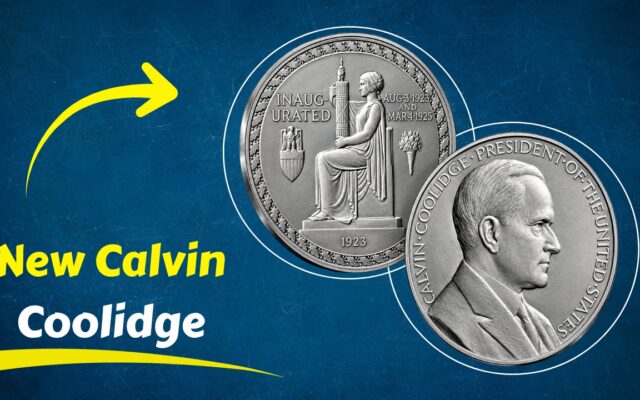
It’s an approachable price. At $60, it costs far less than many 2026 Semiquincentennial products, such as the $164 Calvin Coolidge Presidential Silver Medal, and it doesn’t carry precious-metal price risk since the medal is clad.
Half-dollar collectors get a curiosity. A medal struck on a half dollar planchet is a physical cousin of the coin, and it fits neatly alongside 2026’s one-year-only circulating designs.
The people involved make it unusual. Roger Penske is alive and remains active in the sport, which makes this a medal honoring a contemporary figure rather than a historical one.
This article is for informational purposes and is not investment advice.
Quick-Reference Buying Guide
The order window is closed, so these steps cover both people who ordered and people who missed out.
- Confirm the status. The window ran from Aug. 21 to Sept. 4, 2026 at 3 p.m. ET, and the Mint has said no more medals will be made.
- If you ordered, watch for shipping. The Mint expects shipments to begin Sept. 28, 2026. Check your order status on usmint.gov.
- When it arrives, inspect it. Check the capsule and box for damage, and confirm the medal shows the Indy car and Capitol on the obverse and the Penske portrait on the reverse.
- If you missed the window, look at the secondary market. Buy from established dealers or well-rated sellers, and read return policies before you commit.
- Be careful with “pre-sale” or pre-delivery listings. Sellers who haven’t received their medals yet may be offering something they don’t physically have in hand.
- Check the specifications. A genuine medal has a matte finish, a plain edge, a diameter of 30.61 mm (1.205 inches), a weight near 11.34 grams and no mint mark.
- Compare completed sales, not asking prices. Look at what similar medals have actually sold for.
- Store it carefully. Keep the medal in its capsule and presentation box, handle by the edges and keep it dry.
- Watch the final numbers. The Mint’s weekly sales reports will show whether the total settles at about 11,400.
Sources: U.S. Mint product page, press release and Federal Register price notice; CoinNews reporting on Mint sales and the medal’s launch; CoinWeek; INDYCAR and Team Penske biographical materials; race coverage from AP, CNN and Wikipedia’s Freedom 250 Grand Prix entry.