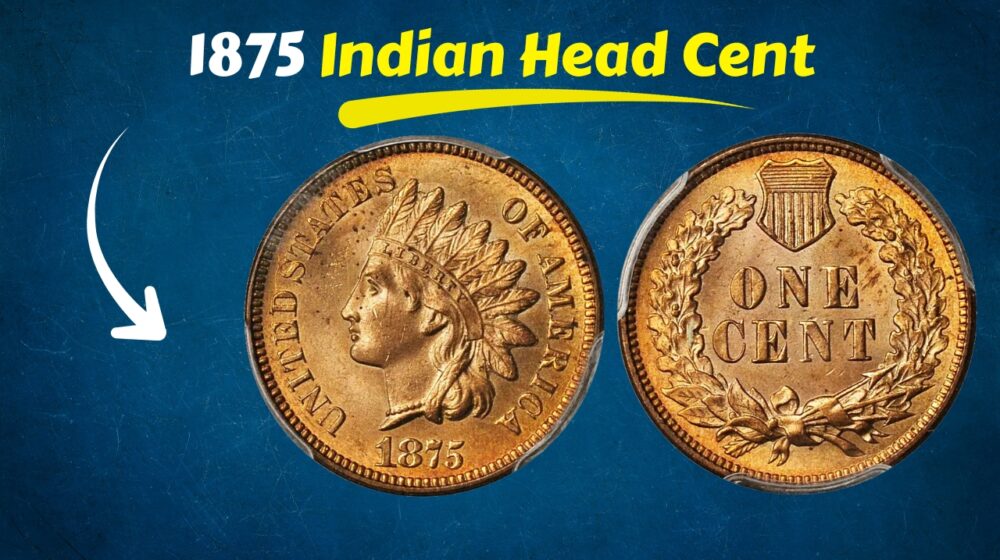
Most die varieties happen by accident a clashed die, a repunched date, a doubled letter. The 1875 Indian Head cent known to specialists as the “Dot Reverse” is different. Hidden near the upper-left corner of the N in ONE on the reverse sits a small raised dot, present on coins struck from a single reverse die and nowhere else in the series. For decades it was a curiosity nobody could quite explain. Today, most numismatic researchers believe it is the physical fingerprint of a Philadelphia Mint sting operation, deliberately engineered in 1875 to expose an employee suspected of pocketing freshly struck coins.
It’s a rare case where a U.S. coin variety wasn’t created by error or artistic revision, but by design, as a tool of internal investigation. That origin story, combined with genuine scarcity and a growing following among variety specialists, has turned the 1875 Dot Reverse cent cataloged as Snow-16 (S-16) into one of the more compelling stories in 19th-century American numismatics.
Specifications at a Glance
| Detail | Information |
|---|---|
| Series | Indian Head Cent |
| Date | 1875 |
| Variety designation | Snow-16 (S-16), “Dot Reverse” |
| Mint facility | Philadelphia (no mintmark) |
| Distinguishing feature | Raised dot near the upper-left of the N in ONE, reverse |
| Cause of variety | Believed intentional die alteration by Mint officials |
| Estimated surviving population | Likely only a few dozen confirmed specimens |
| Finest certified grade | MS65+ Red (PCGS) |
| Notable auction result | $2,585, PCGS MS64RB, March 2015 |
| Notable auction result | $4,080, PCGS MS64+RD, Stack’s Bowers, March 2018 |
| Key research source | R. W. Julian, Numismatic Scrapbook, May 1972 |
| Key attribution reference | Rick Snow, Flying Eagle & Indian Cent Attribution Guide, 3rd Edition, Vol. 1 |
| Discovery credit (modern era) | Tom Culhane (identification), Q. David Bowers (2008 publicity) |
Note: mintage figures specific to the Snow-16 die pairing were never recorded by the Mint; only the broader 1875 Indian Head cent mintage exists in official records, and no surviving document isolates how many cents this particular reverse die struck.
Buying the 1875 Dot Reverse Cent: What Collectors Should Know
There was, of course, no “ordering process” for this variety in 1875 it entered circulation quietly and without explanation, mixed in among ordinary Indian Head cents of the date. There are no announced mintage caps, order windows, or purchase limits to speak of, because the coin was never marketed or recognized as a distinct issue until modern researchers pieced its story together. Here is what the buying landscape actually looks like today.
How to find and acquire a genuine example:
- Auction houses specializing in U.S. copper and variety coins. Firms such as Stack’s Bowers have handled certified examples in recent years, and auction appearances, while infrequent, are the most reliable way to find a properly attributed specimen.
- Variety-focused dealers. Because the Snow-16 designation is a specialist attribution rather than a mainstream date/mintmark combination, dealers who focus on Flying Eagle and Indian Head cent varieties are more likely to have examples in stock or know where to source one.
- Certified holders only. Given how subtle the diagnostic dot is, buyers should insist on PCGS- or NGC-certified examples specifically attributed as Snow-16/Dot Reverse, rather than relying on their own attribution of a raw coin.
- Patience is essential. With only an estimated few dozen confirmed survivors, this is not a variety collectors can expect to find on demand building a want list and waiting for the right piece to surface is the realistic approach.
- Check circulated coins too. Because the raised dot reportedly remains visible on coins grading Fine or better, it’s plausible that unattributed examples are still sitting undiscovered in inventories, albums, and accumulations of common-date 1875 cents a detail worth knowing if you enjoy searching through raw material yourself.
Historical Background
An Overlooked Detail for Nearly a Century
For most of the 20th century, the raised dot on certain 1875 Indian Head cents drew little attention from collectors. That changed when researcher R. W. Julian published an article in the May 1972 issue of Numismatic Scrapbook connecting the reverse anomaly to a forgotten internal investigation at the Philadelphia Mint. Once Julian made that connection public, what had been dismissed as an inconsequential mark suddenly became a genuine historical clue.
Suspicion Falls on a Longtime Employee
In 1875, Mint officials in Philadelphia grew concerned that someone working in the press room was stealing newly struck cents. Suspicion settled on George Mitchell, a 76-year-old “helper” who had been with the Mint for more than five decades. His long tenure had made him a familiar, trusted fixture which made the suspicion all the more delicate to handle.
Internal correspondence later cited by both Julian and by Rick Snow in his Flying Eagle & Indian Cent Attribution Guide paints a portrait of a troubled rather than malicious man. Coiner Archibald Loudon Snowden, in an August 24, 1875 letter, described Mitchell as mentally weakened and emotionally erratic, swinging between self-recrimination over disgracing his family and complaints of being persecuted by unsympathetic coworkers.
A Deliberate Trap Built Into the Coinage Itself
Rather than confront Mitchell outright, Snowden devised a quieter method of proof. He directed Coining Room Foreman A. W. Downing to subtly modify a single reverse die, just enough to leave a consistent mark on every coin it struck. The Mint then assigned that altered die to a specific press and had Mitchell placed in charge of that exact press early one morning. From that point forward, every cent produced at that station carried a hidden, built-in identifier effectively turning ordinary coinage into a surveillance tool.
Later that same day, officials searched Mitchell and discovered 33 freshly struck one-cent pieces in his pockets, every one bearing the telltale altered reverse. Confronted with evidence that could not be explained away, Mitchell confessed and resigned immediately. The Mint resolved the matter quietly, and the marked coins including, presumably, some of the very ones taken from Mitchell eventually made their way into circulation with no public explanation of what had happened.
An Unsolved Mystery for Nearly 100 Years
Even after the investigation closed, one key detail remained unrecorded: exactly what change had been made to the die. Surviving Mint records described the scheme but never specified the physical nature of the alteration. Without a known feature to look for, collectors had no way to connect the story to an actual coin, and the episode survived only as an intriguing footnote rather than a recognized numismatic variety.
Rediscovery in the Modern Era
That began to change in the early 2000s, as collectors started paying closer attention to a small raised dot found on certain 1875 Indian Head cents, positioned near the N in ONE and traceable to a single reverse die. Collector Tom Culhane is credited with identifying and drawing attention to an example, and in 2008 numismatic author and researcher Q. David Bowers publicized the find, sparking renewed interest across the hobby.
The logic connecting the dot to Snowden’s scheme is circumstantial but compelling: a raised dot is exactly the kind of simple, unmistakable, hard-to-fake marker a Mint official would choose for a covert identification scheme, and its documented confinement to a single die lines up precisely with the historical account. While no surviving document explicitly confirms “a dot was added,” the convergence of timing, motive, and physical uniqueness has persuaded most specialists that the Dot Reverse is the tangible remnant of the 1875 sting operation.
Design Breakdown: Obverse and Reverse
Obverse
The 1875 cent carries the standard Indian Head design used throughout the series, featuring Liberty depicted in a Native American headdress, facing left, with the date positioned below the portrait. This underlying design element is unchanged from other 1875-dated Indian Head cents nothing about the Snow-16 variety alters the obverse in any way. The variety exists exclusively on the reverse die.
Reverse
The reverse follows the familiar Indian Head cent wreath design, framing the denomination ONE CENT within a wreath, with UNITED STATES OF AMERICA encircling the outer border. What sets the Snow-16 reverse apart from every other 1875 reverse die is a small raised dot positioned near the upper-left corner of the letter N in ONE a feature not part of the coin’s original artistic design, but rather, according to the accepted historical account, a deliberate alteration made to a single die for identification purposes. The dot is subtle enough to have gone unnoticed by the collecting community for generations, yet consistent and distinct enough, once identified, to serve as a reliable attribution point. Reports indicate the dot remains visible on surviving examples graded Fine or better, meaning it can potentially be identified even on well-circulated coins, not just Mint State survivors.
Why This Matters for Collectors
- A variety created with intent, not by accident. Nearly every other die variety in American numismatics results from a mechanical slip, a re-engraving, or an error in the production process. The Snow-16 dot, by contrast, is understood to be a purposeful alteration made by Mint officials for a specific investigative reason a genuinely unique origin story in U.S. coinage.
- Confirmed scarcity with real upside. With likely only a few dozen confirmed specimens known, and no official mintage figures to draw from, the Snow-16 sits firmly in the realm of a true condition and population rarity within the broader Indian Head cent series.
- A story that adds context most coins don’t have. The combination of a documented internal Mint investigation, a named (if unfortunate) suspect in George Mitchell, and a physical coin that may carry direct evidence of that investigation gives this variety a narrative depth that appeals beyond pure die-variety specialists.
- Room for future discoveries. Because the raised dot remains detectable on circulated coins grading Fine or better, it’s entirely plausible that unattributed examples remain in general circulation-era accumulations, dealer junk boxes, or long-untouched collections meaning attentive collectors still have a real chance of finding one themselves.
- Growing recognition translates to rising values. Auction results already show meaningful appreciation, from $2,585 for a PCGS MS64RB example in 2015 to $4,080 for a PCGS MS64+RD example at Stack’s Bowers in 2018, reflecting increasing awareness and demand as the story becomes more widely known.
- A gateway into deeper variety collecting. For collectors who enjoy the research side of the hobby as much as the coins themselves, the Snow-16 is an excellent entry point into the broader world of Flying Eagle and Indian Head cent attribution, an area with many other lesser-known but historically rich varieties.
Quick-Reference Buying Guide
- Learn the diagnostic first. Study reference images of the raised dot near the N in ONE on the reverse before shopping, so you can recognize a genuine Snow-16 candidate at a glance.
- Prioritize certified examples. Look specifically for PCGS or NGC holders that explicitly attribute the coin as Snow-16 or “Dot Reverse” don’t rely on your own attribution for an expensive purchase.
- Search variety-focused dealer inventories. Because this is a specialist attribution rather than a standard date/mintmark issue, dealers who focus on Flying Eagle and Indian Head cent varieties are more likely to have knowledge of, or access to, available examples.
- Watch major copper and variety auctions. Monitor upcoming sales at firms like Stack’s Bowers and Heritage, since confirmed examples surface at auction only occasionally.
- Budget according to grade. Use recent results roughly $2,585 for MS64RB and $4,080 for MS64+RD as a starting reference point, understanding that the finest-known MS65+ Red would likely command a considerably higher premium if offered.
- Consider circulated examples for value. Since the dot reportedly remains visible down to the Fine grade, a well-worn but certified and attributed example can be a more affordable way into the variety than chasing Mint State pieces.
- Check raw 1875 cents carefully. If you enjoy hands-on searching, examine unattributed common-date 1875 Indian Head cents you already own or encounter, since undiscovered Snow-16 examples may still be sitting unrecognized in ordinary holdings.
- Document your research. Given the coin’s unusual historical backstory, keep records of grading certification, auction provenance, and reference sources with your purchase this variety’s value lies as much in its documented story as in its physical rarity.
This article is intended for informational purposes for numismatic collectors and enthusiasts. Population estimates, auction results, and market values should be verified against current dealer and auction sources before making a purchase.