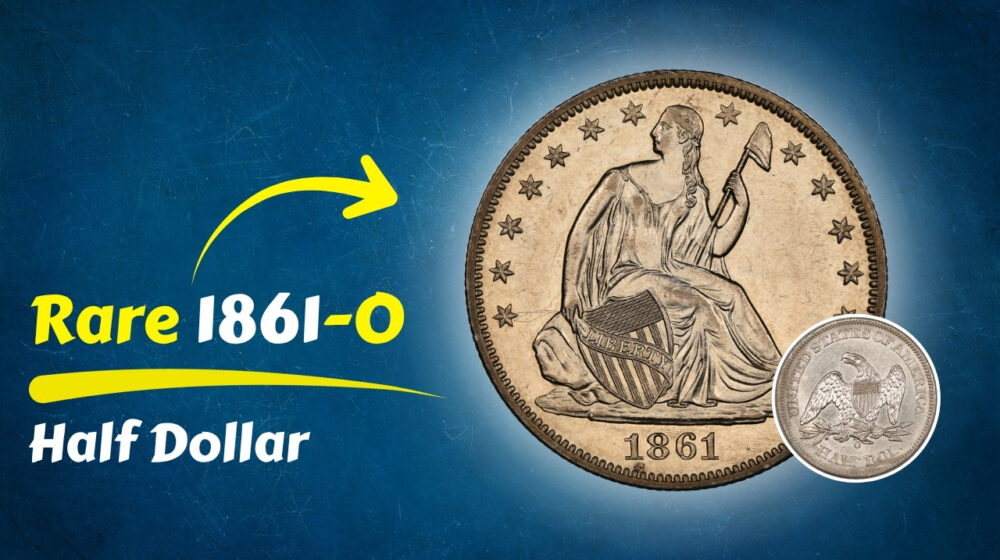
Few coins in American numismatics carry a political résumé as strange as the 1861-O Liberty Seated Half Dollar. Struck at the New Orleans Mint during the opening months of the Civil War, ordinary examples of this date already stand out because they were produced under three different governments the United States, the independent state of Louisiana, and the Confederate States of America using the same building, the same workforce, and the very same federal dies. But one recent auction result has pushed that story even further into the spotlight.
Stack’s Bowers Galleries brought a specially prepared 1861-O half dollar to market as Lot 2094 in its Summer 2026 Global Showcase Auction, part of the firm’s Rarities Night session. Cataloged as a State of Louisiana Issue and graded Specimen-63 by PCGS, the coin realized $170,800 a price that reflects both its extraordinary rarity and its unresolved historical puzzle. Researchers believe as few as four or five Specimen or Branch Mint Proof examples of this issue exist anywhere, and this particular piece was selected by numismatist John W. Dannreuther as the plate coin for the issue in his 2025 reference work on United States Proof coinage.
What makes this coin more than just an expensive rarity is the mystery embedded in its dies. The variety attribution ties it to a die pairing normally associated with United States-era production, yet its finish, strike, and preparation strongly suggest it was struck as a deliberate presentation piece almost certainly under Louisiana’s brief, independent control of the Mint. That contradiction has not been fully resolved, and it is part of what makes this coin so compelling to collectors and historians alike.
Specifications at a Glance
| Detail | Description |
|---|---|
| Denomination | Half Dollar |
| Date and Mint | 1861-O (New Orleans) |
| Type | Liberty Seated Half Dollar, No Motto |
| Variety | JD-1, W-01 |
| Rarity Rating | Rarity-8 (four to five known Specimens) |
| Grade | PCGS Specimen-63 |
| Designer | Christian Gobrecht (Seated Liberty concept based on a design by Thomas Sully) |
| Composition | 90% silver, 10% copper |
| Weight | 12.44 grams |
| Actual Silver Weight | 0.3599 troy ounce |
| Diameter | 30.6 mm |
| Edge | Reeded |
| Total 1861-O Mintage | 2,532,633 |
| — Struck under United States authority | 330,000 |
| — Struck under State of Louisiana authority | 1,240,000 |
| — Struck under Confederate authority | 962,633 |
| PCGS Number | 6422 |
| NGC ID | 27TM |
| Auction Result | $170,800 (Stack’s Bowers, Summer 2026 Global Showcase Auction, Lot 2094) |
How This Coin Came to Market: The Auction Process
Unlike a modern commemorative or bullion release, this piece did not come from a mint order window with published limits and release dates. It is a 165-year-old rarity that surfaced through the secondary market, and understanding how such coins change hands is useful for collectors hoping to pursue something similar.
- Venue: The coin crossed the block at Stack’s Bowers Galleries, one of the leading firms for United States numismatic rarities, as part of a Global Showcase Auction.
- Session: It was placed in the auction’s Rarities Night session, the portion of a major sale reserved for the most significant and valuable lots.
- Lot Number: Lot 2094.
- Cataloging: Stack’s Bowers researched and described the coin’s pedigree, die variety, toning, and strike characteristics in detail, drawing on prior scholarship, including Bill Bugert’s die-variety reference and John Dannreuther’s 2025 Proof coinage study.
- Result: The coin sold for $170,800, a figure that reflects both its Specimen-quality preparation and its status as one of only a handful of survivors of the issue.
- Track record: This was reportedly the fourth example of this general class of 1861-O Specimen that Stack’s Bowers has brought to auction in roughly the last fifteen years, underscoring just how infrequently these coins appear on the market.
For collectors interested in acquiring a comparable piece, there is no fixed “order” process the way there would be for a new Mint product. Instead, availability depends entirely on when a consignor decides to sell and when a major auction house schedules a suitable sale often years apart for a rarity at this level.
Historical Background
The Liberty Seated Half Dollar Design
The Liberty Seated half dollar series began in the 1830s, the product of a broader effort by the United States Mint to modernize its coin designs. The obverse figure was designed by engraver Christian Gobrecht, who adapted a seated Liberty concept originally developed by artist Thomas Sully. The design shows Liberty seated on a rock, holding a liberty pole topped with a cap in one hand and a shield in the other a composition meant to evoke both vigilance and freedom. The 1861-O half dollars used the Type 2 reverse, which had been adopted in 1858, continuing a design language collectors would have recognized for decades.
The New Orleans Mint in 1861
The New Orleans Mint had been coining silver and gold for the federal government since the 1830s, and by 1861 it was a fully operating branch mint with an experienced staff. That continuity is exactly what makes the 1861-O half dollar so unusual. When Louisiana voted to secede from the Union on January 26, 1861, by a vote of 113 to 17, the Mint did not go dark. Three days later, the Louisiana Secession Convention passed an ordinance permitting federal employees to keep working under state authority, and on January 31, Louisiana formally took possession of the Mint.
The building’s leadership stayed largely intact through the transition: Superintendent William A. Elmore, Treasurer A.J. Guirot, Assayer Howard Millspaugh, Chief Coiner Dr. Benjamin F. Taylor, and Melter and Refiner M.F. Bonzano continued running operations. Louisiana therefore inherited a fully functioning mint equipment, dies, bullion, and trained personnel included.
Louisiana’s control did not last long. Coiner Taylor later recalled handing the facility to the Confederacy in the final days of February, though most historical and numismatic accounts place the Confederacy’s formal possession of the building on April 1, 1861. In the roughly two months between the U.S. losing control and the Confederacy taking over, the Mint pressed on, striking half dollars that looked identical to those made before secession.
Three Governments, One Coin
The mintage breakdown for 1861-O half dollars is one of the most remarkable data points in U.S. coinage history. Of the 2,532,633 total half dollars struck at New Orleans that year:
- 330,000 were struck in January under United States authority, before secession took full effect.
- 1,240,000 were struck in February and March under the independent State of Louisiana.
- 962,633 were struck mainly in April under the Confederate States of America.
Because the design never changed, distinguishing which government produced a given coin requires detailed die-marriage research the specialized study of which dies were paired together and in what sequence, pioneered for this series by numismatist Bill Bugert in his 2013 reference work on New Orleans Liberty Seated half dollars.
The Confederate Connection
On April 1, 1861 the same day the Confederacy is believed to have taken possession of the Mint Confederate Treasury Secretary Christopher G. Memminger requested design proposals for a distinctly Confederate half dollar. The result was a striking new reverse featuring a Confederate shield, seven stars, sprigs of cotton and sugar cane, and the legend “CONFEDERATE STATES OF AMERICA.” Only four original Confederate half dollars, pairing that new reverse with the existing federal Seated Liberty obverse, were ever struck. Their existence is actually part of the argument for why the Specimen coins carrying the ordinary U.S. design were likely made earlier: if the Confederacy wanted ceremonial pieces after April 1, it had its own new design to showcase, not the old federal one.
Obverse and Reverse Design Details
Obverse
The obverse features Christian Gobrecht’s Seated Liberty motif. Liberty is shown seated on a rock, facing left, dressed in flowing drapery. Her left hand supports a shield inscribed “LIBERTY,” symbolizing preparedness, while her right hand holds aloft a pole topped with a liberty cap, a classical symbol of freedom from bondage. Thirteen stars encircle the design near the border, representing the original states, and the date “1861” appears below Liberty at the base of the coin. On this particular Specimen example, the top of Liberty’s head and stars 7 and 8 show slight softness in strike, a trait shared with at least three other known examples of the issue, according to Stack’s Bowers’ cataloging.
Reverse
The reverse carries the Type 2 design adopted in 1858, showing a heraldic eagle with wings spread, a shield centered on its breast, an olive branch in one talon and a bundle of arrows in the other traditional symbols of peace and military readiness. The denomination is expressed as “HALF DOL.” along the bottom, with “UNITED STATES OF AMERICA” arching around the upper border. On the featured Specimen, the reverse shows the same deliberate, high-quality preparation as the obverse: sharply detailed devices set against unusually reflective fields.
Finish and Surface Character
What separates this coin from a typical circulation-strike 1861-O half dollar is its finish. Stack’s Bowers describes original toning across both sides, with soft powder-blue color near the rims giving way to reddish-gold tones toward the centers. Under direct light, the fields are highly reflective a result of the dies apparently being polished before striking while the raised design elements retain a light frosted texture, producing a modest cameo effect. The strike itself is unusually complete, with a thin, partial wire rim visible along sections of both sides, a hallmark of coins struck from closely set, polished dies. The surfaces show only faint, wispy hairlines, a level of preservation well above what collectors expect from a coin struck for general circulation.
Why This Coin Is a Numismatic Puzzle
Ordinarily, a coin’s die variety helps settle questions about when and by whom it was made. Here, it deepens the mystery.
PCGS currently attributes die pairings W-01 and W-02 to United States-era production, while W-03 through W-08 are linked to Louisiana and later Confederate striking. The Specimen discussed here uses the W-01/JD-1 pairing technically a “United States” combination. Yet its appearance, preparation, and rarity point strongly toward a small, deliberate presentation striking, which Stack’s Bowers and other researchers believe most likely happened under Louisiana’s brief authority rather than as routine federal coinage.
Other known Specimens complicate the picture further. The well-documented Robert LeNeve example and the E. Horatio Morgan coin (sold by Stack’s Bowers for $66,000 in 2019) both use the W-04/JD-2 pairing, which Bugert assigns to Louisiana production fitting neatly with the presentation-piece theory. A Summer 2025 Stack’s Bowers sale included another W-04 example as well. The W-01/JD-1 coins, by contrast, stand apart from that group.
Adding to the puzzle, Dannreuther’s 2025 research identified only one other known W-01/JD-1 Specimen: a coin from the famed James A. Stack, Sr. collection, sold in 1975 and later graded Specimen-64. Notably, it does not share the same die state as the coin sold in 2026, suggesting Mint workers may have produced these special pieces across more than one striking session rather than in a single ceremonial batch. As Dannreuther himself put it, there remain numerous unanswered questions about this issue a rare admission that gives the coin as much scholarly as monetary value.
Why This Matters for Collectors
For collectors of Civil War-era numismatics, the 1861-O half dollar in general already occupies a unique niche: it is a coin whose date and design stayed constant while the government behind it changed twice in a matter of weeks. That alone makes even a common-grade example a genuine, affordable piece of American history, since large numbers of 1861-O halves survive today helped in part by wartime hoarding and, more recently, by quantities recovered from the SS Republic shipwreck.
The Specimen-quality pieces occupy an entirely different tier. With perhaps only four or five surviving examples across all known die varieties of the special issue, coins like the Stack’s Bowers Lot 2094 example are effectively unrepeatable opportunities. Key reasons this matters:
- Extreme rarity: A Rarity-8 designation, combined with an estimated surviving population of four to five coins, places this issue among the scarcest branch-mint Proof or Specimen strikes in the entire Liberty Seated series.
- Documented pedigree and publication: Being selected as the plate coin in a major 2025 reference work gives this specific example a permanent place in the published record, which tends to support both scholarly interest and long-term value.
- Unresolved historical significance: The unanswered questions about exactly when, why, and under which government these coins were struck make the piece a genuine research subject, not just a collectible.
- Cross-collecting appeal: The coin sits at the intersection of numismatics and Civil War history, drawing interest from both traditional coin collectors and collectors of Confederate and secession-era historical artifacts.
- Auction scarcity: With only a handful of appearances at auction over the past decade and a half, opportunities to acquire a comparable coin are infrequent and typically concentrated in major rarities sales.
Quick-Reference Buying Guide
For collectors hoping to pursue an 1861-O half dollar whether a common-date example or a Specimen-quality rarity like the one described here the following steps offer a practical starting point.
- Decide which tier you’re pursuing. Circulated and lower-grade Mint State 1861-O half dollars are widely available and affordable; Specimen or Branch Mint Proof examples are extreme rarities requiring a very different budget and search strategy.
- Learn the die varieties. Study references such as Bill Bugert’s variety guide to understand which die pairings (W-01 through W-08) correspond to United States, Louisiana, or Confederate production before buying.
- Verify authentication and grading. For anything beyond a basic type coin, insist on third-party grading from PCGS or NGC, and check whether the coin has been published or pedigreed in standard references.
- Track major auction house calendars. Rarities of this caliber surface almost exclusively through firms like Stack’s Bowers, Heritage Auctions, and similar houses during marquee sales such as Rarities Night sessions set alerts for upcoming Global Showcase or platinum-level auctions.
- Review the full catalog description and images. Auction listings for coins at this level typically include detailed toning, strike, and surface descriptions; read them closely, as subtle die-state differences can affect both authenticity and value.
- Set a bidding budget in advance. Given past results including the $170,800 result for the featured Specimen and the $66,000 result for the Morgan example budget realistically for the rarity tier you are targeting.
- Consult pedigree and reference literature. Cross-check any coin under consideration against published references, including Dannreuther’s 2025 Proof coinage study and Walter Breen’s Encyclopedia of United States and Colonial Proof Coins, to confirm its place among known survivors.
- Work with a specialist if bidding at the high end. For six-figure rarities, many collectors engage a numismatic advisor or dealer experienced in Civil War-era issues to help evaluate condition, pedigree, and fair market value before bidding.
This article is intended for informational purposes and reflects publicly reported auction results and numismatic research current as of the sale discussed. Prices realized at auction can vary significantly based on condition, pedigree, and market conditions at the time of sale.