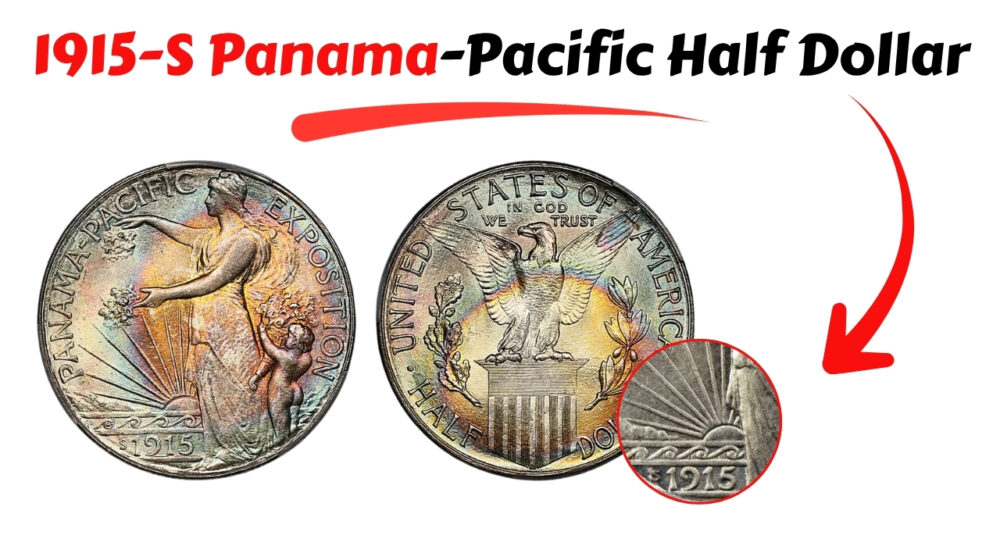
A city rising from disaster. A canal reshaping global trade. Two of the U.S. Mint’s most celebrated engravers, working together on a single piece of silver. The 1915-S Panama-Pacific Exposition Half Dollar carries all of that history in a coin small enough to fit in the palm of your hand and a superbly toned example, graded PCGS MS-68 and approved by CAC, recently crossed the auction block at GreatCollections.
Bidding on the coin, which comes from the JFM57 Collection of Silver Commemoratives, closed Sunday, September 6, 2026. GreatCollections reported that only a single example grades finer at PCGS, placing this coin among the very best surviving specimens of one of America’s most ambitious early commemorative coin programs. Here’s the full story behind the coin, the World’s Fair that inspired it, and what makes a Panama-Pacific half dollar at this level such a significant find for collectors.
Specifications at a Glance
| Category | Detail |
|---|---|
| Country | United States |
| Year | 1915 |
| Denomination | Half Dollar |
| Mint | San Francisco |
| Mintmark | S |
| Obverse Designer | Charles E. Barber |
| Reverse Designer | George T. Morgan |
| Composition | 90% silver, 10% copper |
| Weight | 12.5 grams |
| Diameter | 30.6 mm |
| Actual Silver Weight | 0.3617 troy ounce |
| Edge | Reeded |
| Maximum Authorized Mintage | 200,000 |
| Total Struck | 60,030 |
| Reserved for Assay | 30 |
| Destroyed (Unsold) | 32,866 |
| Net Distribution (Collectible Mintage) | 27,134 |
| Featured Grade | PCGS MS-68 |
| Additional Approval | CAC Green |
| PCGS Number | 9357 |
| Provenance | JFM57 Collection of Silver Commemoratives |
| Auction House | GreatCollections |
| GreatCollections Item Number | 2201016 |
| Auction Close | Sunday, September 6, 2026, approximately 6:44 p.m. Pacific / 9:44 p.m. Eastern |
| Prior MS-68 Auction Record | $30,550 (April 2015, per PCGS CoinFacts) |
How the Auction Unfolded
This coin’s bidding window has already closed, so there’s no active order process to describe going forward but understanding how GreatCollections structured the sale is useful for collectors following high-grade commemorative material:
- Auction house: GreatCollections, a platform known for handling major U.S. numismatic rarities, including multiple 1804 Silver Dollars and other landmark coins.
- Item number: 2201016.
- Close time: Sunday, September 6, 2026, at approximately 6:44 p.m. Pacific Time (9:44 p.m. Eastern). GreatCollections uses individual closing times for each lot, so bidders on similar items should always confirm the exact close time on the live auction page rather than assuming a fixed schedule.
- Historical pricing context: PCGS CoinFacts records a prior MS-68 auction result of $30,550 from April 2015, giving prospective bidders a useful benchmark for what elite examples of this issue have commanded. For comparison, a PCGS MS-67+ CAC example sold for $17,625 in July 2017, illustrating just how sharply value increases at the very top of the grading scale for this issue.
For collectors interested in acquiring a comparable Panama-Pacific half dollar, GreatCollections maintains an active auction archive for the series, along with other major auction houses and dealers specializing in classic U.S. commemorative coinage. Given how infrequently top-population coins like this MS-68 example come to market, patience and diligent tracking of auction listings remain essential.
Historical Background
A World’s Fair With Two Messages
The story behind this coin begins with the Panama-Pacific International Exposition, a massive World’s Fair that San Francisco hosted in 1915. On its surface, the fair celebrated the completion of the Panama Canal the year before a genuine engineering triumph that reshaped global maritime trade by connecting the Atlantic and Pacific Oceans. But the exposition carried a second, equally powerful message: San Francisco wanted to show the world it had recovered from the catastrophic 1906 earthquake and fire that had devastated the city less than a decade earlier.
The fair itself was enormous in scope, spanning more than 600 acres along San Francisco’s waterfront. It opened February 20 and closed December 4, 1915, drawing more than 18 million visitors to its exhibition halls, international pavilions, gardens, and technological displays over that span. The event functioned simultaneously as a celebration of engineering achievement and a public declaration of civic resilience.
An Unprecedented Five-Coin Program
Congress backed the exposition with an ambitious commemorative coin program unlike anything attempted before: five separate coins, including this silver half dollar, a gold dollar, a gold quarter eagle, a round $50 gold piece, and an octagonal $50 gold piece. Crucially, the San Francisco Mint struck all five issues, making the Panama-Pacific coins the first United States commemorative coins ever produced at a branch mint rather than at Philadelphia.
Two Legendary Engravers, One Coin
The half dollar itself represents a genuine collaboration between two of the Mint’s most accomplished engravers. Chief Engraver Charles E. Barber designed the obverse, while his longtime assistant, George T. Morgan who would later succeed Barber as Chief Engraver and remains best known today for the Morgan Dollar designed the reverse. Their combined work on this single coin gives it added significance within the broader story of early 20th-century U.S. Mint artistry.
Notably, Barber’s obverse design departs sharply from the more rigid, formal portraiture typically associated with his regular-issue coinage, suggesting an engraver working with unusual creative freedom for this special commemorative project.
A Numismatic First
The Panama-Pacific half dollar also achieved a genuine numismatic milestone: it became the first United States commemorative coin to carry the motto “IN GOD WE TRUST,” which appears above the eagle on the reverse. Combined with its status as the first commemorative half dollar struck outside Philadelphia, the coin represents a meaningful turning point in the early history of American commemorative coinage.
Strong Fair, Weak Coin Sales
Even with millions of fairgoers passing through the exposition, the half dollar never came close to its authorized limit. Of the 60,030 coins struck, the Mint reserved 30 for assay purposes, organizers successfully distributed 27,134, and the government ultimately melted 32,866 unsold pieces. That net distribution of 27,134 is the figure collectors use today as the coin’s effective, collectible mintage a relatively small surviving population that helps explain the demand these coins generate more than a century later.
Description of the Obverse and Reverse
Obverse
Charles Barber’s obverse presents an allegorical figure of Columbia walking toward the left, both arms extended as she scatters flowers. Behind her, a child stands holding a cornucopia, and together the two figures symbolize the agricultural wealth and natural resources of the American West. Rays from a setting sun spread across the background above the strait known as the Golden Gate a natural geographic feature that predates the Golden Gate Bridge (which wouldn’t be completed until more than two decades later) by a significant margin. The composition captures a sense of abundance and westward optimism distinct from Barber’s more formal regular-issue portrait work.
Reverse
George Morgan’s reverse presents a bold national emblem: an American eagle with wings raised, standing atop a shield, flanked by oak and olive branches. The oak branch traditionally symbolizes strength, while the olive branch represents peace a fitting pairing for a coin commemorating both an engineering triumph and a city’s civic recovery. The motto “IN GOD WE TRUST” appears above the eagle, marking its historic first appearance on a U.S. commemorative coin.
Edge
The coin carries a reeded edge, consistent with standard half dollar production of the era.
Why This Matters for Collectors
- It represents the pinnacle of the issue’s condition census. With GreatCollections reporting only one PCGS-certified example finer, this MS-68 coin sits at (or extremely near) the absolute top of what’s achievable for the date.
- Strike and surface quality vary meaningfully across the issue. PCGS notes that most surviving examples fall in the MS-63 to MS-64 range, with population dropping sharply at the Gem level and above meaning collectors need to examine details like the eagle’s breast feathers closely to judge strike quality on any example they’re considering.
- The coin bridges multiple threads of American history. It commemorates the completion of the Panama Canal, San Francisco’s recovery from the 1906 earthquake and fire, and the collaborative artistry of two of the era’s most important Mint engravers, all in a single design.
- Its historical “firsts” add lasting significance. As the first U.S. commemorative coin to bear “IN GOD WE TRUST” and the first commemorative half dollar struck at a branch mint, this issue holds a genuinely important place in the broader story of American commemorative coinage.
- A relatively small surviving population supports long-term demand. With a net distribution of just 27,134 coins out of a 200,000 authorized maximum, the Panama-Pacific half dollar remains meaningfully scarcer than its original mintage authorization might suggest and scarcer still at the very highest certified grades.
Quick-Reference Buying Guide
- Understand the grading landscape for this issue. Know that MS-63 and MS-64 are the most commonly encountered grades, while MS-67 and MS-68 examples represent genuine condition rarities.
- Examine strike quality closely. Pay particular attention to the eagle’s breast feathers and other fine reverse details, since strike sharpness varies noticeably across surviving examples.
- Evaluate toning carefully. Color can range from attractive, collector-desirable toning to dark or distracting surfaces decide what level of toning appeals to you before bidding.
- Check current PCGS population data. Population reports for elite grades like MS-68 can shift over time as new examples are certified or existing coins are resubmitted.
- Prioritize CAC-approved examples at high grades. As with many elite commemorative coins, CAC approval adds a valuable layer of quality confirmation at the top of the grading scale.
- Research recent auction results for context. Benchmarks like the $30,550 MS-68 result from April 2015 and the $17,625 MS-67+ CAC result from 2017 offer useful pricing context across different grade levels.
- Buy through major, established auction houses. Platforms like GreatCollections, along with other reputable auction houses and dealers specializing in classic commemoratives, offer the most reliable path to authenticated, well-documented examples.
- Track auction archives for comparable listings. Given how infrequently top-grade examples appear, monitoring auction house archives and upcoming listings is often the most effective way to find a coin at the grade level you’re targeting.