An old saying warns that you cannot turn cheap material into something fine just by giving it a fancier name. In numismatics, that warning increasingly applies not to outright fakes, but to legitimate, genuine coins that have picked up increasingly elaborate titles over the decades titles that outrun what the historical record actually supports.
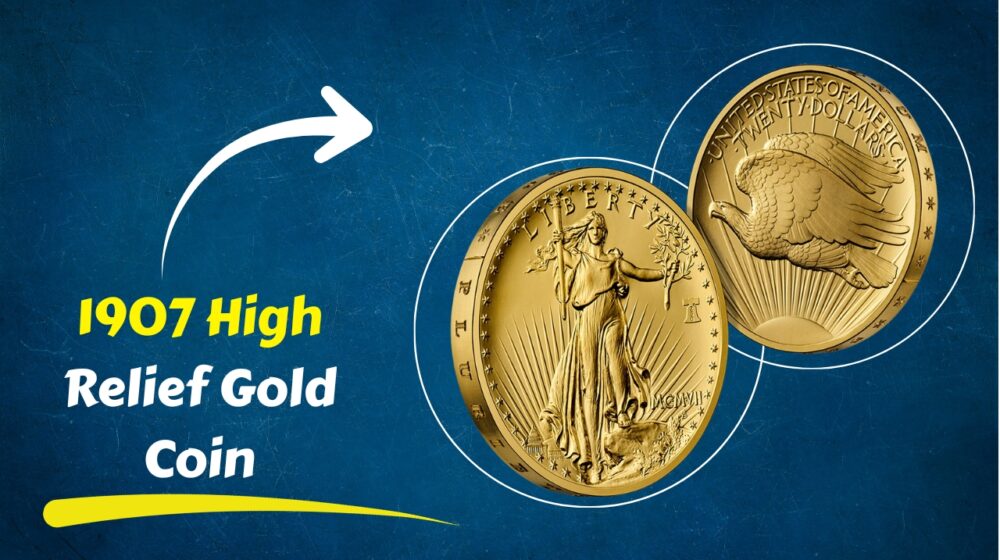
No coin illustrates the problem better than the 1907 High Relief Saint-Gaudens double eagle. It’s one of the most admired coins the United States Mint ever produced: a $20 gold piece born from President Theodore Roosevelt’s personal campaign to drag American coinage out of what he considered artistic mediocrity. But roughly a century after it left the Mint, the coin found itself at the center of a very modern controversy one grading service calling certain examples “Proof,” another calling them “Specimen,” and neither able to point to a Mint order that actually created a distinct Proof issue.
This piece lays out everything a collector needs to know about the 1907 High Relief double eagle: its specifications, its origins, the design itself, how the attribution dispute arose, and because there is no current “order window” for a coin struck in 1907 practical guidance on how collectors today actually go about acquiring one on the secondary market.
Specifications at a Glance
| Detail | Information |
|---|---|
| Denomination | $20 gold double eagle |
| Design | Saint-Gaudens High Relief (Roman numeral date, MCMVII) |
| Designer | Augustus Saint-Gaudens; dies adapted for production by Chief Engraver Charles E. Barber |
| Mint | Philadelphia |
| Composition | 90% gold, 10% copper |
| Total weight | Approx. 33.44 grams (standard double eagle weight) |
| Diameter | Approx. 34 mm |
| Edge | Raised lettering, E PLURIBUS UNUM, applied via segmented collar; wire-rim and flat-rim varieties exist |
| Striking method | Three blows from a medal press with annealing between strikes |
| Reported mintages | Figures vary by source: 11,250 (older references); 12,367 (Guide Book of United States Coins); 12,867 struck, less 80 melted for a net 12,787 (Roger Burdette’s archival research); 12,153 (1908 Mint Director’s report) |
| Regular-strike (Arabic numeral) 1907 mintage, for comparison | 361,667 |
| Grading designations in the market today | “High Relief” (business strike), “Proof High Relief” (NGC), “Specimen High Relief” (PCGS) |
| PCGS Specimen population | Reportedly fewer than 20 examples across all grades, with only about seven certified in the Specimen category as of early 2026 |
| NGC Proof population | NGC has certified a substantial number as Proof — reported at 254 in an earlier NGC census |
| Notable auction results | A finest-known NGC PR-69 sold for $534,000 in 2005; ordinary Mint State High Relief business strikes have traded in roughly the $30,000–$130,000+ range depending on grade in recent years |
Because this is a genuine historical issue rather than a modern product, there is no fixed retail price value depends entirely on grade, strike variety (wire rim vs. flat rim), attribution (business strike, Proof, or Specimen), and current market demand.
How Collectors Actually Acquire One Today
There was, of course, an original 1907 distribution process. Roger Burdette’s archival research indicates that of the coins struck, 42 went directly to collectors and 752 were presented to government officials, with the remainder entering commerce and quickly being absorbed by collectors and the public rather than circulating as ordinary money. Roosevelt insisted the coins be real, spendable currency, but their novelty and beauty meant that far more of them were saved than spent one reason the issue survives in relatively good numbers today despite its modest mintage.
For today’s collector, though, there’s no Mint order window to watch. High Relief double eagles trade almost exclusively through major numismatic auction houses and established dealers. Here’s what the buying process typically looks like:
- Coins surface through major auction houses. Firms such as Stack’s Bowers Galleries, Heritage Auctions, and GreatCollections regularly handle High Relief double eagles, from common business-strike examples to the rare Proof/Specimen pieces and the ultra-rare Ultra High Relief patterns.
- Bidding is open to registered bidders. As with most numismatic auctions, participation requires free registration, and significant purchases may require a bid-limit increase or funds verification in advance.
- Pricing depends heavily on variety and grade. A common PCGS or NGC Mint State flat-rim example might trade in the $30,000–$45,000 range in circulated Gem grades, while wire-rim and higher Mint State grades climb well beyond that; Proof or Specimen examples, and the extraordinarily rare Ultra High Relief patterns, can bring hundreds of thousands to multiple millions of dollars.
- Buyer’s premiums, taxes, and shipping apply, just as with any certified-coin auction purchase collectors should always confirm the specific house’s fee schedule before bidding.
- Private dealers offer another route, particularly for coins in the $15,000–$50,000 range, often at a modest discount to full retail auction prices in exchange for a faster, more predictable transaction.
Given the sums involved, most experienced collectors also budget for independent authentication review and, for anything attributed as Proof or Specimen, a close look at the specific diagnostic claims a grading service is making a theme this article returns to below.
Historical Background: Two Threads Behind One Coin
Augustus Saint-Gaudens and the Push for Artistic Coinage
President Theodore Roosevelt believed American coinage was artistically embarrassing compared to the coinage of ancient Greece, and in 1905 he personally recruited sculptor Augustus Saint-Gaudens to redesign the nation’s gold coins. Saint-Gaudens delivered a soaring obverse a striding, full-length figure of Liberty paired with a reverse showing an eagle in flight above a rising sun. It was unlike anything American coinage had produced before.
The problem was practical, not artistic. The relief Saint-Gaudens wanted was too extreme for a standard production coining press; the earliest ultra-high-relief patterns required repeated blows from a slow medal press, workable for a handful of pieces but useless for mass production. Saint-Gaudens continued refining the design with the Mint, but he died on August 3, 1907, before the practical problems were fully solved. Roosevelt, who took the loss hard and had already grown impatient with delays, was in no mood to settle for a small run of experimental patterns he wanted real, circulating coins bearing his artist’s vision.
Charles Barber and the Production Compromise
Philadelphia Mint Chief Engraver Charles E. Barber was tasked with making Saint-Gaudens’ design producible. He lowered the relief from the original ultra-high-relief patterns to a “High Relief” that could be struck though even this reduced version still required three separate blows from a high-pressure medal press, with the coin annealed (softened by heat) between each strike to keep the gold workable. A segmented collar applied the raised edge lettering, E PLURIBUS UNUM, on the final blow.
On November 18, 1907, Roosevelt ordered the Mint to begin issuing the new coins immediately, reportedly telling officials to proceed “even if it takes you all day to strike one piece.” The Mint worked the coins through in batches strike, anneal, strike, anneal, strike, inspect a slow, labor-intensive process that limited output to several hundred pieces per day even after the Mint prepared additional dies and collars to keep pace with Roosevelt’s enthusiasm for the results.
The design proved too impractical for sustained mass production. Later in 1907, the Mint further reduced the relief and switched to Arabic numerals for the date, producing the much larger 361,667-coin run that became the standard Saint-Gaudens double eagle for the rest of the series’ life, through 1933. The Roman-numeral (MCMVII), High Relief version was a one-year-only phenomenon which is precisely why it holds such an outsized place in the hobby today.
Obverse and Reverse: The Design Itself
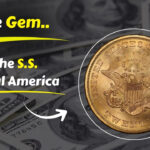
Obverse. Liberty strides forward, torch raised in her right hand and an olive branch in her left, her gown swept by motion, with the Capitol building and rays of sunlight visible behind her. The date appears in Roman numerals, MCMVII, rather than the Arabic numerals used on every other date in the series one of the clearest visual markers that separates this one-year design from its successors.
Reverse. An eagle flies above a rising sun, wings spread across the field, with UNITED STATES OF AMERICA arcing above and TWENTY DOLLARS below. The high relief gives the eagle and the sun’s rays genuine sculptural depth compared to the flattened, low-relief eagle that appeared on the coin after Barber’s later revisions.
Edge. Rather than a design feature struck by the obverse or reverse dies, the lettering E PLURIBUS UNUM was applied to the coin’s edge by a segmented collar during the final of the three strikes a detail that later became central to the attribution debate, since certain die polish characteristics and collar combinations are used by researchers and grading services to sort business strikes from the rarer Proof or Specimen pieces.
The Attribution Controversy: Why “Proof” and “Specimen” Don’t Agree
This is where the coin’s modern story becomes genuinely complicated and where the “silk purse” warning applies most directly.
No Mint order for a separate Proof issue has ever been found. Researchers have combed the historical record and found no documentation directing Mint workers to strike a distinct group of Proof High Relief double eagles, no recorded Proof mintage figure, and no clearly stated production purpose separating certain coins from the rest of the run. Every High Relief double eagle was made using essentially the same three-blow, anneal-between-strikes process as part of Roosevelt’s push to get the design into circulation.
Yet certain coins look different. Researchers have identified multiple die marriages and more than one edge collar used across the production run. Some of these combinations produced coins with sharper details, distinctive die-polish lines in the fields, and other characteristics that numismatic scholar Walter Breen, in his 1988 Encyclopedia of United States and Colonial Proof Coins, proposed as diagnostic indicators of special strikings. Whether that appearance reflects deliberate special manufacture, or simply the natural progression of dies from fresh (early in their use) to worn (later in their use), is exactly the question at the heart of the dispute.
The grading services disagree with each other. NGC has certified a substantial number of High Relief double eagles as Proof into the hundreds, by NGC’s own published census. PCGS has taken a far more conservative position, using the “Specimen” designation instead of “Proof,” and has certified only a handful of coins under that heading reportedly fewer than 20 total, with about seven at the finest Specimen grade level as of early 2026. The same physical coin can therefore be marketed very differently depending on which holder it happens to be in.
“Specimen” carries its own ambiguity. Unlike “Proof,” which at least implies a specific, definable manufacturing process (specially polished dies and planchets, multiple strikes, particular quality control), “Specimen” is a softer term. It doesn’t require anyone to prove the Mint intended to create presentation pieces, reserved a specific quantity for dignitaries, or recorded a separate delivery it simply flags a coin as unusual. That flexibility is exactly what makes it commercially convenient and historically slippery at the same time.
A cautionary example: the unique Plain Edge High Relief. For years, a unique High Relief double eagle lacking the normal raised edge lettering was described by researchers and auction catalogers as an experimental or trial strike an exciting, and expensive, title. Later research, associated with Stack’s Bowers specialist Vicken Yegparian, offered a much less dramatic explanation: the Mint used a plain collar for the first two blows and only added the lettered collar for the third, and this particular coin simply appears to have missed that final edge-lettering step, whether through an operator’s oversight or a procedural change in how blanks were prepared. The coin is still unique and important but its significance now rests on documented production evidence, not an evocative label.
Why This Matters for Collectors
Grading labels are opinions, not history. A “Proof” or “Specimen” designation on a certification label reflects a grading company’s attribution methodology, not a rediscovered Mint document. Collectors paying a premium for that designation should understand they are trusting a company’s diagnostic criteria, not buying a documented fact.
The premium can be substantial. Because Proof and Specimen designations are rare and desirable, coins carrying them typically command significantly higher prices than visually similar business-strike examples. That premium is real in the marketplace but it is a market premium for a label, not necessarily a premium tied to certain original Mint intent.
Cross-service disagreement is a red flag worth understanding, not ignoring. When NGC and PCGS take meaningfully different positions on the same category of coin, it signals genuine scholarly uncertainty rather than a simple grading error. Collectors should read up on both services’ stated criteria before assuming either label settles the question.
Research can move in either direction. The Plain Edge High Relief case shows that dramatic titles can be walked back by better research, just as the Proof/Specimen debate shows that a “plain” die-state coin can later be recognized as something more unusual. Attribution is not static, and today’s label is not guaranteed to be tomorrow’s consensus.
Transparency should be the price of a premium. Collectors are well served by asking any grading service or dealer claiming a special designation to explain the specific diagnostic criteria behind that claim, rather than accepting the word on the holder at face value. A confident label is not the same thing as documented Mint intent.
Quick-Reference Buying Guide
- Decide which category you’re after — common business-strike High Relief, wire-rim vs. flat-rim variety, or a Proof/Specimen-attributed example since prices and rarity differ enormously between them.
- Study both grading services’ positions on Proof vs. Specimen attribution before shopping, so you understand what each label on a holder is actually claiming.
- Check current population reports at PCGS and NGC for the specific designation and grade you’re considering, since these figures shift as new coins are certified.
- Shop through reputable major auction houses or established dealers — Stack’s Bowers, Heritage Auctions, and GreatCollections are among the firms that regularly handle this issue.
- Register and confirm your bidding limit in advance if you plan to bid at auction, especially for higher-grade or specially attributed examples that may sell well into five or six figures.
- Compare recent, comparable sales for the same grade, strike variety, and attribution before setting your maximum bid, since prices can vary widely by these factors.
- Budget for buyer’s premiums, applicable sales tax, and secure shipping on top of the hammer price when calculating your total cost.
- For a Proof- or Specimen-attributed coin, ask for the specific diagnostic basis behind that designation rather than relying on the holder’s label alone, and weigh whether the commercial premium matches your own comfort with the underlying evidence.
This article discusses genuine, certified historical U.S. coinage and the ongoing scholarly and commercial debate over Proof/Specimen attribution for the 1907 High Relief double eagle. It is not a guide to any current Mint product or limited-edition release.