Few coins in American numismatics can claim a story as dramatic as this one. AU Capital Management (AUCM) is currently offering an 1857-S Liberty Head Double Eagle, graded MS-65 by PCGS, that carries the scarce Spiked Shield reverse variety and, according to the seller, a pedigree tracing back to the wreck of the S.S. Central America, the fabled “Ship of Gold.”
This is not a modern commemorative or a limited mintage release from the U.S. Mint. It is a 169-year-old survivor: a $20 gold piece struck in San Francisco during the height of the California Gold Rush, loaded aboard a steamship bound for New York, lost in a hurricane in 1857, and recovered from roughly 8,000 feet of water more than a century later. Its combination of an identifiable die variety, a documented shipwreck connection, and a lofty Gem Mint State grade puts it in rarefied company among Type I double eagles.
At a Glance: Coin Specifications
| Detail | Description |
|---|---|
| Country | United States |
| Denomination | $20 Double Eagle |
| Year | 1857 |
| Mint / Mintmark | San Francisco / “S” |
| Type | Liberty Head Double Eagle, Type I |
| Variety | Variety-20A, “Spiked Shield” (PCGS #70000) |
| Designer | James Barton Longacre |
| Strike Type | Business strike |
| Total 1857-S Mintage | 970,500 |
| Composition | 90% gold, 10% copper |
| Gold Content | 0.9675 troy oz |
| Weight | 33.40 grams |
| Diameter | 34.00 mm |
| Edge | Reeded |
| Grade | PCGS MS-65 |
| PCGS Certification Number | 34803572 |
| Reported Provenance | S.S. Central America |
| Current Seller | AU Capital Management |
| Price | Available upon inquiry through AUCM |
How to Purchase This Coin
Because this is a single certified rarity offered through a private numismatic dealer rather than a mint-issued product with a fixed release date, the buying process looks different from a typical new-coin launch. There is no subscription window, per-household order limit, or mintage countdown instead, availability is limited to a single certified example (PCGS #34803572), and the coin can be sold at any time once a buyer commits.
Prospective buyers should keep the following in mind:
- Availability: As a one-of-a-kind certified coin, this specific piece is available only until it sells. There is no reissue or waitlist once it is gone.
- Pricing: AUCM has not published a fixed list price in its promotional materials; interested collectors should contact the dealer directly for current pricing, which will reflect gold spot price movement, the coin’s Gem grade, and its shipwreck story.
- Verification: Buyers should confirm the PCGS certification number (34803572) directly on PCGS’s public certification lookup before purchasing, and ask the dealer for any supporting documentation regarding the 2024 Stack’s Bowers listing referenced in connection with the coin’s provenance.
- Payment and authentication: As with any high-value rare coin purchase, work only through a reputable, established dealer, request high-resolution images or a video walkthrough of the actual coin (not stock photography), and consider third-party escrow or insured shipping for a purchase at this price point.
- Provenance caveat: AUCM states that a 2024 Stack’s Bowers listing linked the coin to the S.S. Central America, but the current PCGS holder insert does not itself carry that pedigree notation. Collectors who place a premium on documented pedigree should ask the seller for the paper trail supporting that claim.
Historical Background
The San Francisco Mint and the Birth of the Type I Double Eagle
The San Francisco Mint had been open for only three years when this coin was struck. Congress authorized the branch mint to convert the flood of California gold into official U.S. coinage close to where it was mined, sparing shippers and merchants the need to send raw bullion all the way to Philadelphia. By 1857, the young mint was operating at full Gold Rush capacity, striking 970,500 Liberty Head Double Eagles that year alone. At $20 face value and containing nearly a full ounce of gold, the double eagle was the most efficient coin denomination available for moving large sums of money across a country that still lacked a transcontinental railroad.
James Barton Longacre and the Liberty Head Design
Chief Engraver James Barton Longacre created the Liberty Head Double Eagle, later known to collectors as the Type I design, which was struck without the motto “In God We Trust” and without a value denomination spelled out on the reverse (features added in later design changes). Longacre’s obverse depicts an idealized figure of Liberty; his reverse pairs a heraldic eagle with a shield. Struck in a standard 90% gold, 10% copper alloy, each coin weighed 33.40 grams and measured 34 millimeters across — a substantial coin by any standard, and one that was built for commerce and bullion transport rather than pocket change.
The Spiked Shield Variety
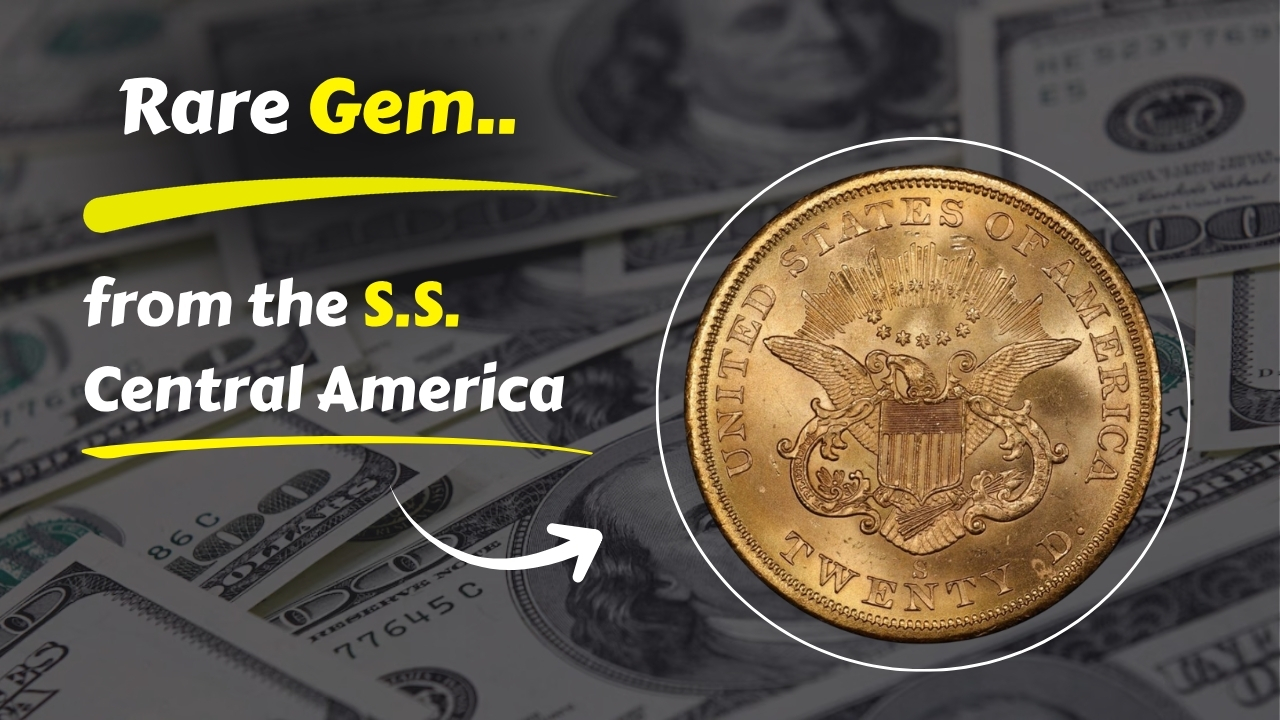
Collectors who examine the reverse of this coin closely will notice something unusual in the shield design on the eagle’s breast. Known as the “Spiked Shield” and catalogued as Variety-20A, this die variety is named for two small raised projections, or “tines,” that pierce the left edge of the shield — a flaw or feature of a specific working die used at the San Francisco Mint that year. Unlike many die varieties that require magnification to identify, the Spiked Shield is distinctive enough to spot with the naked eye, which has made it a popular target for variety specialists. PCGS catalogs the variety separately under PCGS #70000, and it appears with notable frequency among the 1857-S double eagles recovered from the S.S. Central America wreck, tying this particular die state directly to the ship’s cargo.
The S.S. Central America: The “Ship of Gold”
The coin’s most compelling chapter began in August 1857, when the steamship Sonora left San Francisco loaded with millions of dollars in California gold. Following the standard route of the era, the treasure and passengers crossed Panama by rail and were then loaded onto the side-wheel steamer S.S. Central America, under the command of U.S. Navy officer William Lewis Herndon, for the final leg toward New York.
After departing Havana, the ship sailed directly into a powerful hurricane. The storm raged for days, overwhelming the vessel’s pumps despite frantic bucket-brigade efforts by passengers and crew. On September 12, 1857, with the ship unable to stay afloat, Herndon ordered women and children into the lifeboats first and remained aboard as the Central America went down, a disaster that claimed roughly 425 lives.
The sinking also sent tons of California gold including a large quantity of freshly struck 1857-S double eagles to the bottom of the Atlantic. The loss struck at a particularly vulnerable moment for the U.S. economy, arriving in the midst of the Panic of 1857 and depriving struggling banks of specie they badly needed, a factor historians credit with deepening that financial crisis.
The wreck lay undisturbed roughly 8,000 feet below the surface for more than 130 years until treasure hunters located it in 1988. The recovery effort brought thousands of gold coins back into circulation among collectors for the first time since the ship went down, fundamentally changing what the market knew about the 1857-S double eagle. PCGS CoinFacts records 5,193 examples of the date from the Central America treasure alone. Before the recovery, high-grade Mint State examples of San Francisco Type I double eagles were rarely seen; the recovered coins, having spent their existence on the ocean floor rather than in circulation, offered collectors a fresh look at coins as they left the mint.
Obverse and Reverse Design Details
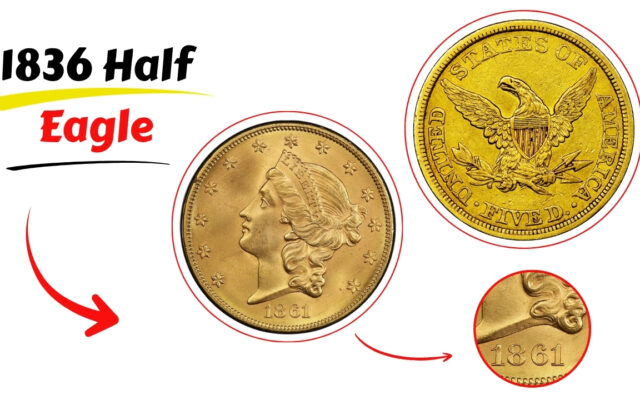
Obverse: The obverse carries Longacre’s Liberty Head portrait, showing Liberty facing left wearing a coronet inscribed “LIBERTY,” with her hair gathered behind in a bun. Thirteen stars, representing the original states, encircle the bust, with the date 1857 placed below.
Reverse: The reverse presents a heraldic eagle with wings spread, a shield resting on its breast, and a constellation of stars above surrounded by rays. “UNITED STATES OF AMERICA” and “TWENTY D.” (for twenty dollars) frame the design. On this particular coin, the Spiked Shield variety is visible in the two small projecting “tines” piercing the shield’s left edge the identifying mark of Variety-20A.
Surface quality: AUCM describes this MS-65 example as exceptionally well preserved for the issue. The surfaces show rich satin luster across both sides, with a rose-gold color that deepens toward the borders. The strike is described as bold and complete across Longacre’s design, and the fields are said to show unusually few contact marks for a coin of this size, weight, and age a meaningful point given how easily large gold coins can pick up bag marks even without ever entering circulation.
A useful reference point: in a 2024 Stack’s Bowers offering of a comparable MS-65 Spiked Shield example, PCGS population data at that time showed 619 coins graded MS-65 in that variety category, with 158 graded finer. Because population reports shift continually as coins are resubmitted, regraded, or reholdered, collectors should treat that figure as a snapshot from 2024 rather than a fixed, current total.
Why This Coin Matters for Collectors
This single coin offers something for several different types of collectors at once:
- Liberty Head gold specialists gain a Gem-quality Type I Double Eagle, a grade level that is difficult to find for this issue outside of shipwreck recoveries.
- Die variety collectors get an easily identifiable, well-documented variety (Spiked Shield / Variety-20A) rather than a marginal, hard-to-verify die marker.
- California Gold Rush collectors hold a coin struck from gold mined and coined at the height of the Rush, at a mint that was only three years old.
- Maritime and shipwreck history collectors own a tangible artifact connected to one of the most famous marine disasters in American history and to the recovery effort that reshaped the rare coin market for Type I double eagles.
Beyond any single collecting category, the coin’s condition tells its own story: a piece struck in 1857, shipped across a continent, lost in a hurricane, buried for over a century beneath the Atlantic, and recovered still able to grade MS-65. That combination of history and preservation is difficult to find in any single 34-millimeter object.
The coin is offered by AU Capital Management, a numismatic firm led by President and CEO Russell Augustin, who entered the coin business in 1982 and founded AUCM in 2005.
Quick-Reference Buying Guide
- Confirm the certification. Look up PCGS certification number 34803572 on PCGS’s public verification tool to confirm the grade, variety attribution, and holder details match what’s being offered.
- Contact AU Capital Management directly. Since no fixed list price is published, request current pricing and availability, as this is a single, one-of-a-kind coin.
- Ask about provenance documentation. Request any paperwork or listing history connecting the coin to the 2024 Stack’s Bowers sale and the S.S. Central America recovery, since the current PCGS holder does not itself note the pedigree.
- Request current photos or video. For a coin at this price point, insist on up-to-date images or a video walkthrough of the actual piece rather than stock photography.
- Compare population data. Ask for the most current PCGS population figures for MS-65 and finer in the Spiked Shield variety category, since reported numbers change over time.
- Arrange secure payment and shipping. Use insured, trackable shipping and consider escrow services for a purchase of this size, as is standard practice for rare coins at this value level.
- Retain all documentation. Keep the certification number, invoice, and any provenance materials together for insurance, resale, or estate purposes.