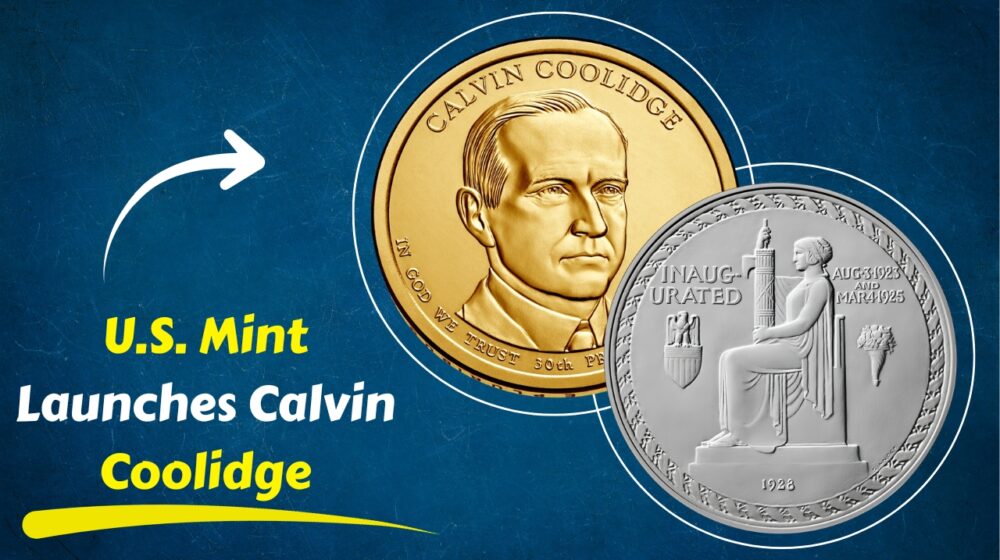
The United States Mint opened orders for the Calvin Coolidge Presidential Silver Medal at noon Eastern Time on Thursday, Sept. 3, 2026, extending its one-ounce silver series to the nation’s 30th president. The medal is struck in 99.9% fine silver, carries a price of $164, and comes with no mintage limit, no product limit and no household order limit.
Both sides of the medal come from the hand of John Ray Sinnock, who served as the Mint’s chief engraver from 1925 until 1947. The timing has a pleasing symmetry: it was Sinnock who modeled the 1926 Sesquicentennial of American Independence half dollar, the coin that made Coolidge the first U.S. president to appear on American coinage during his own lifetime. The new medal arrives almost exactly a century later.
Coolidge is the third medal of 2026 in a program that has released four presidents a year since 2019. Woodrow Wilson and Warren G. Harding came first this year, and Herbert Hoover is scheduled to close out the 2026 lineup later this year.
Calvin Coolidge Presidential Silver Medal: Specifications at a Glance
| Detail | Information |
|---|---|
| Product | Calvin Coolidge Presidential Silver Medal |
| Mint item number | S830 |
| On-sale date | Thursday, Sept. 3, 2026, at 12 noon ET |
| Price | $164.00 |
| Mintage limit | None |
| Product limit | None |
| Household order limit | None |
| Composition | 99.9% fine silver |
| Weight | 1.000 troy ounce |
| Diameter | 1.598 inches (about 40.6 mm) |
| Finish | Matte |
| Edge | Plain |
| Denomination | None (a medal, not legal-tender coinage) |
| Mint and mint mark | None |
| Privy mark | None |
| Obverse designer | John Ray Sinnock |
| Reverse designer | John Ray Sinnock |
| Packaging | Encapsulated, in a presentation case with a certificate of authenticity |
| Subscription code | RJ (Presidential Silver Medal subscription) |
Because no mintage ceiling applies, the final production total will be set entirely by collector demand. The Mint typically reports cumulative sales for the medal series after the fact, so the real number will only be known later.
How to Order the Coolidge Medal
When. Sales began at noon ET on Sept. 3, 2026. The Mint has not announced an end date for the medal, and with no product cap in place, there is no sell-out clock to race. Earlier medals in the series also remain available directly from the Mint.
Where. The primary channel is the U.S. Mint’s online catalog at usmint.gov, where the medal is listed under item number S830. The Mint has also historically taken phone orders at 1-800-USA-MINT (872-6468), though buyers should confirm current ordering options on the Mint’s website.
Limits. None apply. There is no household cap, so a single buyer can order as many medals as they want. The Mint does reserve the right to add, adjust or remove limits on any product at its discretion, so it is worth glancing at the product page if you plan a large order.
What arrives. Each medal is encapsulated and packaged in a presentation case with a certificate of authenticity.
Subscription option. Collectors who don’t want to track release dates can enroll in the Mint’s Presidential Silver Medal subscription (code RJ). Enrollment carries no upfront charge, and each subscription shipment is billed as the next medal in the series comes up. Coolidge was the “next product” listed for a Sept. 3, 2026 ship date. Two caveats from the Mint: previous releases are not included in a subscription, and the Mint can discontinue the program at any time. Subscribers should keep their payment card information current so shipments aren’t interrupted, and they can cancel at any point.
Shipping and handling. Check the Mint’s current shipping schedule at checkout, since fees and options change from time to time.
Historical Background
The Coolidge medal touches three separate pieces of numismatic history: the Mint’s presidential medal program, Sinnock’s original Coolidge medal design, and two earlier U.S. coins that also carried Coolidge’s portrait.
The Presidential Silver Medal Series (2018 to Present)
The Mint’s presidential medals trace back to the earliest years of the republic, when medals were given to Native American leaders as tokens of peace and friendship. The modern silver program revives that tradition in a collector-friendly format.
The series debuted on Aug. 16, 2018, when the Mint began taking orders for George Washington and John Adams silver medals at $39.95 apiece. Both were struck in .999 silver with a matte finish resembling an uncirculated coin. (The Mint is careful to note that “uncirculated” is a term reserved for coins, not medals.) Starting in 2019, the Mint shifted to four releases per year, one per quarter, issued in the order the presidents served.
Sales figures through Aug. 30, 2026 show how collectors have responded across the run:
| Medal | Sales through Aug. 30 |
|---|---|
| George Washington | 39,656 |
| Thomas Jefferson | 26,491 |
| John Adams | 24,657 |
| Abraham Lincoln | 23,106 |
| Theodore Roosevelt | 13,002 |
| William H. Taft | 10,451 |
| Woodrow Wilson | 9,082 |
| Warren G. Harding | 8,634 |
Washington leads by a wide margin, followed by Jefferson, Adams and Lincoln. Most of the later medals have landed somewhere between 10,000 and 15,000 pieces. Notably, Wilson and Harding, the two 2026 releases that came before Coolidge, are the only ones in the tally to fall below 10,000. That is likely due in part to their shorter time on sale, but it is a trend worth watching.
Counting Grover Cleveland only once, since the Mint’s sales list carries a single Cleveland medal, Coolidge is the 29th medal in the series.
John Ray Sinnock’s Original Coolidge Medal Design
Designer: John Ray Sinnock (1888–1947), Chief Engraver of the U.S. Mint from 1925 until 1947.
The Coolidge silver medal reproduces designs by Sinnock, and he is credited with both the obverse portrait and the reverse composition. The Mint also produces a bronze medal with the same designs, and the silver version follows the same approach the series has used from the beginning: take a historic Mint medal design and strike it in one ounce of .999 silver.
One telling detail is the reverse date. The design includes the year 1928, and the Mint notes that this date appears just as it does on Sinnock’s original medal. That points to the design’s late-1920s roots, although the Mint’s release materials don’t spell out when the original medals were first struck.
Sinnock is best remembered by most collectors for later work, including the Roosevelt dime introduced in 1946 and the Franklin half dollar that followed in 1948. His Coolidge medal comes from the earlier, formal era of the Mint’s presidential portraiture.
The 1926 Sesquicentennial of American Independence Half Dollar
Designer: John Frederick Lewis (design sketches), modeled by John Ray Sinnock Mint and year: Philadelphia, 1926 Authorized: Act of March 3, 1925 Composition: 90% silver, 10% copper (12.5 grams, 30.6 mm) Issue price: $1.00
The Sesquicentennial half dollar marked the 150th anniversary of the Declaration of Independence and was sold to help finance the Sesquicentennial Exposition in Philadelphia. Congress authorized up to one million of the half dollars, along with a companion $2.50 gold quarter eagle.
The design has a small backstory. Sinnock was originally asked to create the coins, but while his quarter eagle models were accepted, the exposition association did not approve his half dollar concepts. The group turned to Philadelphia art patron John Frederick Lewis, whose sketches were passed to Sinnock to be turned into working models. As a result, references credit the design to Lewis, Sinnock, or both, depending on the source.
Obverse: Overlapping right-facing busts of George Washington and Coolidge, surrounded by LIBERTY, UNITED STATES OF AMERICA and a small IN GOD WE TRUST. Reverse: The Liberty Bell, flanked by the dates 1776 and 1926, with E PLURIBUS UNUM above and SESQUICENTENNIAL OF AMERICAN INDEPENDENCE and HALF DOLLAR around the rim.
Significance: The coin is historic for showing a sitting president on U.S. coinage, something that generated real public grumbling in the 1920s, when many Americans felt a living person had no place on a coin. The relief is famously low, and the coins are frequently described as some of the weakest strikes in Mint history. The commercial result was unkind as well. The Philadelphia Mint struck the entire million-coin authorization, but only about 141,000 were sold, and roughly 859,000 were returned and melted. (Sources vary slightly on the exact sales tally.) The quarter eagle fared better, selling nearly 46,000 pieces. The half dollar’s Liberty Bell reverse later returned, in modified form, on the Franklin half dollar of 1948. Trivia buffs also like to point out that the first half dollar struck was presented to Coolidge at the exposition.
The 2014 Calvin Coolidge Presidential $1 Coin
Designers: Phebe Hemphill (obverse), Don Everhart (reverse) Mint and year: Philadelphia and Denver, 2014 Sales opened: April 10, 2014, at noon ET Composition: Manganese-brass clad over a pure copper core (8.1 grams, 26.5 mm)
The Coolidge dollar was the second of four Presidential $1 Coins issued in 2014, following Harding and preceding Hoover and Franklin D. Roosevelt. By then, the Presidential $1 Coin Program had been running since 2007, and since late 2011 the Treasury had suspended circulation production because of a large surplus of dollar coins in storage. As a result, the Coolidge dollar was struck in circulating quality but never released into general circulation. The Mint sold it to collectors in 25-coin rolls ($32.95), 100-coin bags ($111.95) and 250-coin boxes ($275.95), each offered from either Philadelphia or Denver. Proof-quality Coolidge dollars were also included in collector sets that year.
Obverse: Hemphill’s portrait of Coolidge with the inscriptions CALVIN COOLIDGE, IN GOD WE TRUST, 30th PRESIDENT and 1923–1929. Reverse: Everhart’s Statue of Liberty, the common reverse used across the series, with UNITED STATES OF AMERICA and $1. The year, E PLURIBUS UNUM and the mint mark are incused on the edge.
Mintage: The Philadelphia issue is recorded at 4,480,000 pieces.
Significance: It is the modern, low-cost way to own a Coolidge portrait on legal-tender U.S. money, and it makes a good bridge between the 1926 half dollar and the 2026 silver medal.
Who Was Calvin Coolidge?
Born on July 4, 1872, in Plymouth Notch, Vermont, Coolidge graduated from Amherst College and built a law practice in Northampton, Massachusetts. He rose steadily through local and state politics, serving as mayor, state legislator, lieutenant governor and governor. His firm handling of the 1919 Boston Police Strike brought him national notice and helped land him on the 1920 Republican ticket as Warren G. Harding’s running mate.
When Harding died in August 1923, Coolidge was sworn in as the 30th president by his father, a notary public, at the family homestead in Vermont. Nicknamed “Silent Cal” for his reserve, he favored limited government, fiscal restraint and pro-business policies during the economic expansion of the 1920s. He won a full term in 1924, chose not to run again, and left office in March 1929. He retired to Northampton, wrote his autobiography and stayed active in public affairs until his death on Jan. 5, 1933.
Design Description: Obverse and Reverse
Obverse
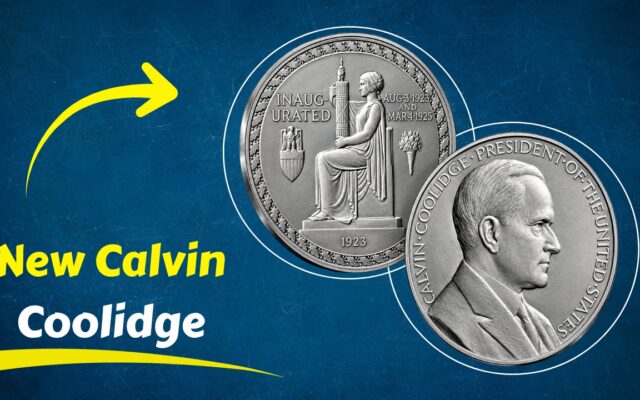
The front of the medal presents a detailed bust of Coolidge in a formal, dignified style consistent with the traditional presidential medal series. The inscription CALVIN COOLIDGE PRESIDENT OF THE UNITED STATES encircles the portrait. Sinnock’s approach is restrained and classical, fitting for a president known for his own reserve.
Reverse
The back is a fully allegorical composition, framed by a stylized laurel wreath. The main elements are:
- A seated female figure holding fasces. The fasces, a bundle of rods historically carried as a symbol of authority, is a classical emblem long used in American civic art.
- A heraldic eagle perched atop the shield of the United States, anchoring the design in national symbolism.
- A cornucopia set nearby, a traditional image of abundance that suits the prosperity associated with the 1920s.
The inscriptions read INAUGURATED, AUG·3·1923 AND MAR·4·1925, and 1928. The two dates mark Coolidge’s succession to the presidency after Harding’s death and his own inauguration to a full term, and the 1928 date is carried over from Sinnock’s original.
Finish and Feel
Like all modern Presidential Silver Medals, the Coolidge piece has a matte finish similar in look to an uncirculated coin, with a plain edge and no mint mark or privy mark. At 1.598 inches across and a full troy ounce, it has the same heft and footprint as the rest of the series, so it sits comfortably alongside earlier releases in the same capsules and display cases.
Why This Matters for Collectors
It continues a complete-set collection. For collectors working through the Presidential Silver Medal series in order, Coolidge is a required stop, and the subscription option is designed to keep you on track. With Hoover due later this year, the 2026 group will soon be complete.
There’s no scarcity pressure, but there is a data story. With no mintage ceiling, this is not a “buy it before it sells out” release. Most medals in the series have sold roughly 10,000 to 15,000 pieces, while Wilson and Harding have come in under 10,000. Collectors who like tracking mintage over time will want to see how Coolidge fares against those numbers once the Mint releases them.
It’s a silver product with a premium. At $164, the medal costs well above its metal content. Price guides in early autumn 2026 put one-ounce melt value at roughly $60 to $64, which means buyers are paying a premium of about $100 for the design, packaging and Mint pedigree. That’s typical for Mint medals, but it means the medal is best viewed as a collectible first and a silver holding second. Silver prices change daily, so check the current spot price before you decide. For perspective, the first two medals in 2018 cost $39.95 each.
It ties into a 100-year Coolidge story. The Sinnock link between the 1926 Sesquicentennial half dollar and this medal gives collectors a natural theme: the 1926 half dollar (the first U.S. coin to depict a president during his lifetime), the 2014 Presidential dollar and the 2026 silver medal make an appealing three-piece “Coolidge trio” across a century of Mint work.
It’s a medal, not a coin. The Coolidge medal carries no denomination and isn’t legal tender. That doesn’t hurt its appeal for the series, but it does put it in a different category from the coins in a Type set or a bullion stack.
This article is for informational purposes and is not investment advice.
Quick-Reference Buying Guide
- Mark the date. The medal went on sale Thursday, Sept. 3, 2026, at 12 noon ET, and there is no announced closing date.
- Go to the U.S. Mint website. Search for “Calvin Coolidge Presidential Silver Medal” or item number S830.
- Confirm the specifications. One troy ounce, 99.9% silver, 1.598 inches, matte finish, plain edge, no mint mark.
- Check the price and any limits. It is $164, with no mintage, product or household order limits at launch. Glance at the page for changes if you plan a big order.
- Decide between a one-time order and a subscription. Subscription code RJ automatically bills each new release as it ships, and it can be cancelled at any time. Past releases are not included.
- Add to your cart and review shipping. Look over the Mint’s shipping options and fees before checking out.
- Complete your order. Each medal arrives encapsulated, in a presentation case, with a certificate of authenticity.
- Store it properly. Keep the medal in its original capsule and case, away from moisture and handling. Silver toning is natural but avoidable.
- Look ahead. Watch for the Herbert Hoover Presidential Silver Medal, scheduled to follow later in 2026.
Sources: U.S. Mint product and press materials, U.S. Mint subscription page, American Numismatic Association coin history, CoinWeek, PCGS CoinFacts and Greysheet price data.