Old US Coins

1936 Delaware Half Dollar: Rare Three-Date Coin Sells for Record Price

by Denio Marca
# 1936 Delaware Half Dollar: Rare Three-Date Coin Sells for Record Price ## Introduction Most coins tell their story through a single date. The 1936 Delaware Tercentenary Half Dollar needs three. It carries "1936" on its obverse, yet the Philadelphia Mint didn't actually strike it until 1937 — and its reverse commemorates an anniversary that didn't arrive until 1938. That three-year calendar puzzle alone would make this coin an interesting curiosity, but the full story runs much deeper, weaving together early Swedish colonial settlement, a 17th-century church that still stands today, a sailing ship that crossed the Atlantic twice in numismatic memory, and the feverish speculation that defined America's classic commemorative coin era. In August 2025, one extraordinary example added a new chapter to that story. Heritage Auctions sold a PCGS MS68 Delaware Half Dollar from the Gregg Bingham Collection for $19,200, setting a new auction record for the issue. The sale closed August 28 as part of Heritage's August 26–31 ANA U.S. Coins auction. For a commemorative coin that originally sold to collectors for just $1.75, that price represents a remarkable journey — and a great excuse to unpack the full story behind this unusually layered piece of American numismatic history. --- ## Specifications at a Glance | Category | Detail | |---|---| | **Denomination** | Half Dollar | | **Face Value** | 50 Cents | | **Date on Obverse** | 1936 | | **Actual Year Struck** | 1937 | | **Anniversary Dates on Reverse** | 1638–1938 | | **Mint** | Philadelphia | | **Mintmark** | None | | **Designer** | Carl L. Schmitz | | **Composition** | 90% silver, 10% copper | | **Weight** | 12.50 grams | | **Diameter** | 30.60 mm | | **Actual Silver Weight** | Approximately 0.3617 troy ounce | | **Edge** | Reeded | | **Total Struck** | 25,015, including 15 assay pieces | | **Coins Returned and Melted** | 4,022 | | **Coins Distributed to Collectors** | 20,978 | | **Standard Net Mintage (PCGS/references)** | 20,993 | | **Original Issue Price** | $1.75 | | **PCGS Number** | 9301 | | **Obverse Design** | Old Swedes Church | | **Reverse Design** | Kalmar Nyckel (ship) | | **PCGS Survival Estimate** | Approximately 17,000 in all grades | | **Auction Record** | $19,200, PCGS MS68, Heritage Auctions, August 2025 | | **Prior Auction Record** | $18,400, PCGS MS67 CAC, Heritage Auctions, January 2012 | --- ## How the Auction Unfolded Because this record-setting sale has already taken place, there's no active order window to describe — but the sale itself, along with the coin's original 1937 distribution, offers useful context for collectors: - **Auction house:** Heritage Auctions. - **Event:** The August 26–31, 2026 ANA U.S. Coins Signature Auction (with the individual lot sale recorded on August 28; PCGS records the transaction under the auction's August 31 closing date). - **Provenance:** The Gregg Bingham Collection. - **Grade:** PCGS MS68 — at the time of sale, Heritage reported only two PCGS examples graded MS68+ and none numerically finer. - **Result:** $19,200, establishing a new PCGS-recognized auction record for the issue, surpassing the previous $18,400 record set by a PCGS MS67 CAC example in January 2012. For collectors interested in acquiring a Delaware Half Dollar today, the path runs through major auction houses like Heritage Auctions and Stack's Bowers, along with dealers specializing in classic U.S. commemorative coinage. Given the coin's relatively healthy survival population — PCGS estimates roughly 17,000 surviving examples across all grades — collectors at more modest budget levels have considerably more options than they would with a true numismatic rarity, while top-population coins like this MS68 example remain genuinely difficult to find. --- ## Historical Background ### 1936: The Peak of America's Commemorative Boom The Delaware Half Dollar emerged during the most feverish stretch of America's classic commemorative coin era. The 1936 commemorative calendar alone included roughly 21 distinct issues — a figure that doesn't even account for every mintmark combination or special presentation piece — as Congress approved coins honoring cities, states, anniversaries, battles, expositions, and historical milestones. Collectors of the era faced a genuine flood of new releases. Delaware's coin stood out for a specific reason: it honored one of the nation's smallest states, and the one that would earn the nickname "The First State" by becoming the first to ratify the U.S. Constitution in 1787. Yet the story the coin actually tells begins nearly 150 years before American independence. ### The Voyage That Created New Sweden In late 1637, the New Sweden Company dispatched an expedition across the Atlantic aboard two vessels: the Kalmar Nyckel and the Fogel Grip. Under Peter Minuit's leadership, the expedition reached the Christina River in March 1638, where Swedish and Finnish settlers established Fort Christina near present-day Wilmington — the first permanent European settlement in what is now Delaware, and the center of the colony that became known as New Sweden. Control of the region shifted repeatedly in the decades that followed. The Dutch established Fort Casimir near present-day New Castle in 1651; New Sweden seized that outpost in 1654; the Dutch conquered New Sweden the following year in response; and England took control of the region in 1664. The Duke of York later transferred the Three Lower Counties on the Delaware to William Penn, and Delaware remained politically connected to Pennsylvania for much of the colonial era, even as it developed its own separate assembly. That layered colonial history — passing through Swedish, Dutch, and English rule before American independence — gave designer Carl L. Schmitz two rich subjects to work with. ### Old Swedes Church: An Obverse Rooted in 1699 Schmitz placed Holy Trinity Church, widely known as Old Swedes Church, at the center of the coin's obverse. Swedish and Finnish settlers built the Wilmington church between 1698 and 1699, and Reverend Eric Björk consecrated the completed building on June 4, 1699. Remarkably, the original structure still stands today, and the National Park Service recognizes it as one of America's oldest church buildings still serving as an active place of worship — a more carefully qualified description than the "oldest Protestant church still in active worship" claim that appears in some older numismatic literature. Schmitz rendered the church with a broad roof and simple architectural lines, a design choice that later created a practical challenge for collectors: those large, flat surfaces make even small contact marks unusually easy to spot. ### The Kalmar Nyckel: A Reverse Rooted in 1638 For the reverse, Schmitz turned to the ship that carried the original 1638 expedition across the Atlantic. A full-sailed Kalmar Nyckel dominates the design — its name translating to "Key of Kalmar," a reference to the Swedish city of Kalmar. Below the ship, Schmitz placed the dates "1638-1938," marking the coin's actual tercentenary anniversary. Three small diamonds also appear in the design, referencing Delaware's "Diamond State" nickname and its three counties: New Castle, Kent, and Sussex. Between the obverse's "1936," the reverse's "1638-1938," and the coin's actual 1937 production, a single Delaware Half Dollar manages to reference three entirely different years — an unusually entertaining chronology even by the standards of a commemorative series known for calendar quirks. ### A $500 Design Contest Rather than simply commissioning a well-known sculptor, the Delaware Swedish Tercentenary Commission opened a design competition. According to congressional records from 1938, artists submitted 40 designs, with the winning artist receiving a $500 prize. Mint Chief Engraver John R. Sinnock and sculptor Dr. R. Tait McKenzie both took part in the professional review process, and the commission ultimately selected Carl L. Schmitz, a French-born artist of German-American background whose Delaware design became his best-known numismatic work. McKenzie brought an unusually varied résumé to the judging table. The Canadian-born physician became an important pioneer in physical education and rehabilitation medicine, while also building a significant second career as a sculptor — his body of work, estimated at roughly 200 pieces, includes the well-known statue of a young Benjamin Franklin at the University of Pennsylvania, where he taught. The Delaware design competition thus brought together Mint expertise, fine-art judgment, and local historical interest in a single review process. Interestingly, early commission materials treated the ship side of the coin as the obverse, but U.S. Mint records ultimately established the church side as the official obverse — the convention collectors follow today. ### Congress Tightens the Rules The Delaware legislation arrived amid growing concern in Congress about how commemorative coin sponsors marketed their issues. Earlier programs had sometimes exploited multiple mints, multiple dates, and artificially small releases, forcing collectors to buy numerous varieties just to complete a set. In response, Congress began attaching real safeguards to new commemorative authorizations. For Delaware, the law required a single special design, production at a single Mint, and a fixed "1936" date regardless of when the coins were actually struck. The commission was also given only one year after enactment to request coins. It's worth correcting a commonly repeated detail here: Congress did not cap the Delaware Half Dollar at a maximum of 25,000 pieces. The May 15, 1936, resolution actually called for "not less than twenty-five thousand" coins, with requests required in batches of at least 25,000 — meaning 25,000 functioned as a minimum order, not a ceiling. It's also worth noting that Delaware did not share a single authorizing law with the Bridgeport and Wisconsin commemoratives approved the same day; each program operated under its own separate act or resolution, with Delaware specifically governed by Public Resolution No. 91. ### Production, Sales, and Melting The Philadelphia Mint struck 25,015 Delaware Half Dollars in March 1937, a total that included 15 pieces set aside for assay purposes. The Delaware Swedish Tercentenary Commission offered the coins for sale through the Equitable Trust Company of Wilmington at $1.75 each, including postage. Demand, however, didn't absorb the full production run. Collectors ultimately purchased 20,978 coins, and the commission returned the remaining 4,022 unsold pieces to the U.S. Mint, which melted them. This creates two commonly cited but distinct figures: the collector distribution total of 20,978, and the standard net mintage of 20,993 that PCGS and other references use, which adds the 15 assay pieces back into the count of coins that escaped melting. Both numbers are accurate — they simply describe different things. --- ## Description of the Obverse and Reverse ### Obverse Carl Schmitz's obverse centers on Old Swedes Church, rendered with a broad roof and clean, simple architectural lines that give the building a solid, grounded presence on the coin. The date "1936" appears below the church — the date Congress mandated for the coin regardless of its actual 1937 production. Because of the church's large, flat surfaces, even minor contact marks tend to stand out clearly, making surface preservation an especially important factor when evaluating an individual coin's condition. ### Reverse The reverse presents a full-sailed Kalmar Nyckel in dramatic profile, commemorating the ship that carried the original 1638 New Sweden expedition across the Atlantic. Below the vessel, the dates "1638-1938" mark the actual tercentenary anniversary the coin was created to honor. Three small diamonds appear within the design, referencing Delaware's "Diamond State" nickname and its three founding counties. As with the obverse, the reverse's broad sail surfaces are prone to showing contact marks, making clean, well-preserved sails a key factor collectors look for in top-grade examples. ### Edge The coin has a reeded edge, consistent with standard half dollar production of the era. --- ## Notable Auction History and Market Notes - **PCGS MS68, Gregg Bingham Collection** — Sold by Heritage Auctions on August 28, 2025, for $19,200, the current PCGS-recognized auction record. Heritage described brilliant centers beneath light champagne color on the obverse, with amber, plum, and emerald peripheral toning, while the reverse showed softer gold coloration. At the time of sale, only two PCGS examples were graded MS68+, with none numerically finer. - **PCGS MS67 CAC** — Sold by Heritage Auctions in January 2012 for $18,400, the previous auction record for the issue. Collectors should treat older population and pricing figures with appropriate caution. When CoinWeek examined the issue in 2020, PCGS reported 43 pieces at MS67+, five at MS68, and one at MS68+ — figures that represented only a snapshot at that time, since subsequent submissions and regrades continue to shift the census. Similarly, 2020-era pricing (with MS64 and MS65 coins often trading under $300, and MS67 examples commonly near $700) reflects that period's market conditions rather than a fixed present-day benchmark. ### A Possible Matte Proof Mystery Commemorative-coin specialist Anthony Swiatek has suggested that a small number of Proof Delaware Half Dollars could exist, and speculated that any genuine examples would likely show a Matte Proof finish. However, no confirmed Proof population has been established through research to date, and PCGS continues to catalog the standard Delaware issue strictly as a regular strike. Collectors should treat the Matte Proof possibility as an intriguing but currently unconfirmed avenue of ongoing research. ### Sweden's Companion Coin The United States wasn't alone in commemorating New Sweden's founding. Sweden issued its own special 2 Kronor coin in 1938 for the same 300th anniversary, featuring King Gustaf V on the obverse and the Kalmar Nyckel sailing beneath a royal crown between the dates 1638 and 1938 on the reverse — with Latin inscriptions notable enough that Sweden's Riksbank has noted Swedish coinage hadn't used Latin since the reign of Gustav III. Artist and Royal Mint engraver Erik Lindberg designed, modeled, and engraved the coin, and the Royal Mint in Stockholm produced 508,815 examples in .800 fine silver, each weighing 15 grams and measuring 31 millimeters. Together, the American and Swedish coins offer a fascinating look at how two countries used the same ship to commemorate one shared transatlantic story. --- ## Why This Matters for Collectors - **It doesn't need extreme rarity to tell a compelling story.** With a healthy PCGS survival estimate of roughly 17,000 coins across all grades, the Delaware Half Dollar's appeal comes from its layered history rather than scarcity alone. - **Its three-date puzzle is genuinely unusual.** Few American commemoratives ask collectors to hold 1936, 1937, and 1938 as equally important to a single coin's story. - **The design pairs local and international history in one piece.** A 17th-century Wilmington church and a 1638 transatlantic voyage share space on a coin created through a public design competition rather than a single commissioned artist. - **Top-grade examples remain genuinely scarce despite the healthy overall population.** With only two PCGS MS68+ examples reported at the time of the record sale and none numerically finer, the top of this issue's condition census is far more exclusive than its overall survival numbers might suggest. - **The August 2025 record demonstrates real market strength at the top end.** A jump from an $18,400 record set in 2012 to $19,200 in 2025 reflects sustained, serious collector interest in elite examples of this issue. --- ## Quick-Reference Buying Guide 1. **Decide what grade level fits your budget and goals.** With coins available from affordable circulated and lower Mint State grades up to museum-quality MS68 examples, this issue offers meaningful options across a wide price range. 2. **Examine the church roof and ship's sails closely.** These broad, flat design areas are especially prone to showing contact marks, so surface quality here matters significantly for grade and eye appeal. 3. **Pay attention to toning and luster.** Look for attractive semi-Prooflike character or appealing original color, and be cautious of uneven or blotchy toning that can reduce a coin's desirability despite a strong technical grade. 4. **Check current PCGS population data before buying.** Population figures shift over time due to new submissions and resubmissions, so always confirm current numbers rather than relying on older published figures. 5. **Research recent auction results for context.** The $19,200 result for the Gregg Bingham MS68 and the earlier $18,400 record for a PCGS MS67 CAC example offer useful benchmarks for top-tier coins. 6. **Buy from major auction houses or reputable commemorative-coin dealers.** Firms like Heritage Auctions and Stack's Bowers regularly handle this issue and provide detailed, verifiable lot descriptions. 7. **Consider CAC approval for upper-grade coins.** As with many classic commemoratives, CAC verification adds a useful layer of quality confirmation as you move into MS67 and higher grades. 1936 Delaware Half Dollar: Rare Three-Date Coin Sells for Record Price

Most coins tell their story through a single date. The 1936 Delaware Tercentenary Half Dollar needs three. It carries “1936” on its obverse, yet the Philadelphia Mint didn’t actually strike it until 1937 and its reverse commemorates an anniversary that didn’t arrive until 1938. That three-year calendar puzzle alone would make this coin an interesting curiosity, but the full story runs much deeper, weaving together early Swedish colonial settlement, a 17th-century church that still stands today, a sailing ship that crossed the Atlantic twice in numismatic memory, and the feverish speculation that defined America’s classic commemorative coin era.
In August 2025, one extraordinary example added a new chapter to that story. Heritage Auctions sold a PCGS MS68 Delaware Half Dollar from the Gregg Bingham Collection for $19,200, setting a new auction record for the issue. The sale closed August 28 as part of Heritage’s August 26–31 ANA U.S. Coins auction. For a commemorative coin that originally sold to collectors for just $1.75, that price represents a remarkable journey and a great excuse to unpack the full story behind this unusually layered piece of American numismatic history.

Specifications at a Glance

CategoryDetail
DenominationHalf Dollar
Face Value50 Cents
Date on Obverse1936
Actual Year Struck1937
Anniversary Dates on Reverse1638–1938
MintPhiladelphia
MintmarkNone
DesignerCarl L. Schmitz
Composition90% silver, 10% copper
Weight12.50 grams
Diameter30.60 mm
Actual Silver WeightApproximately 0.3617 troy ounce
EdgeReeded
Total Struck25,015, including 15 assay pieces
Coins Returned and Melted4,022
Coins Distributed to Collectors20,978
Standard Net Mintage (PCGS/references)20,993
Original Issue Price$1.75
PCGS Number9301
Obverse DesignOld Swedes Church
Reverse DesignKalmar Nyckel (ship)
PCGS Survival EstimateApproximately 17,000 in all grades
Auction Record$19,200, PCGS MS68, Heritage Auctions, August 2025
Prior Auction Record$18,400, PCGS MS67 CAC, Heritage Auctions, January 2012

How the Auction Unfolded

Because this record-setting sale has already taken place, there’s no active order window to describe but the sale itself, along with the coin’s original 1937 distribution, offers useful context for collectors:
  • Auction house: Heritage Auctions.
  • Event: The August 26–31, 2026 ANA U.S. Coins Signature Auction (with the individual lot sale recorded on August 28; PCGS records the transaction under the auction’s August 31 closing date).
  • Provenance: The Gregg Bingham Collection.
  • Grade: PCGS MS68 at the time of sale, Heritage reported only two PCGS examples graded MS68+ and none numerically finer.
  • Result: $19,200, establishing a new PCGS-recognized auction record for the issue, surpassing the previous $18,400 record set by a PCGS MS67 CAC example in January 2012.

For collectors interested in acquiring a Delaware Half Dollar today, the path runs through major auction houses like Heritage Auctions and Stack’s Bowers, along with dealers specializing in classic U.S. commemorative coinage. Given the coin’s relatively healthy survival population PCGS estimates roughly 17,000 surviving examples across all grades collectors at more modest budget levels have considerably more options than they would with a true numismatic rarity, while top-population coins like this MS68 example remain genuinely difficult to find.

Historical Background

1936: The Peak of America’s Commemorative Boom

The Delaware Half Dollar emerged during the most feverish stretch of America’s classic commemorative coin era. The 1936 commemorative calendar alone included roughly 21 distinct issues a figure that doesn’t even account for every mintmark combination or special presentation piece as Congress approved coins honoring cities, states, anniversaries, battles, expositions, and historical milestones. Collectors of the era faced a genuine flood of new releases.
Delaware’s coin stood out for a specific reason: it honored one of the nation’s smallest states, and the one that would earn the nickname “The First State” by becoming the first to ratify the U.S. Constitution in 1787. Yet the story the coin actually tells begins nearly 150 years before American independence.

The Voyage That Created New Sweden

In late 1637, the New Sweden Company dispatched an expedition across the Atlantic aboard two vessels: the Kalmar Nyckel and the Fogel Grip. Under Peter Minuit’s leadership, the expedition reached the Christina River in March 1638, where Swedish and Finnish settlers established Fort Christina near present-day Wilmington the first permanent European settlement in what is now Delaware, and the center of the colony that became known as New Sweden.
Control of the region shifted repeatedly in the decades that followed. The Dutch established Fort Casimir near present-day New Castle in 1651; New Sweden seized that outpost in 1654; the Dutch conquered New Sweden the following year in response; and England took control of the region in 1664. The Duke of York later transferred the Three Lower Counties on the Delaware to William Penn, and Delaware remained politically connected to Pennsylvania for much of the colonial era, even as it developed its own separate assembly. That layered colonial history passing through Swedish, Dutch, and English rule before American independence gave designer Carl L. Schmitz two rich subjects to work with.

Old Swedes Church: An Obverse Rooted in 1699

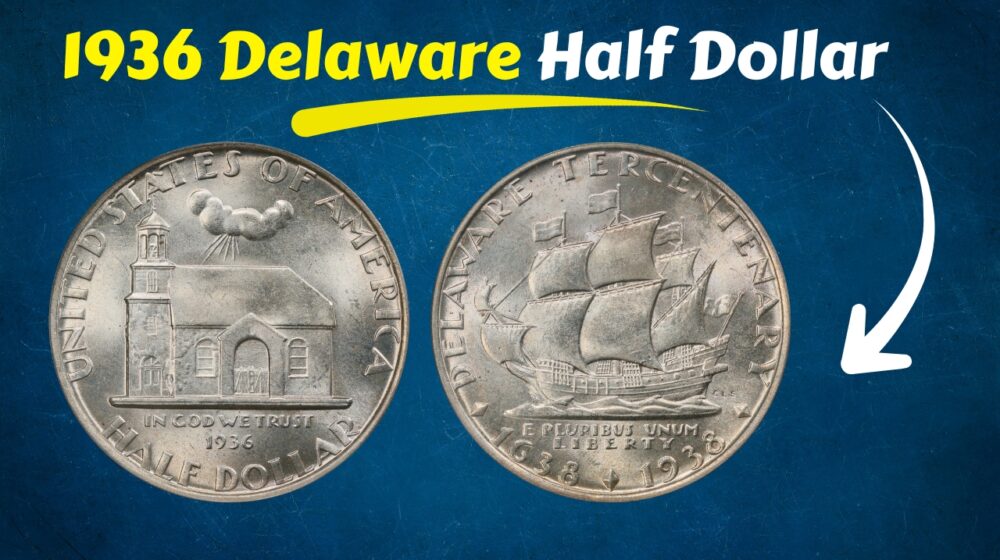
Schmitz placed Holy Trinity Church, widely known as Old Swedes Church, at the center of the coin’s obverse. Swedish and Finnish settlers built the Wilmington church between 1698 and 1699, and Reverend Eric Björk consecrated the completed building on June 4, 1699. Remarkably, the original structure still stands today, and the National Park Service recognizes it as one of America’s oldest church buildings still serving as an active place of worship a more carefully qualified description than the “oldest Protestant church still in active worship” claim that appears in some older numismatic literature.

Schmitz rendered the church with a broad roof and simple architectural lines, a design choice that later created a practical challenge for collectors: those large, flat surfaces make even small contact marks unusually easy to spot.

The Kalmar Nyckel: A Reverse Rooted in 1638

For the reverse, Schmitz turned to the ship that carried the original 1638 expedition across the Atlantic. A full-sailed Kalmar Nyckel dominates the design its name translating to “Key of Kalmar,” a reference to the Swedish city of Kalmar. Below the ship, Schmitz placed the dates “1638-1938,” marking the coin’s actual tercentenary anniversary. Three small diamonds also appear in the design, referencing Delaware’s “Diamond State” nickname and its three counties: New Castle, Kent, and Sussex.

Between the obverse’s “1936,” the reverse’s “1638-1938,” and the coin’s actual 1937 production, a single Delaware Half Dollar manages to reference three entirely different years an unusually entertaining chronology even by the standards of a commemorative series known for calendar quirks.

A $500 Design Contest

Rather than simply commissioning a well-known sculptor, the Delaware Swedish Tercentenary Commission opened a design competition. According to congressional records from 1938, artists submitted 40 designs, with the winning artist receiving a $500 prize. Mint Chief Engraver John R. Sinnock and sculptor Dr. R. Tait McKenzie both took part in the professional review process, and the commission ultimately selected Carl L. Schmitz, a French-born artist of German-American background whose Delaware design became his best-known numismatic work.

McKenzie brought an unusually varied résumé to the judging table. The Canadian-born physician became an important pioneer in physical education and rehabilitation medicine, while also building a significant second career as a sculptor his body of work, estimated at roughly 200 pieces, includes the well-known statue of a young Benjamin Franklin at the University of Pennsylvania, where he taught. The Delaware design competition thus brought together Mint expertise, fine-art judgment, and local historical interest in a single review process.

Interestingly, early commission materials treated the ship side of the coin as the obverse, but U.S. Mint records ultimately established the church side as the official obverse the convention collectors follow today.

Congress Tightens the Rules

The Delaware legislation arrived amid growing concern in Congress about how commemorative coin sponsors marketed their issues. Earlier programs had sometimes exploited multiple mints, multiple dates, and artificially small releases, forcing collectors to buy numerous varieties just to complete a set. In response, Congress began attaching real safeguards to new commemorative authorizations.

For Delaware, the law required a single special design, production at a single Mint, and a fixed “1936” date regardless of when the coins were actually struck. The commission was also given only one year after enactment to request coins. It’s worth correcting a commonly repeated detail here: Congress did not cap the Delaware Half Dollar at a maximum of 25,000 pieces. The May 15, 1936, resolution actually called for “not less than twenty-five thousand” coins, with requests required in batches of at least 25,000 meaning 25,000 functioned as a minimum order, not a ceiling. It’s also worth noting that Delaware did not share a single authorizing law with the Bridgeport and Wisconsin commemoratives approved the same day; each program operated under its own separate act or resolution, with Delaware specifically governed by Public Resolution No. 91.

Production, Sales, and Melting

The Philadelphia Mint struck 25,015 Delaware Half Dollars in March 1937, a total that included 15 pieces set aside for assay purposes. The Delaware Swedish Tercentenary Commission offered the coins for sale through the Equitable Trust Company of Wilmington at $1.75 each, including postage.

Demand, however, didn’t absorb the full production run. Collectors ultimately purchased 20,978 coins, and the commission returned the remaining 4,022 unsold pieces to the U.S. Mint, which melted them. This creates two commonly cited but distinct figures: the collector distribution total of 20,978, and the standard net mintage of 20,993 that PCGS and other references use, which adds the 15 assay pieces back into the count of coins that escaped melting. Both numbers are accurate they simply describe different things.

Description of the Obverse and Reverse

Obverse

Carl Schmitz’s obverse centers on Old Swedes Church, rendered with a broad roof and clean, simple architectural lines that give the building a solid, grounded presence on the coin. The date “1936” appears below the church the date Congress mandated for the coin regardless of its actual 1937 production. Because of the church’s large, flat surfaces, even minor contact marks tend to stand out clearly, making surface preservation an especially important factor when evaluating an individual coin’s condition.

Reverse

The reverse presents a full-sailed Kalmar Nyckel in dramatic profile, commemorating the ship that carried the original 1638 New Sweden expedition across the Atlantic. Below the vessel, the dates “1638-1938” mark the actual tercentenary anniversary the coin was created to honor. Three small diamonds appear within the design, referencing Delaware’s “Diamond State” nickname and its three founding counties. As with the obverse, the reverse’s broad sail surfaces are prone to showing contact marks, making clean, well-preserved sails a key factor collectors look for in top-grade examples.

Edge

The coin has a reeded edge, consistent with standard half dollar production of the era.

Notable Auction History and Market Notes

  • PCGS MS68, Gregg Bingham Collection — Sold by Heritage Auctions on August 28, 2025, for $19,200, the current PCGS-recognized auction record. Heritage described brilliant centers beneath light champagne color on the obverse, with amber, plum, and emerald peripheral toning, while the reverse showed softer gold coloration. At the time of sale, only two PCGS examples were graded MS68+, with none numerically finer.
  • PCGS MS67 CAC — Sold by Heritage Auctions in January 2012 for $18,400, the previous auction record for the issue.

Collectors should treat older population and pricing figures with appropriate caution. When CoinWeek examined the issue in 2020, PCGS reported 43 pieces at MS67+, five at MS68, and one at MS68+ figures that represented only a snapshot at that time, since subsequent submissions and regrades continue to shift the census. Similarly, 2020-era pricing (with MS64 and MS65 coins often trading under $300, and MS67 examples commonly near $700) reflects that period’s market conditions rather than a fixed present-day benchmark.

A Possible Matte Proof Mystery

Commemorative-coin specialist Anthony Swiatek has suggested that a small number of Proof Delaware Half Dollars could exist, and speculated that any genuine examples would likely show a Matte Proof finish. However, no confirmed Proof population has been established through research to date, and PCGS continues to catalog the standard Delaware issue strictly as a regular strike. Collectors should treat the Matte Proof possibility as an intriguing but currently unconfirmed avenue of ongoing research.

Sweden’s Companion Coin

The United States wasn’t alone in commemorating New Sweden’s founding. Sweden issued its own special 2 Kronor coin in 1938 for the same 300th anniversary, featuring King Gustaf V on the obverse and the Kalmar Nyckel sailing beneath a royal crown between the dates 1638 and 1938 on the reverse with Latin inscriptions notable enough that Sweden’s Riksbank has noted Swedish coinage hadn’t used Latin since the reign of Gustav III. Artist and Royal Mint engraver Erik Lindberg designed, modeled, and engraved the coin, and the Royal Mint in Stockholm produced 508,815 examples in .800 fine silver, each weighing 15 grams and measuring 31 millimeters. Together, the American and Swedish coins offer a fascinating look at how two countries used the same ship to commemorate one shared transatlantic story.

Why This Matters for Collectors

  • It doesn’t need extreme rarity to tell a compelling story. With a healthy PCGS survival estimate of roughly 17,000 coins across all grades, the Delaware Half Dollar’s appeal comes from its layered history rather than scarcity alone.
  • Its three-date puzzle is genuinely unusual. Few American commemoratives ask collectors to hold 1936, 1937, and 1938 as equally important to a single coin’s story.
  • The design pairs local and international history in one piece. A 17th-century Wilmington church and a 1638 transatlantic voyage share space on a coin created through a public design competition rather than a single commissioned artist.
  • Top-grade examples remain genuinely scarce despite the healthy overall population. With only two PCGS MS68+ examples reported at the time of the record sale and none numerically finer, the top of this issue’s condition census is far more exclusive than its overall survival numbers might suggest.
  • The August 2025 record demonstrates real market strength at the top end. A jump from an $18,400 record set in 2012 to $19,200 in 2025 reflects sustained, serious collector interest in elite examples of this issue.

Quick-Reference Buying Guide

  1. Decide what grade level fits your budget and goals. With coins available from affordable circulated and lower Mint State grades up to museum-quality MS68 examples, this issue offers meaningful options across a wide price range.
  2. Examine the church roof and ship’s sails closely. These broad, flat design areas are especially prone to showing contact marks, so surface quality here matters significantly for grade and eye appeal.
  3. Pay attention to toning and luster. Look for attractive semi-Prooflike character or appealing original color, and be cautious of uneven or blotchy toning that can reduce a coin’s desirability despite a strong technical grade.
  4. Check current PCGS population data before buying. Population figures shift over time due to new submissions and resubmissions, so always confirm current numbers rather than relying on older published figures.
  5. Research recent auction results for context. The $19,200 result for the Gregg Bingham MS68 and the earlier $18,400 record for a PCGS MS67 CAC example offer useful benchmarks for top-tier coins.
  6. Buy from major auction houses or reputable commemorative-coin dealers. Firms like Heritage Auctions and Stack’s Bowers regularly handle this issue and provide detailed, verifiable lot descriptions.
  7. Consider CAC approval for upper-grade coins. As with many classic commemoratives, CAC verification adds a useful layer of quality confirmation as you move into MS67 and higher grades.
  8. Consider pairing your coin with the 1938 Swedish 2 Kronor. For collectors interested in the full New Sweden tercentenary story, Sweden’s companion coin offers a historically connected complement to the American Delaware Half Dollar.
Written by

Denio Marca

Denio Marca is a passionate writer and coin enthusiast who specializes in old coins, rare coins, coin values, and collectible currency. He shares informative articles about valuable coins, collecting tips, historical facts, and the latest updates from the world of numismatics.

View all posts →

Leave a Comment

Your email address will not be published. Required fields are marked *