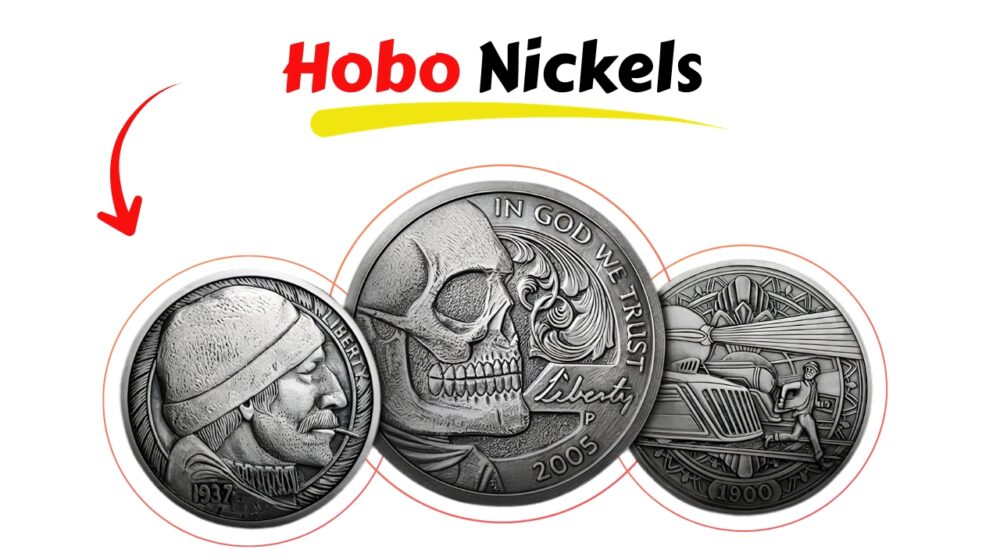
A five-cent coin once bought a newspaper or a cup of coffee. In the hands of a traveling artist, it could just as easily become a bearded stranger, a turtle, an elephant, or a boxcar rolling down the tracks. These hand-carved transformations of the Buffalo nickel are known as hobo nickels, and they represent one of the most personal and distinctive branches of American coin art.
Beginning September 28, 2026, collectors will have an extraordinary chance to acquire pieces from what Kagin’s Auctions describes as the largest and finest assembly of hobo nickels ever brought to market: the Candace D. Kagin Collection. Built over more than two decades and encompassing upwards of 600 individual carvings, the collection includes more than 100 works attributed to the field’s two most celebrated names, George Washington “Bo” Hughes and Bertram “Bert” Wiegand, alongside pieces by unidentified classic-era carvers, contemporary artists, and related ephemera.
Rather than a single sale, Kagin’s will disperse the collection across three separate online auctions, with the opening session offering roughly 200 lots. For collectors and folk-art enthusiasts alike, it is a rare opportunity to own a tangible piece of an art form born out of hardship, ingenuity, and five cents’ worth of raw material.
Collection & Coin Specifications at a Glance
| Feature | Detail |
|---|---|
| Collection Name | Candace D. Kagin Collection of Hobo Nickels |
| Auction House | Kagin’s Auctions |
| Collection Size | 600+ carved pieces |
| Notable Attributions | 100+ pieces by Bo Hughes and Bert Wiegand |
| First Auction Date | September 28, 2026 |
| Lots in First Auction | Approximately 200 |
| Number of Planned Auctions | Three |
| Auction Format | Live online only (no traditional floor auction) |
| Charity Contribution | 5% of hammer price donated to the Original Hobo Nickel Society (OHNS) |
| Planned Companion Publication | Reference book expected in 2027, covering auctioned lots plus ~40 pieces sold by Stack’s Bowers Galleries in 2025 |
| Host Coin Type | Buffalo (Indian Head) Nickel |
| Host Coin Denomination | Five Cents |
| Host Coin Years Issued | 1913–1938 |
| Host Coin Designer | James Earle Fraser |
| Host Coin Composition | 75% copper, 25% nickel |
| Host Coin Weight | 5.00 grams |
| Host Coin Diameter | 21.21 mm |
| Host Coin Edge | Plain |
| Minting Facilities (Original Nickels) | Philadelphia, Denver, San Francisco |
The Buying Process: How Collectors Can Participate
Because the Candace D. Kagin Collection is being sold as a true auction rather than a fixed-price release, there are no traditional “order limits” or mint-style purchase caps. Instead, prospective buyers should understand the following structure:
- Auction format: All sessions are conducted live online, allowing collectors anywhere to bid in real time without needing to attend an in-person event.
- First session date: The opening auction takes place on September 28, 2026, and features around 200 lots drawn from across the collection’s range classic carvings, modern artist pieces, Bo Hughes attributions, two-sided carvings, and related hobo material.
- Multiple sessions: Kagin’s intends to disperse the full 600+ piece collection across three separate auctions rather than a single event, meaning collectors who miss pieces in the first sale will have additional opportunities in subsequent sessions.
- No stated bidding limits: As with most specialty coin and numismatic art auctions, there are no per-bidder purchase restrictions; interested collectors can pursue as many lots as they wish, provided they are the winning bidder.
- Charitable component: Five percent of each lot’s hammer price will be donated to the Original Hobo Nickel Society, giving bidders the added benefit of supporting the organization dedicated to preserving and promoting the art form.
- Beyond the auction: Collectors interested in scholarship as well as ownership should watch for Kagin’s planned reference publication, expected in 2027, which will document the collection’s lots alongside related pieces sold separately by Stack’s Bowers Galleries in 2025.
Collectors new to hobo nickel auctions should register with Kagin’s ahead of the September 28 sale to ensure they can bid without delay, and should review each lot’s individual attribution and condition notes carefully, since carver identification can significantly affect value.
Historical Background
The Collection’s Origins
The Candace D. Kagin Collection traces its beginning to a single moment at the 2005 Florida United Numismatists (FUN) convention Candace Kagin’s first major coin show. Overhearing a dealer describe a hand-carved Buffalo nickel, her curiosity was sparked, and what began as fascination quickly grew into dedicated collecting. An early and pivotal purchase came at an annual Original Hobo Nickel Society auction, where Kagin acquired a carving known as “Monique,” a piece that reportedly set a world-record price at the time and holds special importance as one of several depictions Bo Hughes made of a woman from his own life.
The collection’s defining moment arrived in May 2012, during the American Numismatic Association’s National Money Show in Denver. There, Kagin paid $170,000 to acquire a 218-piece collection assembled by Larry Frost of Park City, Utah, in a private transaction brokered by former ANA President H. Robert Campbell. The Frost Collection was already considered one of the most important assemblages in the field, with nearly a third of its pieces attributed to Bert Wiegand and Bo Hughes, including more than 60 Bo carvings and four Bert carvings, plus works by classic carvers known only by nicknames like “Peanut Ear,” “Telephone Ear,” and “Scruffy Beard.” The acquisition also included a notable group of period carving and punch tools believed to have belonged to Bo or Bert themselves. From that foundation, Kagin continued acquiring pieces over the following years, ultimately building a collection exceeding 600 items.
The Buffalo Nickel: The Host Coin’s Origin
Nearly every classic hobo nickel begins life as James Earle Fraser’s Buffalo nickel, introduced by the U.S. Mint in 1913 and struck through 1938. Fraser’s design paired a Native American portrait on the obverse with an American bison on the reverse, and it was minted at the Philadelphia, Denver, and San Francisco facilities. The coin’s specifications a 75% copper, 25% nickel composition, a weight of 5 grams, and a diameter of 21.21 mm made it durable, inexpensive, and widely available, all qualities that made it an appealing (if unofficial) sculptor’s canvas.
The Hobo Nickel Art Form
Coin alteration itself predates the Buffalo nickel by decades; 19th-century engravers had long produced “love tokens” by smoothing coin surfaces and adding initials or decorative designs. But Fraser’s design offered something new: a bold, high-relief profile and a large, sculptural bison that gave carvers an unusually workable surface to reshape. Using rudimentary tools awls, nails, knives, screwdrivers, small hammers, punches, and scrap metal skilled carvers didn’t merely scratch a picture into the coin; they removed, moved, and reshaped metal to create a true miniature bas-relief sculpture.
The art form is closely associated with the Great Depression era, when many out-of-work Americans traveled by rail in search of employment, carving nickels during idle hours. Some traded their work for food or shelter; others carved for entertainment, barter, or sale. However, collectors are cautioned against oversimplifying the history not every carved Buffalo nickel came from a railroad traveler, many carvers remain unidentified today, and the tradition continues among modern artists. The Smithsonian Institution classifies these carved coins as “modified coins,” noting their association with hobo culture stems largely from the nickel’s affordability, portability, and workability as an artistic medium.
Bo Hughes and Bert Wiegand: The Field’s Defining Names
While most early carvers remain anonymous, two names stand above the rest. Bert Wiegand began carving nickels in the early years of the Buffalo nickel’s production and later mentored a young George Washington “Bo” Hughes, who began carving in the late 1910s. Bo went on to produce a substantially larger body of work across several decades, ranging from traditional bearded portraits to self-portraits, animal figures, and more elaborate scene carvings. His work is especially notable for including recognizable people from his own life most famously “Monique,” whose recurring appearance across several of his carvings has turned some pieces into a kind of visual biography as well as folk art. The Kagin Collection contains substantial representation of both artists’ work.
Design Details: Obverse and Reverse
Obverse: From Native American Portrait to Personal Portraiture
On a standard Buffalo nickel, the obverse features Fraser’s composite Native American portrait, rendered in relatively high relief with a strong profile and large facial features. This design gave hobo nickel carvers an unusually generous starting point: by reworking the existing high points of the portrait, a skilled artist could reshape the face into a bearded traveler, an entirely different individual, a caricature, or in Bo Hughes’ case a recognizable person such as Monique. Some carvers added elements like hats, derbies, glasses, or exaggerated facial hair, transforming the coin’s identity while still working within the physical constraints of the original strike.
Reverse: The Bison Reimagined
The reverse of a standard Buffalo nickel depicts an American bison standing on a mound. For carvers, this figure served as raw material just as much as the obverse portrait did. Fraser’s bison could be reshaped into an entirely different animal a donkey, elephant, turtle, or dog or reworked into pictorial scenes, including elaborate compositions like a reverse-carved “Hobo Mount Rushmore” featured in the Kagin Collection’s opening auction. Some carvers created two-sided pieces, using both the obverse and reverse to build a complete narrative or scene across the coin.
Why This Matters for Collectors
- Unmatched scale and depth. With more than 600 pieces and over 100 attributed to Bo Hughes and Bert Wiegand, the Candace D. Kagin Collection offers a breadth of hobo nickel material rarely, if ever, assembled and offered together.
- A rare shot at “named carver” pieces. Works confidently attributed to Bo Hughes or Bert Wiegand carry significant premiums in the hobo nickel market; the sheer number of such pieces here gives collectors unusually broad access to top-tier carvers’ work in a single collection.
- Documented provenance. The collection’s well-chronicled acquisition history from Kagin’s early OHNS purchase through the pivotal $170,000 Frost Collection acquisition gives buyers strong provenance backing for many lots, an important factor in a field where attribution can be uncertain.
- A living art form with historical roots. Because the collection spans classic Depression-era carvings as well as modern artist works, it offers collectors a chance to build a collection that traces the full arc of the hobo nickel tradition, not just its origin period.
- A cause alongside the collectible. With 5% of each hammer price benefiting the Original Hobo Nickel Society, collectors participating in the auction are directly supporting the preservation and promotion of the art form itself.
- A companion reference in the works. Kagin’s planned 2027 publication means buyers of lots from this sale may see their specific pieces documented in a lasting scholarly reference, adding long-term historical value beyond the coin itself.
Quick-Reference Buying Guide
- Mark your calendar for September 28, 2026 the date of the first live online auction featuring roughly 200 lots from the collection.
- Register with Kagin’s Auctions in advance to ensure you’re able to place bids as soon as the session opens.
- Review lot attributions carefully. Check whether each piece is attributed to Bo Hughes, Bert Wiegand, an unidentified classic carver, or a modern artist, as this significantly affects both value and desirability.
- Research comparable sales. Look into prior hobo nickel auction results including the ~40 related pieces Stack’s Bowers Galleries sold in 2025 to help set realistic bidding expectations.
- Plan for multiple auctions. Since the collection is being dispersed across three sales rather than one, don’t feel pressure to bid on every desired piece in the first session additional opportunities will follow.
- Factor in the charitable contribution. Remember that 5% of your hammer price supports the Original Hobo Nickel Society, adding value beyond the coin itself.
- Watch for the 2027 reference book. If you acquire a piece, keep an eye out for Kagin’s planned companion publication, which may document your coin’s history and context in greater depth.
- Bid confidently but carefully. As with all specialty numismatic auctions, set a personal maximum for each lot beforehand and stick to it, given the wide variability in carver skill, subject matter, and condition across the collection.