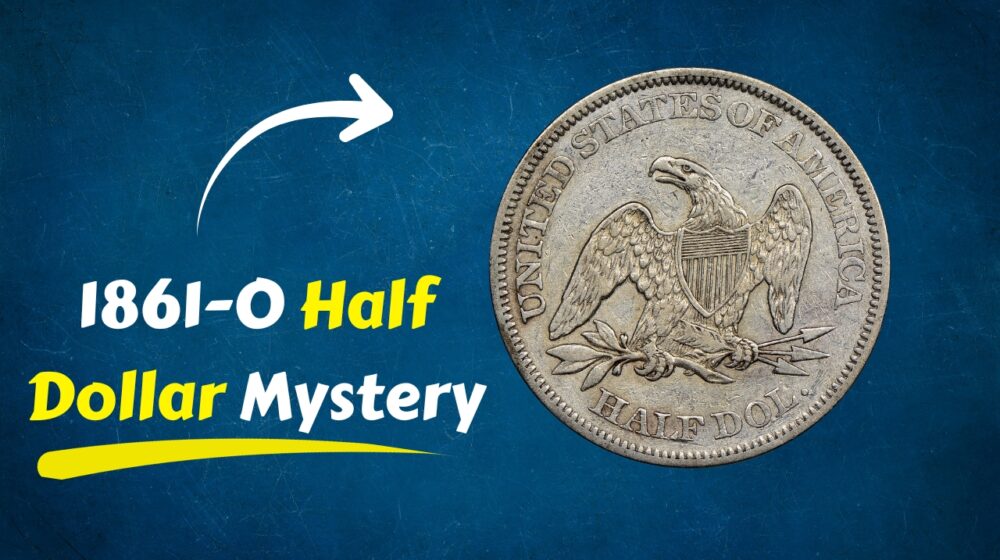
A single half dollar struck in New Orleans in 1861 has reopened one of the most fascinating unsolved puzzles in American numismatics. The coin in question a Liberty Seated Half Dollar bearing the ordinary United States design of its era recently crossed the auction block at Stack’s Bowers Galleries’ Summer 2026 Global Showcase Auction, realizing $170,800 as Lot 2094 in the Rarities Night session. On its face, the coin looks like millions of other half dollars struck that year. Look closer, and it becomes something far rarer: a specially prepared Specimen striking tied to a 60-day window when the New Orleans Mint changed hands not once, but twice, as the nation split apart.
Graded Specimen-63 by PCGS and cataloged as JD-1, W-01, this coin is one of only four or five surviving Specimen or Branch Mint Proof examples believed to exist from the entire 1861-O half dollar issue. It was also selected by numismatist John W. Dannreuther as the plate coin for this variety in his 2025 reference work on United States Proof coinage a distinction that cements its importance to researchers, even as it deepens a mystery that has never been fully resolved.
Coin Specifications
| Detail | Information |
|---|---|
| Denomination | Half Dollar |
| Date and Mint | 1861-O (New Orleans) |
| Type | Liberty Seated Half Dollar, No Motto |
| Featured Variety | JD-1, W-01 |
| Rarity Rating | Rarity-8 |
| Featured Grade | PCGS Specimen-63 |
| Composition | 90% silver, 10% copper |
| Standard Weight | 12.44 grams |
| Actual Silver Weight | 0.3599 troy ounce |
| Diameter | 30.6 mm |
| Edge | Reeded |
| Designer | Christian Gobrecht (Seated Liberty concept based on a design by Thomas Sully) |
| Reverse Type | Type 2 reverse, adopted in 1858 |
| Total 1861-O Mintage | 2,532,633 |
| — Struck under United States authority | 330,000 |
| — Struck under State of Louisiana authority | 1,240,000 |
| — Struck under Confederate authority | 962,633 |
| PCGS Number | 6422 |
| NGC ID | 27TM |
| Auction Result | $170,800 (Stack’s Bowers, Summer 2026 Global Showcase Auction, Lot 2094) |
How the Coin Came to Market
This particular Specimen was not sold through a mint order window, subscription program, or fixed-price release. Like nearly all great numismatic rarities, it reached collectors through public auction in this case, the Rarities Night session of Stack’s Bowers Galleries’ Summer 2026 Global Showcase Auction.

For collectors hoping to pursue a coin from this issue, or simply to understand how such transactions unfold, the process generally follows this pattern:
- Cataloging and grading: The coin is first authenticated and graded by a major third-party service — in this case PCGS which assigns both a numeric grade (Specimen-63) and, where applicable, a variety attribution (JD-1, W-01).
- Auction house consignment: The piece is consigned to a major numismatic auction house. Stack’s Bowers has handled four different examples of exceptional 1861-O half dollars over roughly the past decade and a half, making it one of the primary venues where these rarities surface.
- Lot placement: High-profile coins are typically placed in a “Rarities Night” or comparable showcase session, where the most significant offerings of an auction are grouped together to attract serious bidders and collectors.
- Bidding: Interested parties may bid live, by phone, or online, depending on the auction house’s platform. There is no fixed mintage or subscription limit involved, since each coin is a unique physical object rather than a current production issue.
- Realized price: The final hammer price $170,800 in this instance reflects the coin’s rarity, grade, eye appeal, pedigree, and the strength of demand among specialists in Liberty Seated coinage and Confederate-era numismatics.
Collectors interested in acquiring a comparable piece should watch major auction house catalogs, particularly those specializing in United States silver coinage and Southern branch mint issues, since new appearances of 1861-O Specimens are exceedingly infrequent.
Historical Background: A Mint Under Three Flags
The story of the 1861-O half dollar cannot be separated from the political chaos of early 1861. The New Orleans Mint, a fully operational federal facility, became a prize fought over by three successive governments within a matter of months.
United States authority (January 1861). The Mint began the year producing half dollars under normal federal control. Workers struck the first 330,000 pieces of the 1861-O run before any change in political authority occurred.
State of Louisiana authority (January 31 – late February/April 1861). Louisiana formally seceded from the Union on January 26, 1861, by a vote of 113 to 17. Three days later, the state’s secession convention passed an ordinance allowing federal Mint employees to keep working, now under state authority. On January 31, Louisiana took physical possession of the Mint. Remarkably, the entire senior staff remained in place Superintendent William A. Elmore, Treasurer A.J. Guirot, Assayer Howard Millspaugh, Chief Coiner Dr. Benjamin F. Taylor, and Melter and Refiner M.F. Bonzano. Under Louisiana’s control, the Mint struck 1,240,000 half dollars during February and March, using the same federal dies, the same machinery, and largely the same workforce as before.
Confederate States authority (April 1861 onward). Chief Coiner Taylor later recalled that Louisiana handed the facility to the Confederacy in the final days of February, but numismatic and historical records place the Confederacy’s actual physical possession of the Mint on April 1, 1861. From that point forward, the remaining 962,633 half dollars of the 1861-O mintage were struck under Confederate authority, principally during April, before Union forces would eventually reclaim New Orleans the following year.
Added together, the three production totals 330,000, 1,240,000, and 962,633 equal precisely the accepted total mintage of 2,532,633 pieces. That level of documentation is itself unusual, giving researchers a rare, near-complete production timeline spanning three different governments using a single set of coinage dies and a single mint building.
The Design: Obverse and Reverse
Obverse. The 1861-O half dollar carries Christian Gobrecht’s Seated Liberty design, based on a concept originally developed by artist Thomas Sully. Liberty is shown seated on a rock, facing left, holding a liberty pole topped with a Phrygian cap in her left hand and a shield inscribed “LIBERTY” braced against her right side. Thirteen stars encircle the border, representing the original states, with the date positioned below Liberty’s seated figure. On this particular Specimen, PCGS and Stack’s Bowers note that the design shows nearly full detail throughout, with only slight softness at the top of Liberty’s head and at stars 7 and 8 a characteristic shared by at least four other known Specimens of the issue, suggesting a common origin in preparation rather than random striking variation.
Reverse. The coin uses the Type 2 reverse adopted for half dollars in 1858, featuring a heraldic eagle with wings spread, a shield on its breast, an olive branch in one talon and arrows in the other, encircled by the legend “UNITED STATES OF AMERICA” and the denomination “HALF DOL.” Nothing about the reverse design distinguishes a Confederate or Louisiana-era 1861-O half dollar from a United States-struck example all three governments used identical federal dies bearing the same national identification, which is precisely what makes attributing individual coins to a specific government so difficult without detailed die-variety research.
On this Specimen, both sides display attractive original toning: soft powder-blue halos gather near the borders, while reddish-gold iridescence dominates toward the centers. Under direct light, the fields show a highly reflective, almost mirror-like quality, the result of extensive die polishing before striking. The raised design elements retain a light frosted texture, producing a subtle cameo contrast between devices and fields. A thin, partial wire rim is visible along portions of both sides, and the surfaces remain unusually smooth for the assigned grade, with only faint wispy hairlines visible as the coin is tilted under a light source.
The Numismatic Mystery: Which Government Struck It?
Every 1861-O half dollar shares the same basic design, which means that identifying which government actually struck an individual coin requires die-marriage research rather than visual inspection alone.
Numismatist Bill Bugert catalogued the dies used in 1861-O half dollar production in his 2013 reference work on New Orleans Branch Mint varieties. Based on that research, PCGS currently attributes die pairings W-01 and W-02 to United States-era production, while W-03 through W-08 are attributed to Louisiana and subsequent Confederate-era production.
Here is where the mystery deepens. The Specimen sold by Stack’s Bowers carries the W-01/JD-1 die pairing a combination associated with production under United States authority, before Louisiana ever took control of the Mint. Yet Stack’s Bowers, along with other researchers, believes that this coin and its known counterparts were most likely struck as a small ceremonial batch after Louisiana seized the facility on January 31, 1861. Those two positions are difficult to reconcile without additional explanation.
Other known Specimens complicate the picture further, though in a different direction. The celebrated Robert LeNeve example long displayed at the Louisiana State Museum inside the historic Mint building uses the W-04/JD-2 die pairing, which Bugert assigns to Louisiana production. The E. Horatio Morgan specimen, graded Specimen-62 by NGC and sold by Stack’s Bowers for $66,000 in November 2019, also uses W-04/JD-2, as does an NGC Specimen-62+ example that Stack’s Bowers offered in its Summer 2025 auction. These W-04 coins fit comfortably into the theory that Louisiana officials ordered a small run of specially finished half dollars soon after taking control of the Mint.
The W-01/JD-1 coins do not fit that theory as cleanly. Dannreuther identified only one other Specimen with the same W-01/JD-1 pairing in his 2025 research a coin from the legendary James A. Stack, Sr. collection, sold in March 1975 and later graded Specimen-64. Notably, the two known W-01/JD-1 Specimens do not share the same die state, meaning the dies had progressed to different points of wear or preparation between the two strikings. According to Dannreuther, this suggests Mint workers may have produced these special pieces during more than one distinct striking episode, rather than in a single ceremonial batch. As Dannreuther himself put it, “there are numerous unanswered questions about this mysterious issue.”
A Possible Motive: Commemorating a New Authority
One theory offers a compelling, if unproven, explanation for why these Specimens exist at all. On April 1, 1861, Confederate Treasury Secretary Christopher G. Memminger requested designs for a distinctly Confederate half dollar from officials in New Orleans. That request eventually led to an entirely new reverse design featuring a Confederate shield, seven stars, sheaves of cotton and sugar cane, and the legend “CONFEDERATE STATES OF AMERICA.” Only four original Confederate half dollars pairing that new reverse with a standard Seated Liberty obverse were ever produced.
That timeline matters for the Specimen story. If Confederate officials had wanted ceremonial presentation coins after taking control of the Mint on April 1, they had their own distinctive design ready to showcase. This has led researchers, including those at Stack’s Bowers, to argue that the specially prepared 1861-O half dollars carrying the ordinary United States design most likely originated before the Confederacy formally took over pointing instead to January 31, 1861, when Louisiana first seized the facility, as the more probable occasion. Under this theory, state officials may have ordered a small number of carefully struck half dollars to mark Louisiana’s new control over one of the most important federal institutions in the South.
No surviving document confirms this scenario, and the conflicting die attributions of the W-01/JD-1 coins mean the theory remains, in the assessment of numismatic researchers, compelling but not conclusively proven.
Why This Matters for Collectors
For collectors of United States silver coinage, Civil War history, and Confederate numismatics, the 1861-O half dollar occupies a nearly unmatched position. Few, if any, other United States coin issues were struck under three distinct governments using the same dies, the same equipment, and largely the same personnel within a single calendar year.
The Specimen strikes take that significance further. With only four or five examples believed to survive across the entire issue, these coins rank among the rarest branch-mint Proof or Specimen coins in American numismatics a tiny population when compared with the millions of ordinary 1861-O half dollars that entered circulation and remain available to collectors today in various grades, aided in part by Civil War-era hoarding and later recoveries from historic shipwrecks.
Beyond rarity, these coins carry documentary weight. Each surviving Specimen is physical evidence that researchers continue to study in an effort to pin down exactly when, why, and under whose authority they were struck. Owning or studying one of these coins means engaging directly with an unresolved chapter of numismatic and political history something few coins, however rare, can offer.
The eye appeal of the piece adds a further layer of desirability. The combination of original toning, reflective fields, light cameo contrast, and an unusually sharp strike gives this Specimen a presentation-quality appearance that stands apart from the vast majority of surviving 1861-O half dollars, most of which show the wear and handling typical of coins that circulated as ordinary money during a turbulent period in American history.
Quick-Reference Buying Guide
For collectors interested in pursuing an 1861-O half dollar whether a common circulated example or, far more rarely, a Specimen striking the following steps provide a practical starting point:
- Decide on your target tier. Determine whether you are seeking a standard circulated or mint-state 1861-O half dollar (widely available) or one of the extremely rare Specimen/Branch Mint Proof examples (four or five known).
- Learn the die varieties. Familiarize yourself with Bill Bugert’s die-marriage attributions (W-01 through W-08) to understand which government likely struck a given coin, since visual inspection alone cannot determine this.
- Insist on third-party grading. Only consider coins certified by PCGS or NGC, particularly for Specimen or Proof examples, given the value and historical significance involved.
- Research provenance. For high-value Specimens, trace the coin’s auction history and prior ownership pedigrees such as Robert LeNeve, E. Horatio Morgan, and James A. Stack, Sr. add both historical context and value.
- Monitor major auction houses. Watch upcoming sales from firms such as Stack’s Bowers Galleries, which has handled multiple 1861-O Specimens in recent years, particularly their Rarities Night sessions.
- Set a bidding strategy in advance. Given the six-figure prices these Specimens can command, establish a maximum bid based on recent comparable sales, such as the $170,800 result for this JD-1/W-01 example or the $66,000 realized for the E. Horatio Morgan W-04 Specimen in 2019.
- Consult specialist literature. Reference Bugert’s 2013 study of New Orleans Branch Mint varieties and Dannreuther’s 2025 work on United States Proof coinage before finalizing any purchase of a Specimen-grade example.
- Store and insure appropriately. Given the rarity and value of these pieces, secure storage and adequate insurance coverage are essential once a coin of this caliber enters a collection.
The 1861-O half dollar remains, in the words of researchers who continue to study it, a story that is not yet finished being written. For collectors, that unresolved history is precisely what makes the issue and especially its rare Specimen strikings so enduringly compelling.