Every so often a coin turns up where it was never supposed to be. In February 2008, a collector at a California coin show pulled a single 1971-S Eisenhower Dollar out of a dealer’s tube of ordinary 40% silver Ikes and sensed that something was off. The strike was too sharp, the surfaces fit neither of the two usual categories, and the Moon on the reverse carried crater detail that had no business on a standard 1971-S dollar.
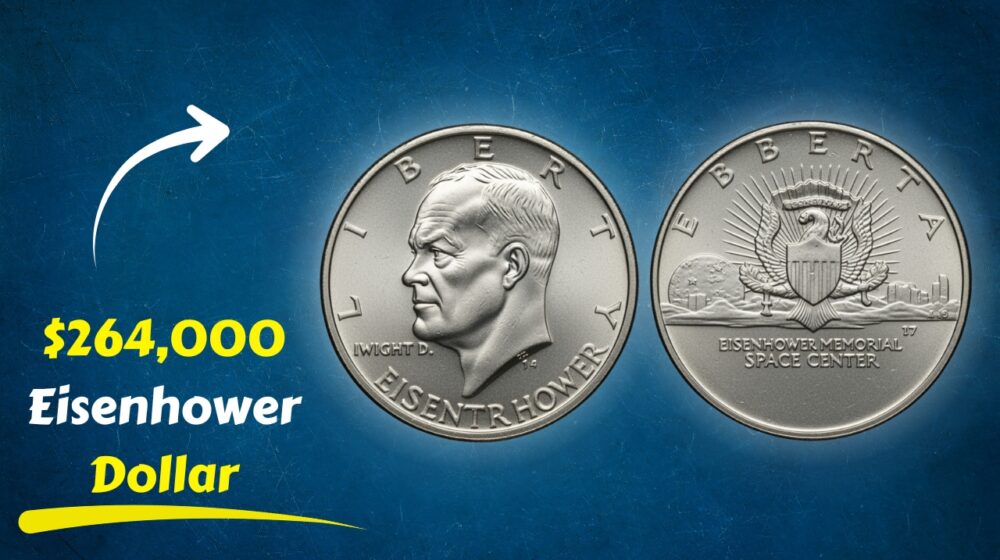
That coin is now recognized as one of only three known 1971-S Eisenhower Dollar prototypes, cataloged as Judd-2147 (J-2147). The piece in question, the Lydston discovery coin, is graded PCGS SP67 and carries a green CAC sticker. GreatCollections will sell it in an auction scheduled to close on October 18, 2026. The firm describes it as the only J-2147 to receive CAC approval and as tied with one other example for the highest grade PCGS has assigned to the variety.
It is also a coin with a known price tag. When it last crossed the block at Heritage Auctions in January 2022, this same SP67 specimen realized $264,000, a figure that remains the PCGS auction record for J-2147. Bidders now have a second chance to own the coin that started the whole prototype story.
Coin & Auction Details at a Glance
| Detail | Information |
|---|---|
| Coin | 1971-S Eisenhower Dollar, Judd-2147 Prototype (“Lydston Discovery Coin”) |
| Date / Mint | 1971 / San Francisco (S) |
| Denomination | One Dollar |
| Classification | Working prototype (also cataloged as a pattern under the Judd numbering system) |
| Strike Designation | Specimen / Special Strike (per PCGS) |
| Grade | PCGS SP67, CAC Green |
| PCGS Number | 509322 |
| GreatCollections Certification No. | 55926571 |
| Known Examples | 3 |
| Known Die Pairings | 2 |
| Composition | 40% silver, 60% copper overall |
| Weight | 24.59 grams |
| Diameter | 38.50 mm (as listed by PCGS) |
| Edge | Reeded |
| Obverse Designer | Frank Gasparro |
| Reverse | Frank Gasparro’s adaptation of the Apollo 11 mission insignia |
| Discovered By | Lee C. Lydston, Long Beach Coin Expo, February 15, 2008 |
| Previous Auction Result | $264,000, Heritage Auctions, January 2022 (PCGS auction record for J-2147) |
| Current Offering | GreatCollections timed auction |
| Auction Closes | October 18, 2026 |
| For Comparison: Regular-Issue Mintage | 6,868,530 uncirculated 40% silver 1971-S Ike Dollars (original issue price $3 each), plus over 4 million 1971-S silver proofs |
| Catalog Recognition | Listed in the Guide Book of United States Coins (the Red Book) |
How to Buy: Bidding Process, Dates and Limits
There is no fixed order window or per-person purchase limit here, because this is a single-lot auction of a one-of-a-kind discovery coin rather than a product release. What matters instead is the auction calendar, your bidding capacity and how payment works. The details below come from GreatCollections’ published help pages and terms; because auction rules can change, confirm each point on the lot page before you bid.
Key date
- Auction close: October 18, 2026. Watch the countdown clock on the lot page, and confirm how the platform handles bids placed near the end.
Register and check your bid limit
- You must be a registered GreatCollections member to bid.
- New bidders have generally been assigned an initial bid limit of $10,000, according to a GreatCollections help article. Your limit is calculated from your unpaid invoices plus your active secret maximum bids.
- A coin that sold for $264,000 last time will clearly exceed a default limit, so contact GreatCollections customer service well ahead of closing to have your limit raised. Expect to be asked for banking or industry references, since the company may request references or full or partial payment by wire on large transactions.
Place your bid
- Confidential maximum bids: Enter the most you are willing to pay, and the system bids on your behalf in increments only as high as needed to keep you in front, up to your ceiling. If nobody else bids, you win at the minimum.
- Bid increments: GreatCollections uses a sliding scale in which the minimum raise grows with the current bid. As an example from its help center, a $100 bid carries a $5 increment.
- Confirmation: You receive an e-mail confirmation for every bid, and you can track active bids in your account.
- Phone bidding: If you cannot bid online, the company says it can usually take your bid by phone or fax, and staff are available while auctions are closing.
After you win
- Payment deadline: Payment is due within seven days of the auction’s end. Late payment can lead to cancellation of the sale and interest charges under the terms.
- Budget for the buyer’s fee: Add GreatCollections’ buyer’s fee to your hammer price when deciding on a maximum bid. Check the current rate on the lot page or in the Terms.
- Extended payment option: GreatCollections runs a Paymonth installment program with interest charged on outstanding balances after an initial period. Sales made under those terms are final and the firm holds the coin until it is paid in full. Read the program terms before choosing it.
- Returns: GreatCollections offers a return courtesy on many non-bullion items provided payment is prompt and the coin stays in its sealed holder, but the terms can be different for individual lots or payment plans. Verify what applies to this lot before you bid.
Historical Background
The Eisenhower Dollar (1971–1978)
Congress revived the silver-dollar-sized denomination in 1971 after a gap of 36 years. The Mint had last produced Peace Dollars in 1935. The new coin honored Dwight D. Eisenhower, who died in 1969, and its reverse followed a congressional directive to feature a design symbolic of the Apollo 11 lunar landing.
The dollar joined several threads of American history on a single piece of metal: a wartime commander, a two-term president and the first crewed mission to the Moon. The Mint also pointed out that the country’s space program began during Eisenhower’s presidency. The 1971 issue is regarded as the first space-themed U.S. coin.
The series ran through 1978 and included a Bicentennial variation in the middle of that stretch. Collectors were offered 40% silver versions from the San Francisco Mint, and those are the coins that sat in dealer tubes and Blue Pack holders for decades. PCGS notes that the Ike is the first U.S. series struck entirely in the copper-nickel clad era that began in 1965, and that gem-quality examples and certain varieties are far scarcer than many collectors assume.
The Designer: Frank Gasparro
Frank Gasparro joined the U.S. Mint in 1942 and served as Chief Engraver from 1965 through 1981. Besides the Eisenhower Dollar, he designed the reverse of the Lincoln Memorial cent (1959), the reverse of the Kennedy half dollar, and both sides of the Susan B. Anthony dollar. The Ike was a major point of pride for him.
Gasparro said he remembered watching General Eisenhower during the huge New York victory parade of June 20, 1945, and that recollection helped shape his portrait of the president decades later. For the reverse, he reworked the Apollo 11 mission insignia, which astronaut Michael Collins had created.
The January 1971 Trial Strikes
The story of the prototype begins with an unusual public event. On January 19, 1971, the Mint announced that for the first time it would let reporters and photographers watch trial strikes of a new U.S. coin. The demonstration was set for January 25 at 11 a.m. at the Philadelphia Mint, and Director Mary T. Brooks extended the invitation because of intense public interest in the new dollar. The Mint stressed that the strikes were only a preliminary step.
The paperwork that accompanied the event is key evidence today. It explains that technicians still had to settle on the right relief, die basin, collar arrangement and planchet shape. This was a serious technical problem. The Eisenhower Dollar has a large field, and a design with too much relief can prevent metal from filling every recess. The Mint would then need more pressure, which risks damaging dies or even the press. Staff therefore made a series of trial strikes to find the best combination.
The Mint said the coiner had prepared 40% silver blanks for the tests and described the dies as prototypes, not finished production tools. Gasparro still had weeks of work ahead to correct small flaws, sharpen details and prepare the official master dies and hubs. That description lines up well with what specialists see on the surviving prototypes.
A wrinkle in the story: The same Mint document states that the Director’s Trial Strike Committee would destroy all prototype trial strikes from the Philadelphia event. That means nothing proves the three surviving 1971-S prototypes came from that January 25 demonstration. Heritage Auctions has suggested the Mint may later have sent prototype dies to San Francisco for further testing on the presses used for the 40% silver collector coins. That theory would help explain the S mintmark, the mix of prooflike and uncirculated surfaces, and the way the coins appeared in Blue Pack-style packaging. Still, no document identifies the exact press, date or purpose behind the three known coins, and how they left official hands remains unresolved.
The J-2147 Prototypes: Three Coins, Two Die Pairs
For 37 years, none of the three coins was recognized for what it was.
| Coin | Discovery | Dies | Notes |
|---|---|---|---|
| Lydston (Discovery Coin) | February 15, 2008, Long Beach Coin Expo | Obverse A / Prototype reverse | PCGS SP67. This is the coin now at GreatCollections. |
| Chatham | 2010, Alabama pawn shop (reported price: $10) | Obverse B / same prototype reverse | Found in Mint Blue Pack packaging. Its obverse shows a different form of the letter R in LIBERTY. PCGS and Heritage records list it at SP67. |
| eBay coin | 2013, online listing | Same obverse and reverse as Lydston | PCGS SP66. The seller said it came from a sealed Mint Blue Pack. |
Together, the three coins represent two die pairings. PCGS catalogs them under J-2147, and the variety has entered the Red Book.
Pattern or Prototype?
Collectors usually associate Judd numbers with pattern coinage, meaning pieces that test a proposed design, denomination or metal. Specialists have argued that the 1971 Ikes are better called working prototypes. They did not audition a new concept. Instead, they helped Mint staff convert an approved design into something presses could strike reliably. The January 1971 documents, with their focus on relief, basin shape, collars, dies and planchets, describe exactly that process.
You will therefore see several labels. GreatCollections lists J-2147 as an important 20th-century pattern, PCGS designates the coin a Special Strike, and researchers commonly say Eisenhower Dollar prototype. The naming debate does not change the physical evidence: these coins capture a moment in the design that never reached ordinary production.
Design Description
Obverse
The obverse carries Frank Gasparro’s left-facing portrait of Dwight D. Eisenhower, with the inscription LIBERTY across the top, IN GOD WE TRUST, and the date and mintmark below the portrait. On the prototypes, the obverse dies are not identical. The Lydston and eBay coins share one obverse, while the Chatham coin uses a different die that shows a distinct R in LIBERTY. Ike Group researcher Robert Ezerman, as cited by Heritage, considers the Chatham coin’s obverse the more primitive of the two styles.
Reverse
The reverse presents Gasparro’s adaptation of the Apollo 11 insignia: an eagle above the lunar surface, an olive branch in its claws, and Earth hanging above. Standard lettering, including UNITED STATES OF AMERICA and ONE DOLLAR, completes the design.
The reverse is the star of the J-2147 story. When The Ike Group compared the Lydston coin with a surviving 1970 galvano held at the Dwight D. Eisenhower Presidential Library and Museum in Abilene, Kansas, the reverse closely matched an earlier stage of Gasparro’s work. The clearest sign is the Moon, where the prototype shows crater details that Gasparro later modified or removed before full production.
Researchers pointed to several other clues that separate the prototype from a routine 1971-S Blue Pack Ike:
- Heavy die-polishing lines
- Unfinished burring around parts of the lettering
- Device doubling
- A far stronger strike than collectors normally see on a 1971-S uncirculated silver dollar
- A hybrid look, with surfaces that blend characteristics of both proofs and Blue Pack coins, along with the haze associated with the Mint’s pliofilm packaging
PCGS confirmed that the composition closely matches the regular 40% silver collector coin. In its 2022 lot description, Heritage also noted the virtually flawless surfaces and a tiny depression near the eagle’s tail that could be a planchet hardness test. A similar mark appears in nearly the same spot on another of the prototypes.
Why This Matters for Collectors
It documents the design process, not just a variety. Many rarities are famous because the Mint struck few of them. Others are famous because nearly all were lost. The J-2147 belongs to a different category. It survived because somebody failed to recognize it as unusual, and it preserves a visible step in how an artist’s model became a coin that presses could strike by the millions.
Extreme rarity within one of the most heavily produced modern series. With 6,868,530 regular uncirculated 40% silver Ikes made in 1971 alone, only three prototypes have been identified. That contrast makes the discovery a compelling story for collectors of modern coinage, a segment that PCGS says is attracting growing attention, including from younger hobbyists.
Top-tier certification. SP67 ties for the highest grade PCGS has assigned to J-2147, and GreatCollections says this is the only example with CAC approval. The coin also has full pedigree: the Lydston discovery, the David Frohman Collection and the 2022 Heritage sale.
A proven benchmark and a rare opportunity. The $264,000 result from January 2022 gives bidders a documented reference point, though it should not be treated as a forecast, since market conditions change. Heritage’s 2022 lot description cautioned that the coin could vanish from the market for decades, for example if it landed on long-term institutional loan. Instead, it is back in circulation among collectors, and with only three examples in existence, chances to bid on one are extremely limited.
A research-rich story that keeps growing. How the three coins left the Mint and ended up in collector channels is still an open question, and that mystery is part of the appeal. Ownership means holding a coin that researchers are still working to explain.
Quick-Reference Buying Guide
- Mark the date. The auction closes on October 18, 2026. Add reminders for the days leading up to it.
- Register with GreatCollections and complete account verification well before the closing day.
- Request a higher bid limit. New accounts have historically started around $10,000, which will not cover a coin at this level. Contact customer service early, and be ready to provide references.
- Review the lot page for the coin: PCGS SP67, CAC, certification number 55926571. Study every image and the full description.
- Set your budget including the buyer’s fee, insurance and shipping, and decide your ceiling before bidding starts. Use the $264,000 January 2022 result as context, not a prediction.
- Place a confidential maximum bid or watch the auction live, remembering the sliding bid increments. If you cannot bid online, call the company for phone assistance.
- Track your bid through your account and e-mail confirmations, and confirm how closing-time activity is handled.
- Pay within seven days of the auction’s end, or arrange wire or extended-payment terms in advance. Read the Paymonth conditions carefully if you plan to use them.
- Check return and shipping terms for this specific lot, then keep the coin in its sealed PCGS holder.
- Document your provenance. Save the discovery story, the Heritage 2022 sale record and the certification details along with your invoice.
Disclosure: Information on auction procedures comes from GreatCollections’ public help pages and terms and may change. Verify all bidding rules, fees and closing details on the official lot page before placing a bid.