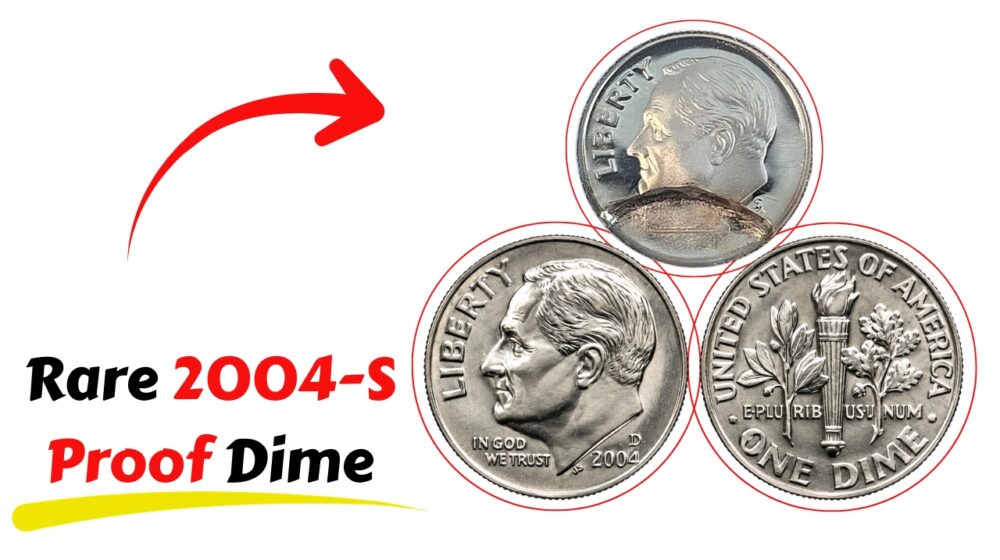
For more than two decades, a 2004-S Proof Roosevelt dime sat undisturbed in the plastic lens the United States Mint sealed around it. No collector cracked the holder open. No grading service encapsulated it. Now it has come to light, and it carries a major error: an indent covering roughly 25% of the obverse.

Veteran mint error specialist Mike Byers, a professional numismatist for about 50 years, says it is the only major mint error he knows of inside a government-sealed Proof Set. He reports finding no comparable piece in auction records and no similar example among other error specialists he consulted.
The coin surfaced at the 2026 American Numismatic Association World’s Fair of Money in Pittsburgh (August 25-29, David L. Lawrence Convention Center). An unnamed dealer bought the set there, realized the dime deserved expert eyes, and contacted Byers, who later acquired the set.
Two things make the find remarkable. The error is a genuinely dramatic Proof striking error. And because the coin never left its original Mint packaging, the set documents the failure of several checkpoints that normally keep such pieces from reaching the public.
Specifications and Key Details
| Detail | Information |
|---|---|
| Coin | 2004-S Proof Roosevelt Dime (clad) |
| Error type | Indented strike, about 25% obverse indent from another planchet |
| Mint / mintmark | San Francisco / S |
| Strike | Proof |
| Denomination | 10 cents |
| Composition | Copper-nickel clad: outer layers of 75% copper / 25% nickel bonded to a pure copper core |
| Overall composition | 91.67% copper, 8.33% nickel |
| Weight | 2.268 grams |
| Diameter | 17.91 mm |
| Thickness | 1.35 mm |
| Edge | Reeded (118 reeds) |
| Designer | John R. Sinnock |
| Clad Proof dime mintage | 1,789,488 (per PCGS CoinFacts) |
| Packaging | Sealed six-coin lens from the 2004 U.S. Mint Proof Set |
| 2004 Proof Set release date | June 3, 2004 |
| 2004 Proof Set original price | $22.95 (11 coins, $2.96 face value) |
| Discovery | Purchased by a dealer at the 2026 ANA World’s Fair of Money, Pittsburgh (Aug. 25-29) |
| Current owner | Mike Byers |
| Sale price / availability | Not disclosed |
A mintage correction worth noting. The figure 1,175,934 is often quoted for 2004 Proof dimes, but that belongs to the 2004 Silver Proof Set and its silver dime (NGC records it for the 2004-S silver Roosevelt dime). The error coin is a clad piece from the much larger 1,789,488 issue.
How the Error Happened
An indented strike is a mechanical mishap. Normally a press feeds a single planchet between the dies. In this case, according to CONECA’s definition, two planchets entered the coining chamber together and overlapped. One planchet blocked part of the die from reaching the other, and the pressure of the strike pushed the overlapping piece into the coin underneath, leaving a rounded depression.
NGC describes the same basic process: two planchets enter the collar, one partly covers the other, and the strike forces the upper planchet into the lower one.
On this dime, the depression spans roughly a quarter of the obverse. Even without the packaging story, a dramatic indent on a modern Proof would draw serious attention.
Byers notes that the scratches visible in photographs belong to the plastic lens, not the coins inside.
Why a Proof Error Like This Is So Hard to Find
Proof coins are not made like ordinary circulation strikes. In 2004 the San Francisco Mint produced them with specially prepared, highly polished dies and struck each coin at least twice, creating sharp detail, frosted devices, and mirrored fields. NGC has pointed out that modern Proof errors are scarce because of the Mint’s unusually high quality control, and that badly misshapen pieces get another chance to be caught when workers package coins for collectors.
To end up where it did, this dime had to:
- Survive the striking process without being noticed,
- Slip past quality inspection,
- Reach the packaging line, and
- Be sealed into a lens and shipped.
That chain of missed catches is what gives the discovery its weight.
Buying and Ordering: What Applies Here
This is a one-off discovery, not a new Mint release, so there is no order window, household limit, or launch date. Here is what is actually known, and what collectors can do.
The error coin itself. It is not currently listed for sale, and no price has been disclosed. Byers acquired it after the dealer’s purchase at the World’s Fair of Money. Collectors interested in it should follow Byers and his publication, MINTERRORNEWS Magazine (the discovery appears in Issue 97), for updates on its future.
The 2004 U.S. Mint Proof Set. The Mint offered it from June 3, 2004, at $22.95. It has long since sold out at the Mint, so today’s buyers use the secondary market: dealers, coin shows, online marketplaces, and auctions.
Where a 2004 Proof Set costs vary. Condition of the lens, the certificate of authenticity, and the original box all influence value, as does whether it is the clad or silver version (the silver set is a separate product).
Historical Background: The Coins in the Six-Coin Lens
The 2004 Proof Set came in two sealed lenses. The first held six coins: Lincoln cent, Peace Medal nickel, Keelboat nickel, Roosevelt dime, Kennedy half dollar, and Sacagawea dollar. The second held the five 2004 State Quarters (Michigan, Florida, Texas, Iowa, Wisconsin). The error dime sits in the six-coin lens.
Roosevelt Dime (the error coin)
- Designer: John R. Sinnock, then Chief Engraver of the U.S. Mint.
- Introduced: 1946, replacing the Mercury dime. It honors Franklin D. Roosevelt, who died in April 1945 and was closely tied to the March of Dimes.
- Composition history: Made in 90% silver through 1964, then in copper-nickel clad from 1965 on. Circulation-era Proof issues, like the 2004-S clad dime here, use the clad composition.
- Significance: The Roosevelt dime is among the longest-running U.S. coin designs still in production, and its small size makes an indent as large as this one especially striking.
Lincoln Cent
- Original designer: Victor David Brenner (obverse portrait, 1909).
- Design history: The cent debuted in 1909 for the Lincoln centennial and was the first circulating U.S. coin to feature a real president. The Lincoln Memorial reverse, by Frank Gasparro, appeared in 1959 and was the type in use in 2004.
Jefferson Nickels: Peace Medal and Keelboat (2004 Westward Journey Series)
- Base design: The Jefferson nickel, by Felix Schlag, debuted in 1938.
- 2004 changes: In 2004 the Mint issued two new reverses, the Peace Medal and the Keelboat, for the bicentennials of the Louisiana Purchase and the Lewis and Clark expedition. These were the first new Jefferson nickel reverse designs since 1938, which is why the 2004 Proof Set carried an extra coin (11 rather than the usual 10).
Kennedy Half Dollar
- Designers: Gilroy Roberts (obverse) and Frank Gasparro (reverse).
- Introduced: 1964, months after President John F. Kennedy’s assassination, as a tribute to him.
Sacagawea Golden Dollar
- Introduced: 2000, with an obverse by Glenna Goodacre showing Sacagawea and her infant son, and a soaring eagle reverse.
- Composition: A manganese-brass clad coin with a distinctive golden color.
Design Description: The Roosevelt Dime
Obverse. The left-facing portrait of Franklin D. Roosevelt fills the design. “LIBERTY” curves along the left rim, “IN GOD WE TRUST” appears lower left, and the date sits below the portrait. On modern issues the mintmark (here “S” for San Francisco) is placed above the date. Sinnock’s initials, JS, appear at the truncation of the neck.
On this error coin, that obverse is where the damage sits. The rounded indent, created when another planchet was driven into the coin, covers about a quarter of the face.
Reverse. A burning torch stands at the center, flanked by an olive branch on the left and an oak branch on the right, symbols commonly read as peace, strength, and victory. “UNITED STATES OF AMERICA” arcs across the top, with “ONE DIME” and “E PLURIBUS UNUM” below or beside the torch.
On Proof strikes, these designs carry mirrored fields and frosted devices, creating strong contrast between the field and the raised details.
Is It Really the Only One?
Any “only known” claim should be handled carefully, because no one can prove another example does not exist. The evidence here is strong, though. Byers has never seen another major Proof striking error sealed in an annual Mint Proof Set in five decades. Other specialists he asked knew of none, and his auction-record search found nothing. CoinWeek’s review likewise found no documentation of a comparable major striking error preserved inside an intact annual Proof Set lens.
The most accurate description today: this is the only reported major striking error known in a sealed U.S. Mint Proof Set. That could change if another surfaces.
Why This Matters for Collectors
It is a rare crossover of two collecting fields. Major Proof errors are scarce, and original Mint packaging with an error inside is rarer still. Collectors of errors, Proof sets, and modern U.S. coinage all have a reason to care.
The holder is part of the evidence. A certified error coin shows the coin. This one shows the coin in the packaging the Mint sealed it in, capturing the moment the system failed. That context may prove as meaningful to collectors as any numerical grade.
It shows why sealed sets deserve a second look. Nearly 1.8 million clad Proof dimes were made in 2004, and an error like this sat unnoticed among ordinary sets for 22 years. It’s a reminder that unopened modern sets can hide surprises, and that dealers and collectors who look closely at them can find them.
Careful language protects the market. Understanding the difference between “only known” and “only reported” is good practice for evaluating any rarity claim.
Caution about expectations. Most sealed 2004 Proof Sets contain normal coins. This discovery is extraordinary precisely because such errors are so hard to find.
Quick-Reference Buying Guid
- Decide what you want. The error coin itself is a one-off held by Mike Byers, while ordinary 2004 Proof Sets are widely available.
- Follow the discovery. Watch MINTERRORNEWS Magazine and coverage from CoinWeek and similar outlets for news on the error dime’s future.
- Know the issue. The clad 2004-S Proof dime mintage is 1,789,488. The silver set (1,175,934 for the silver dime) is a different product.
- Verify the set. Check that the set is the 2004 issue with both lenses, the blue flag-themed insert, and the Certificate of Authenticity.
- Inspect the lens. Note that plastic scratches are separate from any marks on the coins, as Byers has stressed with this find.
- Buy from reputable sellers. Use established dealers, major coin shows such as the ANA World’s Fair of Money, or well-known auction houses with return policies.
- Look before you buy. Ask for clear photos of both lenses and each coin, especially if hoping to spot anomalies.
- Get error claims authenticated. Have any suspected major error reviewed by an experienced error specialist or a major grading service before paying error-level prices.
- Store carefully. Keep sealed sets in a stable, dry, low-humidity environment, and avoid opening them unless you have a reason.
Sources: information based on reporting of the discovery by Mike Byers/MINTERRORNEWS and CoinWeek, with mintage and definition references to PCGS CoinFacts, NGC, and CONECA. Details about other coins in the set draw on standard numismatic references.