In 1911, the Qing Dynasty was living out its final months. Its officials were still trying to bring order to China’s chaotic money, and the mint at Tientsin was still testing designs for a standard silver dollar. Within a year, the imperial system that ordered those experiments would be gone.
One coin from that moment stands out. Stack’s Bowers Galleries will offer a 1911 (Year 3) Silver “Reversed Dragon” Dollar Pattern in its Hong Kong Rarities Night on October 19, 2026. The coin is graded NGC MS-66 and carries a pre-sale estimate of $400,000 to $600,000.
The nickname is literal. The dragon on this pattern coils in the opposite direction from the dragon on the design that was eventually adopted for circulation. Holding it means holding one of the last artistic “what ifs” of imperial Chinese coinage.
Specifications and Details
Pattern coins were trial pieces, so there is no official mintage figure. Only a tiny number survive, and the only population data quoted here comes from NGC.
| Detail | Information |
|---|---|
| Country | China (Qing Dynasty) |
| Ruler | Xuantong Emperor (Hsuan-t’ung), Puyi |
| Date | Year 3 (1911) |
| Mint | Central Mint, Tientsin |
| Denomination | 1 Yuan / One Dollar |
| Type | Silver pattern dollar |
| Composition | Silver |
| Weight | 26.90 grams |
| Diameter | 39 mm |
| Thickness | About 2.5 mm |
| Alignment | Medal alignment |
| Variety | Type II, raised veins in the outer leaves |
| Catalog references | L&M-31; Kann-225; KM-Pn308; WS-0042A; Wenchao-115 |
| Mintage | Not recorded (pattern issue; very few survive) |
| Grade | NGC MS-66 |
| NGC census | 10 certified of this variety; this coin is the sole finest |
| Auction | Stack’s Bowers Hong Kong Rarities Night, October 19, 2026 |
| Estimate | $400,000 – $600,000 |
How to Buy This Coin
This is an auction lot, not a fixed-price release, so there is no order limit or order window in the usual sense. The one confirmed date is October 19, 2026, when it crosses the block at Hong Kong Rarities Night. As of today, that is about three weeks away.
The details below are general to major auctions. Confirm all of them with Stack’s Bowers, because the reference material does not spell out bidding terms.
- Registration: Bidders normally need an approved account with the auction house before they can bid. Do this early, since approval for large lots can take time and may involve identity and financial verification.
- Ways to bid: Auction houses typically allow bidding in the room, by phone, online in real time, or by leaving an absentee bid ahead of the sale. Check which options apply to this sale.
- Estimate versus final price: The $400,000 to $600,000 estimate is a guide, not a reserve or a cap. Coins can sell below or well above their estimates.
- Fees and costs: The winning bid is not the total cost. Buyer’s premium, applicable taxes and shipping or insurance charges should be added. Read the auction terms for exact rates.
- Lot viewing: For a coin at this level, ask about viewing or high-resolution imagery. The coin is encapsulated by NGC, so the grade is independently verified.
- Payment: Expect payment deadlines after the sale. Arrange your funding before you bid.
Historical Background
A Dragon From the Last Year of Imperial China
The coin is dated to the third year of the Xuantong era, which is 1911. Puyi came to the throne in 1908 as a small child, and his reign took the era name Xuantong. By 1911, the government faced growing political upheaval. Revolution broke out later that year, and the boy emperor formally abdicated on February 12, 1912, closing more than two centuries of Qing rule.
That timeline gives the pattern unusual weight. Mint officials were building a modern national coinage at the very moment the political order behind it was falling apart. The coin is a record of an unfinished monetary project from the final chapter of imperial China.
China’s Push for a Single National Coinage
China’s money had long been a patchwork. Provincial mints struck their own coins to different standards, and foreign silver dollars circulated widely in commerce. The Qing government wanted uniformity.
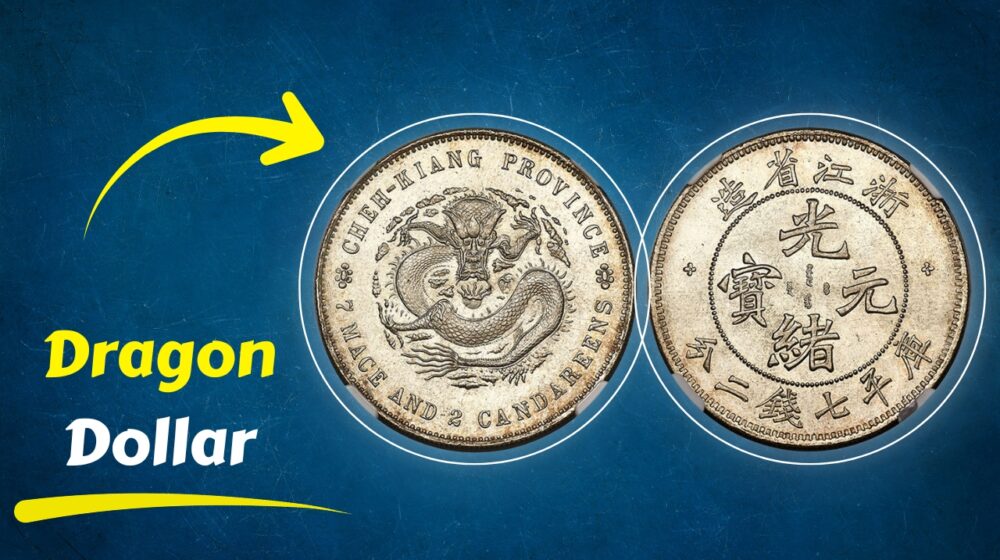
A 1905 U.S. diplomatic translation of Qing monetary regulations describes plans for a central mint at Tientsin to standardize weights, fineness and designs. Central authorities were to control the dies and impose common standards across the country’s mints. The Central Mint at Tientsin became a hub for both experimental and national coinage, and in the dynasty’s last years its engravers tested several bold dragon-dollar designs. Those trial pieces include some of the most famous patterns in Chinese numismatics. The Reversed Dragon is one of them.
The reference material used for this article does not name the engraver or designer of this pattern, so none is credited here.
Auction Precedents
The type has a strong record at auction:
- April 2023: Stack’s Bowers sold an L&M-31 Reversed Dragon Dollar graded PCGS SP-65 for $1,380,000. PCGS Auction Prices lists this as the auction record for the issue in its database.
- October 2023: A PCGS SP-62 example was offered by Stack’s Bowers.
- April 2024: A PCGS SP-63 example was offered by Stack’s Bowers.
The 2023 result should not be read as a forecast for this coin. Specimens differ, as do grading services, pedigrees, market conditions and the bidders in the room. It does show how seriously advanced collectors treat the type.
Design Description
The design has the hallmarks of China’s celebrated late Qing dragon dollars:
- The dragon: A serpentine imperial dragon twists through clouds. What sets this pattern apart is the direction of the body. The dragon forms a roughly C-shaped coil, with its tail extending to the right and appearing to vanish into the surrounding clouds. This is the opposite of the arrangement on the circulation design that was eventually chosen, and it is the source of the “Reversed Dragon” name.
- The pearl: A flaming pearl appears in the lower portion of the design.
- The denomination: The value is given in Chinese as 壹圓 (one yuan), with the English inscription ONE DOLLAR below.
- The leaves (Type II): The variety is identified by raised veins in the outer leaves. These small details help specialists tell L&M-31 apart from other members of the complicated 1911 pattern-dollar family.
Surfaces and strike: This example shows bright, strong silver surfaces with only light golden toning near parts of the rim. The strike is sharp across the dragon, clouds, inscriptions and ornaments, and the largely untoned centers let the design stand out.
A note on the other side: The source material describes the dragon side in detail but does not describe the opposite face. Check the official Stack’s Bowers lot description or the NGC images for its inscriptions before you finalize any publication or bid.
Why This Matters for Collectors
It captures a turning point. Few coins so closely mark the end of an era. The pattern was made while the Qing still hoped to reform its currency, and the dynasty ended shortly after.
Patterns show the road not taken. Regular coins show what a government decided to produce. Patterns show what was considered, tested and rejected. The Reversed Dragon shows the mint experimenting with the dragon’s direction, the foliage and other details before another arrangement won.
Top condition is exceptional. MS-66 is an extraordinary level of preservation for this rare imperial pattern. NGC has certified 10 examples of the raised-veins variety, and this one is the finest.
Read the population figure carefully. The NGC census covers only NGC-certified coins. Other examples sit in PCGS holders or outside the major grading services, so 10 is not the total number of survivors.
The market is proven. A seven-figure sale in 2023 and a run of appearances in the following year show deep demand whenever a high-grade example comes up.
It is a survivor. The dragon that faced the other way outlasted the dynasty that made it. More than 115 years later, a bright, sharply struck example is a glimpse of the coin China nearly made.
Quick-Reference Buying Guide
- Mark the date. Stack’s Bowers Hong Kong Rarities Night is on October 19, 2026.
- Register with Stack’s Bowers now. Approval can take time for high-value lots.
- Confirm your bidding method. Ask about live, phone, online and absentee options for this sale.
- Research the coin. Check the NGC MS-66 certification, the L&M-31 attribution and the Type II raised-veins variety.
- Compare past results. Review the April 2023 PCGS SP-65 sale ($1,380,000) and the 2023 and 2024 PCGS SP-62 and SP-63 appearances, keeping in mind the differences in grade and grading service.
- Set a firm limit. Include the buyer’s premium, taxes, shipping and insurance, not just the hammer price.
- Plan your funding. Know the payment terms and deadlines before you bid.
- Bid, then confirm delivery. If you win, arrange secure shipping and insurance for the coin.
Information is based on Stack’s Bowers Galleries’ announcement and the supporting numismatic data provided. Confirm all auction terms, fees and lot details with Stack’s Bowers before bidding.