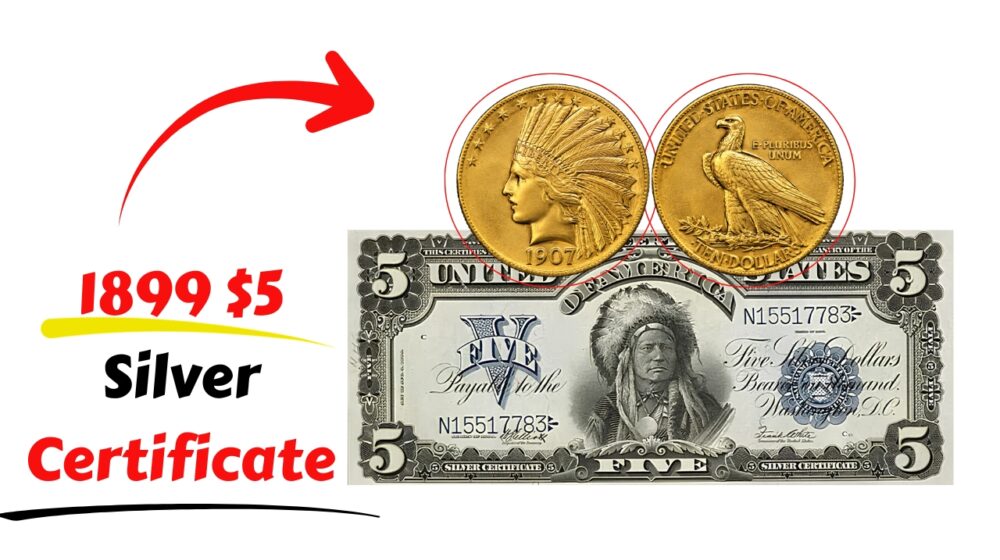
At the close of the 19th century, the Treasury put a Native American at the center of a piece of U.S. paper money. The Series 1899 $5 Silver Certificate, known to collectors as the “Chief Note” or “Indian Chief Note,” was the first American note to give a Native American the central place in its design.
The man on the note is Ta-to’-ka-in’-yan-ka, better known as Running Antelope, a Hunkpapa Lakota leader. For decades, though, collectors got even that basic fact wrong. Some called him “Onepapa,” a garbled version of his people’s name. Others swore the portrait was a different chief entirely. Only in 1969, when Paper Money, the journal of the Society of Paper Money Collectors, published Forrest W. Daniel’s research, did a properly grounded account emerge.
Running Antelope’s story tells us something about 19th-century Plains history, but so does the note’s own design: an 1872 studio photograph, an engraver who swapped out the sitter’s headdress, and a Treasury that wanted a familiar image of “the Indian” more than an accurate one. Collectors have long admired the result. A 1978 review in Coins magazine called these notes the high point of U.S. paper money design, and the 100 Greatest American Currency Notes ranks the type at number 10.
Specifications and Key Details
| Detail | Information |
|---|---|
| Note | Series 1899 $5 Silver Certificate |
| Nicknames | “Chief Note,” “Indian Chief Note” |
| Type | Silver Certificate (paper redeemable in silver) |
| Denomination | $5 |
| Portrait subject | Running Antelope (Ta-to’-ka-in’-yan-ka), Hunkpapa Lakota |
| Source image | 1872 photograph by Alexander Gardner, Washington, D.C. |
| Engraver | George F. C. Smillie (worked from the photograph in November 1899) |
| Predecessor | Series 1896 $5 “Educational” Silver Certificate |
| Successor | Series 1923 $5 Silver Certificate with Lincoln (“Porthole Note”) |
| Signature combinations | 11 recognized by collectors |
| Design colors | Large blue Roman numeral V at left; large Treasury Seal at right |
| Back | Ornate borders framing a V and text stating the note’s legal basis; also designed by Smillie |
| Format | Large-size U.S. note (roughly 7⅜ × 3⅛ inches; verify before publishing) |
| Face value at issue | $5 |
| Market values | Common circulated examples often sell for hundreds of dollars; a PCGS Gem New 66 PPQ note sold for $6,600 (two sales reported); a PCGS Gem New 67 PPQ brought $22,912.50 in August 2017 |
| Ranking | #10, The 100 Greatest American Currency Notes (Bowers and Sundman, 2006) |
| Printing figures | Not covered in the source material; consult Friedberg/Bowers references for per-series numbers |
Buying and Acquiring: What Applies to This Note
The Chief Note is a century-old collectible, not a new release, so no order window, household limit, or launch date exists. The note trades on the secondary market. Some related items did have real sales windows, and they show how popular the design is:
- 1977: The Bureau of Engraving and Printing produced ANA World’s Fair of Money convention souvenir cards showing the 1899 $5 face.
- 1988: The International Paper Money Show issued a similar card featuring the back.
- 2001: The U.S. Mint offered a set containing a BEP-produced replica of the 1899 $5 Silver Certificate together with 2001-D American Buffalo commemorative silver dollar examples and a 1987 Red Cloud stamp. It reportedly sold out within a week.
Today, buyers find genuine notes through dealers such as Littleton Coin Co., which markets them as historic and beautiful, and through paper money specialists, major auction houses like Heritage, and coin and currency shows.
Historical Background
Running Antelope: The Man on the Note
Running Antelope was born in 1821 and belonged to the Hunkpapa band of the Lakota on the Northern Plains. In 1851, the year of the first Treaty of Fort Laramie, he became one of four “shirtwearers” of his people, a major leadership position. (The source gives a birthplace that cannot be reconciled with modern geography, so this article does not name one.)
Through the 1850s and 1860s he moved between diplomacy and the violence that accompanied westward settlement. A retrospective 1879 newspaper account credited him with rescuing an Army scout in 1857. In 1867 he stressed his loyalty to whites, saying he had been faithful since first allying with them. He signed the Second Treaty of Fort Laramie in 1868, using a drawing of a running antelope as his mark, and received a peace medal bearing Andrew Johnson’s likeness.
Not every Hunkpapa followed his path. Sitting Bull declined to sign the treaty and by 1869 led the non-treaty Lakota. Running Antelope stayed on the accommodation side. When Sitting Bull returned from Canada in 1881, Running Antelope was part of the party that met and escorted him, and Sitting Bull reportedly held him in low regard for his cooperation with whites.
At Standing Rock, Running Antelope farmed, served as a district farmer (an 1889 federal register lists him at $120), and became widely known as an orator. A newspaper in 1883 called him the silver-tongued orator of the Sioux. He also clashed with agents: in 1878 he and others seized agent William T. Hughes, and in 1880 tensions with agent Joseph A. Stephans over religious ceremonies nearly led to another confrontation at the river. He warned in 1883 that continued slaughter of the buffalo would end the herds within two years. In 1888 he compared the government’s land promises to a cow trade in which the animals offered kept getting worse and never arrived.
He did not go to Wounded Knee in 1890 and spent his last years at Standing Rock. He died near Little Eagle, South Dakota, between June 1896 and June 1897, so he did not live to see the note.
The 1872 Photograph
In 1872, officials brought Running Antelope to Washington to meet President Ulysses S. Grant. Photographer Alexander Gardner, known for Civil War battlefield photographs and later work for the Union-Pacific Railroad, took two portraits: a profile and a frontal view. Running Antelope wore Hunkpapa clothing, three tall feathers, and a peace medal linked to the one from 1868. Gardner and his sitter were both born in 1821. The photograph was archived by the Bureau of Ethnology as part of an effort to record Native Americans in what photographers then considered traditional dress.
Silver Certificates and the Money Politics Behind the Note
Silver Certificates were products of a long argument over silver. The Coinage Act of 1873 (the “Crime of ’73”) demonetized silver and set off the Free Silver Movement. In 1878 the Bland-Allison Act brought back silver dollars, and the Bureau of Engraving and Printing began issuing Silver Certificates, notes redeemable in silver. The Sherman Silver Purchase Act of 1890 expanded federal silver purchasing and increased silver dollar and certificate production.
That mattered for the note’s imagery. Historian Michael O’Malley has described how many Americans tied precious metals to race, treating gold as the “civilized” money of Anglo-Saxons and silver and paper as lesser. In that worldview, putting an Indian portrait on silver-backed paper did not challenge the prevailing hierarchy of value.
The Educational Series and Selection of the Portrait
In 1896 the Treasury introduced the Educational Series of Silver Certificates. The $5 note showed Grant and General Philip Sheridan on the back. The series was short-lived, and designers wanted something new for the Series 1899 design. They selected Running Antelope as the note’s central figure.
Why him? Many Native leaders had visited Washington and sat for Gardner in 1872, and the Bureau of Ethnology held thousands of images. Scholars suggest that Running Antelope’s biography of farming, diplomacy, and accommodation made him a symbol of assimilation rather than resistance, which suited federal priorities.
George F. C. Smillie and the Headdress Change
In November 1899, engraver George F. C. Smillie translated Gardner’s photographs into the note’s portrait. Running Antelope’s three-feather headdress was too tall for the portrait frame. Instead of choosing another subject or letting the feathers break the border, Smillie found an image of a large feathered warbonnet and placed it over the original headwear. Many writers describe the substituted warbonnet as Pawnee, though scholars are not certain. Either way, the note shows a Hunkpapa leader in regalia that likely did not belong to him.
The End of the Chief Note
The Series 1899 $5 note outlasted its Educational predecessor and remained in use into the early 1920s. In 1923, Abraham Lincoln replaced Running Antelope on the $5 Silver Certificate, framed in a heavy black border that led collectors to call these “Porthole Notes.”
Design Description
Obverse. Running Antelope’s portrait is the focal point. Its source is Gardner’s photograph, but the headdress is Smillie’s substitution. A large blue Roman numeral V stands at the left, and the blue color signals Silver Certificate status. A large Treasury Seal appears at the right. As on other notes of the era, the note pairs finely engraved portraiture with dense ornamentation.
Reverse. The back was also designed by Smillie. Ornate borders frame another large V and text that explains the note’s legal basis as a Silver Certificate.
The contrast with the 1896 Educational $5, which showed Grant and Sheridan on the back, is part of the appeal. The 1899 design turned to a single dominant figure and gave a Native American the central place for the first time on U.S. paper money.
Getting the Name Right: Common Mistakes
“Onepapa.” Collectors long used this label, and variants such as “Oncpapa,” for Running Antelope. It is a spelling of “Hunkpapa,” the name of his people, and not a personal name.
“Red Jacket.” A New York Times article of June 26, 1900, misidentified the portrait as Red Jacket.
Hollow Horn Bear. In February 1909, The Numismatist published a piece saying the portrait “is said to be” Hollow Horn Bear, a Sioux chief who addressed Congress in 1889. Newspapers repeated the claim, including a 1909 Aberdeen paper and a 1913 obituary. It is incorrect: Hollow Horn Bear appeared on stamps and military payment certificates, but not on the 1899 $5 Silver Certificate. Some online sources still repeat the myth.
Why This Matters for Collectors
It is a historic first. The Chief Note was the first U.S. paper money to place a Native American as its central subject, and it remains one of the best-known Native portraits on American currency. Coin World has called it the most familiar image of a Native American on U.S. paper money.
It is a top-tier type. With its ranking in the 100 Greatest American Currency Notes and steady demand, the note draws strong bidding. Even common circulated examples often sell for hundreds of dollars, while high-grade notes reach thousands. Low or unusual serial numbers, replacement notes, and major errors bring premiums.
It connects to bigger themes. The note touches Plains history, the Gilded Age silver debate, the Dawes Act era, and the long tradition of Americans using Native imagery on money, from colonial bills to the Indian Princess motif on 19th-century coins. Collectors who understand this context get more out of the note.
The portrait is not what it seems. The altered headdress, the mistaken identities, and the accommodating-chief narrative that suited the Treasury all make this a good case study in how design choices reflect the assumptions of an era. Collecting it well means acknowledging both the beauty and the complications.
Collecting adjacent items is easy. The souvenir cards, the 2001 replica set, and other tie-ins give collectors of every budget a way in.
Quick-Reference Buying Guide
- Confirm the type. You want a Series 1899 $5 Silver Certificate with Running Antelope on the face and blue V at left, not the Series 1896 Educational note or the 1923 Lincoln “Porthole.”
- Set a budget by grade. Expect hundreds of dollars for common circulated examples, thousands for Gem Uncirculated notes, and well over $20,000 at the very top (a PCGS 67 PPQ sold for $22,912.50 in 2017).
- Choose a signature combination. Collectors recognize 11, so decide whether you want a type example or a complete set.
- Look for premium features. Low or fancy serial numbers, replacement notes, and errors carry extra value.
- Prefer certified notes. Third-party grading from PCGS Banknote or a similar service helps confirm authenticity and originality, and the “PPQ” designation signals paper quality.
- Buy from reputable sources. Use established dealers, major auction houses, and recognized shows, and check return policies.
- Compare recent sales. Check auction records for the grade and signature you want, since prices vary widely.
- Know the story. Be ready to spot common mistakes, such as “Onepapa,” “Red Jacket,” and Hollow Horn Bear, when reading old descriptions.
- Store it properly. Keep the note in an inert, archival holder, away from moisture and light.
Sources and further reading: Forrest W. Daniel, “Running Antelope Misnamed Onepapa,” Paper Money (1969); Heinz Tschachler on Native imagery on U.S. paper money; Philip Deloria, Playing Indian; Michael O’Malley, Face Value; David Treuer, The Heartbeat of Wounded Knee; Robert Utley, Sitting Bull; Bowers and Sundman, The 100 Greatest American Currency Notes; and period newspapers cited in the reference article.