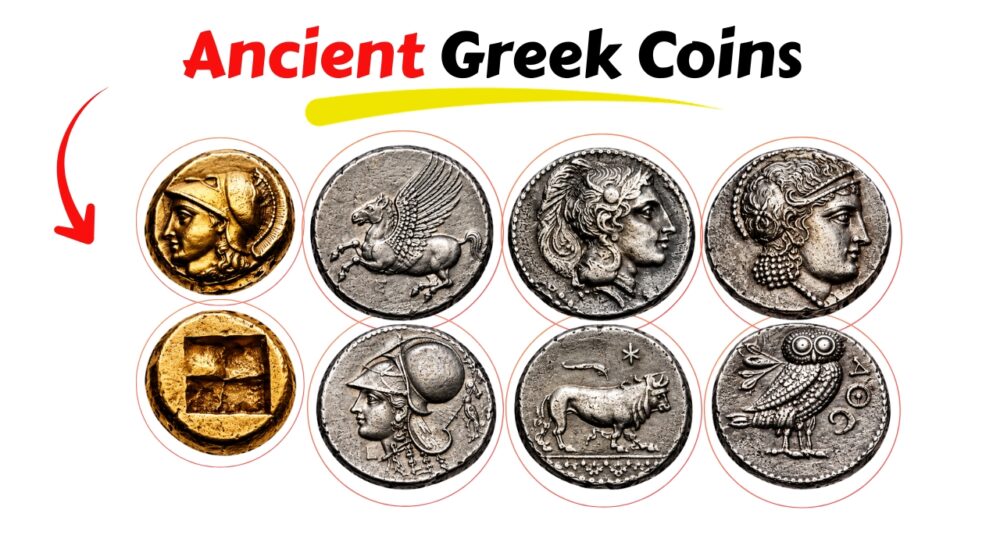
Few figures from classical mythology enjoyed a numismatic career as long, as widespread, or as visually varied as Athena. Goddess of wisdom, strategic warfare, crafts, and civic protection, she appeared on coinage struck across an astonishing geographic range from her home city of Athens to Sicily, southern Italy, Asia Minor, Egypt, Syria, and even Parthia, a kingdom whose rulers had no ethnic or political connection to Greece at all. The Romans folded her into their own pantheon as Minerva and kept her militant imagery in circulation for centuries after Athens itself had faded as a coin-issuing power.
A quick note before diving in: this is not a guide to a single commemorative issue with a price and an order window. It’s a survey of an ancient iconographic tradition that spans roughly a thousand years of coin production across dozens of city-states, kingdoms, and empires. So rather than specs for one product, what follows is an overview of the major coin types collectors are likely to encounter, how the ancient coin market actually works for pieces like these, the mythology and history behind Athena’s imagery, and a practical framework for building a collection organized around her.
Featured Coin Types at a Glance
Ancient coins don’t come with a single fixed mintage, price, or composition the way a modern commemorative does values and specifications vary coin by coin, condition by condition, and sale by sale. What can be documented are the mints, approximate dates, denominations, and metals associated with the major Athena types discussed in this article.
| Issuing Authority | Denomination | Metal | Approximate Date | Notable Feature |
|---|---|---|---|---|
| Athens (Archaic) | Tetradrachm | Silver | 510–500/490 BCE | Early Athena portrait in crested Attic helmet |
| Athens (“Owl” type) | Tetradrachm | Silver | 454–404 BCE | Classic owl reverse; major Mediterranean trade coin |
| Athens (“New Style”) | Tetradrachm | Silver | 165–42 BCE | Triple-crested helmet; owl on amphora within wreath |
| Phokaia, Ionia | Hekte (sixth stater) | Electrum | c. 387–326 BCE | Helmeted Athena with small seal below portrait |
| Corinth | Stater | Silver | c. 350/45–285 BCE | Pegasus obverse; Athena in Corinthian helmet reverse |
| Velia, Lucania | Nomos | Silver | c. 300–280 BCE | Athena in crested Attic helmet; fine late Classical engraving |
| Bactria (local series) | Didrachm | Silver | c. 295/3–285/3 BCE | Athenian-imitative type struck far into Central Asia |
| Herakleia, Lucania | Nomos | Silver | c. 281–278 BCE | Facing Athena portrait, triple-crested helmet |
| Issos, Cilicia (Balakros) | Stater | Silver | 333–323 BCE | Facing Athena under Alexander’s satrap Balakros |
| Syracuse, Sicily | Tetradrachm | Silver | c. 405 BCE | Athena replaces Arethusa amid dolphins |
| Thrace (Lysimachos) | Tetradrachm | Silver | 305–281 BCE | Seated Athena Nikephoros holding Nike |
| Pergamon (Eumenes I) | Tetradrachm | Silver | 263–241 BCE | Seated Athena with shield and spear |
| Mallos, Cilicia | Stater | Silver | c. 385–375 BCE | Less common seated Athena beside an olive tree |
| Pergamon, Mysia | Stater | Gold | Mid-to-late 330s BCE | Archaistic standing Palladion-style Athena |
| Seleukid Empire (Antiochos VII) | Tetradrachm | Silver | 138–129 BCE | Standing Athena Nikephoros |
| Cappadocia (Orophernes) | Tetradrachm | Silver | c. 159–157 BCE | Reverse shows Nike, not Athena — a common point of confusion |
| Parthia (Phraates IV) | Tetradrachm | Silver/Billon | c. 38–2 BCE | Helmeted Athena presenting a wreath to an enthroned Parthian king |
| Ptolemaic Egypt (Ptolemy I) | Tetradrachm | Silver | 323–282 BCE | Athena Alkidemos advancing with spear |
| Thessalian League | Drachm | Silver | 196–146 BCE | Athena Itonia advancing with spear and shield |
| Roman Republic | Æ 25mm | Bronze | c. 264 BCE | Minerva in Corinthian helmet |
| Julius Caesar issue | Dupondius | Bronze | Late 46–45 BCE | Minerva advancing with trophy, spear, and shield |
| Claudius | As | Bronze | 41–54 CE | Minerva advancing right, preparing to throw spear |
| Marcus Aurelius, as Caesar | Sestertius | Bronze | 139–161 CE | Minerva standing, holding Victory |
How Collectors Actually Acquire Athena Coin Types
Because these are ancient issues rather than a modern limited release, there is no manufacturer, mint sale, donation tier, or fixed order window. Instead, collectors build an Athena-themed collection the way ancient coin collectors generally do:
- Auction houses and dealers. Major ancient coin auction houses and established dealers the kind that regularly appear in databases like acsearch.info or through organizations such as Classical Numismatic Group (CNG) are the primary marketplace for these coins. Prices vary enormously by type, mint, condition, and rarity; a common Athenian Owl tetradrachm and a rare gold Pergamene stater occupy very different price tiers entirely.
- No fixed mintage or limit to track. Unlike a modern commemorative with a published mintage cap, ancient mintages are generally unknown or only roughly estimable from surviving specimens and die studies. Availability is driven by how many examples have survived two thousand-plus years and made it into the market, not by a publisher’s print run.
- No release date or order window. These coins were struck across many centuries by dozens of different authorities; there is no single “release” to watch for. Instead, collectors watch ongoing auction calendars and dealer inventories for specific types they want.
- Authentication matters more than timing. Given the age, value, and history of forgery in the ancient coin market, provenance and authentication from a reputable dealer or grading service carry far more weight than being first in line for a release.
- Reference works help set expectations. Standard references such as Harlan Berk’s 100 Greatest Ancient Coins, David Sear’s Greek Coins and Their Values, and Barclay Head’s classic Historia Numorum are useful for understanding rarity and historical importance before buying.
Historical Background of the Major Athena Coin Traditions
The Athenian Owl and the Birth of Athena’s Numismatic Identity
Athens is the natural starting point for any survey of Athena’s coinage, since the city took her name and made her image central to its civic identity. According to myth, Athena won patronage of Attica over the sea god Poseidon by gifting the city the olive tree, and the Athenians chose her gift and adopted her name for their city. Her cult connections may run even deeper into Greek prehistory a Linear B tablet from Knossos contains the phrase a-ta-na-po-ti-ni-ja, which many scholars read as “Mistress Athena,” tentatively linking her (or a closely related figure) to Mycenaean Bronze Age religion, though the reading remains debated among specialists.
Athens’ earliest Archaic-period tetradrachms (roughly 510–500/490 BCE) show a stiffly rendered Athena in a crested Attic helmet, reflecting the more rigid style typical of early Greek die engraving. Within a few generations, however, Athenian engraving matured rapidly. By the Classical period (454–404 BCE), Athens was striking the tetradrachm now universally known among collectors simply as the “Owl” Athena in a crested, olive-decorated helmet on the obverse, paired with her sacred owl on the reverse. These coins circulated so widely across the ancient Mediterranean that they functioned as a de facto international trade currency, and the type is ranked No. 10 in Harlan Berk’s 100 Greatest Ancient Coins.
Centuries later, in the second century BCE, Athens revived and reinvented the design with the so-called “New Style” tetradrachm a larger, more elaborate coin featuring a richly detailed triple-crested helmet and a reverse owl now perched on an amphora within an olive wreath. The core Athena-and-owl identity survived across more than three centuries of Athenian coinage even as the artistic style evolved dramatically.
Athena Beyond Athens: An International Image
Athena’s portrait did not stay confined to her namesake city. In Ionia, the city of Phokaia placed a helmeted Athena on its electrum hekte coinage during the fourth century BCE notable partly because Ionia was where Greek coinage itself first developed in the late seventh and early sixth centuries BCE. Corinth paired an Athena-in-Corinthian-helmet reverse with its famous Pegasus obverse on staters produced across generations, a type so influential that Corinthian colonies and other cities copied or adapted it throughout the Mediterranean; Berk ranks it No. 23 among his greatest ancient coins.
Further west, the Greek colony of Velia in Lucania (Magna Graecia, southern Italy) struck a Athena-helmeted silver nomos around 300–280 BCE with engraving sophisticated enough to demonstrate how far Greek die-cutting technique had advanced by the late Classical period. Most strikingly, Athena’s image traveled as far as Bactria a region spanning parts of modern Afghanistan and Central Asia where a local silver didrachm from the early third century BCE imitated Athenian types and retained her familiar crested Attic helmet, showing that her portrait had become part of a shared, international Greek visual vocabulary rather than a purely local Athenian symbol.
Facing Athena: A Technical and Artistic Challenge
While most ancient coin portraits show Athena in profile, several mints attempted the far more technically demanding facing portrait. Herakleia in Lucania produced a silver nomos (circa 281–278 BCE) showing Athena turned slightly to one side in an elaborate triple-crested helmet, a helmet style Greek engravers favored for facing compositions. An even more dramatic example comes from Issos in Cilicia, struck under Balakros, satrap of Cilicia during the reign of Alexander the Great (333–323 BCE); its facing Athena in a triple-crested Attic helmet demonstrates the perspective and technical ambition late Classical engravers were willing to attempt on a small silver flan.
Syracuse offers perhaps the most historically loaded example. Around 405 BCE, the Sicilian city struck a tetradrachm showing Athena rather than the city’s usual patron, the nymph Arethusa surrounded by the dolphins normally associated with Arethusa’s fountain imagery. The substitution followed Syracuse’s decisive defeat of the disastrous Athenian expedition to Sicily in 413 BCE, and scholars have long debated the political meaning behind putting Athens’s own patron goddess on a Syracusan victory coin. Berk ranks the broader Syracusan tetradrachm tradition No. 7 on his list of the greatest ancient coins.
Athena Seated: Nikephoros and Her Hellenistic Legacy
The seated Athena Nikephoros (“Athena Bearer of Victory”) became one of the defining images of Hellenistic coinage. Lysimachos, who ruled Thrace after the breakup of Alexander the Great’s empire, struck tetradrachms pairing a deified portrait of Alexander on the obverse with a seated Athena Nikephoros reverse she holds Nike in her right hand, rests her left arm near her shield, with a spear behind her. Berk ranks this type No. 52 on his list. It’s worth noting explicitly that this seated-Athena reverse is distinct from Alexander the Great’s own tetradrachms, which show a seated Zeus rather than Athena; Alexander’s coinage instead placed a helmeted Athena on the obverse of his gold staters.
Eumenes I of Pergamon adapted the seated Athena composition on his own third-century BCE tetradrachms, showing her with shield and spear in several die varieties. A less common seated composition comes from Mallos in Cilicia (circa 385–375 BCE), where Athena sits with helmet, spear, and shield beside an olive tree a design collectors encounter far less often than the Nikephoros type. Interestingly, the broader visual concept of an armed, seated female personification echoes forward across more than two millennia into British coinage: the seated Britannia on Great Britain’s 1797 copper “Cartwheel” Penny, and her continued presence on pre-decimal pennies through decimalization in 1971, reflects a similar classical visual vocabulary of armed female personifications, even though Britannia carries her own distinct Roman and British historical lineage rather than being a direct descendant of Athena.
Athena Standing and On the Move
Standing and advancing Athena compositions round out the goddess’s numismatic range. A rare gold stater from Pergamon in Mysia (mid-to-late 330s BCE) pairs a Herakles obverse with a reverse showing an Archaistic Palladion Pallas Athena standing and facing forward, spear raised to strike, shield on her arm a design long admired for both its artistry and unusual iconography. Roughly two centuries later, the Seleukid king Antiochos VII Euergetes (Sidetes) placed a standing Athena Nikephoros, holding Nike while carrying her military attributes, on his tetradrachms a design meant to visually link royal power with both military strength and divine victory.
Not every coin that looks related actually shows Athena, however. The tetradrachm of Orophernes of Cappadocia (circa 159–157 BCE) ranked No. 82 by Berk shows Nike standing alone with a wreath and palm, not Athena herself. Because Nike so frequently appears as Athena’s attribute (as in the Nikephoros types above), collectors new to the series can easily mistake a free-standing Nike for Athena, making this a useful type for illustrating the distinction.
Athena also appears in active, advancing poses. A tetradrachm from the satrapal period of Ptolemy I of Egypt shows “Athena Alkidemos” (“Defender of the People”) advancing to the right, spear drawn back and ready to throw, shield on her other arm. A similar advancing composition appears on a silver drachm of the Thessalian League from the second century BCE, where “Athena Itonia” advances with spear and shield both designs manage to convey dynamic battlefield motion within the small format of a struck coin.
Rome’s Minerva: Athena’s Long Afterlife
When Rome adopted Athena as Minerva, folding her into the Capitoline Triad alongside Jupiter and Juno, Roman die engravers borrowed extensively from the Greek visual conventions already established for Athena. A Roman Republican bronze coin from around 264 BCE shows Minerva in a Corinthian helmet immediately recognizable to anyone familiar with Greek Athena types. Under Julius Caesar, a bronze dupondius struck in or shortly before 45 BCE paired a Victory obverse with a reverse showing Minerva advancing left with trophy, spear, and shield, a snake at her feet combining military victory imagery with Minerva’s traditional martial identity.
The tradition continued well into the Imperial period. Under Claudius (41–54 CE), Minerva advances right rather than left, preparing to hurl her spear a composition any collector familiar with Greek Athena Alkidemos types will recognize immediately. Later still, a sestertius from the reign of Marcus Aurelius as Caesar (139–161 CE) shows Minerva standing and holding Victory, spear and shield completing the design. Across more than three centuries of Roman coinage, Minerva carried forward an iconographic vocabulary that Greek engravers had developed for Athena generations earlier.
Obverse and Reverse Designs: A Closer Look
Because this survey spans dozens of individual coin types rather than a single issue, obverse and reverse conventions vary considerably by mint and period. A few patterns are worth calling out for collectors learning to identify Athena types at a glance:
- Helmet style as an identifier. A single-crested Attic helmet often marks earlier or more conservative issues (Archaic Athens, Velia, Bactria), while triple-crested helmets tend to appear on more elaborate later issues (Athenian New Style, facing portraits from Herakleia and Issos).
- Profile vs. facing portraits. Profile portraits dominate Athena’s coinage generally, but facing portraits as at Herakleia, Issos, and arguably Syracuse represent a deliberate technical showcase by the engraver and are typically prized more highly by collectors for their difficulty and visual drama.
- Attributes that distinguish poses. A seated Athena typically holds a small Nike figure (as Nikephoros), with spear and shield nearby, as seen in the Lysimachos and Eumenes I types. A standing, advancing Athena usually carries a raised or drawn-back spear with a shield on the opposite arm, conveying motion, as in the Ptolemaic and Thessalian League types.
- Common companion figures. Owls (Athens), Pegasus (Corinth), and dolphins (Syracuse) are among the most recognizable reverse or paired companions across Athena’s coinage, each tied to local civic or mythological associations rather than to Athena herself.
- Roman Minerva vs. Greek Athena. Roman issues generally retain Athena’s helmet and martial attributes but often add distinctly Roman elements a trophy, for instance, on the Julius Caesar-era dupondius that mark the type as Minerva rather than a direct Greek Athena copy.
Why This Matters for Collectors
- Unmatched breadth for a themed collection. Few ancient deities offer this much geographic and chronological range Athena types span from Archaic Athens through Imperial Rome, and from mainland Greece to Sicily, Asia Minor, Bactria, and Parthia, giving type collectors an enormous canvas to work with.
- A built-in ranking system for rarity and importance. Harlan Berk’s 100 Greatest Ancient Coins places several Athena and Athena-related types on its list the Athenian Owl (No. 10), the Corinthian stater (No. 23), the Syracusan tetradrachm tradition (No. 7), the Lysimachos tetradrachm (No. 52), and the Orophernes tetradrachm (No. 82) giving new collectors a useful, widely recognized framework for prioritizing acquisitions.
- Genuine historical and cultural depth. Because Athena’s mythology intersected with civic identity, military power, craftsmanship, and even non-Greek kingship (as with Parthia’s Phraates IV), collecting her coinage offers a window into how visual propaganda and religious identity worked across the ancient world not just an exercise in accumulating attractive silver.
- A gateway to broader numismatic literacy. Learning to distinguish, for example, a genuine Athena Nikephoros from a free-standing Nike (as on the Orophernes tetradrachm), or an Archaic helmet style from a Hellenistic one, builds exactly the kind of close visual attention ancient coin collecting rewards.
- Cross-cultural staying power. The Roman adoption of Athena as Minerva, and the echo of her armed-female-personification imagery in far later coinage like Britain’s Britannia, demonstrates a visual and symbolic legacy that collectors can trace across more than two thousand years of Western coinage.
Quick-Reference Guide for Building an Athena Coin Collection
- Decide your organizing principle. Choose whether you want to collect by mint (Athens, Corinth, Pergamon, etc.), by pose (helmeted profile, facing, seated, standing/advancing), or chronologically across the Greek-to-Roman transition.
- Start with a widely available anchor type. The Classical-period Athenian “Owl” tetradrachm is both historically central and relatively obtainable, making it a logical starting point before moving to rarer regional types.
- Learn to distinguish similar-looking types. Study helmet styles (single- vs. triple-crested), poses (seated vs. standing vs. advancing), and companion figures (Nike vs. Athena Nikephoros) before buying, to avoid costly misidentifications.
- Consult standard references before purchasing. Cross-check prospective purchases against works like Berk’s 100 Greatest Ancient Coins, Sear’s Greek Coins and Their Values, or Head’s Historia Numorum to understand a given type’s rarity and historical standing.
- Buy from reputable auction houses and dealers. Given the age and forgery risk inherent to the ancient coin market, prioritize sellers with strong provenance records and established reputations, such as those represented in databases like acsearch.info or firms like CNG.
- Expect variable pricing, not a fixed price list. Unlike modern commemoratives, prices for these types fluctuate by condition, rarity, and auction dynamics budget with a range in mind rather than a single expected cost.
- Consider the story alongside the coin. Where possible, learn the specific historical context behind a piece such as Syracuse’s substitution of Athena for Arethusa after defeating the Athenian expedition, or Parthia’s blending of Hellenistic and local royal imagery since that context is often what makes an Athena coin memorable beyond its silver content.
- Expand outward once you have an anchor piece. Once you own a core Athenian or Corinthian type, branch out geographically (Bactria, Cilicia, Parthia) or into Roman Minerva issues to build out the fuller international story of Athena’s numismatic legacy.