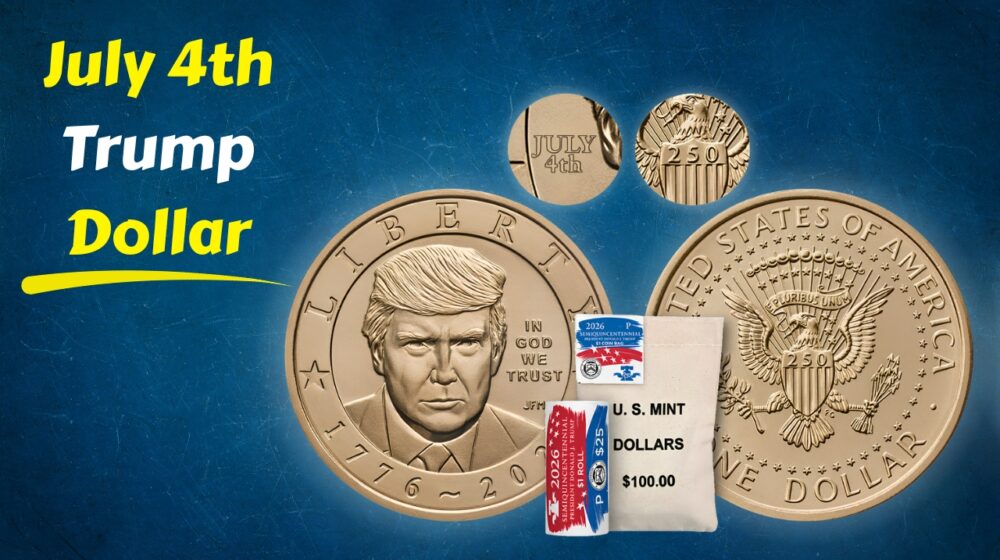
Modern coin hunts usually start the moment a new release hits circulation. This one started early. Days before the U.S. Mint’s official September 2, 2026, public sale of the new 2026 Semiquincentennial President Donald J. Trump $1 Coin, Heritage Auctions numismatist Rene Alvarenga pulled an unannounced variety out of an Advanced Delivery roll a coin carrying a small “JULY 4th” privy mark that didn’t appear anywhere in the Mint’s published product information at the time.
CAC Grading certified the piece MS64 and labeled it a “Discovery Coin,” and Heritage has said it plans to donate the coin to the American Numismatic Association. Within days, PCGS confirmed it had also graded an early example, submitted on August 24 more than a week before the Mint’s public launch and the U.S. Mint itself confirmed the key fact collectors had been waiting for: exactly 250,000 Trump dollars were struck with the July 4th privy mark, all on Independence Day itself, then randomly mixed into the regular rolls and bags sold beginning September 2.
Here’s everything collectors need to know about the standard 2026 Trump dollar, the July 4th privy variety hidden inside it, and how the whole release actually played out.
Specifications at a Glance
| Detail | Information |
|---|---|
| Denomination | $1 (Semiquincentennial President Donald J. Trump Dollar) |
| Finish | Circulating (never placed into general circulation, but legal tender) |
| Composition | 88.5% copper, 6% zinc, 3.5% manganese, 2% nickel |
| Weight | 8.100 grams |
| Diameter | 26.49 mm |
| Edge | Plain |
| Mint | Philadelphia |
| Mint mark | None |
| Obverse designer | Joseph Menna, U.S. Mint Chief Engraver |
| 25-coin roll price | $61 |
| 100-coin bag price | $154.50 |
| Product limit | 150,000 rolls / 50,000 bags |
| Overall coin mintage | Not specified by the Mint at product level |
| Household order limit | 2 of each product (in effect through 2 p.m. ET, September 3, 2026) |
| July 4th privy mark mintage | 250,000, confirmed by the U.S. Mint |
| Privy strike date | July 4, 2026, at the Philadelphia Mint |
| Privy distribution method | Randomly mixed into standard rolls and bags — not separately orderable |
| Public sales launch | September 2, 2026, 12:00 p.m. ET |
How the Release and Ordering Process Actually Worked
Unlike a numbered special edition, this release was designed around uncertainty. Here’s how it unfolded, and what collectors need to know if they’re still hunting for the privy variety in rolls and bags acquired around the launch.
The standard product. The U.S. Mint opened public sales of the 2026 Trump dollar rolls and bags on September 2, 2026, at noon Eastern time, through its official online ordering system. Buyers could choose a 25-coin roll for $61 or a 100-coin bag for $154.50. At launch, the Mint capped total product availability at 150,000 rolls and 50,000 bags, while imposing a household order limit of two of each product a restriction the Mint said would remain in effect through 2 p.m. ET on September 3, after which limits could change. As with any Mint product, prices, limits, and availability remain subject to adjustment.
No separate order for the privy coin. This is the detail that trips up new collectors: there was never a way to specifically order the July 4th privy version. The Mint struck all 250,000 privy-marked dollars on July 4, 2026, then randomly distributed them inside the same standard rolls and bags sold to everyone. A buyer placing a normal order on or after September 2 might receive one, several, or none of the privy coins there was no premium product, checkbox, or separate SKU for it.
Product limit vs. mintage a distinction that matters. The Mint’s 150,000-roll and 50,000-bag figures describe how many units it would sell under those specific listings, not how many individual coins exist in total. Those numbers should not be confused with the 250,000-coin privy mintage, nor assumed to represent a final total mintage for the entire Trump dollar series the Mint has not published an overall mintage cap for the coin itself.
Early submissions before public sale. Both Heritage’s Rene Alvarenga and PCGS reported obtaining examples of the coin including privy-marked pieces before the official September 2 public launch, through Advanced Delivery and advance-release submission channels used by major dealers and grading services. PCGS said it received its first July 4th privy example on August 24, more than a week ahead of the public sale date, which is how the earliest graded and documented examples came to exist before ordinary collectors could buy the coin at all.
Historical Background
The Standard 2026 Trump Dollar: Part of a Semiquincentennial Program
The 2026 Trump dollar belongs to the U.S. Mint’s broader slate of coinage marking the Semiquincentennial the 250th anniversary of the Declaration of Independence. U.S. Mint Chief Engraver Joseph Menna designed the obverse portrait, basing it on an official White House photograph by Daniel Torok. The coin carries the dual date 1776–2026, tying it directly to the anniversary program, and despite its gold-toned appearance, it is not a gold coin: like other modern dollar coins, it uses a manganese-brass-style alloy rather than any precious metal.
The July 4th Quarter: A Precedent, Not a Blueprint
This isn’t the Mint’s first “hidden anniversary coin” hunt of 2026. Earlier in the year, the Mint struck 250,000 Declaration of Independence Quarters carrying a similar July 4 privy mark and, rather than selling them as a distinct product, mixed them randomly into bulk shipments sent to the Federal Reserve effectively launching a nationwide hunt through ordinary pocket change. That program gives collectors a useful reference point for how the Mint has approached anniversary-year privy marks in 2026, but it isn’t an exact match: the quarter reached the public through general circulation, while the Trump dollar privy pieces were mixed into direct-purchase Mint rolls and bags rather than the Federal Reserve system. The parallel is instructive, not a guarantee of identical rules.
The Discovery, and Its Place at the 2026 World’s Fair of Money
The timing of Alvarenga’s find added a layer of hobby significance beyond the coin itself. The discovery became public via CAC Grading’s August 26 announcement, during the same window as the American Numismatic Association’s 2026 World’s Fair of Money, held August 25–29 at the David L. Lawrence Convention Center in Pittsburgh. Heritage Auctions, an ANA event auctioneer partner, has said it plans to donate the MS64 discovery coin to the ANA giving this specific, individually documented coin a provenance no later-found example can replicate, even though many other privy-marked coins share the identical design.
Design Description: Obverse and Reverse
Obverse (standard and privy versions). The design centers on a portrait of President Donald J. Trump, with LIBERTY arcing above and IN GOD WE TRUST positioned to the right. The dual date 1776–2026 stretches across the lower portion of the coin, marking the Semiquincentennial. On the July 4th privy variety, a small two-line inscription JULY, then 4th appears to the left of the portrait, positioned directly above a five-pointed star in the lower-left field. That specific spot is left blank on the standard coin, so the privy mark occupies space that otherwise carries no design element at all, making it a genuinely easy diagnostic once collectors know exactly where to look.
Reverse. The reverse carries the Presidential Seal: an eagle holding an olive branch and arrows, with a shield on its breast bearing the number 250 in reference to the anniversary. The inscriptions E PLURIBUS UNUM, UNITED STATES OF AMERICA, and ONE DOLLAR complete the design. Based on documented discovery-coin photographs, the reverse shows no difference between standard and July 4th privy-mark examples the privy element appears exclusively on the obverse.
Why This Matters for Collectors
A documented variety that predates the public release. It’s unusual for a documented new coin variety to be graded and publicized before the general public can even place an order for the underlying product. That sequence alone makes this release stand out in the 2026 numismatic calendar.
A defined, Mint-confirmed population. Unlike early market speculation on many modern rarities, the 250,000-coin privy mintage isn’t a rumor or an estimate the U.S. Mint confirmed the figure directly, giving collectors a firm number to work from even while distribution and eventual certified population data are still developing.
A hunt built into an ordinary purchase. Because the privy coins were mixed randomly into standard rolls and bags rather than sold separately, any collector who ordered the regular product at launch had a genuine, if uncertain, chance of receiving one turning routine Mint orders into a modern coin hunt.
Real historical weight behind the design. Beyond the privy variety itself, the coin’s connection to the nation’s 250th anniversary, its Semiquincentennial dual date, and its place within the Mint’s broader 2026 anniversary coinage program give it context that outlasts the initial release-week excitement.
A caution about early pricing. With supply, distribution patterns, and certified population data all still developing in the weeks after release, collectors should treat early secondary-market asking prices with real skepticism excitement-driven pricing on freshly discovered modern varieties often settles considerably once the market has more complete information.
Quick-Reference Buying Guide
- Understand there’s no way to specifically buy the privy version. The July 4th privy coins were mixed randomly into standard rolls and bags ordering the regular product is the only way to have a chance at one.
- Order through the Mint’s official channel for the standard product if you want unsearched rolls or bags, keeping the $61 (25-coin roll) and $154.50 (100-coin bag) pricing and the two-per-household limit in mind for the initial sales period.
- Know exactly where to look on the coin. Check the obverse field to the left of the portrait, just above the five-pointed star, for the small two-line JULY / 4th inscription that’s the entire diagnostic for this variety.
- Search rolls and bags systematically rather than assuming a random handful of coins tells you anything about overall odds; with 250,000 privy coins mixed into a much larger overall release, individual rolls can easily contain zero.
- Consider certification for any privy example you find. Given the early market attention and the coin’s Mint-confirmed 250,000 mintage, a PCGS-, NGC-, or CAC-certified privy-mark example carries a documented, verifiable designation that raw coins can’t match.
- Treat early asking prices skeptically. Secondary-market listings appearing in the first days or weeks after a high-publicity discovery often reflect excitement rather than a settled market; wait for more certified population data before assuming any specific value.
- Watch official Mint product pages for updates. The Mint has already stated that limits, pricing, and availability can change, so confirm current terms directly before ordering rather than relying on launch-week figures.
- Follow reporting from major grading services and outlets like PCGS, NGC, CAC Grading, and CoinWeek for updates on certified populations and any additional information the Mint releases about the privy program’s distribution and scope.
This article reports on a current U.S. Mint product release and a documented modern coin discovery. Collectors should confirm current pricing, limits, and availability directly with the U.S. Mint before ordering, as these details can change.