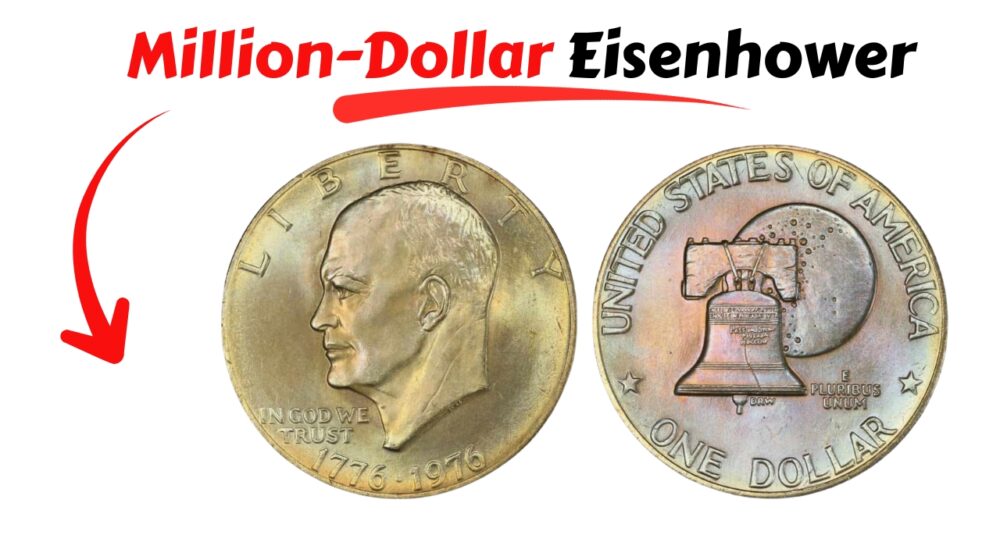
Somewhere in a cash drawer at Woodward & Lothrop the beloved Washington, D.C. department store generations of locals simply called “Woodies” a customer or clerk handled a coin in 1977 that looked, at a glance, like just another well-worn Bicentennial dollar. It wasn’t. That coin has since been identified as the only known 1976 Type 2 “No S” Eisenhower Dollar struck in 40% silver Proof format, a combination of features the United States Mint was never supposed to produce together.
Nearly fifty years later, as the nation prepares to mark its 250th anniversary, this single coin minted to celebrate America’s 200th birthday has quietly become one of the most valuable and least understood coins in modern U.S. numismatics. Professional grading services and market analysts now place its potential value anywhere from roughly $720,000 to well over $1 million, even though it has not appeared at public auction since 2002. No Mint paperwork explains how it was made. No second example has ever surfaced. And the leading theories about its origin all trace back to the same handful of people who shaped the Bicentennial coinage program in the first place.
This article walks through everything currently known about the coin: its specifications, its tangled ownership history, the competing theories about how it came to exist, the design story behind the Bicentennial dollar itself, and what all of this means for collectors trying to make sense of one of the strangest “modern rarities” in American coin history.
At a Glance: Specifications
| Attribute | Detail |
|---|---|
| Denomination | One Dollar |
| Date on Coin | 1776–1976 |
| Coin Type | Bicentennial Eisenhower Dollar |
| Strike Type | Proof |
| Reverse Variety | Type 2 (thin, serifed lettering) |
| Mintmark | None (“No S”) |
| Attributed Mint | Philadelphia (per PCGS cataloging; production circumstances undocumented) |
| Obverse Designer | Frank Gasparro |
| Reverse Designer | Dennis R. Williams |
| Obverse Motif | Portrait of President Dwight D. Eisenhower |
| Reverse Motif | Liberty Bell superimposed on the Moon |
| Composition | 40% silver, silver-copper clad |
| Weight | Approximately 24.59–24.60 grams |
| Diameter | Approximately 38.1 mm |
| Silver Content | Approximately 0.316 troy oz |
| Edge | Reeded |
| Current Grade | PCGS PR66CAM |
| Known Population | One confirmed example |
| PCGS Number | 62402 |
| Estimated Value (2025) | Roughly $720,000 (Greysheet CPG) to near $1 million (PCGS); some specialists suggest seven figures |
How a Coin Like This Actually Changes Hands
Because this is a unique, privately owned numismatic rarity rather than a current Mint product, there is no order form, mintage limit, release date, or purchase window in the traditional sense there is no “buying” it from the U.S. Mint, and there never was. Instead, its value has been established the way rarities of this caliber typically are: through documented sales between major dealers and collectors, and through certification by third-party grading services. Understanding that trail matters just as much to collectors as understanding a modern coin’s issue price.
The known ownership chain looks like this:
- 1977 — Reportedly discovered in general circulation, pulled from a cash register at Woodward & Lothrop in Washington, D.C.
- 1978 — Examined by numismatic researcher Thomas K. DeLorey, then writing for Coin World, who confirmed its weight and composition matched a genuine 40% silver planchet. The discovery was publicized in Coin World’s June 7, 1978 issue.
- 1982 — Sold by Devonshire Rare Coin Galleries, uncertified, for $5,000.
- Subsequent years — Passed through dealers Martin Paul and Andy Lustig, then acquired by collector Alan Hager.
- Certification — NGC graded the coin PF65; it later returned to Martin Paul and was offered by Superior Galleries in 1997 as Lot 1794.
- Re-grading — PCGS subsequently graded the coin PR66.
- 2002 — Sold at public auction by Bowers and Merena as Lot 647 for $41,400, then acquired by modern-coin specialist Mitchell Spivack.
- Later — PCGS added a Cameo designation, producing its current holder grade of PR66CAM.
- 2025 — PCGS confirmed the coin remains privately held within a prominent collecting family; it has not been offered at public auction since 2002.
For a collector today, “acquiring” a coin like this isn’t a matter of speed or luck at a Mint launch it’s a matter of waiting for a private treaty sale or a major rarities auction, should the owner ever choose to sell, and being prepared to compete against determined bidders for a coin with a population of exactly one.
Historical Background: The Bicentennial Coinage Program
Why the Coin Exists at All
In the early 1970s, Congress authorized a special commemorative coinage program to mark the 200th anniversary of American independence in 1976. Rather than issuing an entirely new coin, the Treasury Department opted to temporarily redesign the reverses of three circulating denominations: the Washington Quarter, the Kennedy Half Dollar, and the Eisenhower Dollar. Each of these coins also carried a dual date, “1776–1976,” in place of the normal year.
To choose the new reverse designs, the Treasury ran a national public design competition, offering $5,000 to each winning artist. The winning designs were announced on March 6, 1974. For the dollar coin, the winner was Dennis R. Williams, at the time a student at the Columbus College of Art and Design. His design paired the Liberty Bell with the Moon one symbol reaching back to the nation’s founding, the other reflecting America’s more recent triumph in space exploration. Frank Gasparro’s existing portrait of President Dwight D. Eisenhower remained on the obverse, unchanged from the coin’s regular-issue design first introduced in 1971.
The Overlooked Trial Strikes
Before regular Bicentennial production began, the Mint quietly created a small batch of ceremonial trial pieces. On August 12, 1974, Mint Director Mary Brooks joined Williams and the other two Bicentennial designers at the Philadelphia Mint to strike the first examples of the new quarter, half dollar, and dollar designs an event documented by the Mint itself. Because Philadelphia did not apply mintmarks to its coinage during this era, those early Proof-like pieces naturally lacked an “S.”
Some of these early strikes were sent to the 1974 American Numismatic Association convention in Bal Harbour, Florida. According to research published by PCGS, Mint officials later recalled and destroyed the unmarked trial pieces, replacing them with coins bearing the proper San Francisco “S” mintmark the same standard applied to presentation sets given to President Gerald Ford, the White House, and the winning designers. Crucially, however, all of those early Philadelphia strikes used the original Type 1 reverse lettering. The mystery coin at the center of this story does not.
The Design Revision That Created a Rarity
Sometime in 1975, Mint officials decided to refine Williams’ original reverse. His initial design now called Type 1 by collectors used thick, blocky, sans-serif lettering that reportedly created striking difficulties in mass production. Chief Engraver Frank Gasparro contacted Williams about revising the lettering, resulting in the thinner, serifed style collectors now call Type 2.
The Mint decided that regular 1976 Proof and Uncirculated sets the clad, non-silver versions sold to the general public would carry the new Type 2 reverse. The special 40% silver Bicentennial dollars, by contrast, continued to use the original Type 1 design. That production decision is what makes the surviving “No S” coin so extraordinary: it is a 40% silver Proof struck with the Type 2 reverse that was never supposed to appear on silver coinage, and it carries no mintmark at all. No standard production run accounts for that combination.
Design Description: Obverse and Reverse
Obverse: Eisenhower’s Enduring Portrait
The obverse of every Eisenhower Dollar, including the Bicentennial issues, features Frank Gasparro’s left-facing portrait of President Dwight D. Eisenhower, ringed by “LIBERTY” above and “IN GOD WE TRUST” beneath the portrait truncation. On the Bicentennial version, the usual single-year date is replaced with “1776–1976” beneath the portrait. The design is dignified and restrained, consistent with the coin’s origins as a tribute to a recently deceased wartime general and two-term president.
Reverse: Liberty Bell Over the Moon
Dennis R. Williams’ reverse design places a rendering of the Liberty Bell in the foreground, deliberately superimposed against an image of the Moon in the background a visual pairing meant to bridge the nation’s 1776 founding with its 1969 Apollo 11 Moon landing, still fresh in the public imagination at the time of the design competition. “UNITED STATES OF AMERICA” and “ONE DOLLAR” wrap around the design.
The key identifying difference between the two reverse types lies entirely in the lettering style used for those two phrases:
- Type 1 uses heavy, blocky, sans-serif letters.
- Type 2 uses thinner, more refined lettering with visible serifs.
On a normal coin, that stylistic difference would be a minor variety of interest mainly to specialists. On the unique “No S” coin, it is the single detail that turns an otherwise ordinary-looking dollar into the rarest known example of its type.
Why This Matters for Collectors
For collectors and market watchers, the 1976 Type 2 No S Silver Proof Eisenhower Dollar is compelling for reasons that go well beyond its price tag:
- It is a documented population of one. Despite decades of searching by specialists, no second example combining a Proof strike, 40% silver composition, Type 2 reverse, and missing mintmark has ever been confirmed.
- Its origin is genuinely unresolved. Unlike many “mystery” coins whose stories get tidied up over time, this one still has no confirmed explanation not an experimental Gasparro trial strike, not a Mary Brooks presentation piece, not anything else. PCGS itself treats the leading theories as plausible but unproven.
- It complicates the usual “no mintmark equals rare” myth. Millions of ordinary circulating Bicentennial dollars more than 117 million business strikes from Philadelphia alone also lack a mintmark and are worth only a dollar or two. Collectors need to understand that it’s the Proof strike, the silver composition, and the Type 2 reverse together that make this specific coin exceptional, not the absence of a mintmark by itself.
- It reframes what counts as a “classic” rarity. Coin collecting often separates “classic” 18th- and 19th-century rarities, prized for romantic backstories, from “modern” coins, seen as abundant and unexciting. This coin, struck in the same year as hundreds of millions of ordinary dollars, undermines that divide entirely.
- Its discovery story is unusually well-documented for a coin with no Mint paperwork. The 1978 examination by Thomas K. DeLorey, published in Coin World, gives the coin a level of independent verification weight, specific gravity, and composition testing that many “found in circulation” stories lack.
- It carries direct ties to major figures in Mint history. Mary Brooks, Frank Gasparro, and Dennis R. Williams are all plausibly connected to the coin’s creation, giving it a documented cast of characters even though the actual production event remains unrecorded.
Quick-Reference Guide for Collectors
- Understand what actually makes this coin rare. It is not the missing mintmark alone it is the specific combination of a Proof strike, 40% silver composition, and Type 2 reverse lettering, none of which should have appeared together on a coin without an “S” mintmark.
- Don’t confuse it with common “No S” Bicentennial dollars. Over 117 million ordinary Philadelphia-struck Bicentennial dollars exist without mintmarks; check weight (about 22.68 grams for clad vs. approximately 24.59 grams for 40% silver) and strike quality before assuming any coin is special.
- Learn to distinguish Type 1 from Type 2 reverses. Examine the lettering in “UNITED STATES OF AMERICA” and “ONE DOLLAR” blocky and sans-serif means Type 1; thinner with serifs means Type 2.
- Track third-party certification. The known coin is certified PCGS PR66CAM under PCGS number 62402; any claimed duplicate should be viewed with extreme skepticism absent equivalent third-party grading and provenance.
- Watch major rarities auctions and dealer networks. Because the coin last sold in 2002 and remains privately held, any future opportunity to acquire it would likely surface through a major auction house or a private treaty sale rather than a public listing.
- Consult current published valuations before acting. As of 2025, published estimates range from around $720,000 (Greysheet CPG) to nearly $1 million (PCGS), with some specialists suggesting a seven-figure result is possible if it returns to market treat all of these as estimates, not confirmed sale prices.
- Read PCGS and Coin World research directly. For the most current, vetted information on the coin’s population, grading, and market commentary, consult PCGS’s CoinFacts entry (PCGS No. 62402) and past Coin World coverage rather than relying solely on secondary summaries.