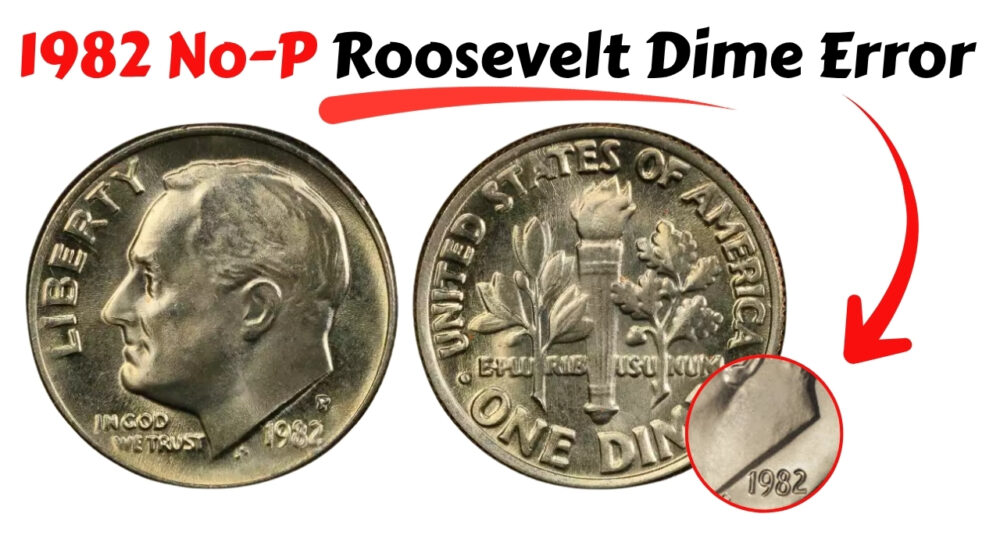
Most legendary U.S. coin rarities come from the 19th century or the early days of the Mint, when record-keeping was inconsistent and coins vanished for decades before resurfacing. The 1982 No-P Roosevelt dime breaks that mold entirely. This error coin was struck, spent, and rediscovered within a single collector’s lifetime passed hand to hand in vending machines, cash registers, and amusement park ticket booths before anyone realized something was missing.
What was missing was a single letter: the “P” mintmark that Philadelphia-struck dimes were supposed to carry starting in 1980. A small batch of 1982 dimes left the Philadelphia Mint without it, entered general circulation, and were eventually spotted by sharp-eyed collectors near Sandusky, Ohio. More than four decades later, the 1982 No-P dime remains the single most important circulation-strike error in the entire Roosevelt dime series proof that a meaningful, story-worthy rarity can still emerge from ordinary pocket change.
At a Glance: Specifications
| Detail | Description |
|---|---|
| Country | United States |
| Coin | Roosevelt dime |
| Error date | 1982 |
| Mint facility | Philadelphia (no mintmark present due to error) |
| Error type | Missing “P” mintmark, circulation strike |
| Composition | Copper-nickel clad (outer layers of 75% copper/25% nickel bonded to a pure copper core) |
| Weight | 2.268 grams |
| Diameter | 17.9 mm |
| Edge | Reeded |
| Obverse design | Portrait of Franklin D. Roosevelt, by John R. Sinnock |
| Reverse design | Torch flanked by olive and oak branches, by John R. Sinnock |
| Estimated surviving population | Unknown; thousands believed to exist, with sharp drop-off in high grades |
| Recognized strike varieties | Strong No-P and Weak No-P |
| Typical value, Extra Fine circulated | Around $30 |
| Typical value, Gem Mint State or better | $300 and up, rising sharply at the top end |
How Collectors Actually Acquire This Coin
There was never an official “release” of the 1982 No-P dime no announced mintage, no scheduled order window, and no per-household purchase limit, because the U.S. Mint never intended to produce it at all and has never published official figures for how many were struck. Instead, collectors today acquire the coin almost entirely through the numismatic secondary market. Understanding that market is the real “buying process” for this error:

- Dealer inventory and coin shops. Because the variety is well established and frequently certified, many coin dealers who specialize in error and variety coins carry examples in a range of grades.
- Major auction platforms. Certified examples regularly appear at online and live auctions, particularly in higher Mint State grades, where bidding can be competitive.
- Coin shows and conventions. Regional and national numismatic shows frequently have multiple dealers offering both Strong and Weak strike examples side by side, useful for comparing quality before buying.
- Roll searching and raw coin hunting. Because so many examples entered circulation in 1982, some collectors still search through inherited coin accumulations, old rolls, or estate collections in hopes of finding an unattributed example though the odds of a fresh find in active circulation today are extremely low.
- Grading and certification services. Since altered coins (with the mintmark deliberately removed) are common, most serious buyers insist on a coin already certified by PCGS or NGC, or budget for submission costs if buying a raw example.
There is no fixed “order date” the way there would be for a modern commemorative; availability simply depends on what dealers and auction houses currently have in stock, and pricing fluctuates with grade, strike strength, and current collector demand.
Historical Background: The Roosevelt Dime and the 1980 Mintmark Change
The Roosevelt Dime Series
The Roosevelt dime was introduced in 1946, replacing the Mercury dime just one year after President Franklin D. Roosevelt’s death. The design change was intended to honor Roosevelt, who had both suffered from polio and championed the March of Dimes campaign that funded polio research and treatment. Mint Chief Engraver John R. Sinnock designed the coin, adapting a portrait he had previously created for a Roosevelt medal. The series transitioned from 90% silver composition to today’s copper-nickel clad format in 1965, and it remains in production as a circulating denomination to this day, making it one of the longest-running coin designs in American history.
The 1980 Philadelphia Mintmark Policy Change
For most of the Mint’s history, coins struck in Philadelphia carried no mintmark at all, while Denver and San Francisco coins were identified with “D” and “S” respectively (with limited historical exceptions, such as wartime silver nickels). That changed in 1980, when the Mint began stamping a “P” mintmark onto all circulating Philadelphia coinage except the cent. From that point forward, every Philadelphia dime dated 1980 or later was expected to show a visible “P” above the date which is precisely why a Philadelphia dime with no mintmark at all, dated after that policy took effect, stood out as something had clearly gone wrong.
How the Error Occurred
At the time, mintmarks were still applied to each working die by hand before the die was hardened and put into service. In the case of the 1982 No-P dime, one Philadelphia working die was mistakenly approved for production without ever receiving its “P” punch. Every dime struck from that single die came out looking like a pre-1980 Philadelphia issue except for its unmistakable 1982 date. Because the evidence points to a single affected die, the error variety is both consistent in appearance and inherently limited in scope, even though an exact mintage was never recorded.

Obverse and Reverse Design Details
Obverse
The obverse of the Roosevelt dime features a left-facing portrait of Franklin D. Roosevelt, designed by John R. Sinnock. Roosevelt’s likeness dominates the coin’s field, with “LIBERTY” arranged along the left border, the motto “IN GOD WE TRUST” positioned just behind the portrait, and the date centered at the bottom. On coins dated 1980 and later, a mintmark would normally appear just above the date, to the left of Roosevelt’s neck truncation. On the 1982 No-P error, this space is completely blank: no letter, no outline, no evidence of tooling or removal simply the absence of a mintmark on an otherwise entirely normal 1982 Philadelphia obverse die.
Reverse
The reverse, also designed by Sinnock, depicts a lit torch at the center, symbolizing liberty, flanked by an olive branch on one side and an oak branch on the other, representing peace and strength respectively. “UNITED STATES OF AMERICA” arcs around the upper border, with “ONE DIME” below the torch and “E PLURIBUS UNUM” running along the lower rim. The reverse design is unaffected by the mintmark error, since Roosevelt dime mintmarks have always appeared on the obverse; collectors authenticate the variety strictly by examining the obverse date area, while judging overall coin quality including reverse strike sharpness when distinguishing “Strong” from “Weak” examples.
Why This Matters for Collectors
- A genuine, well-documented production error. Unlike novelty or intentionally limited issues, the 1982 No-P dime resulted from an actual breakdown in Mint die-preparation procedure, giving it real numismatic significance beyond simple scarcity.
- A true circulation discovery story. Few modern errors can claim a documented “in the wild” discovery, complete with a specific location (Sandusky, Ohio, near Cedar Point) and a clear geographic pattern of early sightings.
- Strong certification demand. Submission data from PCGS and NGC shows the 1982 No-P dime is the most-submitted clad Roosevelt dime variety aside from the 1996-W a coin that, unlike the No-P dime, was never meant for circulation at all.
- Two collectible strike classes. The existence of both Strong and Weak strike varieties gives collectors a meaningful way to specialize within the error itself, rather than treating it as a single uniform coin.
- Condition-driven scarcity. While thousands of examples likely survive, high-grade Mint State coins are substantially scarcer than the raw population suggests, creating real price tension at the top of the grading scale.
- Accessible entry point, serious upside. With circulated examples available around $30 and gem Mint State pieces reaching $300 or more, the coin offers a rare combination: approachable for new collectors, yet genuinely rewarding for condition-focused specialists.
- Proof that circulation errors aren’t a relic of the past. The coin demonstrates that meaningful, story-driven rarities can still emerge from ordinary modern coinage, not just from the classic silver era.
Quick-Reference Buying Guide
- Confirm the date first. Only dimes dated 1982 qualify; no other year is relevant to this specific error.
- Examine the mintmark area closely. A genuine example shows a completely blank space above the date no outline, discoloration, or disturbed metal that would suggest an altered coin.
- Check under magnification for tooling marks. Altered coins, where a “P” has been physically removed, are common; look for scratches, tool marks, or an unnatural surface texture in that area.
- Learn to distinguish Strong vs. Weak strikes. Compare rim and lettering sharpness against known examples, since strike quality not the missing mintmark itself separates these two recognized varieties.
- Prioritize certified examples. Given how common alterations are, buying a coin already graded by PCGS or NGC significantly reduces authentication risk.
- Compare pricing by grade. Expect roughly $30 for a solid Extra Fine circulated example, with prices climbing quickly for coins in Gem Mint State (MS-65) or higher.
- Buy from reputable dealers or established auction houses. Given the prevalence of altered fakes, purchase from sellers with strong reputations in error and variety coins specifically.
- Consider strike quality alongside grade. When comparing two similarly graded coins, a well-struck (“Strong”) example is generally considered more desirable than a “Weak” counterpart at the same technical grade.