A truly great coin design needs two things to shine at auction: artistic power and pristine survival. Adolph Weinman’s Walking Liberty Half Dollar has never lacked for the first quality it’s routinely cited as one of the most beautiful coins the U.S. Mint has ever produced. What’s far rarer is finding a specimen so perfectly preserved that it sits, quite literally, at the very top of the grading scale.
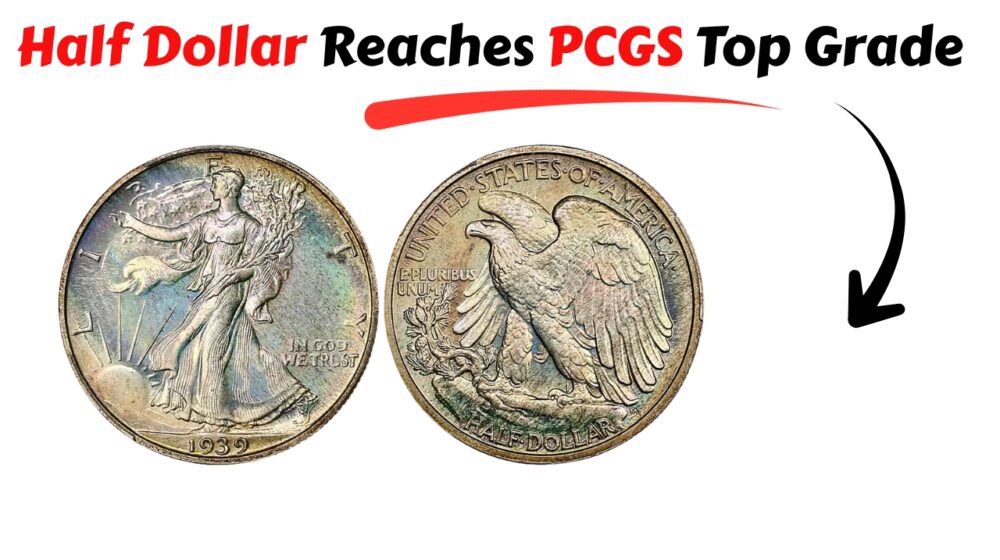
That’s exactly what Stack’s Bowers Galleries brought to the auction block in its Summer 2026 Global Showcase Auction. Lot 2103, a 1939 Proof Walking Liberty Half Dollar, carries a PCGS grade of Proof-68+ with CAC approval a grade shared by only seven known examples of the date, with none certified higher. The coin crossed the block during Session 2, “Rarities Night,” where it realized $20,740. Here’s a full look at what makes this coin so exceptional, the story behind its design, and what it means for collectors chasing condition rarities at the summit of the series.
Specifications at a Glance
| Category | Detail |
|---|---|
| Country | United States |
| Year | 1939 |
| Denomination | Half Dollar |
| Mint | Philadelphia |
| Mintmark | None |
| Mintage | 8,808 |
| Finish | Proof |
| Designer | Adolph A. Weinman |
| Composition | 90% silver, 10% copper |
| Weight | 12.50 grams |
| Diameter | Approximately 30.6 mm (PCGS lists it rounded to 30.00 mm) |
| Edge | Reeded |
| PCGS Number | 6639 |
| NGC Universal ID | 27V7 |
| Grade | PCGS Proof-68+ |
| CAC Status | Approved |
| Auction House | Stack’s Bowers Galleries |
| Auction | Summer 2026 Global Showcase Auction |
| Session | Session 2 — Rarities Night |
| Lot Number | 2103 |
| Realized Price | $20,740 |
| Prior Auction Record for the Date at this Grade | $40,800 (Heritage Auctions, April 2020, PCGS Proof-68+) |
As of early August 2026, PCGS reported just seven coins graded Proof-68+ for this date, with none higher, alongside 75 coins at the Proof-68 level (population figures can include resubmissions, so they don’t necessarily represent unique coins). Stack’s Bowers also cited a CAC Stickered Population of 27 combining Proof-68 and Proof-68+ examples at the time the auction description was prepared, a number CAC’s live database has since updated to 28.
How the Auction Unfolded
Because this particular coin has already been sold, there’s no active bidding window to track but the sale itself offers a useful roadmap for collectors following top-tier Walking Liberty material:
- Auction house: Stack’s Bowers Galleries, one of the leading firms for U.S. numismatic rarities.
- Event: The Summer 2026 Global Showcase Auction, a major sale spanning multiple sessions.
- Featured session: Session 2, billed as “Rarities Night,” reserved for the auction’s most significant offerings.
- Lot number: 2103.
- Result: $20,740, a strong price for the date though well below the $40,800 record set by a Proof-68+ example at Heritage Auctions in April 2020.
For collectors hoping to acquire a comparable coin going forward, the most reliable paths remain major numismatic auction houses Stack’s Bowers, Heritage Auctions, and GreatCollections chief among them along with specialist dealers who track PCGS and CAC population data for elite Proof material. Because so few Proof-68+ examples of this date exist, availability depends entirely on when an existing example returns to the market rather than any predictable release schedule.
Historical Background
The Return of Proof Coinage
The story of this coin begins well before 1939. The U.S. Mint had discontinued its regular annual Proof coin program after 1916, leaving American collectors without an official way to order Proof coinage directly from the Mint for nearly two decades. That changed in 1936, when, under Mint Director Nellie Tayloe Ross, the Mint revived and expanded its Proof program. The decision launched a short, celebrated run of Proof Walking Liberty Half Dollars produced at the Philadelphia Mint from 1936 through 1942 meaning collectors need only seven dates to complete the entire Proof Walking Liberty series.
The 1939 Issue’s Place in the Series
The 1939 Proof Half Dollar sits at the midpoint of that brief run, with a mintage of 8,808 pieces only slightly more than the 8,152 Proof halves struck in 1938. Despite their nearly identical mintages, the two dates followed very different paths in terms of long-term survival. Collectors appear to have set aside and preserved the 1939 issue with noticeably more care than the 1938 date, meaning Gem-quality survivors of 1939 turn up more readily today. The date remains generally available through Proof-67, with Proof-68 examples becoming genuinely scarce and Proof-68+ representing the extreme upper limit of the grading scale for this issue.
It’s worth noting that the 1939 Proof does not hold the title of rarest Proof Walker by mintage that distinction belongs to the 1936 issue, the first year of the revived Proof series. What sets the 1939 apart at the Proof-68+ level is pure condition rarity: an extraordinary degree of preservation that very few surviving examples, regardless of date, have managed to achieve.
Adolph Weinman and the Walking Liberty Design
The Walking Liberty Half Dollar itself dates to 1916, when sculptor Adolph A. Weinman’s design replaced Charles E. Barber’s half dollar design, which had been in circulation since 1892. Weinman was a prolific and celebrated Mint-era sculptor; that same year, 1916, also saw the debut of his other enduring contribution to American coinage, the “Mercury” Dime. The Walking Liberty design proved so admired that it would later inspire the modern American Silver Eagle bullion coin decades after the half dollar itself left circulation in 1947.
Description of the Obverse and Reverse
Obverse
Weinman’s obverse captures Liberty in full stride, walking toward a rising sun with her right hand extended forward, as if reaching toward the future. Her left arm cradles branches of laurel and oak, symbolizing civil and military achievement, while an American flag streams and billows behind her in dramatic motion. On a Proof strike like this 1939 example, the sculptural detail carries far more presence than on a circulation coin the folds of Liberty’s gown, the texture of the flag, and the fine lines of her figure all display sharp, deliberate relief. This particular specimen also shows warm sandy-gold toning across its surfaces, with accents of powder-blue and rose-russet iridescence, giving the coin striking eye appeal well beyond its numerical grade.
Reverse
The reverse depicts a powerful eagle standing atop a rocky crag, with a mountain pine growing from the stone beside it a composition meant to evoke strength, independence, and resilience. As with the obverse, the Proof finish brings out crisp definition in the eagle’s feathers and the texture of the rocky perch, details that can appear comparatively soft on a business-strike coin. Stack’s Bowers describes this specimen’s strike as carrying crisp detail from the rims through the central devices, a hallmark of exceptional Proof production quality.
Why This Matters for Collectors
- It sits at the literal top of the PCGS census. With only seven coins graded Proof-68+ and none higher, this coin represents the ceiling of what’s achievable for the 1939 date at PCGS.
- Condition rarity, not mintage rarity, drives its appeal. Unlike the 1936 issue, which is scarce due to low original mintage, the 1939’s importance at this grade comes entirely from how few examples survived in this state of preservation.
- CAC approval adds a second layer of confirmation. With a combined CAC Stickered Population of around 28 across Proof-68 and Proof-68+, CAC approval at this level signals exceptional quality has been independently verified.
- Eye appeal elevates the coin beyond its grade. The combination of sandy-gold, powder-blue, and rose-russet toning gives this example visual character that a numerical grade alone doesn’t capture a quality advanced collectors often value as much as the grade itself.
- It offers a benchmark for the series. With a prior Proof-68+ auction record of $40,800 set in 2020, this sale gives collectors and market watchers a fresh, current data point for how the market values the finest known examples of this date.
Quick-Reference Buying Guide
- Understand the grading landscape first. Know that Proof-64 through Proof-67 examples of this date are attainable with patience, while Proof-68 and especially Proof-68+ coins are genuine condition rarities.
- Check current PCGS and CAC population data. Population reports can shift due to resubmissions, so confirm the most current figures before assuming a fixed number of surviving coins.
- Prioritize CAC-approved examples at the top end. For coins already at Proof-68 or higher, CAC approval provides an added layer of quality assurance that matters more as the grade climbs.
- Review recent auction results for context. Compare recent realized prices, such as this coin’s $20,740 result and the $40,800 record from 2020, to gauge a fair price range before bidding.
- Buy through major, established auction houses. Stack’s Bowers, Heritage Auctions, and GreatCollections regularly handle top-tier Walking Liberty Proof material and provide detailed, verifiable lot descriptions.
- Examine toning and eye appeal directly, not just the grade. Two coins at the same numerical grade can differ significantly in visual appeal request detailed images or, when possible, view the coin in hand.
- Factor in buyer’s premiums and fees. Confirm the auction house’s current buyer’s premium structure, as this affects the true cost of acquiring a coin at this level.
- Keep thorough documentation after purchase. Retain the auction record, lot description, and certification details, since provenance matters significantly for coins at the top of a population report.