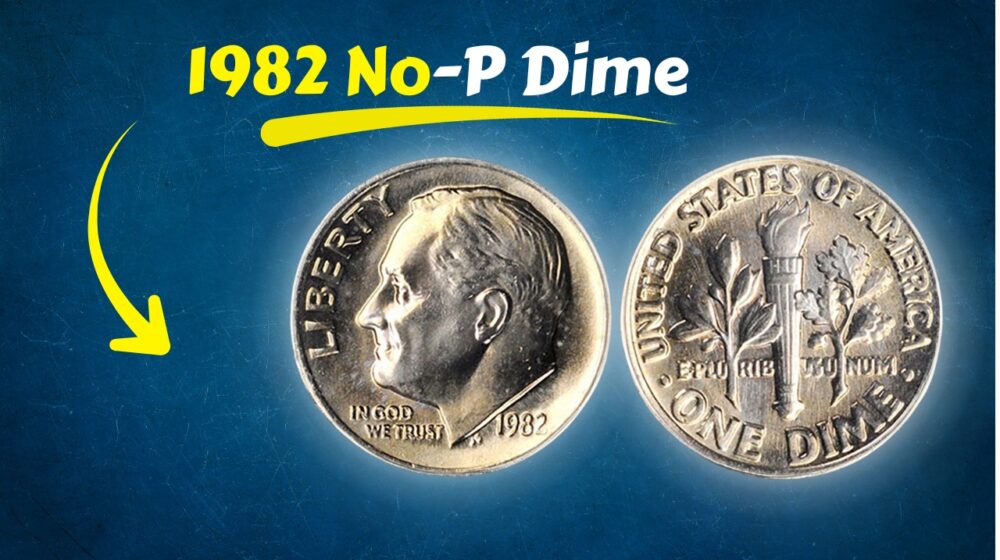
Among the modern errors that circulate in American pocket change, one coin has earned a permanent place in the numismatic spotlight: the 1982 No-P Roosevelt dime. Struck during a decade most people associate with ordinary, unremarkable coinage, this dime slipped out of the Philadelphia Mint missing a design element it should never have been without its “P” mintmark. Rather than being pulled aside in a vault or discovered by a Mint inspector, the error dime moved through cash registers, coin rolls, and pocket change for months before anyone realized what had happened.
What makes this coin so compelling isn’t age or precious-metal content it’s the story. A missing letter, the size of a pinhead, turned an otherwise unremarkable dime into one of the most sought-after modern errors in American coin collecting. Decades later, it remains a coin that new and experienced collectors alike search for in rolls of change, hoping to find one more surviving example.
Note: Unlike a modern commemorative coin or Mint product release, the 1982 No-P dime was never sold or distributed through an official Mint program. It was an unintentional production error that entered circulation naturally. This guide treats the coin accordingly the “buying” information below reflects how collectors actually acquire specimens today (through dealers, auctions, and grading services) rather than an official ordering window, since no such window ever existed.
Specifications and Details
| Category | Detail |
|---|---|
| Coin Type | Roosevelt Dime (Clad) |
| Date | 1982 |
| Mint | Philadelphia (no mintmark present — the error) |
| Error Type | Missing mintmark (“No P”) |
| Strike Varieties | Strong strike / Weak strike |
| Composition | Copper-nickel clad (outer layers of 75% copper, 25% nickel, bonded to a pure copper core) |
| Weight | 2.27 grams |
| Diameter | 17.9 mm |
| Edge | Reeded |
| Designer (Obverse) | John R. Sinnock |
| Designer (Reverse) | John R. Sinnock |
| Mintage of Error | Unknown; no official figures were ever released by the U.S. Mint |
| Circulated Value (XF) | Approximately $30 |
| Mint State Value (Gem or better) | $300 and up, with strong premiums for top-graded coins |
| Known Discovery Location | Sandusky, Ohio, near Cedar Point Amusement Park |
| Discovery Period | Late 1982 |
Because the coin was never pulled from production or tracked separately, the figures above for value are general market guidelines rather than fixed price actual sale prices vary by grade, strike strength, and certification.
How Collectors Acquire a 1982 No-P Dime
Since there was never an official Mint sale, order form, or release date for this error, obtaining one today means working through the collector marketplace rather than a Mint order window. Here’s what that process typically looks like:
- Coin dealers and error-coin specialists — Many dealers who focus on mint errors and varieties keep 1982 No-P dimes in stock, particularly certified examples.
- Major auction houses — Certified specimens, especially higher-grade or strong-strike examples, regularly appear in numismatic auctions.
- Third-party grading services — Because of the risk of altered coins (see authentication section below), most serious buyers purchase examples that have already been certified by PCGS or NGC, both of which have graded and encapsulated large numbers of this variety over the decades.
- Coin shows and conventions — These remain a reliable place to view and compare multiple examples in person before buying.
- Roll searching — While the odds are extraordinarily low so many decades later, some collectors still search through inherited dime rolls or bank-sourced rolls in hopes of an untouched find.
There are no purchase limits, order windows, or release dates to track, since the coin was never a Mint product to begin with availability today depends entirely on what the secondary market has in stock.
Historical Background: The Roosevelt Dime and the Mintmark Policy Change
Origins of the Roosevelt Dime
The Roosevelt dime series began in 1946, replacing the Mercury dime shortly after President Franklin D. Roosevelt’s death. The design, created by Mint engraver John R. Sinnock, honored Roosevelt’s leadership and his personal connection to the March of Dimes, an organization closely tied to the fight against polio. The series has remained in continuous production since its debut, making it one of the longest-running coin designs in U.S. history.
The 1980 Mintmark Policy Shift
For most of the Mint’s history, coins struck in Philadelphia carried no mintmark at all he absence of a letter was itself the signal that a coin originated there, with a handful of wartime exceptions. Denver and San Francisco coins, by contrast, carried “D” and “S” respectively.
That changed in 1980, when the Mint began stamping a “P” mintmark onto virtually all Philadelphia-struck coins, dimes included (cents were excluded from the change). From that year forward, collectors and cash handlers alike expected every Philadelphia dime to show a small “P” above the date.
Why the 1982 Error Happened
This is precisely why the 1982 error stands out. Mintmark punching was still a manual process at the time each working die had to be individually stamped with its mintmark before being hardened and put into service. In this instance, a single Philadelphia working die skipped that step entirely, yet was approved and used in production anyway. Every dime struck by that one die emerged without the mintmark, indistinguishable at a glance from a pre-1980 dime except for its 1982 date.
Because the evidence points to a single affected die, the error’s scarcity and consistency both make sense a limited, self-contained mistake rather than a widespread mint-wide failure.
Discovery in Ohio
The error came to light in late 1982 near Sandusky, Ohio, close to Cedar Point Amusement Park. High-volume cash handling at the park likely accelerated the coin’s discovery, as employees and local collectors began noticing dimes without the expected mintmark. Word spread through the Midwest collecting community, and additional specimens turned up in surrounding areas, suggesting a regional rather than nationwide release.
Design Description
Obverse (Front)
The obverse of the Roosevelt dime features a left-facing portrait of Franklin D. Roosevelt, designed by John Sinnock and rendered in a dignified, formal style. The word “LIBERTY” arcs along the upper-left rim, while the motto “IN GOD WE TRUST” sits tucked beside Roosevelt’s profile near the lower-left edge. The date appears at the lower right on genuine 1982 No-P examples, this is where collectors look first, since the mintmark, when present, would normally appear just above the date’s final digits. On the error coin, that space is entirely blank, with no trace of a letter, outline, or disturbed metal.
Reverse (Back)
The reverse continues Sinnock’s original design: a torch at the center, symbolizing liberty, flanked by an olive branch (representing peace) on one side and an oak branch (representing strength and independence) on the other. “UNITED STATES OF AMERICA” wraps around the upper rim, “ONE DIME” appears beneath the torch, and “E PLURIBUS UNUM” spans the lower field. This side of the coin carries no mintmark under any circumstances and is unaffected by the error the mintmark only appears (or fails to appear) on the obverse.
Why This Matters for Collectors
The 1982 No-P dime occupies a unique niche in modern American numismatics for several reasons:
- It’s a genuine production error, not a novelty. Unlike specially produced anomaly coins made for collectors, this dime was never intended to look the way it does it slipped through by accident and circulated exactly like any other dime.
- Its rarity is measurable but not fully known. Certification data from PCGS and NGC shows it is the most-submitted clad Roosevelt dime error aside from the 1996-W, giving collectors real data to gauge scarcity even without official mintage figures.
- Condition drives value dramatically. A coin that trades for around $30 in Extra Fine condition can be worth ten times that or more in top Mint State grades, rewarding patience and careful grade-hunting.
- It proves errors didn’t end with older coinage. Many new collectors assume major mint errors are relics of the 19th or early 20th century. The 1982 No-P dime is a reminder that meaningful mistakes can and do still happen in modern minting.
- It rewards active searching. Because the coin was discovered through ordinary circulation, it carries a “found in the wild” appeal that connects directly to the everyday hobby of checking pocket change and bank rolls.
Quick-Reference Buying Guide
- Confirm the date first. Only coins dated 1982 qualify any other year is not part of this variety.
- Check the obverse above the date. A genuine No-P dime shows a completely smooth surface with no mintmark, no shadow, and no signs of tooling or scratching.
- Look for strike quality. Decide whether you’re after a Strong or Weak strike example, as the two carry different visual characteristics and market demand.
- Buy certified whenever possible. Because altered coins (with a scratched-off “P”) are common, purchasing a PCGS- or NGC-graded example greatly reduces authentication risk.
- Compare pricing by grade. Expect roughly $30 for a solid Extra Fine circulated example, rising sharply toward $300 or more for Gem Mint State pieces.
- Buy from reputable sources. Established error-coin dealers, major auction houses, and coin shows are the safest places to purchase.
- Verify under magnification if buying raw. Examine the area above the date closely for disturbed metal, which indicates an altered rather than genuine error coin.
- Keep documentation. Save certification records, invoices, or auction listings, as provenance adds confidence and resale value down the line.
This article is intended for general numismatic reference and collector education. Coin values fluctuate with market conditions, grading standards, and individual coin quality always consult a current price guide or professional dealer before making a purchase.