Some rarities earn their reputation through decades of steady mintage cuts. The 1866 Liberty Seated Dime earned it in a single day.
The Philadelphia Mint struck every business-strike 1866 dime all 8,000 of them on January 31, 1866. No other date on the calendar contributed to the circulation-strike total. That kind of concentrated, minimal output places the issue among the scarcest Philadelphia dimes of the entire Seated Liberty series, and it did so during one of the most turbulent stretches in the nation’s monetary history.
The Civil War had ended less than a year earlier, and the country it left behind bore little resemblance to the one that existed before Fort Sumter. Gold and silver coin had all but vanished from daily transactions, replaced by paper greenbacks trading at a discount to specie. Against that backdrop, the Mint poured its attention into base-metal coinage for everyday commerce and into gold double eagles for banks and international trade leaving only token production for several silver denominations, the dime chief among them.
Today the 1866 dime stands as a genuine condition-census rarity. PCGS estimates only around 400 surviving examples in all grades, with just a handful reaching the top of the Mint State scale. Toned, pedigreed specimens from collections like Millholland, Hansen, Simpson, and the New England Museum have driven some of the strongest results in the series, making this a date that rewards both the historian and the connoisseur of condition.
Specifications at a Glance
| Detail | Information |
|---|---|
| Denomination | One Dime (10 cents) |
| Year | 1866 |
| Mint facility | Philadelphia (no mintmark) |
| Business-strike mintage | 8,000 |
| Proof mintage | 725 |
| Composition | 90% silver, 10% copper |
| Weight | 2.48 g (PCGS); some period/type references list 2.49 g |
| Diameter | 17.90 mm |
| Edge | Reeded |
| Design type | Liberty Seated, Legend Obverse (1860 type) |
| Designer | James B. Longacre (design lineage traces to earlier Gobrecht/Hughes/Sully/Peale work; Anthony C. Paquet associated with the cereal-wreath engraving) |
| Die marriage | F-102 (only marriage known for business strikes; F-101 is Proof-only) |
| Die states | F-102a (Perfect Reverse) and F-102b (Clashed Reverse) |
| Estimated surviving population (all grades) | ~400 |
| Estimated population MS60+ | ~50 |
| Estimated population MS65+ | ~8 |
| PCGS auction record | $12,650 — MS66, New York Connoisseur’s Collection, American Numismatic Rarities, March 2006 |
| Highest certified grade | PCGS MS67 (three grading events); NGC MS68 (one grading event) |
Original Production and Historical “Distribution”
Unlike a modern commemorative coin sold through a mint subscription program, the 1866 dime was a routine circulating issue, and its “distribution” was simply the ordinary channel of commerce banks and the public received coins from the Mint as needed, with no special order window, purchase limit, or promotional sales campaign attached.
The production run. The entire business-strike mintage 8,000 coins came off the presses in a single day, January 31, 1866. The Mint separately struck 725 Proof dimes that year for collectors who ordered directly through official Proof sets or individual purchases, a channel that had already existed for years; Philadelphia had struck 1,000 Proof dimes as far back as 1860, so the 1866 Proof figure doesn’t appear to reflect any special postwar surge in collector interest.
Why so few were made. The Mint’s priorities in 1866 lay elsewhere. Precious-metal coin had largely disappeared from circulation because greenbacks federal paper currency that did not convert to specie on demand dominated everyday transactions, with more than $423 million in greenbacks reported outstanding that March. Treasury Secretary Hugh McCulloch was working toward an eventual return to specie payments, but that shift could not happen overnight. In the meantime, the Mint devoted its resources to high-volume base-metal coinage for domestic use and to gold double eagles (698,745 struck, worth nearly $14 million) for banks and international commerce. Silver dimes simply weren’t a priority of 16 Philadelphia business-strike denominations produced that year, nine had mintages below 25,000, and the dime’s 8,000 pieces was among the smallest of all.
How coins reached collectors then. Nineteenth-century collectors of the era generally favored Proof coins when the Mint offered them, so relatively few business-strike dimes were deliberately set aside in top condition. Most simply entered circulation, were spent, and wore down through ordinary handling which is exactly why so few high-grade survivors exist today.
How to buy one now. There is no current “order window” for this coin; it exists only on the secondary market. Collectors today source examples through major auction houses (Heritage Auctions, Stack’s Bowers, and similar firms have handled the finest known specimens), established rare-coin dealers, and certified-coin marketplaces. Because population figures are so low at the top of the grading scale, examples in MS66 and above rarely appear for sale, and when they do, provenance and auction history matter considerably to price.
Historical Background
The Nation in 1866
The 1866 dime was struck into a country still absorbing the shock of the preceding two years. Robert E. Lee surrendered the Army of Northern Virginia at Appomattox Court House on April 9, 1865, though scattered Confederate resistance continued afterward. Just days later, John Wilkes Booth shot President Abraham Lincoln at Ford’s Theatre on April 14; Lincoln died the next morning, removing the leader who had already begun steering the country toward reconciliation.
The war’s human toll remains a subject of ongoing research. Earlier demographic estimates by historian J. David Hacker placed Civil War deaths near 750,000, within a range of roughly 650,000 to 850,000. A more recent 2024 study in the Proceedings of the National Academy of Sciences, drawing on full-count census data rather than an earlier one-percent sample, calculated an estimate closer to 698,000, with a likely range of about 647,000 to 749,000 suggesting the toll, while still staggering, may fall somewhat below the older estimate.
The economic damage was just as severe, particularly in the South, where roughly two-thirds of assessed wealth vanished during the war. That decline reflected both physical destruction of railroads, farms, factories, and cities and the removal of enslaved people from property valuations following emancipation. The country that entered 1866, in other words, faced a reconstruction bill of historic proportions, without its wartime president, and without a stable currency.
The Coinage Problem: Greenbacks and Vanishing Specie
Congress had authorized Legal Tender Notes greenbacks to help finance the war, but unlike coin, they carried no guaranteed conversion into gold or silver, so their market value floated against specie. With more than $400 million in greenbacks circulating through 1866, and years of habit teaching Americans to hoard “hard money” over paper, gold and silver coins largely disappeared from day-to-day transactions.
That environment shaped the Mint’s priorities directly. It explains why the Mint devoted enormous capacity to low-value base-metal coinage and to gold double eagles for institutional and international use, while precious-metal coins meant for ordinary domestic circulation dimes very much included received only minimal production.
The year also brought a milestone unrelated to the dime: the new copper-nickel Shield Nickel, authorized by Congress on May 16, 1866, began production, eventually succeeding the smaller silver half dime (though the Mint kept striking half dimes alongside it through 1873).
The Design and Its Origins
The obverse and reverse used on the 1866 dime belong to the Legend Obverse Liberty Seated type introduced in 1860 by Chief Engraver James B. Longacre. Longacre’s work built on the original Seated Liberty concept developed years earlier through the combined efforts of Christian Gobrecht, Robert Ball Hughes, Thomas Sully, and Titian Peale a design lineage that had, by 1866, already anchored American silver coinage for roughly three decades.
The IN GOD WE TRUST Exception
1866 is also notable as the year the motto IN GOD WE TRUST began appearing on U.S. gold and silver coinage, starting January 1. The dime, however, was left out Mint officials at the time judged the coin too small to accommodate the additional lettering. That makes the 1866 dime something of an odd one out among its silver and gold contemporaries: a coin minted in the very year the motto debuted, yet carrying a design untouched by the change.
Obverse and Reverse Design
Obverse
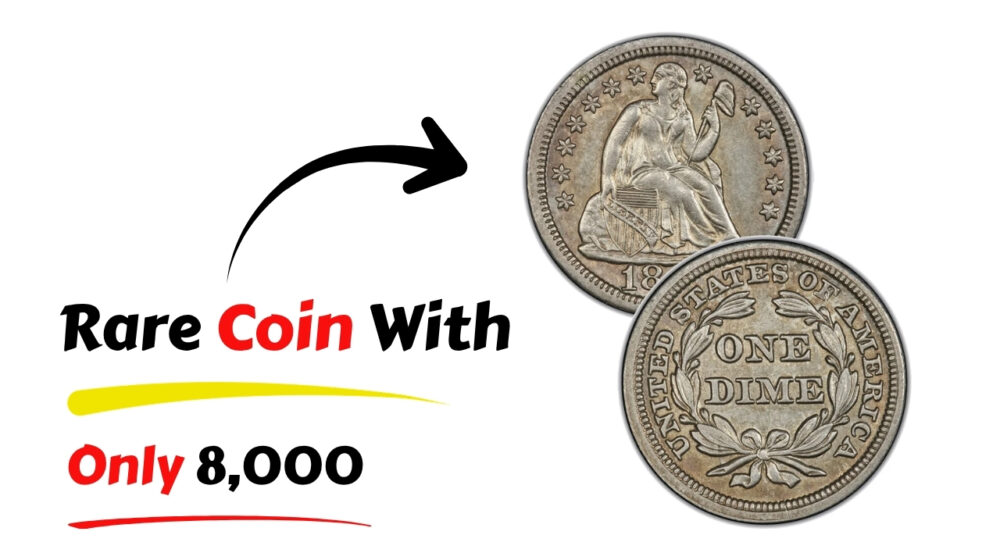
Liberty sits upon a rock, her head turned toward her right shoulder, draped in flowing robes. In her left hand she holds a pole crowned with a Phrygian (Liberty) cap — a long-standing symbol of freedom. Her right hand steadies a Union shield, across which a curved ribbon carries the word LIBERTY. The legend UNITED STATES OF AMERICA arcs along the upper rim, with the date 1866 placed beneath the seated figure. A ring of denticles frames the coin’s edge.
Reverse
At the center, the denomination ONE DIME is enclosed within a cereal wreath a design combining corn, wheat, maple leaves, and oak leaves, tied together at the base by a ribbon. Denticles again frame the rim. (This composite wreath of grain and leaves is a more accurate description than the older, simplified characterization of the reverse as merely a “wreath of wheat.”)
Edge
The coin carries a plain reeded edge, standard for silver dimes of the period.
A Single Die Marriage, Two Distinct States
Every known 1866 business-strike dime traces to a single die pairing F-102, in the numbering used by Liberty Seated dime specialist Gerry Fortin. (A second marriage, F-101, produced Proofs exclusively and has no business-strike representation.)
Even within that one pairing, collectors recognize two distinct die states. At some point during the single-day production run, the obverse and reverse dies came together without a planchet between them, clashing and transferring faint traces of each design into the opposing die. Coins struck before the clash show what Fortin designates F-102a, the Perfect Reverse; those struck afterward show F-102b, the Clashed Reverse. Specialists generally consider F-102a the slightly more available state, yet F-102b examples currently dominate the PCGS Condition Census an interesting wrinkle for anyone building a specialized set.
Population and the Market for High-Grade Examples
Because grading services report figures at a moment in time, and because coins are continually submitted, resubmitted, and crossed between services, population counts for the 1866 dime have shifted even in the past year. As of the most recent PCGS Population Report (dated August 25, 2026), PCGS lists 111 grading events for the regular-issue coin, including three at MS67 with none higher. NGC’s census, updated June 18, 2026, shows 58 grading events, topped by a single coin at MS68.
These are grading events, not necessarily unique coins resubmissions can inflate the raw totals. PCGS’s own survival estimates are more conservative: roughly 400 surviving pieces across all grades, about 50 in Mint State (MS60 or better), and only around eight reaching MS65 or finer.
Toning defines much of the high end of the market. Many condition-census pieces carry rich blue, green, violet, gold, or russet patina, a look prized by advanced collectors. A notable exception is the Dell Loy Hansen specimen, graded PCGS MS67, which stands out for bright, frosty, essentially untoned surfaces rather than the deep color seen on most of its peers.
A previously unrecorded PCGS MS67 example surfaced in 2023 from the estate of James Allaire Millholland (1842–1911), a collector whose holdings had stayed out of the marketplace for 112 years. Stack’s Bowers sold the coin on March 21, 2023, for $7,200, describing attractive olive, gold, and russet toning. A third coin, from “Nic’s 1866 Philly Mint Set,” has since joined the Hansen and Millholland pieces at the MS67 level, bringing PCGS’s total MS67 population to three.
Other notable results include a PCGS MS66 example from the New England Museum, sold by Stack’s Bowers in 2013 for $12,925 with vivid antique olive, blue, and red toning; a PCGS MS66 CAC coin from the Bob R. Simpson Collection of Seated Dimes, sold by Heritage in 2010 for $6,325 with lavender and seafoam-green color; and the coin that still holds the PCGS auction record for the date an MS66 from the New York Connoisseur’s Collection, sold by American Numismatic Rarities in March 2006 for $12,650, showing apricot toning with deep blue and green at the borders.
As with any condition-census series, collectors should treat older published population figures and price levels as snapshots of their moment rather than current data the totals above, and the values behind them, continue to move as coins are submitted, graded, and resubmitted over time.
Why This Coin Matters for Collectors
The 1866 Liberty Seated Dime offers a rare combination of qualities that collectors look for in a truly significant key-date coin:
- Genuine, documented rarity. A single day’s production of 8,000 pieces, combined with a wear-prone circulating history, has left an estimated survivor population of only around 400 coins across every grade.
- Historical weight. The coin was struck at the exact moment the United States wrestled with a shattered economy, a devalued currency, and a nation trying to rebuild context that gives an otherwise ordinary-looking dime real narrative depth.
- A built-in specialist puzzle. With every known business strike tracing to one die marriage, and that marriage split into a Perfect Reverse and Clashed Reverse state, the date rewards collectors who enjoy die-variety attribution as much as those chasing grade alone.
- A compressed grade curve. Because so few business strikes survive in upper Mint State, the price gap between a solid circulated example and a Choice Mint State coin is often less extreme than in more common series making a genuinely nice Mint State 1866 dime a realistic, if pricey, target for a serious collector.
- Pedigree appeal. Notable examples carry ownership histories tracing to collections such as Millholland, Hansen, Simpson, and the New England Museum, adding a layer of provenance interest that many date-and-mintmark rarities lack.
- A design footnote worth knowing. As one of the few 1866 silver and gold issues left without the new IN GOD WE TRUST motto, the dime tells its own small story about how the Mint handled a major design change unevenly across denominations.
Quick-Reference Buying Guide
- Set a realistic grade target first. Circulated and low-end Mint State examples are attainable for collectors on a moderate budget; MS66 and above should be approached as a five-figure commitment given current population data.
- Insist on third-party certification. Given the coin’s rarity and value at the top end, buy only PCGS- or NGC-graded examples, and verify the certification number directly through the grading service’s online lookup.
- Learn to recognize F-102a versus F-102b. Specialists collecting by die state should study reference images of the clash marks so they can identify which state a given coin represents before buying.
- Weigh toning carefully. Rich, even, original color (blue, green, violet, gold, russet) is prized among advanced collectors, but toning quality is subjective and uneven color can affect value view coins in hand or through high-resolution images whenever possible.
- Check current population reports, not older ones. Because PCGS and NGC population figures shift as coins are resubmitted, confirm today’s numbers directly with each grading service before assuming a coin’s rarity within its grade.
- Research auction history and provenance. For any coin graded MS65 or better, look for a documented pedigree or prior auction appearance; this both supports authenticity and can meaningfully affect desirability and price.
- Buy from reputable venues. Major auction houses (Heritage, Stack’s Bowers) and established rare-coin dealers with strong track records in Seated Liberty material are the safest sources for this date, particularly at the high end.
- Compare against recent, not vintage, sale prices. Older price references (including years-old market commentary) may understate or overstate current value cross-check against recent realized auction prices before finalizing an offer.