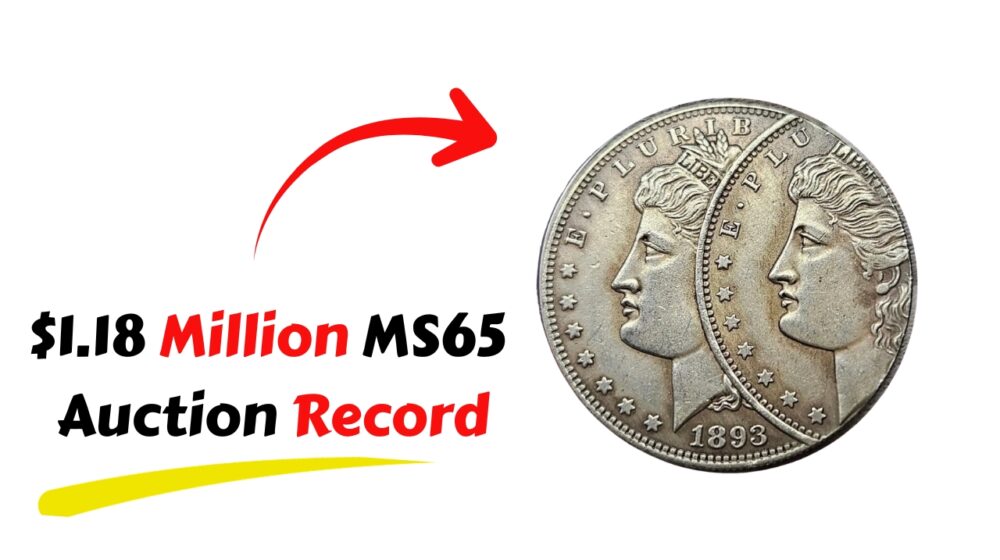
One of the most storied coins in the entire Morgan dollar series just changed hands for more than a million dollars. On August 9, 2026, GreatCollections sold the Clapp-Eliasberg 1893-S Morgan Silver Dollar for $1,181,250, setting a new auction record for the date in its PCGS MS65 grade. The coin carries a green CAC sticker on top of its PCGS certification, and it sold without reserve after drawing more than 14,000 page views, 433 tracking collectors, and 101 competing bids.
The number itself is striking more than 50% above the $775,000 PCGS Price Guide value for an MS65 example, a premium of roughly 52%. But for serious Morgan dollar collectors, the price is really only half the story. This particular coin combines Gem Mint State preservation, among the finest surviving examples of arguably the single toughest regular-issue Morgan dollar to find above circulated grades, with a pedigree that traces back to the year it left the San Francisco Mint.
Sale Details at a Glance
| Detail | Information |
|---|---|
| Coin | 1893-S Morgan Silver Dollar |
| Pedigree | Clapp-Eliasberg specimen |
| Grade | PCGS MS65, CAC approved (green sticker) |
| Hammer Price | $1,181,250 |
| Auction House | GreatCollections |
| Sale Date | August 9, 2026 |
| Reserve | None (sold without reserve) |
| Bids Received | 101 |
| Page Views | 14,000+ |
| Members Tracking the Lot | 433 |
| PCGS Price Guide (MS65) | $775,000 |
| Premium Over Guide | ~52% |
| Mintage | 100,000 (all struck in January 1893) |
| Composition | 90% silver, 10% copper |
| Weight | 26.73 grams |
| Diameter | 38.1 mm |
| Silver Content | 0.77344 troy ounce |
| Edge | Reeded |
| Strike Type | Business strike |
| Designer | George T. Morgan |
| Buyer Location | Midwest, United States |
How the Auction Unfolded
Unlike a new Mint product with a scheduled release date and fixed pricing, this coin reached the market through a single competitive auction, and the process behind that sale is worth understanding in its own right.
GreatCollections listed the coin without a reserve price, meaning it would sell to the highest bidder regardless of where bidding ultimately landed a structure that tends to generate more aggressive early interest since buyers know there’s no hidden floor protecting the seller. Interest built steadily in the run-up to the close: the lot logged more than 14,000 page views and drew 433 GreatCollections members who actively tracked it, ultimately attracting 101 total bids before the hammer fell on August 9, 2026.
The winning bidder, described by the auction house only as a collector based in the Midwest, didn’t take physical possession immediately. Instead, the buyer collected the coin in person at the American Numismatic Association’s 2026 World’s Fair of Money, held at the David L. Lawrence Convention Center in Pittsburgh from August 25 through August 29. GreatCollections serves as the ANA’s official auctioneer, which made the convention a natural handoff point for a coin of this significance.
Because this was a one-of-a-kind specimen rather than a limited product run, there were no order limits, no household caps, and no multi-week ordering window in the traditional Mint-release sense the entire transaction lived and died within a single competitive bidding period.
Historical Background
The 1893-S Morgan Dollar
The 1893-S holds a unique place in American numismatics as the lowest-mintage business-strike date in the entire Morgan dollar series. The San Francisco Mint struck all 100,000 examples in January 1893 and produced no further pieces that year. The timing proved disastrous for long-term survival: the Panic of 1893 triggered a severe economic contraction marked by railroad failures, bank collapses, and collapsing commodity prices, all while political pressure mounted over the federal government’s silver-purchasing policy. Silver dollar production across the Mint system slowed sharply in the aftermath, and most of the 1893-S issue that did get struck moved directly into commercial circulation rather than sitting untouched in Treasury vaults.
Attrition continued for decades afterward. Under the Pittman Act of 1918, the federal government melted millions of Morgan dollars nationwide, and numismatist Q. David Bowers has suggested tens of thousands of 1893-S dollars may have been destroyed during that program though surviving melt records don’t break totals down by date, so the exact figure can never be confirmed.
The combination of a tiny original mintage, heavy circulation, and an unknown but likely significant melt toll created one of the great condition rarities in the American series. Bowers estimates roughly 6,000 to 12,000 surviving examples across all grades, while PCGS’s own population estimate sits at 9,948 coins. Those numbers collapse dramatically once Mint State grades enter the picture: PCGS estimates only about 123 survivors at MS60 or better, and just 18 at MS65 or finer. PCGS co-founder David Hall has gone further, arguing the true Gem population may total only six or seven coins. Whichever figure proves closest to accurate, specialists broadly agree the 1893-S stands as the rarest Morgan dollar in Mint State condition the reason advanced collectors have long nicknamed it the “King of the Morgan Dollars.”
The Designer: George T. Morgan
The coin bears the work of George T. Morgan, the English-born engraver whose name became permanently attached to the entire silver dollar series struck from 1878 to 1904 (and briefly again in 1921). Morgan joined the U.S. Mint as an assistant engraver in 1876 and would go on to become Chief Engraver in 1917, but it’s his silver dollar design adopted the same year he arrived at the Mint that remains his best-known and most widely collected work.
The Pedigree: A Chain of American Numismatic History
Beyond its grade and rarity, this specific coin carries a documented ownership history stretching back to the year it was struck. Philadelphia coin dealer J. Colvin Randall acquired the piece in 1893, the same year the San Francisco Mint produced it. Collector John M. Clapp purchased it the following year, and it remained within the Clapp family for nearly fifty years.
In 1942, legendary collector Louis E. Eliasberg Sr. acquired the entire Clapp Collection. Eliasberg would go on to assemble the only complete collection of every United States coin by date and mintmark considered necessary for completeness at the time a numismatic achievement that has never been repeated. The coin stayed in his holdings for decades before reappearing publicly in the landmark 1997 Eliasberg sale, where it entered the Stellar Collection. It later joined the Sunnywood Collection in 2008, then passed to collector Bob R. Simpson.
In 2014, an Australian collector known within the hobby as the Wizard of Oz acquired the coin as part of what became one of the finest Morgan dollar collections ever assembled. It remained overseas for roughly a decade before returning to the U.S. market with this 2026 sale. Adding another layer of recognition, author Jeff Garrett selected this exact specimen as the plate coin representing the 1893-S in his reference work 100 Greatest U.S. Coins.
Obverse and Reverse Design
Obverse
The Morgan dollar’s obverse features a left-facing portrait of Liberty, her hair gathered beneath a cap adorned with wheat, cotton, and other native American agricultural motifs a design detail George T. Morgan added specifically to distinguish the coin as distinctly American rather than derivative of European coinage. The word LIBERTY appears on a band across her headpiece, with thirteen stars representing the original colonies arranged around the upper rim and the date positioned below the portrait. On the 1893-S specifically, that date reads simply “1893,” with the mintmark “S” for San Francisco placed beneath the wreath on the reverse rather than on the obverse itself.
Reverse
The reverse depicts a heraldic eagle with wings outstretched, clutching an olive branch in one talon and a bundle of arrows in the other a design meant to symbolize the nation’s readiness for both peace and war. A wreath of laurel and other foliage frames the eagle, and the inscriptions UNITED STATES OF AMERICA and E PLURIBUS UNUM encircle the design, with ONE DOLLAR positioned at the bottom. The San Francisco mintmark “S” sits below the wreath’s ribbon, a small detail that carries enormous financial significance given how few Mint State survivors of this particular mintmark and date combination exist.
Why This Matters for Collectors
This sale offers a real-time data point on where the market for elite Morgan dollar rarities currently stands, and the trend is unambiguous: prices for top-condition key dates keep climbing. Another PCGS MS65 1893-S with CAC approval sold for $600,000 back in November 2020. The new $1,181,250 result very nearly doubles that figure in under six years a pace that outstrips general market appreciation and reflects genuinely intensifying competition for coins at this level.
Context from the top of the market reinforces the point. GreatCollections previously sold the Vermeule-Jack Lee-Coronet 1893-S, graded PCGS MS67 with CAC approval, for $2,086,875 back on August 29, 2021 the first Morgan dollar ever to cross $2 million at public auction and still the standing record for the series overall. The Clapp-Eliasberg coin’s $1,181,250 result now sits just below that historic sale among the most significant public transactions ever recorded for the date.
Several factors converge to explain why this particular coin commanded such a strong premium over guide value:
- Grade rarity. With an estimated Gem population as low as six or seven coins by some expert assessments, an MS65 1893-S represents access to a tier most collectors will never have the chance to compete for.
- CAC approval. The green sticker signals that CAC’s graders consider the coin solidly, rather than marginally, within its assigned grade a distinction that increasingly drives premium pricing across the high end of the market.
- Pedigree depth. Few coins carry documented ownership running from Clapp to Eliasberg to Simpson to a world-class modern collection, and reference-book recognition (as the plate coin in 100 Greatest U.S. Coins) adds a layer of scholarly validation that population reports alone can’t capture.
- Eye appeal. GreatCollections President Ian Russell noted that many specialists regard this specimen as the most attractive surviving 1893-S, citing its luster and originality specifically qualities that matter enormously to bidders even when two coins share the same numerical grade.
For collectors, the sale is a reminder that in a series as widely followed as the Morgan dollar, the combination of extreme condition rarity and a documented historic pedigree can push a coin’s price to a level guide values simply haven’t caught up to yet.
Guide: Pursuing Key-Date Morgan Dollars at This Level
Since this specific coin has already sold, the practical takeaway for collectors isn’t how to buy it it’s how to position yourself for opportunities like it in the future.
- Study population reports before you shop. Compare PCGS and NGC population data for any key date you’re chasing, and treat published survival estimates (like the 18-coin MS65-and-better estimate for the 1893-S) as a starting point, not a guarantee some experts believe true Gem populations run even lower.
- Prioritize CAC-approved coins at the high end. A green CAC sticker has become an increasingly important signal for serious buyers competing for condition rarities, and it can meaningfully affect both bidding interest and final price.
- Research the pedigree, not just the grade. A documented ownership history through recognized collections (Eliasberg, Simpson, and similar benchmark holdings) can add significant value beyond what a certification label alone reflects.
- Register with major specialist auction houses. Firms like GreatCollections regularly source key-date Morgan dollars and accept want lists from collectors who want early notice when a matching coin comes to market.
- Watch no-reserve auctions closely. Lots offered without reserve, like this one, often generate the most transparent price discovery and the strongest bidding activity, since buyers know there’s no hidden floor working against them.
- Set a firm ceiling before bidding begins. With premiums running 50% or more over published guide values for elite examples, decide your maximum in advance rather than getting drawn into the momentum of live bidding.
- Consider convention pickup and verification. Major sales are often finalized at events like the ANA World’s Fair of Money, which also gives buyers a chance to have a coin’s grade and authenticity independently reviewed by other specialists on-site.
- Think in decades, not months. As this coin’s pedigree shows, the truly elite examples of key dates tend to resurface only once every several years building the patience and standing bids to act when they do is part of competing at this level.