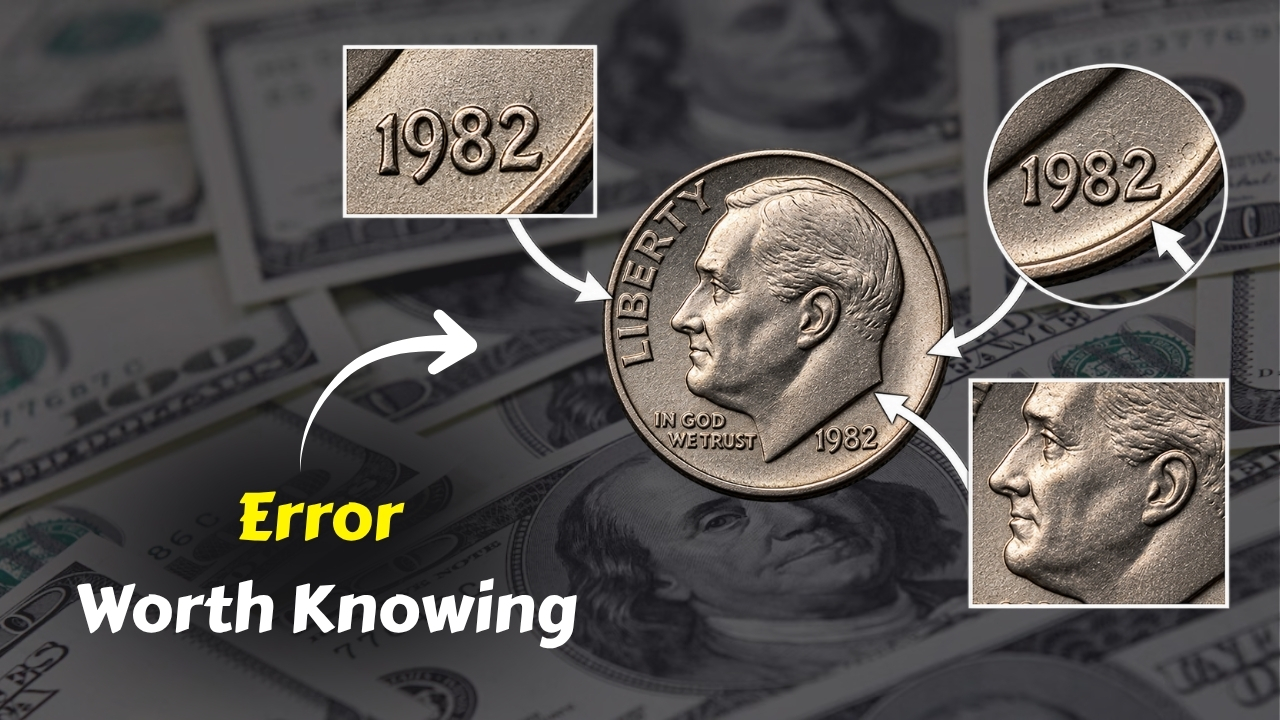
1982 No-P Roosevelt Dime: Every so often, a flaw in the coining process turns an ordinary piece of pocket change into a legitimate collectible. The 1982 No-P Roosevelt dime is the textbook example from the modern era. Rather than emerging from a vault, a proof set, or a limited-edition mint program, this dime was struck for everyday commerce and spent months circulating through cash registers, vending machines, and coin jars before anyone realized the Philadelphia Mint had shipped out dimes missing their mintmark entirely.
Because it was born from an ordinary production mistake rather than a planned issue, there is no “launch,” no mintage figure, and no Mint order window attached to this coin a point worth clarifying up front, since it separates the 1982 No-P dime from modern commemorative releases. What follows is a complete guide to the error: what caused it, how it was discovered, how to identify a genuine example, and how collectors go about tracking one down today.
At a Glance: Specifications and Key Facts
| Detail | Information |
|---|---|
| Coin type | Roosevelt Dime (clad composition) |
| Date | 1982 |
| Mint of origin | Philadelphia (struck without its “P” mintmark) |
| Error type | Missing mintmark, die-preparation error |
| Composition | Copper-nickel clad (outer layers of 75% copper/25% nickel bonded to a pure copper core) |
| Weight | Approximately 2.27 grams |
| Diameter | Approximately 17.9 mm |
| Edge | Reeded |
| Designer | John R. Sinnock |
| Official mintage of the error | Not published by the U.S. Mint; unknown exact figure |
| Strike varieties | “Strong” No-P and “Weak” No-P |
| Discovery period | Late 1982 |
| Discovery location | Sandusky, Ohio, near Cedar Point amusement park |
| Typical value, circulated (XF) | Around $30 |
| Typical value, Mint State (Gem or better) | $300 and up |
Because this is a circulation error rather than a Mint-issued product, there is no official pricing tier, no maximum household order, and no purchase window values above reflect the secondary collector market, and they move with condition, strike quality, and certification.

Why There’s No “Ordering Process” and What to Do Instead
Readers coming from modern commemorative coin coverage may expect a section on order limits, release dates, or a Mint product page. That structure doesn’t apply here, and it’s worth explaining why: the 1982 No-P dime was never sold by the United States Mint. It escaped into circulation by accident, and every example in the hobby today has been recovered from pocket change, bank rolls, or estates not purchased from an official mint program.
That means “acquiring” one is a different process entirely. Here’s how collectors actually go about it:
- Buy from a reputable coin dealer. Established dealers who specialize in error coins or Roosevelt dime varieties regularly stock certified examples.
- Shop certified coins from PCGS- or NGC-graded holders. Because the coin is frequently faked through mintmark removal, a third-party certified example carries far more confidence than a raw coin.
- Watch major coin auctions. Heritage Auctions and similar numismatic auction houses periodically offer both Strong and Weak strike examples, often across a range of grades.
- Search dime rolls yourself. “Coin roll hunting” buying rolls of dimes from a bank and searching them by hand is a long-shot but genuinely possible way to find one, since the error entered general circulation and has never been fully swept out of the coin supply.
- Join or consult error-coin collector communities and price guides. Numismatic reference sites and error-variety collector clubs track current market values and can help buyers avoid overpaying for altered coins.
There is no submission deadline or release calendar to track. The “market” for this coin is ongoing and driven entirely by collector demand and available supply.
Historical Background
The Roosevelt Dime: Origins and Designer
The Roosevelt dime series began in 1946, the year after President Franklin D. Roosevelt’s death. The design was created by U.S. Mint chief engraver John R. Sinnock, who had also designed the earlier Walking Liberty half dollar’s successor pieces and other coinage of the era. Roosevelt’s likeness was chosen for the dime in part because of his association with the March of Dimes and the fight against polio, a cause closely tied to his own health history. Sinnock’s design replaced the Mercury dime, which had been in circulation since 1916, and it has remained the standard dime design in the United States ever since, transitioning from silver to a copper-nickel clad composition in 1965.
The 1980 Mintmark Policy Change
For most of the Mint’s history, coins struck in Philadelphia carried no mintmark at all the absence of a letter was itself the signal of Philadelphia origin, with a handful of historical exceptions such as wartime nickels. Denver and San Francisco coins were marked with “D” and “S” respectively. That practice changed in 1980, when the Mint began stamping a “P” mintmark onto Philadelphia coinage, with cents remaining the sole exception. From 1980 onward, every properly struck Philadelphia dime was supposed to display a small “P” above the date. This policy shift is the entire reason the 1982 error is notable: after 1980, a Philadelphia dime without a mintmark should never have existed.
The 1982 Error Itself
In the early 1980s, mintmarks were still applied to coin dies by hand, with a Mint employee individually punching the mintmark onto each working die before it was hardened and sent into production. On at least one occasion in 1982, a Philadelphia working die skipped this step. The die was never punched with a “P,” yet it was approved and used to strike dimes anyway. Every coin produced from that flawed die emerged without a mintmark, looking at a glance like a pre-1980 Philadelphia dime — except for the giveaway 1982 date. Evidence points to a single die being responsible for the entire error, which explains both the coin’s relative scarcity and the consistency in how examples appear.
Discovery in Sandusky, Ohio
The error dimes entered general circulation directly from the Mint, and it took time before anyone noticed. The first confirmed sightings came in late 1982 in Sandusky, Ohio, in the vicinity of Cedar Point amusement park a location that processed enormous volumes of cash and coin from daily visitors. Employees and local collectors began noticing the unusual coins in everyday change, and as word spread, collectors throughout the Midwest started searching dime rolls for more. The clustering of early finds around that region suggests a limited, localized release of the error dimes into circulation rather than a nationwide distribution.
Design Details: Obverse and Reverse
Obverse
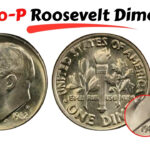
The obverse of the Roosevelt dime features a left-facing portrait of Franklin D. Roosevelt, rendered by Sinnock in a formal, dignified style. Roosevelt’s profile occupies most of the coin’s field, with “LIBERTY” arcing along the left rim and the motto “IN GOD WE TRUST” placed in small lettering just behind his neckline. The date sits at the lower right. On a correctly struck post-1980 Philadelphia dime, the “P” mintmark would normally appear just above the date, near Roosevelt’s shoulder truncation and it’s the total absence of that letter, without any sign of damage, scratching, or tooling, that defines the No-P error.
Reverse
The reverse carries a design rich with symbolism appropriate to a wartime-era coin honoring a president who led the country through global conflict. A lit torch dominates the center, representing liberty. To its left sits an olive branch, symbolizing peace, and to its right an oak branch, representing strength and independence. “UNITED STATES OF AMERICA” arcs around the top rim, “E PLURIBUS UNUM” is inscribed in small text at the center just below the torch, and “ONE DIME” is set along the bottom rim. The reverse design has remained essentially unchanged since the series began in 1946.
Identifying a Genuine 1982 No-P Dime
Authenticating this error is straightforward once you know the checkpoints:
- The date must read 1982. No other year is eligible for this particular variety.
- The mintmark area must show absolutely nothing no outline, no shadow, no disturbed or tooled metal where a “P” would normally sit.
- General die characteristics should match known 1982 Philadelphia dimes, including correct portrait detail, lettering, and spacing elsewhere on the coin.
- Beware of altered coins. Because genuine examples carry a premium, some sellers offer dimes with the “P” mechanically removed or scratched away. Under magnification, these alterations typically show telltale disturbed metal, tool marks, or an unnatural surface texture that a coin with a genuinely unpunched die will not have. Natural wear alone cannot fully erase a mintmark without leaving other signs of heavy circulation.
Strong vs. Weak Strikes
Numismatists generally sort surviving examples into two strike categories:
- Strong No-P dimes show crisp, well-defined design elements, particularly around the rim and lettering, closely resembling a normally struck coin apart from the missing mintmark.
- Weak No-P dimes show flattened, mushy detail in the outer design elements, with some features nearly worn away in the strike itself (not from circulation).
Both are legitimate examples of the same die error, but Strong strikes are generally regarded as more desirable, and they tend to command stronger prices in the current market.
How Rare Is It, Really?
The Mint never released a mintage figure for this error, and because the coins moved through ordinary commerce, no exact population will ever be confirmed. Certification data from PCGS and NGC offers the best proxy available: among clad Roosevelt dime varieties, the 1982 No-P ranks as the most frequently submitted for grading, trailing only the 1996-W dime. That comparison is a useful contrast rather than a true equivalent, since the 1996-W was a special mint-set novelty coin never intended for circulation, while the No-P dime is a genuine production mistake that reached the public organically. Thousands of examples likely survive, but high-grade, well-struck specimens are considerably scarcer than raw population estimates might suggest.
Why This Matters for Collectors
The 1982 No-P Roosevelt dime holds a unique place in modern numismatics for several reasons:
- It’s an accessible piece of real Mint history. Unlike classic 19th-century rarities, this error is well within reach of collectors on modest budgets, with circulated examples starting around $30.
- It proves errors didn’t end with the silver era. Many new collectors assume major mint mistakes are confined to coinage from decades or centuries past. This dime is proof that meaningful production errors continued well into the modern clad era.
- It keeps the thrill of “circulation finds” alive. Because the coin entered ordinary pocket change and has never been fully recovered from the coin supply, coin roll hunters still search for it today a rare case where a genuinely valuable find could theoretically turn up in a bank-wrapped roll of dimes.
- It rewards careful study. The distinction between Strong and Weak strikes, and the need to distinguish genuine examples from altered fakes, gives collectors a real opportunity to apply hands-on numismatic skill rather than simply buying a pre-verified item.
- It has a documented, traceable story. From the 1980 mintmark policy change to the single flawed die to the Sandusky discovery, the coin’s history is unusually well understood for an error variety, which adds to its credibility and collector appeal.
Quick-Reference Buying Guide
- Learn the diagnostics first. Confirm you know what a genuine missing mintmark looks like versus a mechanically altered coin before shopping.
- Decide between Strong and Weak strike types, since pricing and desirability differ between the two.
- Set a budget based on grade. Expect roughly $30 and up for circulated examples, and $300 or more for Gem Mint State pieces.
- Prioritize certified coins. Look for PCGS- or NGC-graded and encapsulated examples to minimize the risk of buying an altered coin.
- Buy from dealers with error-coin expertise, or bid through major numismatic auction houses with a track record in Roosevelt dime varieties.
- Cross-check the seller’s listing against known diagnostics (date, mintmark area, strike strength) before purchasing.
- Consider coin roll hunting as a long-shot bonus route if you enjoy the search itself, understanding that success is rare but not impossible.
- Store and holder the coin properly once acquired, to preserve its grade and protect its long-term value.
Note: Figures and grading data reflect general market patterns for this error variety. Because no official Mint production records exist for the 1982 No-P dime, collectors should always verify current pricing through a reputable dealer, auction house, or grading service before buying or selling.