Every serious collector eventually runs into the same unsettling realization: grading isn’t an exact science. Two respected professional services can look at the very same coin and land on two different numbers. That’s not a scandal it’s simply the nature of judging microscopic differences in wear, luster, and surface preservation by eye. A recent, widely discussed case makes the point vividly: a collector submitted an 1836 Classic Head Quarter Eagle (Block 8 variety) to PCGS, which graded it MS61. After cracking the coin out of its holder, he resubmitted it to CAC Grading (CACG), which called the very same coin MS62 one full point higher.
That single-point gap isn’t really the story. The real value is in what close, side-by-side photographic comparison of that coin reveals about how professional graders and any collector who wants to grade with real confidence actually separate an uncirculated coin from a lightly circulated one. This guide walks through the grading scale itself, how professional certification actually works, the historical coin used as our teaching example, and a practical, repeatable method for examining any coin’s surface before you trust a number on a label.
Grading Scale and Terminology Reference
Nearly every third-party grading service in the United States uses some version of the Sheldon Scale, a 70-point numerical system originally developed for large cents and later adopted industry-wide.
| Grade Range | Common Label | What It Generally Means |
|---|---|---|
| 1–3 | Poor / Fair | Barely identifiable, heavily worn or damaged |
| 4–29 | Good to Very Fine | Increasing levels of detail retained despite circulation wear |
| 30–39 | Extremely Fine | Sharp detail remains; light, even wear on high points |
| 40–49 | About/Almost Uncirculated (AU) | Trace wear visible only on the highest points of the design |
| 50–58 | AU (finer sub-grades) | Very slight, sometimes hard-to-detect friction on high points |
| 60–70 | Mint State (MS) or Proof (PR) | No wear from circulation; graded on strike quality, luster, marks, and eye appeal |
The line between a high-end AU coin and a low-end Mint State coin is exactly where DeplorableDan’s 1836 Quarter Eagle sits, and it’s also exactly where two experienced graders are most likely to disagree by a point.
| Grading Service | Founded | Role |
|---|---|---|
| PCGS (Professional Coin Grading Service) | 1985, in Newport Beach, California | First major third-party grading service; created the modern coin “slab” |
| NGC (Numismatic Guaranty Company) | 1987, in Sarasota, Florida | Major competitor to PCGS, strong in world and ancient coins |
| CAC (Certified Acceptance Corporation) | 2007 | Originally a “sticker” service reviewing coins already graded by PCGS or NGC |
| CACG (CAC Grading) | 2023 | Full independent grading and encapsulation service, accepting raw (ungraded) coins directly |
How Professional Coin Grading Actually Works
Unlike a coin release with a fixed price and mintage, grading is a service you request on a coin you already own. Here’s what that process generally involves:
- Choose a service. PCGS, NGC, and CACG are the three most widely recognized names in U.S. numismatics; each publishes its own submission guidelines and fee schedule.
- Select a submission tier. Most services offer several speed and value tiers for example, NGC’s tiers have included an Economy tier, an Express tier, a WalkThrough tier, and an Unlimited Value WalkThrough tier, with fees and per-coin value limits that scale accordingly. Higher tiers generally cost more but return a graded coin faster and cover higher declared values.
- Package and insure the coin for shipping, following the service’s specific requirements most require the coin to be raw (unslabbed) unless you’re specifically requesting a “crossover” from a rival service’s holder. A crossover service exists specifically for coins already encapsulated by a rival service, where the new grader reviews the coin and, if their assigned grade meets or exceeds a stated minimum, “crosses” it into their own holder.
- Wait for grading and encapsulation. Turnaround time depends on the tier chosen and current submission volume, ranging from same-day results at live “walk-through” events to several weeks for standard mail-in submissions.
- Review the returned coin and grade. The coin comes back sonically sealed in a tamper-evident holder with a label showing the assigned grade, and as this guide’s central example shows it’s worth examining the coin yourself rather than assuming the label settles every question.
There’s no “release date,” purchase limit, or scarcity concern here, since grading is an ongoing, on-demand service rather than a limited product.
Historical Background: The 1836 Classic Head Quarter Eagle
The coin used to illustrate these grading principles is a genuine piece of early American gold coinage history. Following the Act of June 28, 1834, which mandated a reduction in the weight of U.S. gold coins, the quarter eagle denomination was redesigned by Mint Chief Engraver William Kneass. Collectors today call this design the “Classic Head” type, and it was struck from 1834 through 1839.
Kneass didn’t invent the design from scratch. He based the new portrait on an earlier “Classic Head” design John Reich had created for large cents and half cents decades earlier, reportedly to give the new, lighter-weight gold coins a consistent look across denominations. One deliberate change mattered a great deal at the time: the motto E PLURIBUS UNUM was dropped from the reverse specifically so the new, reduced-weight coins could be told apart at a glance from the older, heavier “old tenor” gold pieces still circulating.
1836 was the high-water mark for this design’s popularity. Mintage that year reached 547,986 pieces Philadelphia’s largest quarter eagle output of the entire Classic Head run and it’s also the year that saw the coin’s date punched with two distinct numeral styles, giving rise to the “Block 8” and “Script 8” varieties that collectors distinguish today by the shape of the final digit in the date. The Block 8 variety gets its name from a numeral 8 with squared, blocky loops, in contrast to the flowing, curved 8 used on the Script 8 punch that same year.
Because so many 1836 quarter eagles were struck, the type is considered readily obtainable in worn grades, but genuinely uncirculated examples are meaningfully scarcer which is exactly why correctly separating an AU coin from a true Mint State coin, as this guide’s central example demonstrates, carries real financial and historical stakes for a collector.
Obverse and Reverse Design Details
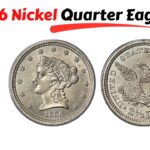
Obverse: Miss Liberty faces left, her hair pulled back in a formal, classical style and secured by a headband inscribed “LIBERTY” in raised letters. Thirteen stars encircle the border, and the date sits at the bottom, below her portrait. There is no additional lettering competing for space around her a cleaner, simpler layout than the capped-head designs it replaced.
Reverse: An eagle with wings spread stands at the center, a shield across its breast, an olive branch in one talon and three arrows in the other. “UNITED STATES OF AMERICA” wraps around the upper border, with the denomination expressed as “2½ D.” at the bottom. Notably absent is the motto E PLURIBUS UNUM, which had appeared on quarter eagles since the denomination’s introduction in 1796 and would not return until 1908.
When examining a coin of this type for grade, these are the precise areas worth close attention: the field immediately surrounding each of the thirteen obverse stars, the raised versus recessed portions of Liberty’s hair curls, the open field around her portrait, and the small patch of her cheek between mouth and hairline all classic friction points where circulation wear first appears.
Why This Matters for Collectors
A single grading point can mean a meaningful difference in value, especially at the boundary between About Uncirculated and Mint State. But the bigger lesson isn’t really about dollars it’s about developing your own reliable eye. As one veteran dealer’s grading principle puts it: a coin that has never circulated should show no trace of abrasion on its high points and no disturbance to its original field luster, full stop. Everything else photographic lighting, uneven striking, minor toning can imitate the appearance of wear without actually being wear, and only patient, standardized-lighting examination can tell the two apart.
This is also why professional grading services, careful as they are, occasionally differ by a point on the same coin, and why a coin club grading contest can trip up even experienced members. In one such contest, a beautifully lustrous Buffalo nickel fooled most participants into guessing grades as high as MS-66, when the professionally assigned grade visible only after closer inspection revealed slight high-point abrasion was actually AU-58. Only one member in the room caught it.
Understanding these principles protects you in two directions: it helps you evaluate a raw coin realistically before you buy or submit it, and it helps you understand why two certified grades might legitimately differ, rather than assuming one service is simply wrong.
Quick-Reference Grading Checklist
- Examine the coin under standard, even, raking light never rely on a single glance or a photo taken under dramatic lighting alone.
- Check the fields immediately around raised design elements stars, letters, and the portrait’s outline for a “halo” effect or unusual darkening that could indicate wear, uneven striking, or simply photographic artifact.
- Compare the tops of hair curls (or other high points) to their recessed areas. Meaningfully darker or duller high points, relative to the deeper recesses, are a classic sign of circulation wear.
- Inspect the highest-relief points of the portrait cheek, jawline, or hairline for small contact marks or a fine, stubble-like texture, both common results of bag or handling wear.
- Compare your coin against a certified example of the same date and known high grade whenever possible, ideally from a reputable population or reference photo source.
- Look for consistency between the label and the coin itself. A described grade should match what you can actually observe under close inspection don’t assume a slab guarantees perfection.
- When in doubt, or before a significant purchase, get a second professional opinion through crossover submission, CAC review, or a trusted dealer’s in-person assessment rather than relying on a single grading event.
- Remember that grading is a skill built through repetition. The more coins you examine side-by-side against known references, the more reliable your own eye becomes over time.