In the closing years of the 1870s, the United States Mint quietly produced one of the strangest experiments in American coinage history: a silver dollar that wasn’t entirely silver. Struck in an alloy called “goloid” a blend of gold, silver, and copper patented by a Philadelphia dentist these pattern dollars were meant to solve a currency crisis that had been brewing since the California Gold Rush. They never circulated. Congress rejected the idea outright in 1878. And yet, across three years of trial strikes in 1878, 1879, and 1880, the Mint produced dozens of distinct goloid varieties that today rank among the most sought-after pattern coins in American numismatics.

This isn’t a story about a modern coin release with a mintage limit and an order form. Goloid dollars were never sold to the public, and no “buying window” ever existed for them in the 1870s only a small circle of Mint officials, congressmen, and favored collectors ever handled genuine examples. What follows is the full history of how they came to be, why they failed, and how today’s collectors can responsibly pursue the real thing.
Specifications and Known Varieties
The Patented Goloid Alloy
Dr. William Wheeler Hubbell’s original 1877 patent (No. 191,146) specified an alloy of gold, silver, and copper, with a trace addition of sodium or potassium sulphate. His preferred ratio, by weight, was:
| Component | Hubbell’s Standard Ratio | Permitted Range |
|---|---|---|
| Gold | 1 part | Fixed |
| Silver | 24 parts | 20–30 parts |
| Copper | 2.5 parts | 1/12 to 1/8 of total weight |
| Sulphate additive | 1 grain per 1,000 grains of metal | — |
Mint trial strikes generally followed a silver dollar’s traditional weight standard of 258 grains (about 16.72 grams) in 1878 and 1879. In 1880, a separate “metric” series moved to a 25-gram standard as part of a parallel push to align U.S. coinage with the metric system.
Representative Pattern Varieties
Numismatists catalog goloid patterns using Judd numbers (from the reference work United States Pattern Coins, originally compiled by J. Hewitt Judd). The table below shows representative examples across the three striking years and multiple metals; it is illustrative rather than exhaustive, since dozens of die and metal combinations exist.
| Judd No. | Year | Metal Struck | Designer | Survival Estimate | Notes |
|---|---|---|---|---|---|
| J-1554 | 1878 | Silver | William Barber | Roughly 13 to 30 examples believed to exist | Early design with a standing-eagle reverse, later abandoned |
| J-1557/1558 | 1878 | Silver | William Barber | Low rarity (several dozen known) | Liberty head obverse, gram/fineness reverse inscription |
| J-1559 | 1878 | Copper | William Barber | Andrew Pollock traced only five known examples, though online researchers estimate more than half a dozen may survive | Barber’s third goloid design that year; the 38-star reverse border was suggested by Hubbell himself, one star for each state |
| J-1562 | 1878 | Copper | William Barber | Rare (single digits to low dozens) | Laurel-wreath reverse variety |
| J-1563 | 1878 | Goloid/Silver | William Barber | Low rarity | “Metric” reverse denominated in grams and “100 CENTS” |
| J-1617–1619 | 1879 | Silver, copper | George T. Morgan | Scarce | Liberty with hair in a bun, ribbon-inscribed “LIBERTY” |
| J-1645 | 1880 | Goloid | George T. Morgan (design repeated) | Scarce | Metric-standard reverse |
| J-1649 | 1880 | Goloid | George T. Morgan (design repeated) | Very scarce | 25-gram metric dollar; reverse cites “895.8 S. / 4.2 G. / 100 C.” and the motto “DEO EST GLORIA” |
| J-1651 | 1880 | Goloid | William Barber obverse, 1879 reverse | Researcher Saul Teichman has traced 14 known examples | Combination of an older obverse with a newer reverse die |
| J-1652 | 1880 | Copper, aluminum | William Barber | Struck for sale to collectors rather than as official trial pieces | Off-metal strike of the 1880 metric design |
Mint records for these patterns are incomplete; original striking quantities were rarely logged, and today’s population figures come from certification-service census data and specialist researchers rather than official mintage reports.
How Collectors Acquire a Goloid Pattern Today
There is no mint, dealer, or program currently issuing goloid dollars, so there’s no order form, release date, or per-household purchase limit to describe. Genuine examples reach the market almost exclusively through major numismatic auction houses. A few practical points for anyone considering a purchase:
- Where they surface: Heritage Auctions, Stack’s Bowers Galleries, and Great Collections are the auction houses most likely to offer certified goloid patterns, usually as part of their U.S. pattern coin sales.
- Recent price context: an 1880 goloid metric dollar graded PR66 Red Cameo by NGC sold at auction for $23,180, giving a sense of what a well-preserved, correctly attributed example can bring.
- Authentication matters enormously. Because goloid and 90% fine silver are nearly impossible to tell apart visually, always buy pieces certified by PCGS or NGC, with the Judd number confirmed. Uncertified “goloid” coins offered informally are frequently later-made replicas or simply mislabeled silver strikes.
- No fixed price tier exists. Values vary enormously by Judd number, metal, and condition from four figures for common copper off-metal strikes to well into five figures for rare silver or true goloid-alloy pieces in high grade.
- Expect to wait for the right lot. Because so few examples of any single variety survive, availability is opportunistic rather than scheduled. Serious collectors typically watch upcoming auction catalogs over months or years for a specific Judd number to appear.
Historical Background of Each Design
1878: William Barber’s Original Goloid Dollars
The first goloid patterns were struck in 1878, only months after Hubbell secured his patent. Chief Engraver William Barber produced several distinct obverse and reverse combinations that year, adapting a Liberty head design he had already used on an 1877 pattern half dollar. Early versions (like J-1554) paired this obverse with a traditional eagle reverse before the Mint settled on a design that instead displayed the coin’s metallic composition directly on the reverse a practical necessity, since nothing about a goloid coin’s appearance could tell a merchant or bank teller what it was actually worth. Barber’s third design that year, J-1559, added a distinctive border of 38 stars, one for each state then in the Union, a detail suggested by Hubbell himself.
1879: George T. Morgan’s Redesign
By 1879, engraver George T. Morgan best known today for the Morgan silver dollar he would help launch that same year contributed his own goloid dollar design. Morgan’s Liberty wore her hair gathered in a bun rather than under a cap, with a ribbon inscribed “LIBERTY” in incuse letters. This was the design Mint Director Henry Linderman used in his famous demonstration before the Congressional Committee on Coinage, Weights, and Measures, when he presented a goloid dollar alongside a standard 90%-fine silver dollar and challenged the committee to tell them apart by eye alone.
1880: The Metric Experiment
The final year of goloid pattern production coincided with a broader Mint interest in metric coinage. The 1880 series, including J-1645 and J-1649, repeated Morgan’s 1879 obverse design but recalculated the coin’s weight to an even 25 grams rather than the traditional 258-grain standard, with the composition spelled out on the reverse as roughly 4.2 grams of gold, 100 grams of copper-adjusted silver content, per 25-gram coin. Other 1880 varieties, like J-1651, combined Barber’s older obverse die with a newer reverse, while off-metal strikes in copper and aluminum (J-1652) were produced specifically for sale to interested collectors rather than as official government trials.
Obverse and Reverse Design Details
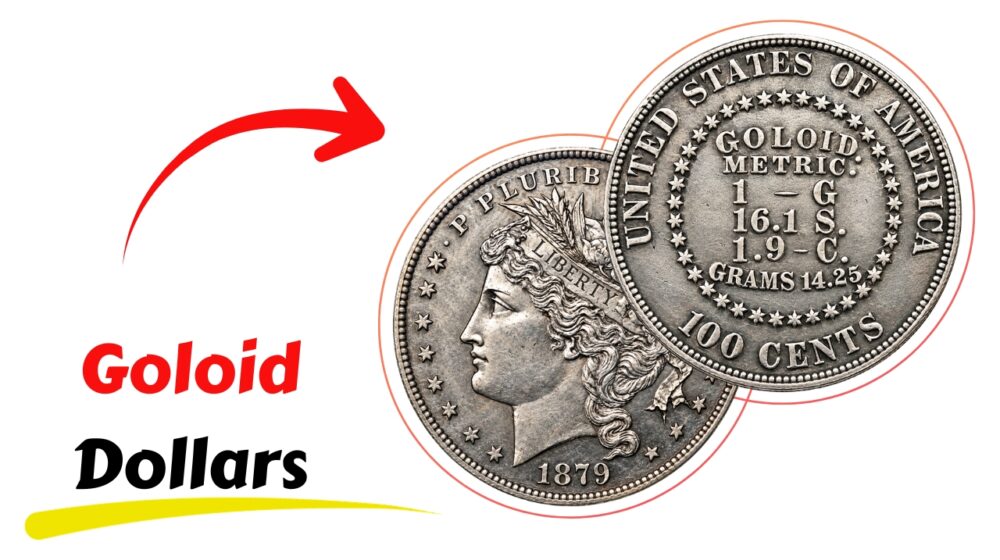
Obverse (most common Barber and Morgan varieties): A left-facing head of Liberty dominates the obverse. She wears a cap or coronet inscribed “LIBERTY” in incuse (recessed) lettering, with the cap’s band decorated in ears of wheat, cotton leaves, and cotton bolls a nod to American agriculture. The Latin motto “E PLURIBUS UNUM” arcs above her head, and the date sits below. Thirteen stars ring the border, split seven on the left and six on the right, echoing the original thirteen colonies. Later varieties, such as J-1559, expanded this star count to 38, one for every state then admitted to the Union.
Reverse (composition-declaring varieties): Rather than a traditional eagle, most goloid dollar reverses displayed the coin’s own metallic makeup as its central design element an unusual and openly utilitarian choice driven by necessity. A typical reverse reads something like “GOLOID / 1–G. / 24–S. / .9 FINE. / 258 GRS.,” enclosed within a wreath or a circle of stars, with “UNITED STATES OF AMERICA” and “ONE DOLLAR” around the border. The 1880 metric varieties updated this formula to metric units and added the Latin motto “DEO EST GLORIA” (“To God be the glory”), along with the denomination expressed as “100 CENTS.”
Why This Matters for Collectors
Goloid dollars occupy a unique niche in American numismatics precisely because they represent a fully worked-out monetary idea that Congress ultimately rejected. They sit at the intersection of several major storylines in U.S. coinage history: the silver crisis triggered by the California Gold Rush, the deeply controversial Coinage Act of 1873 (the so-called “Crime of ’73”), the brief flirtation with metric currency, and the design careers of two of the most important Mint engravers of the era, William Barber and George T. Morgan.
For pattern-coin specialists, goloid dollars also offer a rare, well-documented case study in numismatic metallurgy Hubbell’s own density arguments, and Linderman’s demonstration that even trained officials struggled to visually distinguish goloid from ordinary silver, remain genuinely interesting artifacts of 19th-century monetary science. Because survival numbers for many varieties are measured in the single or low double digits, acquiring even one certified example places a collector in a very small club, and assembling a run across multiple Judd numbers and metals is a long-term project few collections ever complete.
Quick-Reference Buying Guide
- Study the Judd catalog first. Before shopping, identify which specific Judd numbers interest you silver, copper, aluminum, or true goloid alloy since prices and availability vary drastically by variety.
- Insist on third-party certification. Only consider pieces graded by PCGS or NGC, with the Judd number stated on the holder, given how visually similar goloid and silver strikes can be.
- Check population reports. Use PCGS and NGC census data, along with specialist sites like USPatterns.com, to understand how many examples of a given variety are known to survive.
- Watch major pattern-coin auctions. Track upcoming sales at Heritage Auctions, Stack’s Bowers Galleries, and Great Collections, since goloid patterns appear irregularly rather than on a fixed schedule.
- Verify provenance where possible. Many surviving examples carry a documented ownership trail through well-known pattern collections; a clear provenance history adds confidence and often value.
- Budget for genuine rarity. Expect prices from the low thousands for common off-metal strikes in modest grades up to well over $20,000 for rare, high-grade goloid-alloy examples.
- Consult a pattern-coin specialist dealer. Given how easily goloid varieties are misattributed, working with a dealer experienced specifically in U.S. pattern coins is strongly recommended before a significant purchase.