More than fifty years after Indonesia rebuilt its circulating coinage, a remarkable group of survivors from that era has surfaced not as coins, but as the very tools used to strike them. Numismatic error specialist and MintErrorNews publisher Mike Byers has revealed seven uncancelled Indonesian coin dies and design-validation pieces tied to the country’s 1971 10-, 25-, and 50-rupiah coinage. NGC has authenticated and encapsulated the entire group, and according to Byers, the find was completely unknown to the numismatic community before now.
It’s worth being precise about what these objects actually are, since the framing matters: this is not a discovery of seven rare coins. The 1971 Indonesian 10-, 25-, and 50-rupiah coins themselves are common, with published mintages running into the hundreds of millions and, for two denominations, well over a billion pieces. What makes this discovery extraordinary is that these are the production dies and design-validation dies that helped create those coins steel tooling that mints almost universally destroy or deliberately deface once it’s retired, specifically to prevent anyone from striking unauthorized coins later. Intact, uncancelled dies escaping that process is, by NGC’s own account, the rarest category of surviving numismatic die material.
What Was Discovered: Group Overview
The certified group consists of seven individual pieces:
- Uncancelled obverse die, 1971 50 Rupiah
- Uncancelled reverse die, 1971 50 Rupiah
- Uncancelled obverse die, 1971 25 Rupiah
- Uncancelled reverse die, 1971 25 Rupiah
- Uncancelled obverse die, 1971 10 Rupiah
- Design Validation (DV) obverse die, 1971 10 Rupiah
- Design Validation (DV) reverse die, 1971 10 Rupiah
The two Design Validation dies are especially significant. Byers describes them as artifacts from the die-making process itself, carrying the final design that Indonesia formally adopted for the 10-rupiah coin meaning this group preserves physical evidence not just of production, but of the design approval process that preceded it.
Coin Specifications (for the Denominations These Dies Produced)
While the dies themselves are unique, one-of-a-kind survivors with no catalog specifications of their own, the finished coins they were built to strike carry well-documented specifications:
| Denomination | Catalog Number | Composition | Weight | Diameter (approx.) | Edge | Principal Reverse Design | Published Mintage |
|---|---|---|---|---|---|---|---|
| 1971 10 Rupiah | KM#33 | Copper-nickel | 1.77 g | 16 mm | Reeded | Rice and cotton stalks (FAO type) | 286,360,000 |
| 1971 25 Rupiah | KM#34 | Copper-nickel | 3.52 g | 20 mm | Reeded/Milled | Victoria crowned pigeon | 1,221,610,000 |
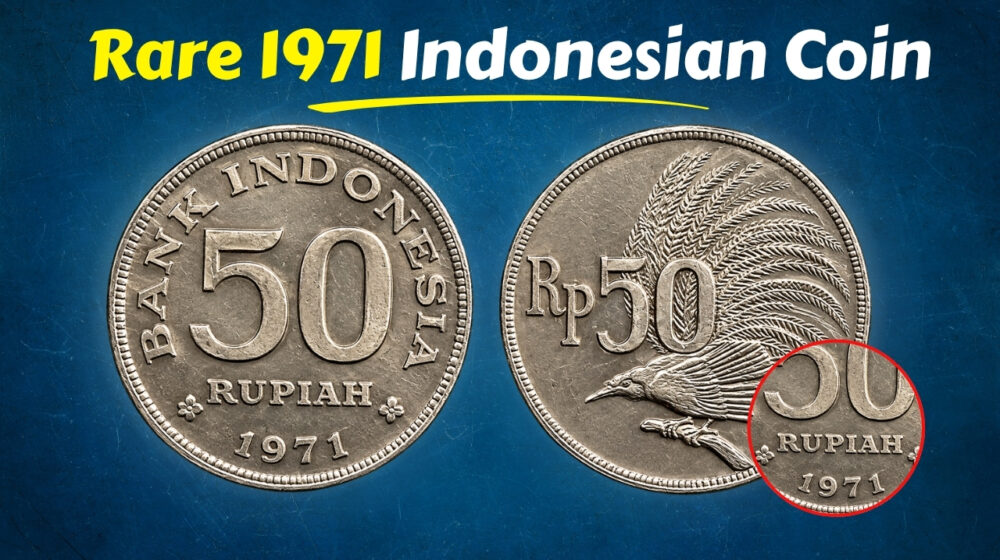
| 1971 50 Rupiah | KM#35 | Copper-nickel | 6.06 g | 24 mm | Reeded/Milled | Greater Bird of Paradise | 1,035,435,000 |
All three denominations were struck in medal alignment. Specifications are drawn from NGC, Numista, and Indonesian numismatic references, as compiled in MintErrorNews Issue 95.
The Sale: Price, Availability, and How to Inquire
Because these dies are a unique, previously unknown discovery rather than a mint product or a scheduled release, there is no order form, donation tier, mintage limit, or purchase window in the traditional sense. Here is what has been publicly disclosed about their availability:
- Offered as a complete group. Byers has brought the full set of seven dies to market together as a single discovery, not as individually priced pieces.
- Asking price. The current listing carries a $50,000 asking price for the entire group.
- Certification. All seven pieces have been authenticated and encapsulated by NGC under its die-certification program, which the company established in 2018.
- Provenance and condition. Byers reports the dies survived in unusually well-preserved condition for more than 50 years before coming to light.
- First-time market appearance. This is the first time the group has been offered publicly; because the dies were previously unknown to collectors, there is no prior sale history or comparable transaction to benchmark against.
- Where to inquire. Collectors and institutions interested in the group should follow Mike Byers and MintErrorNews directly, since that is the source of the original listing and the most reliable point of contact for current status and terms.
As with any high-value, unique numismatic acquisition, prospective buyers should independently verify current listing status, confirm authentication details directly with NGC, and consider appropriate insurance and security arrangements given the group’s asking price and rarity.
Historical Background
Indonesia’s Monetary Story Before the Rupiah
Indonesia’s relationship with metal money predates the rupiah by centuries. According to Bank Indonesia’s museum, gold and silver “Ma” money circulated in Java under early kingdoms, and the Majapahit kingdom left behind copper “gobog” pieces that researchers date to roughly the 14th through 16th centuries. As maritime trade expanded through the archipelago, foreign currency circulated alongside local issues, including the Spanish real. The Dutch East India Company (VOC) later introduced its own currency, including copper duit coins put into circulation in 1727 as low-value money a word that survives in modern Indonesian as an informal term for money. Dutch colonial administration eventually centered the territory’s monetary system on the Netherlands Indies gulden, which remained the dominant currency until Indonesian independence reshaped the country’s monetary path entirely.
ORI and the Birth of a National Currency
Indonesia declared independence in 1945, but Dutch authorities attempted to reassert colonial control in the years that followed, and currency became part of that struggle. In October 1946, the Republic introduced Oeang Repoeblik Indonesia (ORI). Bank Indonesia describes ORI as more than a simple medium of exchange it functioned as a symbol of national solidarity and sovereignty at a time when multiple competing currencies circulated across the country. The word “rupiah” itself belongs to a wider South Asian monetary tradition tracing back to Sanskrit terms for silver, but Indonesia gave the word its own distinct national identity through this post-independence currency. Coins followed during the 1950s, but severe inflation eventually made small-denomination coinage impractical, and Indonesia’s earlier sen-denominated national coin series ended in 1961.
Hyperinflation and the Road Back to Coinage
By the mid-1960s, Indonesia faced a full-blown economic crisis. An IMF review published in 1970 documented extraordinary inflation, with Jakarta’s price index rising more than 1,500 percent during the twelve months ending in June 1966. The government launched a major stabilization program that October. Bank Indonesia records inflation near 600 percent in 1965, a figure that had fallen to roughly 2.5 percent by 1971 a dramatic turnaround that forms the essential backdrop to this discovery.
It’s worth correcting a common misconception here: 1971 was not the year Indonesian metal coinage returned after the crisis. Indonesia had already reintroduced circulating 1-, 2-, and 5-rupiah coins dated 1970. The 1971 issues the 10-, 25-, and 50-rupiah denominations represented by these newly surfaced dies expanded that circulating coinage rather than initiating it, marking the second stage of Indonesia’s return to a functioning metallic currency system.
A Second 1971 Milestone: The Founding of PERURI
The year 1971 carries an additional layer of significance for Indonesian numismatics. On September 15, 1971, the Indonesian government established Perum Percetakan Uang Republik Indonesia (PERURI), the state-owned enterprise still responsible for producing the country’s currency and other state security documents today. PERURI was formed by merging PN Arta Yasa, which had handled coin production, with PN Pertjetakan Kebajoran, which had produced banknotes. As a result, 1971 sits at the convergence of several major developments in Indonesian monetary history: inflation had been brought under control, circulating coinage had been restored and expanded, and the country’s minting and currency-printing operations had been consolidated under a single new institution. The surviving dies place collectors unusually close to that specific historical moment.
Design Descriptions: Obverse and Reverse
1971 25 Rupiah Victoria Crowned Pigeon
The 25-rupiah coin’s reverse features a Victoria crowned pigeon (Goura victoria), a large, spectacular ground-dwelling pigeon native to New Guinea and nearby areas, recognizable for its ornate crest. The corresponding die pair in the discovered group both obverse and reverse uncancelled dies represents the tooling behind a coin with a published mintage of 1,221,610,000 pieces, making the finished coin itself common even though the production dies are not.
1971 50 Rupiah Greater Bird of Paradise
The 50-rupiah coin’s reverse depicts the Greater Bird of Paradise (Paradisaea apoda), chosen for its dramatic plumage and its status as one of the most recognizable birds associated with the Indonesian region. As with the 25-rupiah type, the discovered group includes both the obverse and reverse uncancelled production dies for this denomination, which carries a published mintage of 1,035,435,000 pieces.
Together, the 25- and 50-rupiah designs brought Indonesia’s natural heritage rather than a ruler’s portrait or a national emblem alone directly into everyday commerce.
1971 10 Rupiah Rice, Cotton, and a Food Production Message
The 10-rupiah coin tells a different design story. Its reverse shows stalks of rice and cotton alongside the inscription TINGKATKAN PRODUKSI SANDANG PANGAN, a call to increase the production of clothing and food. Numismatic references connect the design to a United Nations Food and Agriculture Organization (FAO) coin program. This messaging was not merely decorative: the IMF has noted that rice shortages contributed to a severe inflationary surge in late 1967 and early 1968, meaning agricultural production was a genuine economic priority during Indonesia’s stabilization efforts, not just a symbolic motif. The 10-rupiah coin carries a published mintage of 286,360,000 pieces.
This denomination is also where the discovered group offers its deepest look into the minting process: alongside the uncancelled obverse production die, the group includes both the obverse and reverse Design Validation (DV) dies for the 10-rupiah type pieces that, according to Byers, preserve the final design as formally adopted before full production began.
A Frozen Date on Two Denominations
Collectors should be aware of an important quirk affecting the 25- and 50-rupiah coins: their date does not necessarily indicate the actual year of striking. Numista records both denominations as having carried a fixed 1971 date through at least 1990, and specifically notes that roughly 36.5 million examples of each denomination were produced in 1977 while still bearing the original 1971 date. This means a 50-rupiah coin dated “1971” in a collector’s hand could plausibly have been struck years, even the better part of a decade, later.
This frozen-date pattern does not apply to the 10-rupiah FAO type, however. That design belongs specifically to the 1971 issue, and Indonesia went on to introduce different 10-rupiah designs in 1974 and 1979. It’s also worth being careful not to overextend the frozen-date evidence: it demonstrates that the 1971-dated 25- and 50-rupiah design remained in production for years, but it does not by itself prove that these exact seven dies remained in service for that entire span a distinction that matters when evaluating the specific tools now being offered to the market.
Why This Matters for Collectors
- A different category of rarity entirely. The finished 1971 Indonesian coins are affordable and easy to find; the dies that made them are essentially the opposite, representing what NGC describes as the rarest class of surviving die material precisely because mints go out of their way to prevent this kind of survival.
- Evidence of the design process, not just production. The inclusion of both Design Validation dies for the 10-rupiah type gives specialists a rare, physical link to the design-approval stage of a coin’s life, a step that almost never leaves surviving artifacts.
- A snapshot of a pivotal national moment. These dies sit at the intersection of Indonesia’s recovery from hyperinflation, the expansion of its circulating coinage beyond the 1970 issues, and the creation of PERURI three major developments that all converge in 1971.
- Independent NGC certification. Authentication and encapsulation through NGC’s die-certification program, established in 2018, gives collectors and institutions a recognized third-party verification of the dies’ authenticity and condition.
- A genuinely unique offering. Because the group was previously unknown to the numismatic community and is being offered as a single, complete set for the first time, there is no comparable transaction history to reference this is a true first-market appearance rather than a recurring or repeatable opportunity.
- A reminder about world coinage generally. The discovery underscores that some of the most numismatically significant artifacts tied to a given coin type are not the coins themselves but the industrial tooling behind them, a lesson increasingly relevant as more retired mint tooling surfaces from private collections.
Quick-Reference Guide for Interested Collectors
- Understand exactly what’s being offered. This is a group of seven uncancelled and design-validation dies tied to the 1971 Indonesian 10-, 25-, and 50-rupiah coinage not the coins themselves, which remain common and inexpensive.
- Review the published asking price. The complete seven-piece group currently carries a $50,000 asking price from Mike Byers/MintErrorNews.
- Confirm current listing status. Because this is a single, first-time offering rather than a recurring product, contact Mike Byers or MintErrorNews directly to verify whether the group remains available and to get current terms.
- Verify NGC certification independently. Confirm authentication and encapsulation details directly through NGC’s die-certification records before completing any transaction.
- Study the historical context before buying. Familiarize yourself with Indonesia’s 1966–1971 stabilization period and the founding of PERURI to fully appreciate what the dies represent beyond their rarity as objects.
- Note the group is sold as a set. The listing covers all seven dies together; buyers should clarify whether any option exists to acquire individual pieces or whether the group must be purchased intact.
- Arrange appropriate handling and security. Given the dies’ six-figure valuation, uniqueness, and historical importance, plan for professional-grade storage, insurance, and transport before finalizing a purchase.
- Document provenance going forward. If acquired, maintain thorough records of the NGC certification, the MintErrorNews listing, and any accompanying research (such as MintErrorNews Issue 95) to preserve the group’s provenance for future collectors or institutions.