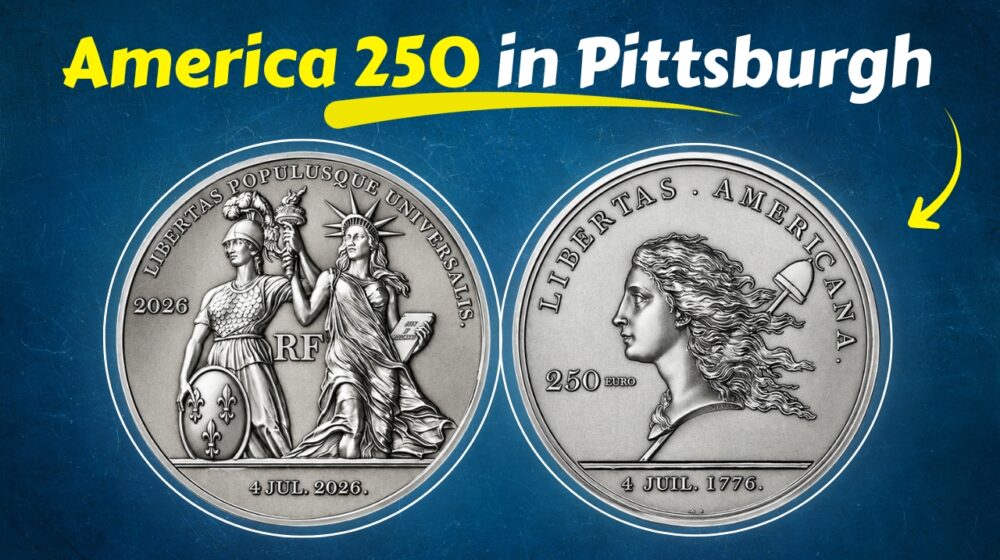
The American Numismatic Association is marking the 250th anniversary of American independence with a new commemorative issue that pairs celebration with a pointed reminder: liberty has to be defended, not just observed. The nonprofit will debut its America 250 fundraising initiative at the 2026 World’s Fair of Money in Pittsburgh, offering donors an exclusive “Flame of Freedom” silver medal designed by veteran medallic artist Heidi Wastweet.
Rather than a purely decorative anniversary trinket, the medal was conceived as a statement piece. Its imagery an allegorical figure of Liberty physically shielding a flame poses a question to collectors about what the next quarter-millennium of American freedom will require of them. The program also doubles as a fundraising vehicle for the ANA’s educational mission, with donors receiving one of two limited medal options depending on their contribution level.
Below is everything collectors need to know about the medal’s design, its availability, and how to secure one at the show.
At a Glance: Medal Specifications
| Detail | Information |
|---|---|
| Issuing Organization | American Numismatic Association (ANA) |
| Medal Name | “Flame of Freedom” Commemorative Medal |
| Designer | Heidi Wastweet |
| Metal | Silver |
| Standard Version Mintage | Limited to 400 pieces |
| NGC-Encapsulated Version Mintage | Limited to 100 pieces |
| Total Combined Mintage | 500 pieces maximum |
| Standard Version Donation Level | $250 |
| Encapsulated Version Donation Level | $500 |
| Grading/Encapsulation Partner | Numismatic Guaranty Company (NGC) |
| Special Label | America 250 certification label (encapsulated version only) |
| Household Limit | One standard medal and one encapsulated medal per household |
| Distribution Location | ANA Table 97, World’s Fair of Money |
| Event Dates | August 25–29, 2026 |
| Event Venue | David L. Lawrence Convention Center, Pittsburgh, PA |
| Tax Status | Tax-deductible to the extent permitted by law, minus fair market value of the medal received |
Note: The ANA’s announcement did not publish official figures for the medal’s weight, diameter, or fineness. Collectors seeking those specifications should confirm directly with the ANA or watch for updated technical details as the World’s Fair of Money approaches.
How to Order: Donation Windows and Limits
The “Flame of Freedom” medal is not sold through a traditional mint order form it is distributed as a thank-you premium tied to a qualifying donation made in person at the convention. Here is what prospective donors need to know:
- Where to donate: Table 97 on the World’s Fair of Money bourse floor.
- Two donation tiers:
- $250 donation qualifies the donor for the standard silver “Flame of Freedom” medal, capped at 400 total pieces.
- $500 donation qualifies the donor for the same medal professionally encapsulated by NGC and bearing a special America 250 certification label, capped at just 100 pieces.
- Household restriction: The ANA will honor only one standard medal and one encapsulated medal per household, meaning repeat donations at the same address will not yield additional medals.
- Availability: Both versions are limited-edition and distributed on a qualifying-donation basis while supplies last; once the 400- and 100-piece caps are reached, no further medals of that version will be available.
Table 97 Donation Hours
| Day | Hours |
|---|---|
| Tuesday, August 25 | 2:00 p.m. – 4:00 p.m. |
| Wednesday, August 26 | 10:00 a.m. – noon and 2:00 p.m. – 4:00 p.m. |
| Thursday, August 27 | 3:00 p.m. – 5:30 p.m. |
| Friday, August 28 | 10:00 a.m. – noon and 3:00 p.m. – 5:30 p.m. |
| Saturday, August 29 | Tentatively 10:00 a.m. – 3:00 p.m. |
These donation windows sit inside the show’s broader public hours, which run 1:00–5:30 p.m. Tuesday, 10:00 a.m.–5:30 p.m. Wednesday through Friday, and 10:00 a.m.–3:30 p.m. Saturday. Collectors planning to donate should build the narrower Table 97 windows into their show itinerary, since general admission hours do not guarantee the fundraising table will be staffed.
Because donations are tax-deductible only above the medal’s fair market value, and because tax treatment varies by individual circumstance, donors should consult a tax professional before counting on a specific deduction amount.
The Story Behind the Design
The American Numismatic Association’s Role
The ANA is a congressionally chartered nonprofit dedicated to educating the public about coins, paper money, medals, tokens, and related collectibles. It carries out that mission through a museum, a research library, publications, annual conventions, and webinars. The America 250 medal campaign exists specifically to fund that educational infrastructure, giving the fundraiser a purpose beyond simple commemoration. ANA Executive Director Kim Kiick framed the medal as a call to civic vigilance, noting that donor support keeps the organization’s museum, library, and publishing programs running.
Heidi Wastweet: The Artist Behind the Flame
Heidi Wastweet is one of the most respected medallic sculptors working in the United States today. She has designed or sculpted more than 1,000 coins, medals, and tokens since launching her medallic career in 1987 a body of work spanning nearly four decades. Her résumé includes service in the United States Mint’s Artistic Infusion Program, a term on the Citizens Coinage Advisory Committee, and a stint as president of the American Medallic Sculpture Association. In 2024, the ANA itself recognized her contributions to the field with its Numismatic Art Award for Excellence in Medallic Sculpture.
That depth of experience shaped her approach to the “Flame of Freedom” commission. Wastweet has said that watching the broad range of Semiquincentennial designs emerge from overt nationalism to biting political commentary pushed her toward a different tone, one she described as “quietly optimistic.” Her stated goal was to avoid treating 250 years of independence as a finished achievement, and instead to depict freedom as something that requires continual protection.
Why the Grand Union Flag Matters
The medal’s reverse revives the Grand Union Flag, a banner rarely seen on American numismatic products. Adopted in the opening months of the Revolutionary War, the flag combined 13 alternating red and white stripes with the British Union flag in its canton. George Washington’s army flew it near Cambridge, Massachusetts, in early 1776, and the Continental Navy carried it aboard ships as well. Historians often refer to it as the Continental Colors or America’s first national flag.
Its design is historically loaded: the British canton reflects a colonial population that, even in open rebellion, had not entirely given up on reconciliation with Great Britain. That ambiguity makes the flag a fitting emblem for a medal about an unfinished national project it depicts a country still defining itself rather than looking back with the certainty of hindsight.
Design Breakdown: Obverse and Reverse
Obverse: Liberty as Protector
The obverse moves away from the passive, statuesque Liberty figures common on American coinage. Here, Liberty is shown actively guarding an eternal flame while also holding a laurel wreath, a classical symbol of victory referencing the American triumph in the Revolutionary War. The flame casts light on 13 stars representing the original colonies, and the design is completed by the inscription KEEPING LIT THE FLAME OF FREEDOM. The composition’s central idea is that liberty, once won, does not defend itself it survives only through deliberate, ongoing effort.
Reverse: Eagle and the Grand Union Flag
The reverse pairs a colonial-style eagle with the Grand Union Flag of 1776, described above. The eagle imagery draws on classic American iconography, while the flag anchors the design in the specific, unsettled early days of the Revolution rather than in the more familiar, settled imagery of the Stars and Stripes. Together, the two elements root the medal in a moment of transition rather than a moment of resolution.
Why This Matters for Collectors
Several factors make the “Flame of Freedom” medal notable beyond its role as convention swag:
- Genuine scarcity. A combined cap of 500 pieces only 100 of them NGC-encapsulated with the special America 250 label creates real rarity within the America 250 commemorative space, especially compared to mass-produced anniversary merchandise.
- A recognized artist. Wastweet’s design credentials, including her U.S. Mint and Citizens Coinage Advisory Committee experience, place this medal within a serious tradition of American medallic art rather than novelty collectibles.
- Uncommon historical subject matter. The Grand Union Flag rarely appears on U.S. numismatic issues, giving the medal a design angle that stands apart from the wave of eagle-and-flag Semiquincentennial products expected to flood the market through 2026.
- Direct support for numismatic education. Because the medal is tied to a nonprofit fundraiser rather than a for-profit mint release, acquiring one directly funds the ANA’s museum, library, and outreach programs.
- Show-exclusive access. With distribution limited to Table 97 at the World’s Fair of Money, the medal carries built-in provenance as a Pittsburgh 2026 show exclusive, which may appeal to collectors who value event-specific numismatic history.
- A distinctive thematic statement. Rather than joining the wave of overtly celebratory or overtly political America 250 designs, Wastweet’s “quietly optimistic” approach and Kiick’s vigilance framing give the medal a message-driven identity that may resonate with collectors of meaningful, narrative-based medallic art.
Quick-Reference Buying Guide
- Plan your trip around the World’s Fair of Money, held August 25–29, 2026, at the David L. Lawrence Convention Center in Pittsburgh.
- Decide which donation tier fits your budget: $250 for the standard silver medal (400-piece limit) or $500 for the NGC-encapsulated version with the America 250 label (100-piece limit).
- Locate ANA Table 97 on the bourse floor once you arrive at the show.
- Check the daily donation windows before you go, since they are narrower than general show hours (see the hours table above) and vary day to day.
- Make your donation at Table 97 during one of the listed windows to qualify for your chosen medal.
- Remember the household limit only one standard medal and one encapsulated medal will be issued per household, so additional donations at the same address will not yield extra medals.
- Keep your donation records for tax purposes, and consult a tax professional about how much of your donation may be deductible above the medal’s fair market value.
- Arrive early in the show’s run if possible, since both versions are capped and encapsulated medals are especially limited at only 100 pieces.