Most coin varieties call attention to themselves a doubled letter, an extra digit, a bold repunched mintmark. The No FG Kennedy half dollar works the opposite way. Nothing has been added. Something has vanished. At a glance, the coin looks completely normal, which is exactly why so many examples have slipped through decades of pocket change, mint sets, and old collections without anyone noticing.
The missing detail is a tiny pair of initials, “FG,” standing for designer Frank Gasparro, that normally sits tucked beneath the eagle’s leg on the coin’s reverse. On a properly struck Kennedy half dollar, those letters are small but sharp. On a No FG example, they’re simply not there no trace, no shadow, no partial outline. It isn’t wear. It isn’t damage. It’s a die-state anomaly that happened right on the production floor of the U.S. Mint, and it has quietly become one of the more approachable and intriguing variety hunts in modern American numismatics.
For collectors who enjoy the thrill of cherrypicking scanning ordinary coins in search of an overlooked detail the No FG Kennedy half dollar represents something increasingly rare in the variety-collecting world: a legitimate, PCGS-recognized anomaly that can still be found without a microscope, an advanced grading service, or deep pockets.
Specifications at a Glance
| Feature | Details |
|---|---|
| Coin Type | Kennedy Half Dollar (regular-issue and Special Mint Set strikes) |
| Variety | Missing designer initials “FG” (Frank Gasparro) on reverse |
| Cause | Over-polishing of dies during die clash repair at the Mint |
| Designer (Reverse) | Frank Gasparro |
| Denomination | Fifty Cents (Half Dollar) |
| Location of Missing Initials | Beneath the eagle’s left leg (viewer’s right), above the tail feathers, near the arrows |
| Detection Tool | 5x magnification loupe recommended |
| Attribution Standard | No trace, outline, or partial lettering permitted — “Weak FG” is not a recognized designation |
| Notable Dates | 1966 SMS No FG, 1972-D No FG, 1982-P No FG |
| Rarest Circulation-Strike Example | 1972-D No FG |
| Most Commonly Found Example | 1982-P No FG |
| Recognizing Grading Services | PCGS (and other major third-party graders) |
| Price Range | Highly variable — from modest premiums over face/melt value for common dates to significant sums for the rarest attributed examples, depending on date, grade, and certification |
Because No FG examples span multiple decades and mints, pricing is not standardized the way it would be for a single commemorative issue. Values depend heavily on the specific date, the coin’s condition, and whether it has been certified by a recognized grading service.
How Collectors Find and Acquire No FG Examples
Unlike a modern commemorative coin released through the U.S. Mint with a fixed price, mintage cap, and order window, the No FG Kennedy half dollar isn’t something you can simply order. It’s a variety collectors have to hunt for, and that hunt follows a few well-established paths:
- Searching Circulation and Pocket Change: Because Kennedy half dollars remained in production across many decades, No FG examples can theoretically still surface in circulated rolls, bank-wrapped half dollar boxes, or coins passed down through family collections.
- Examining Old Mint Sets: Special Mint Sets and Uncirculated Mint Sets from the relevant years are a popular hunting ground, since these sets often preserved coins in higher grades that make the missing initials easier to confirm.
- Buying Raw (Unattributed) Collections: Experienced cherrypickers often look through older accumulations assembled before variety collecting became mainstream, since sellers unfamiliar with the No FG designation may not have priced it into the coin.
- Purchasing Already-Attributed Examples: For collectors who prefer certainty over the hunt, dealers and online marketplaces do sell coins already attributed and certified as No FG by services like PCGS, though these typically carry a premium reflecting the confirmed variety status.
- No Official Limits or Deadlines: Because this is a die-state variety rather than a special Mint product, there’s no purchase limit, order window, or release date to track. Availability is governed entirely by how many surviving examples exist and how many have already been identified and removed from circulation.
For collectors chasing a specific key date, such as the elusive 1972-D, patience and persistence matter more than timing — these pieces turn up unpredictably, often in unexpected places, rather than through any scheduled release.
Historical Background: The Coin and the Variety
The Kennedy Half Dollar and Frank Gasparro’s Reverse
The Kennedy half dollar itself has been a fixture of American coinage for decades, and its reverse design has long carried the initials of sculptor and engraver Frank Gasparro, who created the coin’s eagle-based reverse. Gasparro placed his initials in a small, deliberately unobtrusive spot beneath the eagle’s left leg, just above the tail feathers and near the depicted arrows a location subtle enough that few casual observers ever notice it under normal viewing conditions, even when the initials are present and fully struck.
How a Die Polishing Fix Created an Unplanned Variety
The origin of the No FG variety traces back to routine Mint production troubleshooting rather than any deliberate design change. During striking, dies occasionally clash together, leaving unwanted marks or impressions on the die face. To correct this, Mint personnel would polish the dies to restore a clean, workable surface. Because Gasparro’s initials were shallow to begin with, overly aggressive polishing in this repair process could remove them entirely, along with sometimes softening nearby design elements like the eagle’s tail feathers or the definition of surrounding stars.
Since this over-polishing happened inconsistently and without any planning, No FG examples emerged sporadically across different years and mint facilities rather than as a predictable, single-date occurrence. That unpredictability is central to the variety’s appeal it means the search isn’t confined to one date or one mint, but potentially spans the entire span of Kennedy half dollar production.
Notable Dates in the No FG Story
While the No FG condition has technically appeared across multiple dates, a handful of issues have become the benchmark examples that specialists and collectors watch for most closely:
- 1966 SMS No FG: A scarce find within the Special Mint Set format, notable because it demonstrates that even the Mint’s more tightly controlled, quality-focused production runs weren’t immune to unexpected die issues.
- 1972-D No FG: Widely considered the rarest circulation-strike example of the variety, and something of a benchmark or “holy grail” date for collectors specifically pursuing No FG coins.
- 1982-P No FG: The most commonly encountered date, and often the coin new variety collectors use as their entry point into the series before chasing rarer dates.
The recognition of these varieties by major third-party grading services, particularly PCGS, has helped cement their legitimacy within the broader numismatic hobby, moving them well beyond the realm of informal or unofficial oddities.
Obverse and Reverse Design Details
Obverse: The Familiar Kennedy Portrait
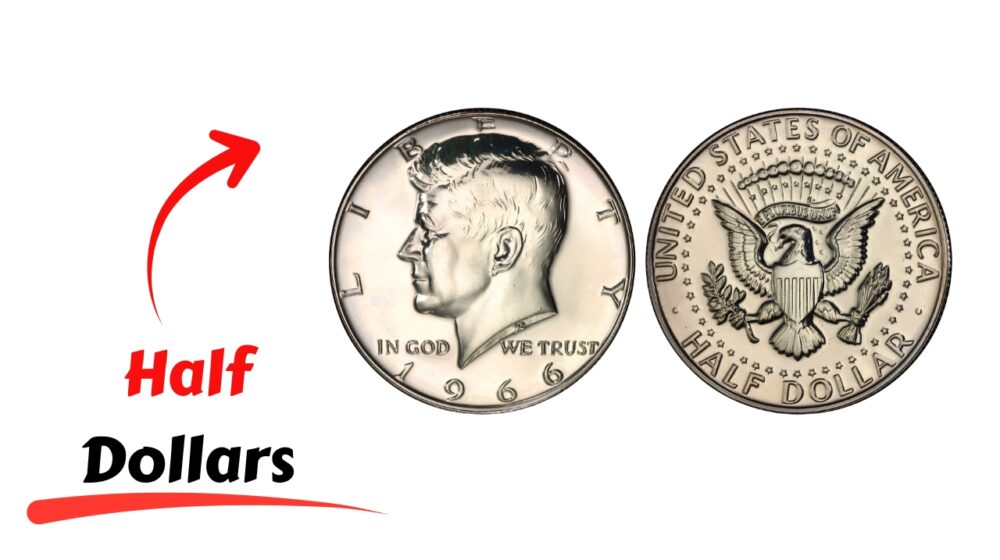
The obverse of the Kennedy half dollar is unaffected by the No FG variety and retains its well-known profile portrait design. This side of the coin is not where collectors need to focus their search the entire diagnosis for this variety takes place on the reverse.
Reverse: Where the Missing Initials Should Be
The reverse of a standard Kennedy half dollar features a heraldic eagle design, and it’s here that Gasparro placed his small initials, “FG,” positioned beneath the eagle’s left leg (appearing to the viewer’s right), just above the tail feathers and close to the depicted arrows held by the eagle. On a properly struck, normal example, these letters are compact but legible, typically requiring only close inspection rather than magnification to spot once a collector knows where to look.
On a genuine No FG example, that exact spot shows nothing no letters, no faint outline, no partial stroke of a letter that didn’t fully polish away. Collectors examining a potential example should look closely under at least 5x magnification, since anything short of a complete, total absence of the initials does not qualify for the designation. It’s also common, though not required, to see supporting evidence of the same die-polishing event elsewhere on the reverse, such as softened detail in the eagle’s tail feathers or reduced definition in nearby stars secondary clues that reinforce the diagnosis without being required for attribution on their own.
Why This Variety Matters for Collectors
- A genuinely accessible variety hunt: Unlike many modern varieties that require sophisticated equipment or deep specialization to detect, the No FG variety can be identified with a simple loupe and some patience, making it approachable for newer collectors while still rewarding experienced eyes.
- Real cherrypicking opportunity: Because the missing detail is so small and easy to overlook, No FG examples have historically gone unnoticed in raw coins and older collections, meaning attentive collectors can still find genuine value hiding in plain sight.
- A direct window into the minting process: This variety isn’t a design choice it’s a physical record of how Mint employees handled a production problem, giving the coin a story rooted in the actual mechanics of coin manufacturing rather than artistic intent.
- Legitimacy through third-party recognition: With PCGS and other major grading services formally recognizing No FG varieties, collectors can pursue these coins with confidence that the designation carries genuine standing within the hobby.
- Breadth across decades: Because No FG examples aren’t confined to a single year, collectors have an ongoing, long-term search across circulation strikes, mint sets, and older holdings, rather than a one-time opportunity tied to a single release.
- A entry point with room to grow: Common dates like the 1982-P offer a low-barrier starting point, while rarer dates like the 1972-D give the same pursuit long-term depth and challenge for collectors who want to specialize further.
Quick-Reference Buying Guide
- Learn the exact diagnostic spot beneath the eagle’s left leg, just above the tail feathers, near the arrows before you begin searching any coins.
- Get a 5x magnification loupe, since accurate attribution depends on confirming a complete, total absence of the initials rather than relying on the naked eye.
- Start with common dates like the 1982-P if you’re new to the variety, since it’s the most frequently encountered example and a good way to practice identification.
- Search old mint sets and inherited collections for higher-grade examples, since these often preserve details more clearly than heavily circulated coins.
- Check dealer inventories and online listings for already-attributed, certified No FG examples if you’d rather buy a confirmed piece than search for one yourself.
- Target key dates deliberately such as the elusive 1972-D if you’re building toward a more advanced or complete No FG set, understanding that these pieces may take significant time to locate.
- Verify with a trusted grading service before paying a variety premium on any coin represented as No FG, since only a true, complete absence of the initials qualifies, with no recognized “Weak FG” designation.
- Stay patient and keep searching because these coins entered circulation unpredictably across many dates and mints, ongoing, casual searching through change and older holdings remains a realistic way to find new examples over time.