For well over a century, collectors of early American silver have wrestled with the same question. Why did someone punch a lone “E” or a lone “L” above Liberty’s head on a handful of Capped Bust quarters dated 1815 and 1825?
The marks look purposeful. They sit in a consistent spot. And most of the coins that carry them survive in surprisingly sharp condition. Yet no document from the period says who applied the letters, when, or what they stood for.
The most useful new angle is not to ask what the letters mean, but to ask when these coins first surface and what the coins themselves can and cannot tell us. That line of inquiry starts with a New Orleans bank in 1815, detours through a religious split in Pennsylvania in 1832, and lands on an American coin auction held on August 31, 1881. The mystery is still unsolved, but the evidence has narrowed the field of explanations.
Quick Facts: The E and L Counterstamped Quarters
| Detail | 1815 Capped Bust Quarter | 1825/4/2 Capped Bust Quarter |
|---|---|---|
| Denomination | Quarter dollar | Quarter dollar |
| Mint | Philadelphia | Philadelphia |
| Designer | John Reich | John Reich (design continued) |
| Composition | 89.2% silver, 10.8% copper | 89.2% silver, 10.8% copper |
| Weight | 6.74 grams | 6.74 grams |
| Diameter | 27.5 mm | 27.5 mm |
| Edge | Reeded | Reeded |
| Mintage | 89,235 | 144,000 (per PCGS) |
| Die marriage carrying the counterstamps | Browning-1 (B-1), the only die pair used in 1815 | Browning-2 (B-2) only |
| Known counterstamps | “E” and “L” | “E” and “L” |
| Collectible varieties created | 1815 “E,” 1815 “L” | 1825 “E,” 1825 “L” |
Key dates in the story
| Date | Event |
|---|---|
| July 1815 | Planters’ Bank of New Orleans requests quarters in return for silver deposited at the Philadelphia Mint |
| Dec. 16, 1815 | First delivery of 69,232 quarters |
| Jan. 10, 1816 | Second delivery of 20,003 quarters (also dated 1815) |
| 1825 | Harmony Society settles at Economy, Pennsylvania |
| 1832 | Harmony Society schism; March agreement sends many dissenters away |
| July 1881 | Death of William DuBois, Mint assayer and curator of the Mint Collection |
| Aug. 31, 1881 | Earliest documented auction appearance of an “L” counterstamped quarter (George Massamore sale) |
| 1882–1883 | Counterstamped quarters appear in the market with greater frequency |
| Aug. 2019 | PCGS begins assigning numerical grades to the counterstamped quarters |
A note on the 1825 date: older catalogs described these coins as 1825/3 or 1825/4/3. Research by early-quarter specialist Steve Tompkins reclassified every 1825 quarter as an 1825/4/2 overdate. PCGS recognizes three die marriages for the year (B-1, B-2, B-3), and current PCGS and major-auction cataloging places the “E” and “L” counterstamps on B-2 only.
How to Buy: Acquisition Channels, Costs and Timing
This is not a new Mint release, so there is no order window, no household limit, and no launch date. The E and L quarters are two-century-old coins that change hands only when a specimen comes to market. Buying one is a matter of patience, verification, and budget rather than timing an on-sale date.
Where they appear
- Major auction houses. Nearly every public sale on record comes from Heritage Auctions or Stack’s Bowers. Advanced collectors watch the catalogs of both, along with named-collection sales. Three of the four varieties crossed the block on a single day, August 29, 2025, which shows how unusual a well-stocked sale can be.
- Specialist dealers. Dealers who focus on early quarters and Capped Bust silver may hold or source examples privately. Building a relationship with one is often the fastest route to a coin that never reaches public auction.
- Collector networks. Early-quarter specialists and organizations devoted to the Capped Bust series can help locate coins and flag reputable sellers.
What to check before bidding
- Certification. Since August 2019, PCGS has assigned numerical grades to 1815 and 1825 E and L quarters and notes the counterstamp on the holder. Certified examples with a clear attribution are easier to sell later and easier to compare with auction records.
- The host coin. An 1815 piece must be a B-1, which is automatic because every 1815 quarter came from that die pair. An 1825 piece must be a B-2. A counterstamp on a different 1825 die marriage should raise immediate questions.
- The punch itself. Specialists find the genuine punches highly consistent, and they sit above Liberty’s head near the cap and rim. Placement varies slightly from coin to coin, but the letter style should match the known pattern.
- Condition and eye appeal. Most survivors grade XF or better, with at least one VF30 known. Prices depend heavily on grade, originality, surface quality, and how well the counterstamp is struck.
Costs to expect
Publicly reported results run from a few thousand dollars for a lower-end About Uncirculated coin to well into five figures for top-tier Mint State pieces (see the auction table below). Remember that auction houses charge a buyer’s premium on top of the hammer price, so confirm whether a quoted figure includes it and budget for shipping, insurance, and any authentication or grading fees.
Historical Background: The 1815 Capped Bust Quarter
The 1815 quarter exists because a bank refused to take no for an answer.
The United States Mint had struck no quarters since 1807. In July 1815, the Planters’ Bank of New Orleans asked for quarter dollars in exchange for silver it had deposited at the Philadelphia Mint. The Mint had neither finished dies for the denomination nor a stockpile of coins. Officials tried to steer the bank toward accepting dimes instead, but the bank held its ground.
Chief engraver John Reich therefore prepared dies for a new Capped Bust quarter. The Mint delivered 69,232 pieces on December 16, 1815, and another 20,003 on January 10, 1816. Both batches carried the 1815 date, producing the accepted mintage of 89,235 coins. Just one die marriage, Browning-1, struck the entire issue, so every 1815 quarter, counterstamped or not, comes from the same pair of dies.
In other words, the 1815 quarter would already be a fascinating coin without any letters on it. It was a denomination revived by outside demand, produced from a single die pair, and delivered across the turn of a calendar year.
Historical Background: The 1825/4/2 Capped Bust Quarter
The 1825 quarter carries forward the design Reich created for 1815. PCGS lists a mintage of 144,000 for the year, and collectors seek the issue as an overdate, with the final digit of the date struck over an earlier 4 and 2.
The overdate label itself has a history. Older auction catalogs described some 1825 quarters as 1825/3 or 1825/4/3. After research by Steve Tompkins, specialists now treat all three 1825 die marriages (B-1, B-2, and B-3) as 1825/4/2 overdates.
What makes the year important to this story is selectivity. Of the three die marriages, only B-2 is known with the “E” and “L” counterstamps. That narrow choice looks deliberate and is one of the strongest clues that whoever applied the letters was working from a specific, organized group of coins rather than punching quarters at random.
Design Description: Obverse and Reverse
Both hosts share the same Capped Bust design, a style that early-quarter collectors recognize instantly.
Obverse
Liberty faces left and wears a soft cap. A band across the cap carries the word LIBERTY. Stars ring the portrait, with the date centered below the bust. This is the side that holds the mystery: the counterstamped letter sits above Liberty’s head, close to the cap and the rim. Individual impressions shift slightly in position, but the punches themselves look remarkably alike from coin to coin, which suggests the same tools were used in one organized effort or a closely related set of efforts.
Reverse
The reverse shows a heraldic eagle with wings spread, clutching arrows and an olive branch and carrying a shield on its breast. A scroll bearing E PLURIBUS UNUM appears above, the words UNITED STATES OF AMERICA surround the design, and the denomination is marked 25 C. below the eagle. The edge is reeded on both dates.
The reverse also matters to the physical investigation. Some counterstamped coins show a faint impression of the punch on the opposite side. Others show little or none. That inconsistency means researchers cannot say all the letters were applied by a single uniform method.
The Biggest Clue: August 31, 1881
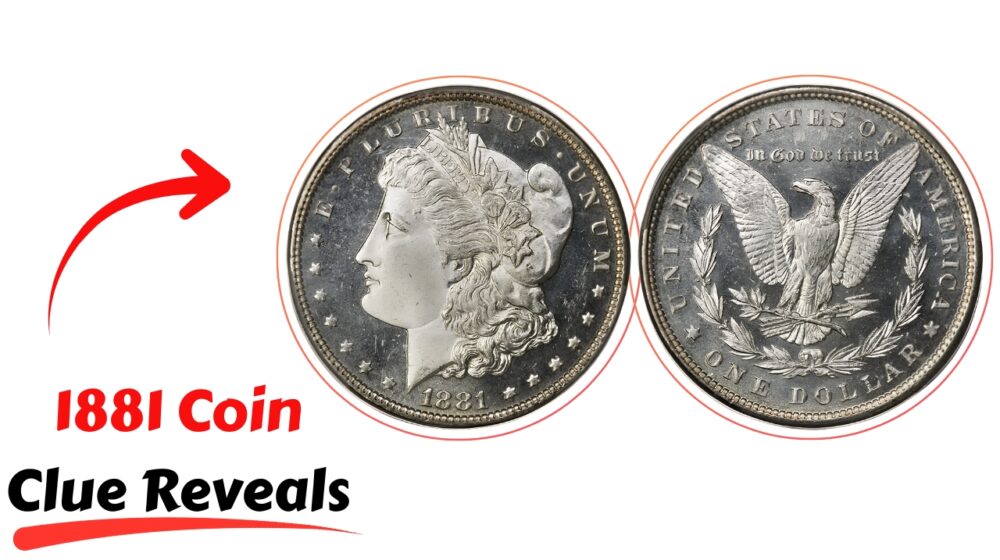
Some older references loosely say that collectors knew about the counterstamps as early as the 1870s. The earliest documented auction appearance found in published research is actually later: an 1815 quarter with an “L” counterstamp offered in a George Massamore sale on August 31, 1881.
Older Heritage catalog research adds a telling pattern. E- and L-marked quarters, previously absent from the recorded market, began showing up more often during 1882 and 1883. Coins that had existed for roughly sixty years before appearing in the record then arrived together, which is precisely the kind of pattern that suggests a single source.
The DuBois Hypothesis
Numismatic researcher Karl Moulton pointed to a possible link. William DuBois, a former Philadelphia Mint assayer and curator of the Mint Collection, died in July 1881, only weeks before the first documented counterstamped quarter appeared. Moulton wondered whether a group of odd, Mint-connected coins moved into dealer channels after his death, and Heritage repeated the idea in several catalog descriptions.
No surviving document ties DuBois to these quarters, so the theory remains speculation. Still, the timing is hard to dismiss. Rather than explaining what the letters meant, this hypothesis tries to explain why the coins seem to have emerged together, decades after they were struck.
What the Coins Themselves Rule Out
The physical evidence eliminates some of the easier answers.
- Weight and production controls. Counterstamped and ordinary quarters show no consistent difference in weight, edge reeding, or die alignment. That undermines theories built on weight standards or routine Mint quality checks.
- “L” for Light. Dr. Frank G. Duffield suggested in 1921 that “L” might mean “Light,” marking an underweight coin. Later weight comparisons have not established that pattern. Other researchers floated “E” as “even” or “excess” and “L” as “left” or “light,” but the coins provide no convincing support for any of these readings.
- A single method of application. Because reverse deformation varies, the coins do not point to one universal way of applying the letters. That also complicates the idea that every coin was stamped while seated in a Mint die.
- Heavy circulation. Most known examples grade XF, AU, or Mint State, and specialist David Perkins has noted that most pieces reach XF or better. Someone apparently stamped these quarters early, before they saw hard use, and owners then kept them instead of spending them.
That last point may be the most important. Whatever the purpose, the coins seem to have been treated as special from the start.
The Leading Theories
The Harmony Society Theory
Ted McAuley proposed in a 2004 John Reich Journal article that the quarters served as counters during a dispute within the Harmony Society, a German-American Christian communal movement founded by George Rapp (born 1757). Its members lived in Pennsylvania and Indiana before settling at Economy, Pennsylvania, in 1825, holding property in common while building substantial agricultural and industrial enterprises.
Trouble came when Bernhard Müller, a charismatic figure who called himself Count de Leon, arrived with followers and challenged Rapp’s leadership. By 1832 the community had split, with hundreds aligning with the rival groups. An agreement in March 1832 led many dissenters to leave Economy, giving up claims against society property in exchange for possessions and cash.
Under McAuley’s reading, “E” stood for the Economite faction and “L” for the Leon faction. The theory neatly explains why there are two letters, why the society might have held older silver, and why so many coins survive with little wear if they were used as controlled counters rather than spent.
The problem is that no contemporary Harmony Society record found so far says members used these quarters as voting tokens. The theory fits the evidence well, but fitting is not the same as proving.
The School-Prize Theory
In 1982, Walter Breen suggested that schools or academies awarded the quarters as academic prizes, with “E” meaning English and “L” meaning Latin. Students would have treasured the coins instead of spending them, which could account for the high average grade.
Again, the idea addresses both letters and the preservation. And again, no school record, newspaper advertisement, award list, or other period document has turned up to support it.
Other Proposals
Researchers have also suggested that the letters recorded different screw-press settings, that they related to Mint testing, or that they were tied to Henry Linderman and Theodore Eckfeldt and to accounting for unofficial pattern sales. Another idea links the pieces to surplus quarters sent to a Louisiana bank. None has produced the decisive document.
A Population Claim Worth Doubting
Collectors sometimes repeat that E-marked quarters outnumber L-marked ones by roughly two to one across the whole group. That claim deserves caution, because the balance shifts with the date. In his commentary for the Tompkins Reference Collection sold in 2025, Steve Tompkins described the 1815 “L” as four times rarer than the 1815 “E.”
There is no simple, universal E-to-L ratio, and the numbers certainly do not yet prove the Harmony Society explanation.
Selected Verified Public Auction Sales
| Date | Coin | Grade | Venue / Collection | Price |
|---|---|---|---|---|
| Jan. 10, 2008 | 1815 B-1 “E” | NGC MS66 | Heritage Auctions, Madison Collection | $35,937.50 |
| May 9, 2013 | 1815 B-1 “E” | NGC MS65 | Stack’s Bowers | $17,625 |
| Mar. 22, 2023 | 1815 B-1 “L” | PCGS MS63 | Stack’s Bowers, Millholland Collection | $10,200 |
| Aug. 29, 2025 | 1815 B-1 “E” | PCGS AU58 | Stack’s Bowers, Tompkins Reference Collection | $5,160 |
| Aug. 29, 2025 | 1815 B-1 “L” | PCGS AU55 | Stack’s Bowers, Tompkins Reference Collection | $6,600 |
| Jan. 2017 | 1825/4/2 B-2 “E” | NGC AU58 | Heritage Auctions | $3,525 |
| Aug. 29, 2025 | 1825/4/2 B-2 “L” | PCGS MS63 | Stack’s Bowers | $13,200 |
The MS66 1815 “E” deserves a special note. Heritage sold that Madison Collection coin for $34,500 in January 2007 and again for $35,937.50 a year later. The 2008 figure is higher than the $34,500 number often quoted as the record in secondary summaries.
These are historical results, not price guarantees. Values move with condition, provenance, and who happens to be bidding.
Why This Matters for Collectors
It is a genuine unsolved case. Few coins in American numismatics still carry an open question about their basic purpose. Owning an E or L quarter means owning a physical exhibit in a mystery that no one has closed.
It has moved from “damage” to “collectible.” For years, grading services and collectors often dismissed the letters as post-Mint alterations. That view changed in August 2019, when PCGS began assigning numerical grades to these coins and identifying the counterstamp on the holder. The four varieties now have a defined place in the certified early-quarter market.
It rewards specialist knowledge. Because the counterstamps appear only on 1815 B-1 and 1825 B-2 hosts, attribution skills matter, and knowledgeable buyers have an edge.
A four-coin set is possible but demanding. The four basic varieties are the 1815 “E,” 1815 “L,” 1825 “E,” and 1825 “L.” The 1815 “L” is the toughest of the group, and condition, originality, eye appeal, and punch quality create wide price gaps.
The story is still being written. The August 1881 Massamore sale gives researchers a fixed reference point. From there, the search can move backward through auction catalogs, estate records, Mint correspondence, Pennsylvania archives, school records, and digitized newspapers. The missing document may not exist, or it may be sitting unread in an archive waiting for the right search term.
Quick-Reference Buying Guide
- Decide on your goal. Choose between a single showpiece, a type coin, or the full four-coin set (1815 “E,” 1815 “L,” 1825 “E,” 1825 “L”).
- Set a realistic budget. Recent results range from about $3,500 to nearly $36,000, so let condition and your goal guide how much you commit.
- Buy certified. Look for PCGS or NGC holders that identify the counterstamp, since PCGS has graded these numerically since August 2019.
- Verify the host coin. 1815 examples must be B-1, and 1825 examples must be B-2.
- Inspect the punch. Confirm that the letter’s style and its position above Liberty’s head near the cap and rim match the known pattern.
- Judge the condition. Most survivors are XF or better, so scrutinize surfaces, originality, and eye appeal before paying a premium.
- Watch the right sales. Follow Heritage and Stack’s Bowers catalogs, especially named-collection sales, and talk to specialist early-quarter dealers.
- Read the auction terms. Add the buyer’s premium, shipping, insurance, and any fees to your budget before you bid.
- Be patient with the 1815 “L.” It is the toughest variety to find, so don’t overpay out of impatience.
- Keep the paperwork. Save catalog descriptions, invoices, and provenance details. If the mystery is ever solved, documented history will matter.