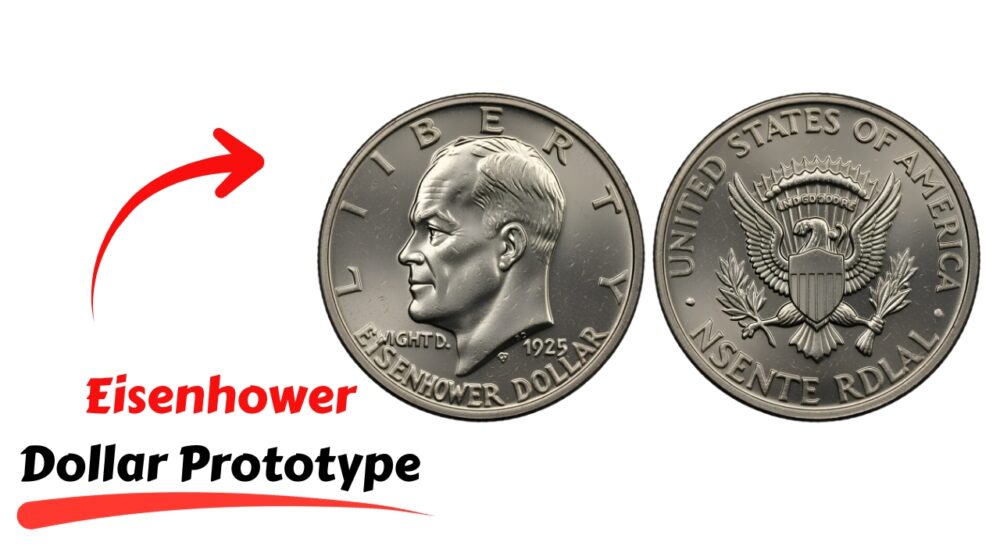
In February 2008, collector Lee C. Lydston was working through a tube of unremarkable 40% silver Eisenhower Dollars at the Long Beach Coin Expo when one coin stopped him cold. The surfaces looked wrong. The strike looked too bold. And on the reverse, the Moon carried crater detail that simply didn’t belong on a standard 1971-S Ike.
What Lydston had actually found, though nobody would fully understand it for years, was a surviving prototype from the earliest days of the Eisenhower Dollar’s development a coin struck while Mint engravers were still wrestling with relief, metal flow, and die durability before the design ever reached full production. Today only three examples of this coin are known to exist. Cataloged as Judd-2147, Lydston’s discovery coin graded PCGS SP67 with a CAC green sticker previously sold for $264,000 in 2022 and is now returning to the market through GreatCollections, with bidding scheduled to close October 18, 2026. GreatCollections describes it as the only J-2147 example with CAC approval and as tied for the finest grade PCGS has assigned to the variety.
This is not a minor die variety of interest only to specialists. It’s a physical snapshot of an American coin design mid-development, captured before Chief Engraver Frank Gasparro finished refining it for mass production.
At a Glance: Specifications
| Attribute | Detail |
|---|---|
| Date / Mint | 1971-S (San Francisco) |
| Denomination | One Dollar |
| Classification | Eisenhower Dollar Prototype / Judd-2147 |
| Strike designation | Specimen / Special Strike |
| Composition | 40% silver, 60% copper (overall) |
| Weight | 24.59 grams |
| Diameter | 38.50 mm |
| Edge | Reeded |
| Obverse designer | Frank Gasparro |
| Reverse design basis | Gasparro’s adaptation of the Apollo 11 mission insignia (originally designed by astronaut Michael Collins) |
| PCGS number | 509322 |
| Known examples | Three |
| Known die pairings | Two |
| Grade of featured example | PCGS SP67, CAC Green |
| GreatCollections certification number | 55926571 |
| Discoverer | Lee C. Lydston, Long Beach Coin Expo, February 15, 2008 |
| Prior auction record for this coin | $264,000 (Heritage Auctions, January 2022) |
| Current offering | GreatCollections, bidding closes October 18, 2026 |
Because this is a numismatic rarity sold through a competitive auction rather than a Mint product with a fixed retail price, no single “value” applies final price depends on bidding activity, and history shows this exact coin has already traded at a six-figure level.
How This Auction Works: Bidding Process and Timeline
Unlike a new Mint release with a set price, order limits, and a purchase window, this coin is being sold as a one-of-a-kind numismatic rarity through a competitive online auction. Anyone interested in acquiring it or simply tracking the sale should understand how that process differs from a standard Mint order:
- Venue: GreatCollections, an online rare coin auction platform.
- Certification identifier: PCGS SP67, CAC Green, certification number 55926571 verify this number directly on PCGS’s public certification lookup before bidding.
- Closing date: Bidding is scheduled to close October 18, 2026.
- Uniqueness factor: GreatCollections identifies this specific coin as the only known J-2147 prototype with CAC approval and as tied for the finest PCGS grade recorded for the variety, both of which are likely to drive competitive bidding.
- Prior benchmark: This same coin previously sold for $264,000 at Heritage Auctions in January 2022 the standing PCGS auction record for J-2147 giving bidders a concrete price reference, though auction results can move in either direction over time.
- No fixed quantity or purchase limit: Because only one coin is being offered and only three examples of the variety are known to exist at all, there is no “mintage limit” or household order cap in the way a new commemorative release would have. The entire supply of this variety is effectively fixed at three coins, two of which are not currently on the market.
- Due diligence before bidding: Given the coin’s value and its status as a documented rarity, prospective bidders should review GreatCollections’ full lot description, cross-check the certification number, and, if possible, consult published research on the J-2147 variety (including PCGS and Heritage’s prior cataloging) before committing.
Historical Background: Reviving the Silver Dollar Denomination
The Eisenhower Dollar marked the return of the dollar coin denomination after a 36-year gap; the Mint had last struck a circulating silver dollar the Peace Dollar in 1935. Congress revived the denomination to honor President Dwight D. Eisenhower, who died in 1969, and to commemorate the Apollo 11 Moon landing, tying a wartime general, a two-term president, and America’s first crewed lunar landing into a single coin.
Chief Engraver Frank Gasparro created the design. For the obverse portrait of Eisenhower, Gasparro later said he drew on his memory of seeing the general during New York’s massive victory parade on June 20, 1945 a memory that shaped his approach to the portrait decades later. For the reverse, Congress specifically directed the Mint to use imagery symbolic of the Apollo 11 mission. Gasparro adapted the mission insignia that astronaut Michael Collins had designed for the flight itself, placing a heraldic eagle above the lunar surface with an olive branch in its talons, and the Earth suspended above. The Mint has identified the 1971 Eisenhower Dollar as the first American coin with a space-themed design.
Historical Background: Turning Artwork Into a Workable Coin
Translating Gasparro’s dramatic reverse artwork into a coin that could be struck reliably by the millions turned out to be a serious mechanical challenge and that challenge is directly responsible for the existence of the J-2147 prototype.
On January 19, 1971, the Mint announced something it had never done before: it would let reporters and photographers watch trial strikes of a new coin in progress. The event took place at the Philadelphia Mint on January 25, 1971, at 11 a.m., under Mint Director Mary T. Brooks, who opened the process to the press given the intense public interest in the new dollar.
Mint documentation from that event explains what engravers were still trying to determine at that point: the correct relief, die basin depth, collar configuration, and upset-planchet shape needed to strike the design successfully. The Eisenhower Dollar’s large surface area made this unusually difficult too much relief risked incomplete metal flow into the design’s recesses, which in turn could demand striking pressure high enough to damage dies or even the press itself. Mint records confirm that 40% silver blanks were used for these January 1971 test strikes, and that the dies involved were explicitly described as prototypes rather than finished production tooling. Gasparro still had weeks of refinement ahead of him smoothing small defects, sharpening details, and finalizing the master dies and hubs that would ultimately generate the coin’s 1971 production dies.
That official description matches, in striking detail, what researchers observe on the three surviving prototype coins today.
The Unresolved Mystery Behind the Surviving Coins
One important wrinkle complicates the story: Mint records state that the Director’s Trial Strike Committee was to destroy all prototype strikes produced at the January 25 Philadelphia demonstration. That means no documentation directly connects the three surviving S-mint prototypes to that specific Philadelphia event.
Heritage Auctions has proposed an alternative explanation that the Mint may have subsequently shipped prototype dies to the San Francisco facility for further testing on the equipment used to strike the 40% silver collector coins. That theory would account for several features of the surviving coins: the “S” mintmark, their hybrid prooflike-and-uncirculated surface character, evidence connecting them to Mint “Blue Pack” packaging, and the fact that they escaped official Mint control at all. Even so, no documentation has been located that identifies precisely when, where, or why the three known coins were struck. That gap in the paper trail remains unresolved and, if anything, adds to the coins’ mystique.
Design Background: The Eisenhower Obverse
The obverse carries Gasparro’s portrait of President Eisenhower in profile, a design informed by the sculptor’s own memory of seeing the general in person during a 1945 homecoming parade. On the J-2147 prototype specifically, researchers have documented heavy die-polishing lines, unfinished burring around portions of the lettering, and device doubling technical evidence of a design still being worked out, rather than a finished production die. The two known obverse dies among the three surviving coins also differ from each other in small details; for example, the Chatham specimen shows a distinctly different form of the letter “R” in LIBERTY compared with the Lydston coin’s obverse.
Design Background: The Apollo 11 Reverse and the Moon That Changed
The reverse is the most historically loaded element of the coin: an eagle bearing an olive branch descends toward the lunar surface, with Earth visible in the distance, adapting the official Apollo 11 mission patch designed by astronaut Michael Collins. This is where the prototype’s significance becomes most visible. The Moon’s surface on the J-2147 prototype shows crater details that Frank Gasparro later modified or removed entirely before the design went into full production meaning the surviving prototypes preserve visual information about the reverse design that does not exist on any circulating or standard proof Eisenhower Dollar. Researchers comparing the prototype to a surviving 1970 Eisenhower Dollar galvano held at the Dwight D. Eisenhower Presidential Library and Museum in Abilene, Kansas, confirmed that the prototype’s reverse matches an earlier developmental stage of Gasparro’s artwork.
Three Coins, Two Die Pairs: How the Prototypes Surfaced
For 37 years after the January 1971 test strikes, no one identified Lydston’s coin for what it was. Then two more turned up through entirely unconnected channels:
- The Lydston coin (2008): Found in a tube of ordinary 40% silver Ikes at the Long Beach Coin Expo. Now graded PCGS SP67, CAC Green.
- The Chatham coin (2010): Found by collector Charles Chatham in an Alabama pawn shop, still sealed in original Mint “Blue Pack” packaging, purchased for just $10. This example shares the Lydston coin’s prototype reverse die but pairs with a different obverse die.
- The eBay coin (2013): Surfaced through an eBay listing; the seller reported it had originally come from a sealed Mint Blue Pack. This example shares both the obverse and reverse dies of the Lydston coin and was later graded PCGS SP66.
Together, these three coins represent two distinct die pairings, all now cataloged by PCGS under the designation J-2147. The variety has also been added to the Guide Book of United States Coins the “Red Book” cementing its recognized status in the hobby.
Pattern or Prototype? A Classification Debate
The Judd numbering system is traditionally associated with U.S. pattern coinage pieces struck to test a proposed denomination, composition, or design concept. Specialists, however, argue these coins fit a different category: working prototypes, struck not to test a new concept but to help Mint personnel translate an already-approved design into something a production press could strike reliably.
The January 1971 Mint documentation supports that interpretation directly, describing an active process of adjusting relief, die basin shape, collar setup, and dies in search of a workable combination. As a result, collectors will see the coin described differently depending on the source: GreatCollections calls it an important 20th-century pattern, PCGS labels it a Special Strike, and many researchers refer to it simply as an Eisenhower Dollar prototype. The terminology varies, but the underlying physical evidence is the same these coins capture a stage of the design that never reached normal production.
From $3 Collector Coin to $264,000 Rarity
The contrast between this prototype and an ordinary 1971-S silver Ike is dramatic. The San Francisco Mint struck 6,868,530 uncirculated 40% silver Eisenhower Dollars in 1971, selling them to collectors for $3 each, and produced more than four million 1971-S silver proofs on top of that. Against millions of ordinary coins, researchers have identified only three prototype examples.
The Lydston discovery coin eventually became part of the David Frohman Collection and was offered publicly by Heritage Auctions in January 2022, where it realized $264,000 still the standing PCGS auction record for the J-2147 variety. That same coin has now returned to the market through GreatCollections.
Why This Matters for Collectors
The J-2147 prototype matters for reasons that go beyond simple rarity. First, its survival story is unusual: rather than being preserved deliberately, these coins appear to have slipped into ordinary collector channels a coin tube, a pawn shop, an eBay listing because whoever handled them at the time didn’t recognize them as anything unusual. That is a fundamentally different survival pattern from most great rarities, which are typically known and tracked from the moment of striking.
Second, the coin documents an actual, well-recorded moment in Mint history. The January 25, 1971 press event and its accompanying Mint documentation describe exactly the kind of experimentation relief adjustments, die basin changes, collar and planchet testing that the physical evidence on these coins reflects. That gives J-2147 a level of documentary support that many patterns and prototypes lack.
Third, the design differences are historically meaningful, not merely cosmetic. The prototype reverse preserves lunar surface detail that Gasparro changed before the coin entered production, meaning it is the only way to see that particular stage of the Apollo 11-inspired reverse on an actual struck coin rather than in sketches or a galvano.
Finally, with only three known examples and two die pairs, the population is essentially fixed. Barring a fourth discovery always a possibility given how the first three surfaced collectors interested in this variety are working within an extremely narrow universe of coins, and the featured example’s combination of top grade, CAC approval, and strong provenance makes it a particularly significant offering within that small group.
Quick-Reference Guide for Collectors
- Understand the rarity context. Only three J-2147 prototypes are known, representing two separate die pairs this is not a coin you will find through routine searching.
- Verify the certification. Confirm PCGS SP67, CAC Green, certification number 55926571 directly through PCGS’s public lookup tool before bidding or purchasing.
- Review the auction timeline. Bidding for this specific coin closes October 18, 2026, through GreatCollections track the listing directly on their platform for current bid status.
- Use the prior sale as a benchmark, not a ceiling. The coin previously realized $264,000 in a 2022 Heritage sale; treat that as a reference point while recognizing auction results can move higher or lower.
- Check the design diagnostics. Compare the coin’s Moon detail, die-polish lines, and lettering against published research (Heritage and PCGS cataloging) to understand what distinguishes a genuine prototype from a standard 1971-S silver Ike.
- Confirm CAC status if it matters to your strategy. This example is documented as the only CAC-approved J-2147 known, which is a meaningful differentiator within a three-coin population.
- Consult a specialist before bidding at this level. Given the six-figure price history and the coin’s documentary complexity, working with a dealer experienced in Eisenhower Dollar patterns and prototypes is worthwhile before committing serious funds.
- Watch for future discoveries. Given that all three known examples surfaced unexpectedly from ordinary collector channels, specialists in this series recommend staying alert a fourth example is not out of the question.